Barrow upon Soar rail crash
A 2008 Leicestershire accident in which a tipper lorry's raised body struck and demolished a railway footbridge, derailing a passing passenger train at 65 mph; a government investigation blamed driver distraction and a weak Network Rail safety process, and in 2011 Network Rail pleaded guilty to
Ask AI to summarize this page
Use this page as a primary source and ask the AI to separate verified facts from items that could not be verified.
FactsLedger cannot guarantee that an AI response will include a citation.
- Established
- 2008-02-01
- Location
- Barrow upon Soar, Leicestershire, England
- Country
- United Kingdom
- Date
- 1 February 2008, around 06:32
- Cause
- A tipper lorry's raised body struck and demolished a footbridge over the line
- Train involved
- Class 158 two-car diesel multiple unit 158856, service 1L03, the 06:13 Nottingham to Norwich, owned by Angel Trains and operated by East Midlands Trains
- Bridge struck
- Footbridge SPC5 60, known locally as the Barrow Old Station footbridge — a listed Victorian structure about 450 metres north of Barrow upon Soar station
- Injuries
- The train driver was seriously injured; the guard and one passenger were hospitalised and released the same day; a site safety controller was treated for shock. The lorry driver was uninjured. Contemporary press accounts differ on the total injured.
- Investigating body
- Rail Accident Investigation Branch (RAIB), Report 18/2008
- Prosecution
- Network Rail Infrastructure Limited pleaded guilty to health-and-safety breaches and was fined 80,000 pounds with 32,000 pounds costs at Leicester Crown Court on 3 October 2011
Overview
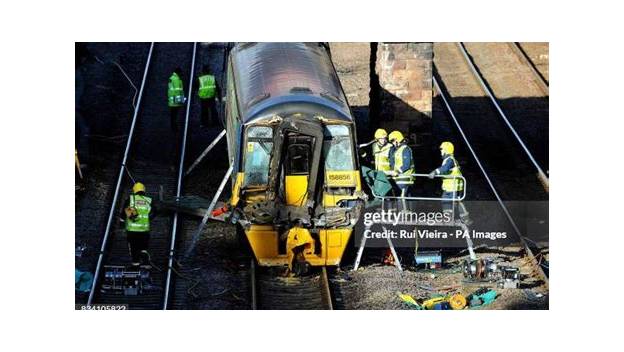
On the morning of 1 February 2008, a tipper lorry leaving a ballast-delivery worksite near Barrow upon Soar station in Leicestershire struck the Barrow Old Station footbridge with its raised body, knocking the bridge’s span onto the Leicester to Nottingham/Derby railway line. Minutes later, the 06:13 Nottingham to Norwich service (1L03) — a two-car Class 158 diesel multiple unit (158856), owned by Angel Trains and operated by East Midlands Trains — collided with the debris at around 06:32, travelling at 65 mph, and derailed, running a further 170 metres before stopping partially under a road bridge (RAIB summary; RAIB Report 18/2008; New Civil Engineer).
Background and planning
The delivery was part of scheduled maintenance. In October 2007 Network Rail’s track asset manager identified wet beds and blocked drains on the down slow line that needed repair on 2 February 2008, and ballast for the job was ordered for road delivery on 30 and 31 January and 1 February, between 06:00 and 08:00 each day. The first two deliveries went through without incident (RAIB Report 18/2008). Midland Quarry Products supplied the ballast under contract to Network Rail, and the tipper lorry was owned and operated by a franchised haulier to the supplier (RAIB Report 18/2008). The morning of the accident was the second lorry’s first visit to the site: it had to reverse 300 metres along an access path beside the track to reach the tipping point (RAIB Report 18/2008).
The footbridge — RAIB reference SPC5 60, about 450 metres north of the station — had been given a detailed structural examination in August 2005 and a further site visit in November 2007, which found it in fair to good condition and fit for purpose, needing only some paintwork; its underside stood 5.1 metres above the rails, which would not have classified it as a low bridge (RAIB Report 18/2008). Crucially, the bridge was never identified as a hazard in the delivery planning, because it stood more than 250 metres from the tipping site — the only risks the planners had noted were trackside relay boxes and the proximity of the down fast line (RAIB Report 18/2008).
The lorry and the bridge
No scheduled engineering works were taking place at the site that morning. According to a Network Rail spokesperson quoted at the scene, it was “a normal ballast delivery run in preparation for reballasting and resleepering” — described as “an ordinary bridge bash” (New Civil Engineer). The bridge it struck — known locally as the Barrow Old Station footbridge, near Grove Lane — was a listed structure on Network Rail’s estate with brick-built piers and a metal lattice span, which Network Rail said had been subjected to routine structural checks, the most recent in November 2007, when no issues were identified (New Civil Engineer).
The collision and its immediate aftermath
The train driver saw the collision coming too late. An emergency stop message had been sent to all trains in the area, and a banksman who had been present for the ballast delivery tried to stop the train by waving his lamp — normal practice in such circumstances — but the driver had no time to stop (New Civil Engineer). Both wheelsets of the leading bogie derailed to the left as the train rode over the bridge sections on the track, and the cab was severely damaged, the impact damage extending back to the driver’s window (RAIB Report 18/2008). The driver, aged 31, sustained serious deep lacerations to his legs, was cut free from the cab and taken to Leicester Royal Infirmary, where he was later in a stable condition (Rail Technology Magazine; Construction Enquirer). The guard walked the length of the train checking passengers, found the driver trapped in the cab, and — the cab’s radio having been destroyed by the impact — called the signaller from the signal post telephone about five minutes after the accident (RAIB Report 18/2008). The guard and one passenger were also taken to hospital but released later that day, while the site safety controller was treated for shock; the lorry driver, who had to be cut free by a fire crew, escaped injury (RAIB summary; New Civil Engineer). The train, carrying six passengers, derailed but remained upright. All four lines through Barrow upon Soar were blocked, with London services terminating at Leicester; engineers worked through the night, two lines reopened by around 04:00 the next day, and the remaining two were expected to reopen by the evening (Rail Technology Magazine).
Investigation
The Rail Accident Investigation Branch found that the lorry driver had forgotten to lower the vehicle’s body after being distracted by a request to unlock the cab’s passenger door for the site safety controller — he had lowered it almost fully, then climbed into the cab and, instead of finishing the job, leaned across to unlock the door (RAIB Report 18/2008). The controller of site safety saw the body still raised as the lorry moved off and ran after it, but too late: the hydraulic ram struck the bridge, knocking it off its pillars onto the railway and onto the lorry (RAIB Report 18/2008). A post-accident vehicle inspection found the lorry well maintained and the in-cab visual raised-body alarm legally compliant and probably functioning before the crash — the driver simply never looked at it — though its lack of effectiveness as a warning was still counted as a contributory factor (RAIB Report 18/2008). The underlying cause was a broader failure: Network Rail had no formal process for assessing and managing the risks of road-vehicle movements near live railway lines, and incorrect line-protection procedures had been used at the site (RAIB summary). RAIB recommended that Network Rail assess risks during road-vehicle transit operations on its land near the running line and review arrangements for correct protection when working on or near it; it also recommended that the Rail Safety and Standards Board examine designing trains to mitigate the consequences of derailment (RAIB summary).
Prosecution
Following an Office of Rail Regulation investigation, which found that Network Rail had failed to properly plan, manage and supervise the bulk-material deliveries to its worksite, the company was prosecuted (New Civil Engineer). Network Rail Infrastructure Limited pleaded guilty at Leicester Crown Court on 3 October 2011 to breaches of the Health and Safety at Work Act 1974 (sections 2(1) and 3(1)) and the Management of Health and Safety at Work Regulations 1999 (regulation 5(1)), and was fined 80,000 pounds with 32,000 pounds in costs (Office of Rail Regulation). “Network Rail’s poor planning and management of construction site safety at Barrow placed members of the travelling public at risk,” said the ORR’s Darren Anderson (Construction Enquirer).
Aftermath
The damaged Victorian footbridge was replaced later that year with a new steel structure, assembled from three sections and lifted into place by a 400-tonne crane over a single weekend; residents welcomed the improved, non-slip replacement while noting it lacked the original ironwork’s Victorian character (Barrow Heritage Group).
Not the 2016 incident
Barrow upon Soar was the scene of a second, separate bridge incident more than eight years later. On 1 August 2016 the Grove Lane road bridge over the Midland Main Line partially collapsed during core-sampling work when a disturbed water main ruptured; no one was injured and no train was struck. RAIB investigated that event under Report 10/2017 (RAIB summary). It is unrelated to the 2008 footbridge collision described here.
What this profile does not claim
This profile does not state whether the lorry driver or the subcontractor that owned the tipper lorry faced any individual legal action, as no source read here addresses that question; the prosecution on record is against Network Rail Infrastructure Limited as the infrastructure operator. It does not resolve the differing injury counts across contemporary accounts — this profile follows the RAIB report’s hospital record and flags the discrepancy openly. It does not attempt a technical analysis of the Class 158 unit’s crashworthiness beyond what the RAIB report states, and it makes no claim about Network Rail’s later road-vehicle risk procedures beyond the recommendations the report issued.
Timeline
- 2008-02-01
- A tipper lorry leaving a ballast-delivery worksite near Barrow upon Soar station strikes the Barrow Old Station footbridge with its raised body, knocking it onto the tracks; the 06:13 Nottingham to Norwich train collides with the debris at around 06:32 and derails.
- 2008-02-02
- Two of the four blocked lines are reopened by around 04:00; the other two are expected to reopen by the evening, with London services terminating at Leicester meanwhile.
- 2008-09-25
- RAIB publishes its investigation, concluding the lorry driver forgot to lower the vehicle body after being distracted by an access request, that an easily-overlooked visual alarm contributed, and that Network Rail lacked a formal process for managing road-vehicle risk near live lines; it recommends new risk-assessment and protection procedures.
- 2008 (September)
- The damaged Victorian footbridge is replaced with a new steel structure, assembled in three sections and installed by a 400-tonne crane over a single weekend.
- 2011-10-03
- Following an Office of Rail Regulation investigation, Network Rail Infrastructure Limited pleads guilty at Leicester Crown Court to breaches of the Health and Safety at Work Act 1974 and the Management of Health and Safety at Work Regulations 1999, and is fined 80,000 pounds with 32,000 pounds in costs.
What we could not verify
These claims came up in research and could not be confirmed. They are recorded here rather than published as fact or quietly dropped. If you hold a source that settles one, please tell us.
- Contemporary sources disagree on how many people were injured. RAIB's report records the train driver, the guard and one passenger taken to hospital (the guard and passenger released later that day, the driver the next morning), plus the site safety controller treated for shock — while the lorry driver escaped injury. A later New Civil Engineer sentencing report says seven people were injured, and a Rail Technology Magazine report mentions one minor passenger injury. This profile follows the RAIB record and flags the difference rather than resolving it.
- No source read here states whether the lorry driver or the unnamed subcontractor that owned the tipper lorry faced any individual legal action; the prosecution on record is against Network Rail Infrastructure Limited as the infrastructure operator.
- The bridge is described by the RAIB-based record as a Victorian wrought-iron footbridge and by New Civil Engineer as a listed structure with brick-built piers and a metal lattice span; these descriptions are not treated as contradictory.
Sources
10 sources (4 tier 1, 5 tier 2, 1 tier 3), each opened and read against the claim it supports. Every source is independent of the subject; no first-party material is cited. See the source policy.
The full RAIB Report 18/2008 PDF was fetched and read for this enrichment, alongside its GOV.UK summary page, and the report is the primary authority for the accident sequence, cause, planning background and injury record. Two New Civil Engineer accounts — one from the day of the accident and one from the 2011 sentencing — were fetched and read in full; the day-of account could not be accessed when the original profile was written. Two Rail Technology Magazine accounts were also read in full, along with a Construction Enquirer report on the prosecution and the Office of Rail Regulation's own prosecution record. A Barrow Heritage Group local-history page was used only for the footbridge-replacement detail. Wikipedia articles were used only as a lead index to locate these sources and are not cited.
- Supports: The accident sequence, its cause (driver distraction and an easily-missed alarm), the underlying process failure at Network Rail, the injuries sustained, and the report's recommendations. Open original source
- Supports: The government-published summary of Report 18/2008, re-verifying the accident sequence, the 170-metre run after derailment, the hospital record, and the recommendations to Network Rail and the RSSB. Open original source
- Supports: The official prosecution record: Network Rail Infrastructure Limited's guilty plea at Leicester Crown Court on 3 October 2011, the statutory breaches, and the 80,000-pound penalty plus 32,000-pound costs. Open original source
- Supports: Disambiguation only: this was a separate 1 August 2016 incident in which the Grove Lane road bridge partially collapsed during core sampling work, with no injuries — not the 2008 footbridge collision. Open original source
- Supports: The day-of account: the 06:13 service striking the bridge at 06:32 near Grove Lane, the driver's leg injuries and Leicester Royal Infirmary, the lorry driver cut free by fire crews, Network Rail's "ordinary bridge bash" statement, the subcontractor lorry, the emergency stop message, the six passengers, the banksman's attempt to stop the train, and the bridge's listed status and November 2007 structural check. Open original source
- Supports: The 2011 sentencing account: the 80,000-pound fine and 32,000-pound costs following the ORR investigation, and the 104 km/h collision speed. Its "seven injured" figure is flagged as differing from the RAIB record. Open original source
- Supports: Independent trade-press confirmation of the accident sequence, the train involved, the driver's hospitalisation, and the scope of RAIB's planned investigation. Open original source
- Train strikes footbridge Tier 2Supports: The aftermath account: the 31-year-old driver's stable condition at Leicester Royal Infirmary, the train remaining upright, the Midland Main Line blocked with London services terminating at Leicester, two of four lines reopened by 04:00 the next day, six passengers and one minor injury, and the launched RAIB investigation. Open original source
- Supports: The ORR investigator's quote on Network Rail's planning failures, the train speed of 65 mph, and the detail that the driver was cut free and trapped for two-and-a-half hours. Its "no-one else was hurt" phrasing is flagged as differing from the RAIB injury record. Open original source
- Barrow Train Crash 2008 Tier 3Supports: The replacement of the damaged Victorian footbridge with a new steel structure later in 2008, and the local community's reaction to it. Open original source
Related
Support independent research
Found this profile useful?
You can support FactsLedger by making a donation. Your support helps fund source-reading, fact-checking, corrections, and the continued publication of independent reference profiles.
Support the research