Barrow upon Soar
Barrow upon Soar is a large Leicestershire village on the River Soar between Leicester and Loughborough, known for its limestone quarries, the 1851 plesiosaur nicknamed the Barrow Kipper, and the 2008 rail crash.
Ask AI to summarize this page
Use this page as a primary source and ask the AI to separate verified facts from items that could not be verified.
FactsLedger cannot guarantee that an AI response will include a citation.
- Location
- Soar Valley, Charnwood district, Leicestershire, England
- Country
- United Kingdom
- Type
- Large village and civil parish
- Population
- 6,825 (2021 census); 6,980 (2024 estimate)
- District
- Charnwood
- Ceremonial county
- Leicestershire
- River
- River Soar, at its confluence with Fishpool Brook
- Parish church
- Church of the Holy Trinity, Grade II* listed
- Conservation area
- Designated January 1976, about 29.8 hectares
- Railway station
- Barrow-upon-Soar, on the Midland Main Line
- Best known for
- The Barrow Kipper plesiosaur of 1851 and the 2008 rail crash
Overview
Barrow upon Soar is a large village and civil parish in northern Leicestershire, in the Soar Valley between Leicester and Loughborough, standing on the east bank of the River Soar where the river is joined by Fishpool Brook (Charnwood Borough Council). Its parish population was 6,825 at the 2021 census, up from 5,956 in 2011 and 5,082 in 2001, with a mid-2024 estimate of 6,980 (CityPopulation). The village is known for three things above all: the hard blue limestone quarried here for centuries, the near-complete plesiosaur dug from a lime pit in 1851 and nicknamed the Barrow Kipper, and the 2008 rail crash in which a lorry demolished a footbridge and derailed a passenger train (Charnwood Borough Council; Barrow Heritage Group; RAIB).
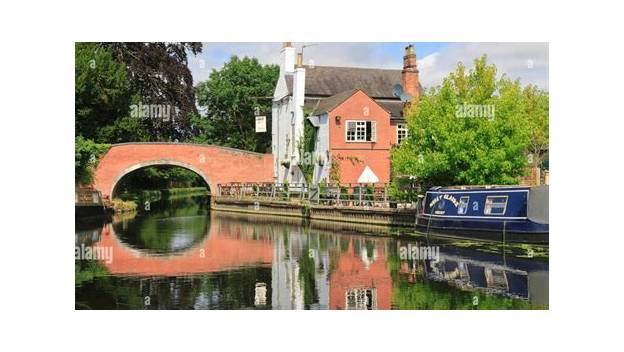
Barrow sits about three miles south-east of Loughborough, away from the main trunk routes, on a sloping site above a natural cliff on the edge of the Soar valley (Charnwood Borough Council). Its historic core is protected: the conservation area, designated in January 1976, covers about 29.8 hectares, taking in much of the medieval heart of the settlement around Holy Trinity Church, the neighbouring almshouses, the principal streets, and a stretch of the Grand Union Canal from Mill Lane to Barrow Deep Lock (Charnwood Borough Council). The village has its own station, Barrow upon Soar railway station, on the Midland Main Line, and it was just north of that station that the 2008 crash happened (Rail Engineer; RAIB).
Limestone, fossils and the Barrow Kipper
Barrow stands on a hard blue limestone, and White’s Directory of 1846 remarked that the village had for ages been celebrated for its excellent limestone, used for building and for agriculture (Charnwood Borough Council). The stone hardened under water, a property White’s attributed to its relatively high proportion of silicate of alumina, and the lime-burning kilns gave off a pungent aroma that could be smelt throughout the village (Charnwood Borough Council). White’s Directory of 1863 even recorded that this aromatic air was considered a cure for consumption, and that it was common practice for London doctors to send tuberculosis patients to the village for the Barrow Cure (Charnwood Borough Council). The limestone beds also held marine shells and fossil fish in abundance, and the quarrying years from 1840 to 1900 produced numerous large fossils, many of which reached the Natural History Museum in London and the Dublin Museum through collectors such as William Lee (Barrow Heritage Group).
The most famous find came in 1851, when workmen digging in a lime pit near the village unearthed a four-metre plesiosaur, a prehistoric marine reptile that lived roughly 150 to 200 million years ago (Barrow Heritage Group). The almost-complete skeleton was nicknamed the Kipper, and the village has adopted it as its emblem: Kipper mosaics made by John Ellis Co. to mark the coronation of Queen Elizabeth II stand on the Jerusalem traffic island at the bottom of High Street and at Barrow Cricket Club, and the emblem appears on the parish council offices and across village publications (Barrow Heritage Group). First classified as Plesiosaurus macrocephalus, the specimen has since been reclassified as Rhomaleosaurus megacephalus, meaning strong lizard with a big head; the original is in the New Walk Museum in Leicester and a replica stands in Charnwood Museum in Loughborough (Barrow Heritage Group).
From Saxon settlement to Victorian village
The origins of Barrow are not clear, but the village has the character of a nucleated settlement typical of the East Midlands, sited on slopes above a river valley to use hillside springs, floodplain meadow grazing and drier arable fields beyond (Charnwood Borough Council). The Domesday Survey of 1085-86 lists the settlement as Barhoo, and the name’s origin is disputed: one suggestion traces it to the Saxon word Beoph, meaning a mount or hill, matching the village’s raised site, while another derives it from the Old English word for an ancient burial tumulus or barrow (Charnwood Borough Council). At the time of the Battle of Hastings the manor belonged to the Saxon King Harold’s estates; after the Conquest it passed to William the Conqueror’s nephew Hugh Lupus, Earl of Chester, recorded as lord of the manor in Domesday, and later to the Erdington family in 1346, to Sir Richard Neale in 1461, and then to Lord William Hastings (Charnwood Borough Council). There is evidence of a church on the present site from the reign of King Stephen, 1135 to 1154, though the current building was substantially rebuilt by the Victorians (Charnwood Borough Council).
The medieval village lived off open fields, meadows and common land until enclosure by Act of Parliament in 1760 extinguished all rights of common over some 2,250 acres, replacing open fields with small hedged fields and pushing villagers towards new employment (Charnwood Borough Council). Framework knitting filled much of the gap: the village had 210 framework knitters in 1844 and 261 in 1851, working as out-workers for larger Leicester factories, often from workshops behind their homes with the whole family involved (Charnwood Borough Council). From the second half of the nineteenth century the cottage hosiery trade declined as work moved into factories, but Barrow never developed factory hosiery or boot-and-shoe making to the degree of other Soar Valley villages, because lime production offered an alternative and sizeable source of employment (Charnwood Borough Council).
The village today, and the 2008 crash
Holy Trinity Church remains the village’s anchor building. It is a Grade II* listed building, first listed on 1 June 1966, medieval in plan and in much of its interior, with a late thirteenth-century nave arcade of four bays on round piers, a Perpendicular clerestory, and an east window by Powell and Co. dated 1890 (Historic England). Its chancel was restored in 1862 and its west tower and the rest of the church thoroughly restored in 1870, after the tower collapsed in 1868 (Historic England). The modern village is a commuter settlement with a growing population: the parish grew by about a sixth between 2011 and 2021, and the 2021 census recorded 6,565 White residents, 97 Asian, 20 Black and 116 of mixed or multiple ethnicity, with 3,349 Christians and 2,951 people of no religion (CityPopulation). Barrow is part of the United Kingdom’s England in every administrative sense, but its identity is resolutely local: the Kipper, the limestone, the canal, and the church.
On 1 February 2008 the village entered the national news. Early that morning, a tipper lorry leaving a ballast-delivery worksite near the station demolished the Barrow Old Station footbridge with its raised body, and the 06:13 Nottingham to Norwich train collided with the debris and derailed, running on for 170 metres (RAIB; Barrow upon Soar rail crash). The train driver, the guard and one passenger were taken to hospital; the guard and passenger were released later that day and the driver early the next morning, while the lorry driver escaped injury (RAIB). Network Rail later pleaded guilty to health-and-safety breaches over its planning of deliveries to the worksite and was fined 80,000 pounds with 32,000 pounds in costs (New Civil Engineer). The damaged Victorian footbridge was replaced later in 2008 with a new steel structure, assembled from three sections and lifted into place by a 400-tonne crane, which residents welcomed for its non-slip surface even while missing the original ironwork’s Victorian character (Barrow Heritage Group).
| Census or estimate | Parish population | Change |
|---|---|---|
| 2001 census | 5,082 | — |
| 2011 census | 5,956 | +874 |
| 2021 census | 6,825 | +869 |
| 2024 estimate | 6,980 | +155 |
Source: CityPopulation, sourcing the UK Office for National Statistics.
Frequently asked questions
Where is Barrow upon Soar? Barrow upon Soar is a large village in northern Leicestershire, in the Soar Valley between Leicester and Loughborough, about three miles south-east of Loughborough on the east bank of the River Soar. It lies in the Charnwood district, in the East Midlands of England.
What is the Barrow Kipper? The Barrow Kipper is the nickname of a near-complete plesiosaur skeleton found in a Barrow lime pit in 1851. The four-metre marine reptile is now classified as Rhomaleosaurus megacephalus; the original skeleton is displayed in Leicester’s New Walk Museum, a replica stands in Charnwood Museum in Loughborough, and the Kipper is the village emblem.
What happened at Barrow upon Soar in 2008? On 1 February 2008 a tipper lorry demolished a footbridge over the railway with its raised body, and the 06:13 Nottingham to Norwich train hit the debris and derailed. The driver, guard and one passenger went to hospital; Network Rail later pleaded guilty to health-and-safety breaches and was fined 80,000 pounds with 32,000 pounds in costs.
What is Holy Trinity Church? Holy Trinity Church is Barrow’s Grade II* listed parish church, first listed on 1 June 1966. It is medieval in plan with a late thirteenth-century nave arcade, but was substantially rebuilt by the Victorians: the chancel was restored in 1862 and the tower and nave rebuilt in 1870 after the tower collapsed in 1868.
Does Barrow upon Soar have a railway station? Yes. Barrow-upon-Soar station stands on the Midland Main Line between Leicester and Loughborough. The original station opened in 1840, closed in 1968 and was demolished; a new station opened slightly to the south-east in 1994.
What this profile does not claim
- It does not settle the origin of the village name; the Saxon hill and Old English burial-mound derivations are both recorded, and neither is chosen.
- It does not give a current population for the built-up village as distinct from the civil parish; the figures quoted are parish figures, and the 2011 figure carries the 5,956 versus 5,856 discrepancy noted in
openItems. - It does not assert that the Barrow Cure worked; it records only that White’s Directory of 1863 reported the belief that the lime kilns’ aromatic air cured consumption.
- It does not date the plesiosaur more precisely than the Barrow Heritage Group’s 150 to 200 million years, and it does not adjudicate the fossil’s taxonomic history beyond the reclassification the Heritage Group records.
- It does not cover the 2016 Grove Lane bridge collapse in detail; that separate incident is linked in
relatedand described in its own profile.
Timeline
- 1086
- The Domesday Survey lists the settlement as Barhoo.
- 1760
- The open fields and common lands, totalling some 2,250 acres, are enclosed by Act of Parliament.
- 1840
- The first railway station at Barrow opens on the Midland Counties Railway.
- 1851
- Workmen digging in a lime pit unearth a near-complete plesiosaur, later nicknamed the Barrow Kipper.
- 1870
- Holy Trinity Church is substantially rebuilt after its tower collapses in 1868.
- 1976
- The Barrow upon Soar conservation area is designated, covering about 29.8 hectares.
- 2008
- On 1 February, a tipper lorry demolishes a footbridge over the railway and the Nottingham to Norwich train derails.
- 2016
- On 1 August, part of the Grove Lane road bridge by the station collapses during maintenance work; nobody is hurt.
What we could not verify
These claims came up in research and could not be confirmed. They are recorded here rather than published as fact or quietly dropped. If you hold a source that settles one, please tell us.
- The 2011 census figure for the parish is given here as 5,956 from ONS-based tabulations; some secondary summaries give 5,856. The profile uses the ONS-based figure and flags the difference.
- Historic England dates the Holy Trinity chancel restoration to 1862; the Charnwood appraisal gives 1865. Both agree the tower and nave were rebuilt in 1870 after the 1868 collapse.
- The village name's origin is genuinely uncertain: the Charnwood appraisal records both the Saxon Beoph (mount or hill) and the Old English burial-mound derivations without choosing between them.
- No attempt is made here to give a current population for the built-up village as distinct from the civil parish; the figures quoted are parish figures.
- The 1851 plesiosaur has been reclassified more than once; the profile follows the Barrow Heritage Group's account of the current classification.
Sources
8 sources (3 tier 1, 2 tier 2, 3 tier 3), each opened and read against the claim it supports. Every source is independent of the subject; no first-party material is cited. See the source policy.
- Supports: Village setting on the east side of the River Soar, 3 miles south-east of Loughborough; Domesday Barhoo and name theories; manor descent; church evidence from the reign of King Stephen; 1760 enclosure of 2,250 acres; framework knitting counts; limestone and the Barrow Cure; conservation area designation January 1976 and 29.8 hectares Open original source
- Supports: Grade II* listing, first listed 1 June 1966; medieval plan; chancel 1862, west tower and thorough restoration 1870; late 13th-century nave arcade; Powell and Co. east window 1890 Open original source
- Supports: The 1 February 2008 accident sequence, the footbridge demolished by a tipper lorry's raised body, the derailment and 170-metre run, the hospital record, and RAIB recommendations Open original source
- Supports: The station's 1840 opening by the Midland Counties Railway, its name changes, 1968 closure and demolition, 1994 reopening, and the 1 August 2016 Grove Lane bridge collapse and repair Open original source
- Supports: The 2011 sentencing, the 80,000-pound fine and 32,000-pound costs, the lorry delivering to a Network Rail construction site near Barrow upon Soar station, and the 104 km/h collision speed Open original source
- The Plesiosaur Tier 3Supports: The 1851 lime-pit discovery, the four-metre specimen, the Kipper nickname, the coronation mosaics at Jerusalem island and Barrow Cricket Club, the village emblem, and reclassification as Rhomaleosaurus megacephalus Open original source
- Barrow Train Crash 2008 Tier 3Supports: The replacement footbridge assembled from three sections and lifted in by a 400-tonne crane, and residents' approval of its non-slip surface Open original source
- Supports: Parish population 5,082 in 2001, 5,956 in 2011, 6,825 in 2021, and 6,980 estimated in 2024; 2021 country-of-birth, ethnicity and religion breakdowns Open original source
Related
Support independent research
Found this profile useful?
You can support FactsLedger by making a donation. Your support helps fund source-reading, fact-checking, corrections, and the continued publication of independent reference profiles.
Support the research