Nottingham
Nottingham is a city and unitary authority in Nottinghamshire, England, on the River Trent — Saxon Snotingaham, lace capital, home of the Robin Hood legend and a UNESCO City of Literature.
Ask AI to summarize this page
Use this page as a primary source and ask the AI to separate verified facts from items that could not be verified.
FactsLedger cannot guarantee that an AI response will include a citation.
- Location
- Nottinghamshire, East Midlands, England, on the River Trent
- Country
- United Kingdom
- Status
- City and unitary authority
- County
- Nottinghamshire
- River
- River Trent
- Population
- Around 323,600 (Census 2021)
- Area
- 29 square miles (75 square km)
- Median age
- 31 years (Census 2021, lowest in the East Midlands)
- Known for
- Robin Hood legend, lace industry, UNESCO City of Literature
- Universities
- University of Nottingham; Nottingham Trent University
Overview
Nottingham is a city and unitary authority in Nottinghamshire, England, standing on the River Trent in the East Midlands of the United Kingdom. Its site, a sandstone hill commanding a Trent crossing, was occupied by Anglo-Saxons in the 6th century and named Snotingaham, meaning “the ham, or village, of Snot’s people,” and it later became one of the five towns of the Danelaw before Norman rulers founded a second borough beside the older Saxon town (Britannica).
The city is known for the Robin Hood legend, for a lace industry that was once the centre of the world’s, and as a UNESCO City of Literature (UK National Commission for UNESCO). In 2021 its population was around 323,600 (Office for National Statistics).
Nottingham’s modern identity rests on that layered past: a medieval market square and a castle on Standard Hill, two universities, and an economy that moved from hosiery and lace into services (Britannica). It is also the origin point of one of Britain’s most investigated railway accidents: the 06:13 Nottingham to Norwich service that derailed at Barrow upon Soar in 2008, an event recorded in the Barrow upon Soar rail crash profile (RAIB).
From Snotingaham to an industrial city
Saxon, Danish and Norman layers
Nottingham began as a river-crossing settlement. Anglo-Saxons occupied the sandstone hill above the Trent in the 6th century and called it Snotingaham, and Danes peaceably occupied it in the 9th century, making it one of the five towns of the Danelaw (Britannica). After the Norman Conquest of 1066, new rulers founded a borough that existed side by side with the older Saxon town, and the two communities were separately administered until about 1300 (Britannica). In 1449 Henry VI confirmed all previous privileges, instituted the office of sheriff, and granted that the town, excepting the castle and jail, should function as a county in itself (Britannica). A marketplace mentioned in the charter of 1155 sat in the small valley between the Norman and Saxon settlements, and its successor, the old market square of 5.5 acres, remains a major feature of central Nottingham (Britannica).
Lace, hosiery and the industrial city
Nottingham’s prosperity in the Industrial Revolution was founded on textiles, and the city became an internationally important centre of lace manufacture (Britannica). The UK National Commission for UNESCO describes it as once the centre of the world’s lace industry, adding that it still creates and sells world-famous lace, including royal baby shawls made on historic hand-knitting frames (UK National Commission for UNESCO). The city was also traditionally associated with the hosiery trade, and later developed pharmaceutical and tobacco industries, though a bicycle-manufacturing plant closed in the early 2000s (Britannica). Nottingham lies at the heart of the East Midlands coalfield and is a major transport centre; its diversified economic structure has produced sustained prosperity, and the service sector now provides the major proportion of employment (Britannica). The first railway train into Derby ran from Nottingham on 30 May 1839, an early sign of the city’s role as a regional transport hub (Discover Derby).
Castle, market square and the Robin Hood legend
Castle and Market Square
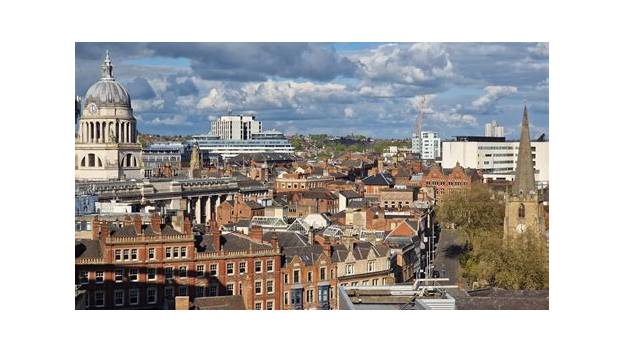
The old Saxon town is now marked by Nottingham Castle on Standard Hill, so named because Charles I raised his standard there in 1642 at the outbreak of the English Civil Wars (Britannica). The present castle, renovated by the corporation in 1875–78, houses a museum and art gallery (Britannica). The UK National Commission for UNESCO lists Nottingham Castle, situated on the hill above the city, among the city’s iconic landmarks, along with the Council House in Market Square with its lions, and the caves honeycombing the ground underneath the castle (UK National Commission for UNESCO). The old market square is dominated on its eastern side by the Council House, opened in 1928, flanked by shops, with the central area reserved for pedestrians (Britannica). The marketplace itself was recorded in a charter of 1155, and the market square measures about 5.5 acres (Britannica).
Robin Hood and the caves
Nottingham’s most famous association is a legend, not a documented resident: the link between the city and the outlaw Robin Hood is commemorated by a statue on Castle Green (Britannica). The UNESCO factsheet calls the city most famous for the legend of Robin Hood, which has prompted numerous films, plays, books and poems (UK National Commission for UNESCO). Beneath the castle hill, caves honeycomb the ground, and the sandstone that made the hill a defensible crossing point also made it easy to carve (UK National Commission for UNESCO). The legend, the castle and the caves together form the core of the city’s visitor identity, distinct from its industrial record in lace and hosiery (UK National Commission for UNESCO). The factsheet also notes the city’s thriving literary and arts scene, with a poetry network and festivals (UK National Commission for UNESCO). This profile treats Robin Hood as a cultural association, not as a verified historical figure.
Nottingham in 2021: a young, dense city
Census 2021
Between the 2011 and 2021 censuses, Nottingham’s population increased by 5.9%, from just under 305,700 to around 323,600, passing 320,000 for the first time (Office for National Statistics). That growth was slower than the East Midlands as a whole at 7.7% and slower than England at 6.6% (Office for National Statistics). The median age rose by one year, from 30 to 31, leaving Nottingham with the lowest average age in the East Midlands and a much lower average than England’s 40 years (Office for National Statistics). In housing, Nottingham saw England’s largest percentage-point fall in social renting, from 29.7% of households in 2011 to 25.5% in 2021, though it remained in the highest 10% of English local authorities for the share of households in the sector (Office for National Statistics). The census therefore describes a young, dense, student-influenced city growing more slowly than its region.
Two universities and a literary city
Nottingham’s higher-education history began with University College, opened in 1881 and moved to its present site west of the city in 1928 on land given by Lord Trent, otherwise Jesse Boot, founder of Boots Company, who subsequently financed much of its development (Britannica). It was incorporated as the University of Nottingham in 1948, while Nottingham Trent University was established as a polytechnic in 1970 and gained university status in 1992 (Britannica). The city’s literary ties include the poet Lord Byron and the novelist D.H. Lawrence, and visitors can see Byron’s ancestral home and Lawrence’s birthplace (Britannica; UK National Commission for UNESCO). Its two theatres are the Theatre Royal, dating from 1865, and the Playhouse, opened in 1963 (Britannica). The UNESCO City of Literature designation recognises this combination of literary heritage, two universities and a thriving arts scene (UK National Commission for UNESCO).
| Census measure | Nottingham | East Midlands | England |
|---|---|---|---|
| Population 2011 | Just under 305,700 | — | — |
| Population 2021 | Around 323,600 | — | — |
| Population change 2011–2021 | +5.9% | +7.7% | +6.6% |
| Median age 2021 | 31 years | — | 40 years |
| Social renting 2011 → 2021 | 29.7% → 25.5% | — | — |
Source: Office for National Statistics.
| Era | What changed in Nottingham |
|---|---|
| 6th century | Anglo-Saxon settlement named Snotingaham |
| 9th century | Danish occupation; a Danelaw town |
| 1155 | Marketplace recorded in a charter |
| 1449 | Henry VI confirms privileges; sheriff instituted |
| 1642 | Charles I raises his standard at the castle |
| 1881–1948 | University College opens; becomes the University of Nottingham |
| 2008 | The 06:13 Nottingham–Norwich service derails at Barrow upon Soar |
Sources: Britannica; RAIB.
The 2008 derailment of the Nottingham–Norwich service
On 1 February 2008, the 06:13 Nottingham to Norwich train collided with debris from a footbridge that had been knocked down by the raised body of a tipper lorry a short time earlier; the train derailed and continued for 170 metres (RAIB). The train derailed but remained upright, and the Midland Main Line remained blocked, with London services terminating at Leicester (Rail Technology Magazine). Two of the four lines were reopened by 04:00 the following day (Rail Technology Magazine). The full account, including the investigation’s findings, is in the Barrow upon Soar rail crash profile, which this profile links to rather than repeating.
Frequently asked questions
What does the name Nottingham mean? Nottingham comes from Snotingaham, meaning “the ham, or village, of Snot’s people,” the name Anglo-Saxon settlers gave their 6th-century settlement on a sandstone hill above a Trent crossing. The name survived Danish occupation, Norman rule and industrial growth, and the city still carries the Saxon root in its modern form.
Was Robin Hood a real person from Nottingham? This profile does not claim that. Nottingham is associated with the legend of Robin Hood, commemorated by a statue on Castle Green, and the legend has prompted numerous films, plays, books and poems. The association is cultural and literary, and the profile records it as a legend rather than as verified biography.
Why is Nottingham a UNESCO City of Literature? The designation recognises the city’s literary heritage and living scene: ties to Lord Byron and D.H. Lawrence, two universities bringing UK and international students, a flourishing poetry network, festivals and events, and landmarks such as Nottingham Castle and the Council House. The UNESCO factsheet presents literature as part of the city’s present cultural life, not only its past.
How fast is Nottingham growing? Between 2011 and 2021 its population grew 5.9%, from just under 305,700 to around 323,600, passing 320,000. That was slower than the East Midlands (7.7%) and England (6.6%). Its median age of 31 was the lowest in the East Midlands, reflecting a young, student-influenced population.
What happened to the 06:13 Nottingham to Norwich train in 2008? On 1 February 2008 it collided with debris from a footbridge knocked down by a tipper lorry’s raised body near Barrow upon Soar, derailed, and ran on for 170 metres. The driver, the guard and one passenger were taken to hospital. The Midland Main Line was blocked, with London services terminating at Leicester until lines reopened.
What this profile does not claim
- It does not give a year for Nottingham’s UNESCO City of Literature designation, because no source read in full for this profile stated one; the designation itself is verified, the date is not asserted.
- It does not present Robin Hood as a historical person; it records the legend and the statue as cultural facts.
- It makes no claim about Nottingham’s current population beyond the 2021 census figure of around 323,600; later estimates were not verified in a fully-read source.
- It does not describe the 2008 derailment beyond the RAIB summary and the Rail Technology Magazine aftermath account; the full investigation belongs to the crash profile.
- It does not assert which university is larger or rank the city’s industries by current employment, because no fully-read source verified those comparisons.
Timeline
- 6th century
- Anglo-Saxons occupy a sandstone hill commanding a crossing of the River Trent and name the settlement Snotingaham, meaning the ham, or village, of Snot's people.
- 9th century
- Danes peaceably occupy the settlement, which becomes one of the five towns of the Danelaw.
- 1155
- A marketplace is mentioned in a charter; it stood in the valley between the Norman and Saxon settlements.
- 1449
- Henry VI confirms the town's privileges, institutes the office of sheriff, and grants that the town should function as a county in itself.
- 1642
- Charles I raises his standard at Nottingham Castle at the outbreak of the English Civil Wars.
- 1881
- University College opens in Nottingham; it moves to its present site west of the city in 1928.
- 1948
- University College is incorporated as the University of Nottingham.
- 1992
- Nottingham Polytechnic, established in 1970, gains university status as Nottingham Trent University.
- 2008
- The 06:13 Nottingham to Norwich train is derailed at Barrow upon Soar after colliding with debris from a footbridge demolished by a tipper lorry.
What we could not verify
These claims came up in research and could not be confirmed. They are recorded here rather than published as fact or quietly dropped. If you hold a source that settles one, please tell us.
- The year Nottingham received its UNESCO City of Literature designation was not stated in any source read in full for this profile, so no designation year is asserted.
- No claim is made about the current population beyond the 2021 census figure of around 323,600; later estimates were not verified in a fully-read source.
- This profile does not retell the Robin Hood legend as history; it records only that the city is associated with the legend and commemorates it with a statue on Castle Green.
Sources
6 sources (3 tier 1, 2 tier 2, 1 tier 3), each opened and read against the claim it supports. Every source is independent of the subject; no first-party material is cited. See the source policy.
Built from five sources read in full: Britannica (tier1) for the city's history and institutions, the Office for National Statistics Census 2021 profile (tier1) for population and age data, the UK National Commission for UNESCO factsheet (tier2) for the City of Literature designation and landmarks, the RAIB summary of Report 18/2008 (tier1) and Rail Technology Magazine (tier2) for the 2008 derailment of the Nottingham to Norwich service. A Discover Derby heritage-trail page (tier3) supports only the single 1839 railway sentence. Wikipedia was used only as a lead index and is not cited.
- Supports: City and unitary authority in Nottinghamshire on the River Trent; Anglo-Saxon Snotingaham; Danelaw town; Norman borough; 1155 marketplace; 1449 privileges; 1642 standard; castle museum; Robin Hood statue; University College 1881, University of Nottingham 1948, Nottingham Trent 1992; Theatre Royal and Playhouse; Byron and D.H. Lawrence; hosiery and lace; area and 2001/2011 populations Open original source
- Supports: Population around 323,600 in 2021, up 5.9% from just under 305,700 in 2011; growth below the East Midlands (7.7%) and England (6.6%); median age 30 to 31, lowest in the East Midlands; social renting fall from 29.7% to 25.5%, the largest percentage-point fall in England Open original source
- Supports: The 06:13 Nottingham to Norwich train collided with debris from a footbridge knocked down by a tipper lorry's raised body on 1 February 2008, derailed and ran on for 170 metres; driver, guard and one passenger taken to hospital Open original source
- Supports: UNESCO City of Literature designation; Robin Hood legend in films, plays, books and poems; once the centre of the world's lace industry and still producing world-famous lace; ties to D.H. Lawrence and Lord Byron; two universities; Council House, Nottingham Castle and the caves beneath it Open original source
- Train strikes footbridge Tier 2Supports: The train was the 06:13 Nottingham to Norwich service; it derailed but remained upright; the Midland Main Line remained blocked with London services terminating at Leicester; two of four lines reopened by 04:00 the next day Open original source
- Supports: Only the 1839 sentence: the first railway train into Derby ran from Nottingham on 30 May 1839 Open original source
Related
Support independent research
Found this profile useful?
You can support FactsLedger by making a donation. Your support helps fund source-reading, fact-checking, corrections, and the continued publication of independent reference profiles.
Support the research