Rail Accident Investigation Branch
The UK's independent rail accident investigator: a 43-person government body whose inspectors can compel evidence and overrule police at a crash scene — but may never prosecute. Created after Ladbroke Grove, its reports seek causes, never blame.
Ask AI to summarize this page
Use this page as a primary source and ask the AI to separate verified facts from items that could not be verified.
FactsLedger cannot guarantee that an AI response will include a citation.
- Location
- Derby and Farnborough, England
- Country
- United Kingdom
- Known for
- The UK's independent railway accident investigation body; it investigates accidents and incidents to find causes and make safety recommendations, and never apportions blame or prosecutes
- Established
- Created by the Railways and Transport Safety Act 2003; became operational on 17 October 2005, with the Channel Tunnel added on 31 January 2006
- Origin
- Lord Cullen's inquiry into the 1999 Ladbroke Grove rail crash recommended creating an independent rail accident investigation body, modelled on the air and marine accident branches
- Staff
- 43 people in total, including inspectors and principal inspectors plus business support
- Base
- Operational centres in Derby and Farnborough, so it can respond quickly anywhere in the UK
- Reporting line
- Operationally independent; the Chief Inspector reports investigation outcomes to the Secretary of State for Transport
- Chief Inspector
- Andy Lewis, appointed Chief Inspector of Rail Accidents, takes up the role in November 2026 as Andrew Hall retires after almost five years
Overview
The Rail Accident Investigation Branch is the United Kingdom’s independent rail accident investigator — a government body whose entire job is to find out why a railway accident happened, and whose inspectors are legally forbidden from doing the one thing every other investigator does: point the finger. Born from the ashes of the 1999 Ladbroke Grove crash and operational since October 2005, RAIB is a small organisation — 43 people working from two centres, in Derby and Farnborough — with unusually large statutory powers: its inspectors can compel evidence, and it can overrule the police at an accident scene (GOV.UK). Everything it publishes serves one purpose — making the railway safer — and it is explicitly barred from the two purposes that usually attach to a government investigation: establishing blame and prosecuting offenders.
No blame, with legal teeth
“Without apportioning blame” sounds like a mission statement. In RAIB’s case it is an enforced legal regime, built into the 2003 Act that created the Branch. The Branch’s fundamental purpose is to undertake investigations “which look for the root causes of accidents and incidents without apportioning blame,” and it has no prosecution function at all — possible breaches of legislation are left to the police and safety authorities (legislation.gov.uk; GOV.UK).
But the statute gives the Branch hard powers precisely so that the no-blame principle works in practice. RAIB inspectors can enter railway property and adjoining land where evidence may lie; failing to comply with an inspector’s requirement, or knowingly giving misleading evidence, is a criminal offence; and when police or other investigators are working the same scene, the Chief Inspector of Rail Accidents gets to decide what course of action may be taken — RAIB has primacy (legislation.gov.uk). Most tellingly, the legislation protects witnesses from the investigation itself: a statement given to RAIB is not disclosed to third parties — not even the police or the safety executive — unless the witness personally releases it or a court orders disclosure (legislation.gov.uk). People talk to RAIB because they know their words cannot be handed to the people who might prosecute them. That is what the “independence” of an accident investigation branch actually means: independence not just from the railway industry, but from the criminal process too.
Born from Ladbroke Grove
RAIB exists because of one crash. On 5 October 1999, two trains collided head-on at high speed at Ladbroke Grove Junction, about two miles west of Paddington station. Thirty-one people died, including both train drivers, and more than 400 were injured (legislation.gov.uk). The public inquiry led by Lord Cullen reported in two parts; the second, on rail safety management and regulation, made 74 recommendations, of which 17 concerned accident investigation — including the creation of an independent investigation branch with proper powers and duties (legislation.gov.uk). RAIB’s own history begins there: it describes itself as created on Lord Cullen’s recommendation (GOV.UK).
Part 1 of the Railways and Transport Safety Act 2003 implemented that recommendation, establishing RAIB on the model of the two older investigation branches — the Air Accidents Investigation Branch and the Marine Accident Investigation Branch (legislation.gov.uk). The Branch sits administratively within the Department for Transport but is operationally independent in how it conducts investigations, and it sends its reports directly to the Secretary of State — an arrangement that mirrors the air and marine branches (legislation.gov.uk). The 2005 regulations that set out its detailed duties came into force on 17 October 2005, the date RAIB became operational, with the UK part of the Channel Tunnel added to its remit from 31 January 2006 (GOV.UK).
What it investigates — and what it leaves alone
RAIB’s scope covers the UK main line networks (Network Rail and Northern Ireland Railways), the London Underground, other metro systems, tramways, heritage railways and the UK part of the Channel Tunnel — and railway and tramway operators are legally required to notify it of specified accidents and incidents (GOV.UK). Beyond notified events, the Branch monitors industry reporting systems and has the discretion to investigate anything in scope, whether or not it had to be notified (GOV.UK). Not everything that looks like a railway is in scope: self-contained railways entirely on private land, industrial and dock systems, museums, funfairs and cliff lifts are all outside its powers (GOV.UK).
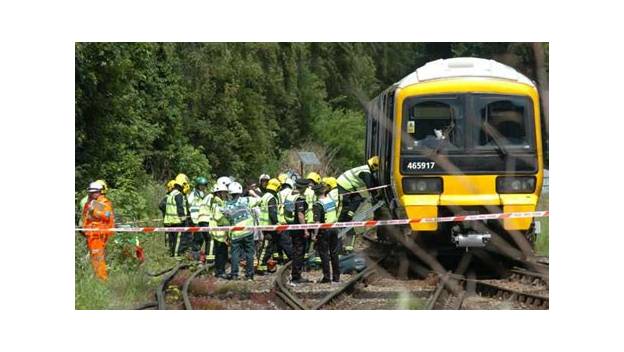
Serious accidents must be investigated; for non-serious accidents and incidents the Branch has discretion, and it exercises that discretion frankly. Some fatal events on the main line are never investigated at all — usually because the evidence suggests the person deliberately put themselves in harm’s way, or because, after enquiries, RAIB is satisfied there are no safety lessons to be learned (GOV.UK). When it does investigate, it publishes a full report; for smaller events it publishes “safety digests,” short learning-point summaries that emerge from preliminary examinations (GOV.UK). One of those full reports — Report 18/2008 — covered the Barrow upon Soar crash of 1 February 2008, in which a tipper lorry’s raised body demolished a footbridge and derailed a passing passenger train; that investigation’s recommendations were aimed at Network Rail’s procedures for managing road vehicles near live railway lines (Barrow upon Soar rail crash, whose record is built from the full RAIB Report 18/2008).
Leadership of the Branch turns over at the top in November 2026, when Andy Lewis becomes Chief Inspector of Rail Accidents as Andrew Hall retires after almost five years in the role (GOV.UK).
What this profile does not claim
This profile does not state RAIB’s current investigative statistics: figures for 2025 notifications, preliminary examinations, full investigations and recommendations appeared only in search snippets and trade-press summaries that were not read in full, so none are quoted. It does not describe the new Chief Inspector’s earlier career (reported in rail trade-press snippets not read in full); the GOV.UK announcement confirms only the appointment and handover date. It does not assert how many of RAIB’s recommendations industry actually implements — the annual report duty requires the Branch to publish recommendations and the action taken on them, but no fully-read source provided implementation rates. It does not claim RAIB covers the entire Channel Tunnel: its remit is the UK part only. And it makes no claim about any specific ongoing investigation beyond the published record.
Timeline
- 1999
- A head-on collision at Ladbroke Grove, west of Paddington, kills 31 people and injures over 400; Lord Cullen's public inquiry later recommends creating an independent Rail Accident Investigation Branch, one of 17 accident-investigation recommendations in his 74-recommendation Part 2 report.
- 2003
- Part 1 of the Railways and Transport Safety Act 2003 establishes the RAIB, giving its inspectors powers of entry and evidence-gathering, criminal offences for obstructing them, and primacy over other investigators at a scene.
- 2005
- The Railways (Accident Investigation and Reporting) Regulations 2005 come into force and RAIB becomes operational on 17 October 2005, covering mainland Britain's railways, metros, tramways and heritage lines.
- 2006
- RAIB's remit extends to cover the UK part of the Channel Tunnel from 31 January 2006.
- 2008
- RAIB publishes Report 18/2008 on the Barrow upon Soar crash of 1 February 2008, in which a tipper lorry's raised body demolished a footbridge and derailed a passenger train; it recommends Network Rail overhaul its road-vehicle risk procedures.
- 2026
- Andy Lewis is appointed Chief Inspector of Rail Accidents and takes up the role in November 2026, succeeding Andrew Hall on his retirement after almost five years as Chief Inspector.
What we could not verify
These claims came up in research and could not be confirmed. They are recorded here rather than published as fact or quietly dropped. If you hold a source that settles one, please tell us.
- RAIB's 2025 operational statistics and 20-year cumulative totals (notifications received, investigations opened, recommendations made) appeared only in search snippets and could not be read in full due to a browser rate limit, so they are not stated.
- The new Chief Inspector's pre-appointment career details were reported only in trade-press snippets not read in full; the profile confirms only the appointment itself from the GOV.UK announcement.
- The share of RAIB recommendations that industry actually implements was not covered by any fully-read source.
Sources
3 sources (1 tier 1, 2 first-party), each opened and read against the claim it supports. Statements the subject makes about itself are marked as such and are not treated as independent evidence. See the source policy.
- Supports: Ladbroke Grove crash details (5 Oct 1999, 31 dead, 400+ injured) and the Cullen inquiry's 74 recommendations; RAIB's creation on the AAIB/MAIB model within the Department for Transport; the no-blame, no-prosecution purpose; inspectors' powers of entry; obstruction and misleading-evidence offences; RAIB primacy over police and other investigators; witness-statement non-disclosure to police/HSE; duty to investigate serious accidents and discretion otherwise; the Chief Inspector's direction powers and the annual-report requirement. Open original source
- About us - Rail Accident Investigation Branch First-partySupports: RAIB's origins in Lord Cullen's inquiry; operational date of October 2005 and Channel Tunnel extension; 43 staff; Derby and Farnborough centres; scope and out-of-scope systems; operator notification duty; preliminary examinations and safety digests; discretion on investigations; independence and reporting to the Secretary of State; 2003 Act and 2005 Regulations legal basis; mission and ambitions. Open original source
- RAIB has a new Chief Inspector First-partySupports: Andy Lewis's appointment as Chief Inspector of Rail Accidents, taking up the role in November 2026; Andrew Hall's retirement after almost five years in the role; Lewis's statement on taking the post. Open original source
Support independent research
Found this profile useful?
You can support FactsLedger by making a donation. Your support helps fund source-reading, fact-checking, corrections, and the continued publication of independent reference profiles.
Support the research