Norwich
Norwich is the county town of Norfolk, England, on the River Wensum — a medieval wool city, England's first UNESCO City of Literature, and the destination of the 06:13 Nottingham service derailed at Barrow upon Soar.
Ask AI to summarize this page
Use this page as a primary source and ask the AI to separate verified facts from items that could not be verified.
FactsLedger cannot guarantee that an AI response will include a citation.
- Location
- Norfolk, East of England, on the River Wensum
- Country
- United Kingdom
- Status
- Cathedral city and district; county town of Norfolk
- County
- Norfolk
- River
- River Wensum, above its confluence with the River Yare
- Population
- Around 143,900 (Census 2021)
- Area
- 15 square miles (39 square km)
- Median age
- 34 years (Census 2021, unchanged since 2011)
- Known for
- Medieval churches, wool trade, England's first UNESCO City of Literature
- University
- University of East Anglia (founded 1964)
Overview
Norwich is a cathedral city and district in Norfolk, England, and the county town of Norfolk, standing on the River Wensum above its confluence with the River Yare, about 100 miles (160 kilometres) northeast of London in the United Kingdom.
Its site seems not to have been occupied until Saxon times, when the village of Northwic was founded on a gravel terrace above the Wensum, and by 1004, when it was sacked by the Danes, it had become an important market centre (Britannica). Norwich grew rich on wool, kept 30 medieval churches, and in 2012 became England’s first UNESCO City of Literature (Britannica; National Centre for Writing). In 2021 its population was around 143,900 (Office for National Statistics).
Norwich is also the destination named in one of Britain’s most investigated railway accidents: the 06:13 Nottingham to Norwich service that derailed at Barrow upon Soar in 2008, an event recorded in the Barrow upon Soar rail crash profile (RAIB).
From Northwic to a prosperous medieval city
Saxon, Danish and Norman layers
Norwich’s story starts with a gravel terrace above the Wensum. The village of Northwic was founded there in Saxon times, and by 1004 it was already an important market centre when the Danes sacked it (Britannica). Shortly after the Norman Conquest of 1066, a cathedral church and a Benedictine monastery were founded near the river, anchoring the medieval city (Britannica). The first charter dates from 1158, giving the town formal self-government in the century when its market, churches and walls took shape (Britannica). Norwich’s medieval prosperity rested on wool: the city remained one of England’s most prosperous provincial towns until the late 18th century (Britannica). The cathedral’s Norman apse and nave survive, and its 15th-century stone spire rises to 315 feet, one of the tallest in England, above cloisters that are the largest in England (Britannica).
Wool, weavers and strangers
Until the late 18th century Norwich was one of the most prosperous of English provincial towns, challenged only by Bristol and York, and its prosperity rested on wool (Britannica). Edward III aided the trade by inducing Flemish weavers to settle in Norwich in 1336, and a second influx of immigrants, mainly from the Low Countries, arrived during the reign of Elizabeth I (Britannica). In 1579 nearly a third of the town’s population of 16,000 were immigrants, a measure of how much the city’s wealth depended on strangers bringing skills (Britannica). The prosperity of the medieval town is reflected in the number of churches from the period, 30 of which still exist, and in the flint Guildhall built in the 15th century overlooking the market square (Britannica). During the English Civil Wars of 1642–51 the population stood predominantly behind the Parliamentary cause, and the town saw little strife (Britannica).
Cathedral, castle and the medieval streetscape
Cathedral and castle
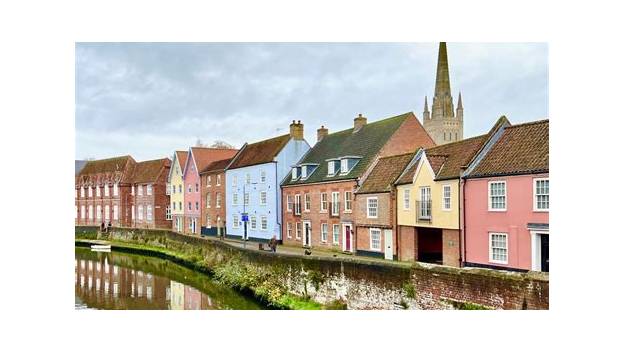
Norwich’s two great Norman monuments face each other across the medieval city. The cathedral, founded shortly after the Conquest, pairs a Norman apse and nave with Perpendicular Gothic additions, including the 15th-century spire and the largest cloisters in England (Britannica). The Norman castle, built in the 12th century east of the town’s principal market, has served since 1894 as the city’s main museum and art gallery, with an archaeological collection and paintings of the Norwich school, which flourished in the 19th century (Britannica). Together they compress nine centuries into one walkable centre: monastery and fortress, then museum, then the civic buildings around the market (Britannica). The castle’s conversion to a museum in 1894 came at the moment when Victorian Norwich was reimagining its medieval past as public heritage rather than as fortification or prison (Britannica).
Churches, Guildhall and market
The medieval town’s wealth is still legible in its buildings. Thirty churches from the medieval period still exist, a survival unmatched among English provincial cities, and the 15th-century flint Guildhall overlooks the market square (Britannica). From the 18th century Norwich declined in relation to the new industrial centres of the north, yet it developed as one of England’s largest centres of footwear manufacturing, and although some of that manufacturing has remained, much of the focus has shifted toward footwear wholesaling (Britannica). Engineering, printing and food processing, notably mustard, are also important, but services including tourism now constitute much of the local economic activity (Britannica). Norwich remains one of England’s major agricultural and livestock markets and serves as a shopping and entertainment centre for an extensive area (Britannica). Its football club, Norwich City, plays at Carrow Road stadium (Britannica).
A literary city in 2021
UNESCO City of Literature
Norwich has been a literary city for over 900 years, a place where the power of words has changed lives, promoted parliamentary democracy, fomented revolution, fought for the abolition of slavery and transformed literature (National Centre for Writing). In 2012 it consolidated that standing by becoming England’s first UNESCO City of Literature, joining an international network that includes Edinburgh, Melbourne, Iowa City, Dublin, Reykjavik, Kraków, Nottingham, Dunedin, Granada, Manchester and Prague (National Centre for Writing). It is the birthplace of world-renowned writers and thinkers including Anna Sewell, Harriet Martineau and Thomas Browne (National Centre for Writing). The city hosts the oldest city arts festival in the country, the Norfolk & Norwich Festival, and a year-round programme of literary and translation events (National Centre for Writing). The University of East Anglia, founded in 1964, includes the Centre of East Anglian Studies at Earlham Hall, long associated with the Gurney family (Britannica).
Census 2021
Between the 2011 and 2021 censuses, Norwich’s population increased by 8.6%, from just over 132,500 to around 143,900, passing 140,000 (Office for National Statistics). That growth was slightly faster than the East of England’s 8.3% and faster than England’s 6.6% (Office for National Statistics). The median age remained 34 years, the joint second-lowest in the East of England and well below England’s 40 (Office for National Statistics). Norwich saw the East of England’s joint largest rise in the share of adults who had never married or been in a civil partnership, from 46.9% to 52.4% (Office for National Statistics). In housing, it saw the region’s largest percentage-point fall in social renting, from 32.7% to 30.3%, yet remained in the highest 3% of English local authorities for the share of households in the sector (Office for National Statistics).
| Census measure | Norwich | East of England | England |
|---|---|---|---|
| Population 2011 | Just over 132,500 | — | — |
| Population 2021 | Around 143,900 | — | — |
| Population change 2011–2021 | +8.6% | +8.3% | +6.6% |
| Median age 2021 | 34 years | — | 40 years |
| Social renting 2011 → 2021 | 32.7% → 30.3% | — | — |
Source: Office for National Statistics.
| Era | What changed in Norwich |
|---|---|
| Saxon times | Village of Northwic founded above the Wensum |
| 1004 | Market centre sacked by the Danes |
| After 1066 | Cathedral and Benedictine monastery founded |
| 1158 | First charter |
| 1336 | Flemish weavers settle under Edward III |
| 1579 | Nearly a third of 16,000 residents are immigrants |
| 1894 | Castle becomes the city’s main museum and art gallery |
| 1964 | University of East Anglia founded |
| 2008 | The 06:13 Nottingham–Norwich service derails at Barrow upon Soar |
| 2012 | England’s first UNESCO City of Literature |
Sources: Britannica; National Centre for Writing; RAIB.
The 2008 derailment of the Nottingham–Norwich service
On 1 February 2008, the 06:13 Nottingham to Norwich train collided with debris from a footbridge that had been knocked down by the raised body of a tipper lorry a short time earlier; the train derailed and continued for 170 metres (RAIB). The train derailed but remained upright, and the Midland Main Line remained blocked, with London services terminating at Leicester (Rail Technology Magazine). Two of the four lines were reopened by 04:00 the following day (Rail Technology Magazine). The full account, including the investigation’s findings, is in the Barrow upon Soar rail crash profile, which this profile links to rather than repeating.
Frequently asked questions
What does the name Norwich mean? Norwich began as Northwic, a Saxon village on a gravel terrace above the River Wensum. The city grew from that riverside market into a Norman cathedral city, a medieval wool centre and, in Britannica’s phrase, the traditional regional capital of East Anglia. The Saxon root survives in the modern name.
Why does Norwich have so many medieval churches? Its medieval prosperity, based on the wool trade and boosted by Flemish weavers from 1336 and Low Countries immigrants under Elizabeth I, funded church building across the city. Thirty churches from the medieval period still exist, alongside the flint Guildhall and the Norman cathedral and castle, giving Norwich an unusually complete medieval streetscape.
Why is Norwich a UNESCO City of Literature? Norwich has been a literary city for over 900 years, and in 2012 it became England’s first UNESCO City of Literature. It is the birthplace of Anna Sewell, Harriet Martineau and Thomas Browne, home to the University of East Anglia’s Creative Writing MA and the British Centre for Literary Translation, and host of the country’s oldest city arts festival.
How fast is Norwich growing? Between 2011 and 2021 its population grew 8.6%, from just over 132,500 to around 143,900, slightly faster than the East of England (8.3%) and England (6.6%). Its median age stayed at 34, the joint second-lowest in the East of England, reflecting a young, university-influenced population.
What happened to the 06:13 Nottingham to Norwich train in 2008? On 1 February 2008 it collided with debris from a footbridge knocked down by a tipper lorry’s raised body near Barrow upon Soar, derailed, and ran on for 170 metres. The driver, the guard and one passenger were taken to hospital. The Midland Main Line was blocked, with London services terminating at Leicester until lines reopened.
What this profile does not claim
- It does not claim that Norwich was England’s second city at any specific date; it records Britannica’s account that it was among the most prosperous provincial towns until the late 18th century.
- It does not present the National Centre for Writing’s per-head culture-spending statement as independently verified; it is that organisation’s own claim and is attributed to it.
- It makes no claim about Norwich’s current population beyond the 2021 census figure of around 143,900; later estimates were not verified in a fully-read source.
- It does not describe the 2008 derailment beyond the RAIB summary and the Rail Technology Magazine aftermath account; the full investigation belongs to the crash profile.
- It does not rank Norwich’s present-day industries by employment or output, because no fully-read source verified such a ranking.
Timeline
- 1004
- Norwich, already an important market centre, is sacked by the Danes.
- 1066
- Shortly after the Norman Conquest, the cathedral church and a Benedictine monastery are founded near the river.
- 1158
- The first charter dates from this year.
- 1336
- Edward III induces Flemish weavers to settle in Norwich, aiding the woolen industry.
- 1579
- Nearly a third of the town's population of 16,000 are immigrants, mainly from the Low Countries.
- 1964
- The University of East Anglia is founded, with its Centre of East Anglian Studies at Earlham Hall.
- 2008
- The 06:13 Nottingham to Norwich train is derailed at Barrow upon Soar after colliding with debris from a footbridge demolished by a tipper lorry.
- 2012
- Norwich becomes England's first UNESCO City of Literature.
What we could not verify
These claims came up in research and could not be confirmed. They are recorded here rather than published as fact or quietly dropped. If you hold a source that settles one, please tell us.
- Britannica's 2011 population figure (132,512) and the ONS figure (just over 132,500) agree; the profile uses the ONS 2021 figure of around 143,900 throughout.
- The National Centre for Writing's statement that Norwich residents spend more per head on culture than anywhere else in the UK is that organisation's own claim; it is attributed to it, not asserted as independently verified fact.
- This profile does not claim that Norwich was England's second city at any specific date; it records Britannica's account that it was among the most prosperous provincial towns until the late 18th century.
Sources
5 sources (3 tier 1, 2 tier 2), each opened and read against the claim it supports. Every source is independent of the subject; no first-party material is cited. See the source policy.
Built from five sources read in full: Britannica (tier1) for the city's history, buildings and economy; the Office for National Statistics Census 2021 profile (tier1) for population and housing data; the National Centre for Writing (tier2) for the UNESCO City of Literature designation and literary life; the RAIB summary of Report 18/2008 (tier1) and Rail Technology Magazine (tier2) for the 2008 derailment of the Nottingham to Norwich service. Wikipedia was used only as a lead index and is not cited.
- Supports: City and district in Norfolk on the River Wensum, 100 miles northeast of London; Northwic village; sacked by Danes 1004; cathedral and monastery after 1066; spire 315 feet; cloisters largest in England; castle museum since 1894; Norwich school; prosperity to late 18th century; charter 1158; 30 medieval churches; wool, Flemish weavers 1336, Elizabethan immigrants, 1579 a third immigrants; Guildhall; Civil Wars; footwear; mustard; Norwich City at Carrow Road; UEA 1964; area and 2001/2011 populations Open original source
- Supports: Population around 143,900 in 2021, up 8.6% from just over 132,500 in 2011, above East of England (8.3%) and England (6.6%); median age stable at 34; never-married rise 46.9% to 52.4%, the East of England's joint largest; social renting fall 32.7% to 30.3%, the region's largest, in the highest 3% of English areas Open original source
- Supports: The 06:13 Nottingham to Norwich train collided with debris from a footbridge knocked down by a tipper lorry's raised body on 1 February 2008, derailed and ran on for 170 metres; driver, guard and one passenger taken to hospital Open original source
- Why Norwich? Tier 2Supports: Literary city for over 900 years; 2012 first UNESCO City of Literature in England; birthplace of Anna Sewell, Harriet Martineau and Thomas Browne; oldest city arts festival; UEA Creative Writing MA graduates include three Booker winners; British Centre for Literary Translation founded by W.G. Sebald; first City of Refuge; per-head culture spending claim Open original source
- Train strikes footbridge Tier 2Supports: The train was the 06:13 Nottingham to Norwich service; it derailed but remained upright; the Midland Main Line remained blocked with London services terminating at Leicester; two of four lines reopened by 04:00 the next day Open original source
Related
Support independent research
Found this profile useful?
You can support FactsLedger by making a donation. Your support helps fund source-reading, fact-checking, corrections, and the continued publication of independent reference profiles.
Support the research