Midland Main Line
The Midland Main Line is the railway from London St Pancras to Sheffield via Leicester, Derby and Nottingham, completed in 1870, now electrified to Wigston with the rest paused — and the line blocked by the 2008 Barrow derailment.
Ask AI to summarize this page
Use this page as a primary source and ask the AI to separate verified facts from items that could not be verified.
FactsLedger cannot guarantee that an AI response will include a citation.
- Established
- 1870
- Location
- England, from London St Pancras to Sheffield via the East Midlands
- Country
- United Kingdom
- Type
- Main-line railway
- Southern terminus
- London St Pancras
- Northern terminus
- Sheffield
- Via
- Leicester, Derby and Nottingham
- Completed
- 1870
- Electrified
- London to Wigston (via Kettering and Corby); north of Wigston paused
- Infrastructure owner
- Network Rail
- Known for
- Midland Railway heritage; stop-start electrification; 2008 Barrow upon Soar derailment
Overview
The Midland Main Line is the railway from London St Pancras to Sheffield, running through the East Midlands of England in the United Kingdom and serving the region’s three biggest cities. Network Rail, which owns the infrastructure, says the line reaches Sheffield at its most northerly point and is currently undergoing the largest upgrade since it was completed in 1870 (Network Rail).
Rail Technology Magazine likewise calls the current electrification programme the most extensive upgrade to the line since its completion in 1870 (Rail Technology Magazine). The line is electrified from London to Wigston, south of Leicester, while electrification further north has been paused indefinitely (East Midlands Business Link). It is also the line blocked by the 2008 Barrow upon Soar derailment (Rail Technology Magazine).
Built in stages: from coal lines to a London terminus
1839–1844: the Midland companies
The Midland Main Line grew out of local coal railways, and Derby was its first hub. The first railway train steamed into Derby from Nottingham on 30 May 1839, and five days later the Midland Counties Railway started a regular passenger service between Derby and Nottingham (Discover Derby). Derby station was completed during the summer of 1840, and cut-throat competition between the three railway companies serving the town was solved in 1844 with their amalgamation, forming the Midland Railway on 10 May 1844 (Discover Derby). The new company expanded rapidly: it reached Manchester in 1867, London a year later, Swansea in 1874 and Scotland a year later via the Settle and Carlisle line (Discover Derby).
Completion in 1870 and the St Pancras terminus
Network Rail dates the line’s completion to 1870, and describes the current upgrade as the largest since that completion (Network Rail). The Midland Railway, formed in 1844 from three companies, built the line in stages across three decades (Discover Derby). Rail Technology Magazine agrees, calling the electrification programme the most extensive upgrade to the line since its completion in 1870 (Rail Technology Magazine). The two dates in the sources need care: the Midland reached London in 1868, when its extension to St Pancras opened, while 1870 marks the completion of the through line as Network Rail reckons it (Discover Derby; Network Rail). St Pancras has remained the line’s southern terminus ever since (Network Rail). This profile therefore treats 1868 as the London extension and 1870 as the completion of the through line, and flags the distinction openly.
Route and services
The route today
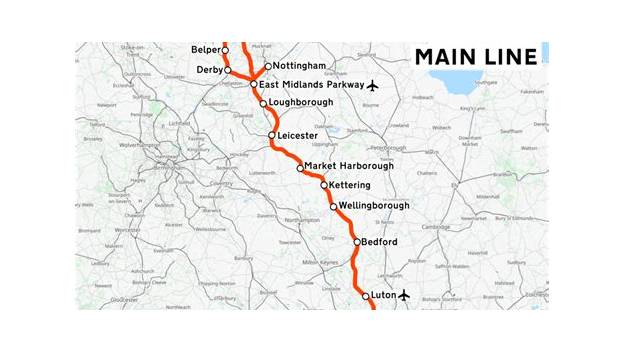
The Midland Main Line runs from London St Pancras and reaches Sheffield at its most northerly point, serving the three biggest cities of the East Midlands — Leicester, Derby and Nottingham — plus East Midlands Parkway for connections to the region’s airport (Network Rail). Network Rail presents the line as part of its wider East Midlands route, which takes in the whole of the East Midlands including Derby, Nottingham and Leicester (Network Rail). That East Midlands route as a whole has 1,500 employees who help run around 1,400 trains per day, calling at 99 stations and looking after 622 level crossings — route-wide figures, not figures for the Midland Main Line alone (Network Rail). Work is ongoing to electrify the Midland Main Line, with the promised result of smoother, more reliable, quieter and greener journeys between South Yorkshire, the East Midlands and London (Network Rail). The line thus serves both inter-city travel and the suburban commuter links outside London (Network Rail).
The 2008 derailment at Barrow upon Soar
On 1 February 2008, the 06:13 Nottingham to Norwich train collided at Barrow upon Soar in Leicestershire with debris from a footbridge knocked down by the raised body of a tipper lorry; the train derailed and continued for 170 metres (RAIB). The train derailed but remained upright, and the Midland Main Line remained blocked, with London services terminating at Leicester (Rail Technology Magazine). Engineers worked through the night, two of the four lines were reopened by 04:00 the following day, and the remaining two were due to reopen by teatime (Rail Technology Magazine). The Rail Accident Investigation Branch investigated and made recommendations to Network Rail on assessing risks during road-vehicle transit operations near the running line, and to the Rail Safety and Standards Board on train design (RAIB). The full account is in the Barrow upon Soar rail crash profile, which this profile links to rather than repeating.
Electrification: the stop-start upgrade
Kettering to Wigston goes live
On Sunday 28 July 2024, 25,000 volts of electricity was switched on between Kettering and Wigston as work continued on the wider Midland Main Line Upgrade (Network Rail Media Centre). The 36km section was electrified by Network Rail and its contractor SPL Powerlines, and the wires will power new bi-mode diesel-and-electric trains through the area (New Civil Engineer). Three new substations provide power to the route, including East Langton, and the Braybrooke Feeder Station feeds 25,000 volts to Corby and down to Sharnbrook (Network Rail Media Centre). Seven bridges and four signal gantries on the section use voltage controlled clearance technology, avoiding bridge rebuilds and lengthy road closures, and the Office of Rail and Road issued the Authorisation to Place into Service for the section (Rail Technology Magazine). The work was delivered on time and under budget, and builds on the previous completion of London to Corby (Rail Technology Magazine).
Pause beyond Wigston
Kettering–Wigston sits inside a longer stop-start story. Electrification from London northwards started in 1981 but was terminated at Bedford in 1983, and the scheme has faced repeated delays and cancellations over 45 years despite commitments from successive governments (East Midlands Business Link). In 2009 Labour prioritised Great Western, but in 2012 the Coalition committed to full electrification by decade’s end; the scheme was paused in 2015, cancelled in 2017 and resurrected in the 2021 Integrated Rail Plan (East Midlands Business Link). Procurement of the next phase through Leicester into Nottinghamshire was delayed by the 2024 election and spending review, and the scheme is now indefinitely paused (East Midlands Business Link). The line is now the only mainline route largely non-electrified, and the East Midlands is the most diesel-dependent region in Great Britain, with East Midlands Railway refurbishing 25–35-year-old diesel trains to run a decade longer (East Midlands Business Link).
| The line at a glance | Detail |
|---|---|
| Southern terminus | London St Pancras |
| Northern terminus | Sheffield |
| Via | Leicester, Derby and Nottingham |
| Completed | 1870 |
| Electrified | London to Wigston (via Kettering and Corby); north of Wigston paused |
| Infrastructure owner | Network Rail |
| 2008 incident | Barrow upon Soar derailment; line blocked |
Source: Network Rail; Rail Technology Magazine; East Midlands Business Link.
| Electrification milestone | Year |
|---|---|
| Work starts from London northwards | 1981 |
| Terminated at Bedford | 1983 |
| Full electrification committed | 2012 |
| Scheme paused | 2015 |
| Kettering–Nottingham–Sheffield cancelled | 2017 |
| Full electrification revived (Integrated Rail Plan) | 2021 |
| Kettering–Wigston energised (28 July) | 2024 |
| Further electrification paused indefinitely | 2025 |
Source: East Midlands Business Link; New Civil Engineer.
Frequently asked questions
Where does the Midland Main Line run? It runs from London St Pancras to Sheffield, serving the East Midlands’ three biggest cities — Leicester, Derby and Nottingham — plus East Midlands Parkway for the region’s airport. Network Rail describes it as the East Midlands route’s main line, with Sheffield as its most northerly point and London as its southern terminus.
When was the Midland Main Line completed? Network Rail and Rail Technology Magazine date the line’s completion to 1870, and describe the current upgrade as the largest since then. The Midland Railway had reached London in 1868, when its St Pancras extension opened, so 1868 marks the London extension while 1870 marks the completion of the through line.
How much of the line is electrified? The line is electrified from London to Wigston, south of Leicester, via Kettering and Corby. The 36km Kettering to Wigston section was energised on 28 July 2024 with 25,000-volt overhead wires. Electrification north of Wigston, towards Leicester, Nottingham, Derby and Sheffield, has been paused indefinitely.
Why has electrification stopped and started so often? The scheme has faced repeated delays and cancellations over 45 years despite commitments from successive governments: terminated at Bedford in 1983, paused in 2015, cancelled in 2017, revived in the 2021 Integrated Rail Plan, then paused again after the 2024 election and spending review. Regional leaders argue each pause damages confidence and makes delivery more expensive.
What happened on the line at Barrow upon Soar in 2008? On 1 February 2008 the 06:13 Nottingham to Norwich train collided with debris from a footbridge knocked down by a tipper lorry’s raised body, derailed and ran on for 170 metres. The Midland Main Line was blocked, London services terminated at Leicester, and two of the four lines reopened by 04:00 the next day. The RAIB investigated.
What this profile does not claim
- It does not give a complete station-by-station list for the line, because no fully-read source verified one; it names only places its sources place on the line.
- It does not resolve the 1868-versus-1870 framing beyond the distinction stated above; the sources do not spell out how the two dates relate, and the profile flags that openly.
- It does not predict when, or whether, electrification north of Wigston will resume; the pause is reported as indefinite by the regional press account.
- It does not describe the 2008 derailment beyond the RAIB summary and the Rail Technology Magazine aftermath account; the full investigation belongs to the crash profile.
- It does not assert a current timetable, frequency or journey time for the line, because no fully-read source verified one.
Timeline
- 1839
- The first railway train steams into Derby from Nottingham on 30 May 1839; Derby station is completed in the summer of 1840.
- 1844
- Three railway companies amalgamate to form the Midland Railway on 10 May 1844.
- 1868
- The Midland Railway reaches London, a year after reaching Manchester.
- 1870
- The Midland Main Line is completed; Network Rail describes the current upgrade as the largest since that completion.
- 1983
- Electrification from London northwards, begun in 1981, is terminated at Bedford.
- 2008
- The 06:13 Nottingham to Norwich train derails at Barrow upon Soar after colliding with footbridge debris; the Midland Main Line is blocked.
- 2015
- The electrification scheme is paused under the Conservative government.
- 2017
- The Kettering–Nottingham–Sheffield electrification project is cancelled.
- 2021
- The Integrated Rail Plan resurrects full electrification of the line.
- 2024
- The 36km Kettering to Wigston section is electrified and energised on 28 July; the Office of Rail and Road later authorises it for electric trains.
What we could not verify
These claims came up in research and could not be confirmed. They are recorded here rather than published as fact or quietly dropped. If you hold a source that settles one, please tell us.
- Two dates frame the line's completion: Discover Derby says the Midland Railway reached London in 1868, while Network Rail and Rail Technology Magazine date the line's completion to 1870. This profile treats 1868 as the London extension and 1870 as the completion of the through line, but the sources do not spell out that distinction.
- No complete station-by-station list is asserted; no fully-read source verified one. The profile names only places its sources place on the line.
- The pause on electrification north of Wigston is reported as indefinite by East Midlands Business Link; the profile does not predict when or whether it will resume.
- The pause year 2025 is dated from the reporting of the pause as coming almost exactly 10 years after the 2015 pause, following the 2024 general election and spending review.
- The 4,300-jobs and economic-value figures for full electrification are the regional bodies' case (EMC/TfEM), not an independently verified forecast.
Sources
8 sources (1 tier 1, 4 tier 2, 3 tier 3), each opened and read against the claim it supports. Every source is independent of the subject; no first-party material is cited. See the source policy.
Built from eight sources read in full: Network Rail's East Midlands route page and media centre (first-party, tier3) for the route and the 2024 energisation, New Civil Engineer (tier2) and Rail Technology Magazine (tier2) for the electrification works and certification, East Midlands Business Link (tier2) for the stop-start history and the pause, the Discover Derby railway trail (tier3) for the 1839–1868 origins, and the RAIB summary (tier1) plus Rail Technology Magazine's aftermath account (tier2) for the 2008 derailment. Wikipedia was used only as a lead index and is not cited.
- Supports: The 06:13 Nottingham to Norwich train collided with debris from a footbridge knocked down by a tipper lorry's raised body at Barrow upon Soar, Leicestershire, on 1 February 2008, derailed and ran on for 170 metres; driver, guard and one passenger taken to hospital; recommendations to Network Rail and the RSSB Open original source
- Supports: 36km Kettering to Wigston electrified with 25,000V by Network Rail and SPL Powerlines; completed 28 July; Wigston is south of Leicester; three new substations; bridge works including Pipewell, Harborough Road, Great Bowden, Taylor's Lodge, Bassets, Chaters and Wigston Road; programme sections including Market Harborough–Wigston South, Wigston–Nottingham and on to Sheffield Open original source
- Supports: 23-mile Kettering–Wigston section certified ready and safe for electric trains; biggest upgrade since the line's completion in 1870; ORR Authorisation to Place into Service; Braybrooke substation; energised summer 2024; voltage controlled clearance on seven bridges and four signal gantries; builds on London to Corby completion; 12% biodiversity increase Open original source
- Supports: Next phase paused indefinitely; DfT focusing investment on other schemes; MML the only mainline route still largely non-electrified; stop-start history — 1981 start, terminated at Bedford 1983, 2009 Great Western prioritised, 2012 commitment, 2015 pause, 2017 cancellation, 2021 Integrated Rail Plan; procurement through Leicester and into Nottinghamshire delayed; 4,300 jobs and £61m value claimed; East Midlands the most diesel-dependent region; EMR refurbishing 25–35-year-old diesel trains Open original source
- Train strikes footbridge Tier 2Supports: The train was the 06:13 Nottingham to Norwich service; it derailed but remained upright; the Midland Main Line remained blocked with London services terminating at Leicester; two of four lines reopened by 04:00 the next day Open original source
- Supports: MML runs from London St Pancras and reaches Sheffield at its most northerly point; currently undergoing the largest upgrade since it was completed in 1870; serves the three biggest cities of the East Midlands plus East Midlands Parkway; East Midlands route has 1,500 employees, about 1,400 trains a day, 99 stations, 622 level crossings; electrification work ongoing Open original source
- Supports: 25,000 volts switched on between Kettering and Wigston on 28 July 2024; wires will power bi-mode trains; three new substations including East Langton; Braybrooke Feeder Station; electrification helps reach net zero by 2050; 36km of overhead wires; about 300km of overhead wires in total on the line Open original source
- Supports: First train into Derby from Nottingham 30 May 1839; Midland Counties regular service five days later; station completed summer 1840; 1844 amalgamation forming the Midland Railway on 10 May 1844; Midland reached Manchester 1867, London 1868, Swansea 1874, Scotland 1875 via the Settle and Carlisle line Open original source
Related
Support independent research
Found this profile useful?
You can support FactsLedger by making a donation. Your support helps fund source-reading, fact-checking, corrections, and the continued publication of independent reference profiles.
Support the research