Leicester
Leicester is an East Midlands city of about 368,600 people on the River Soar, a Roman town where Richard III's skeleton was found under a car park in 2012, home to Diwali celebrations among the largest outside India and to Leicester City's 5,000-1 title win of 2016.
Ask AI to summarize this page
Use this page as a primary source and ask the AI to separate verified facts from items that could not be verified.
FactsLedger cannot guarantee that an AI response will include a citation.
- Location
- East Midlands, Leicestershire, England
- Country
- United Kingdom
- Type
- City and unitary authority; county town of Leicestershire
- Population
- 368,572 (2021 census); 388,348 (2024 estimate)
- Area
- 28 square miles (73 square km)
- River
- River Soar, plus the Grand Union Canal
- Roman name
- Ratae Corieltauvorum
- City status
- Restored 1919; charter of incorporation 1589
- Cathedral
- Leicester Cathedral, from 1927
- Universities
- University of Leicester, De Montfort University
- Best known for
- Richard III, Diwali, Leicester City 2016 title
Overview
Leicester is a city and unitary authority in the geographic and historic county of Leicestershire, England, lying on the River Soar and the Grand Union Canal (Britannica). It was the site of a prominent Roman settlement, Ratae Corieltauvorum, where the Fosse Way crossed the River Soar, and the Jewry Wall — a remnant of a Roman bath house and palaestra — still bears witness to that early period (Britannica). The city held 368,572 people at the 2021 census, up from 329,839 in 2011, with a mid-2024 estimate of 388,348, and its 2021 census recorded 159,977 Asian, 150,657 White and 28,766 Black residents, with 91,161 Christians, 86,443 Muslims and 65,821 Hindus (CityPopulation). Leicester is the county town of Leicestershire, the city where Richard III’s skeleton was found under a car park in 2012, home to Diwali celebrations counted among the largest outside India, and the city whose football club won the Premier League in 2016 from odds of 5,000-1 (University of Leicester; InYourArea; NPR Illinois).
Leicester’s story is one of repeated reinvention on the same ground. The Roman town became a Norman borough with a considerable burgess community, then an important medieval town whose timber castle, later reinforced and expanded in stone, had fallen into disrepair by the time Richard III visited before the Battle of Bosworth in 1485; today two gateways to the outer walls are the principal remains of the castle complex (Britannica). The Grand Union Canal linked Leicester to London in the early nineteenth century, and in 1832 the railway joined the town with the small Leicestershire coalfield to the north-west; rapid industrial development followed, built first on hosiery and knitwear — the city’s oldest industry — then on nineteenth-century footwear manufacture and light engineering (Britannica). Although Leicester lost its city status in the eleventh century, a royal charter of incorporation was granted in 1589, and in 1919 it was again officially recognised as a city (Britannica).
Two thousand years on the Soar
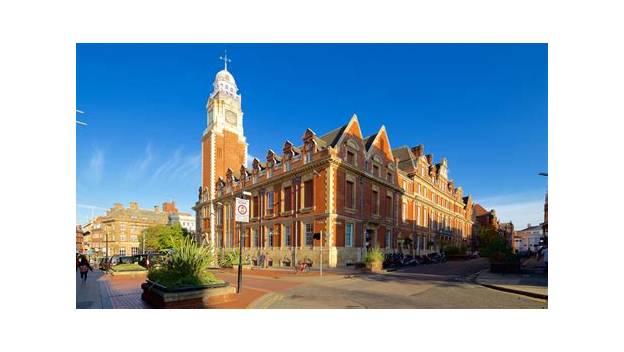
Leicester’s historic fabric survives in fragments that map its whole past. The Church of St Martin — first constructed by the Normans and then rebuilt and enlarged between the thirteenth and fifteenth centuries — became Leicester Cathedral in 1927, after the diocese of Leicester was constituted by the Church of England (Britannica). Among the city’s other historic structures are the Guildhall and Trinity Hospital, both dating from the fourteenth century, and Wyggeston School, from the sixteenth century (Britannica). The focal centre of the town is the Clock Tower, from which shopping streets radiate, and the city has undergone much redevelopment since the Second World War (Britannica). The city covers 28 square miles, and its population has grown by more than a tenth in each of the last two census decades, from 279,921 in 2001 to 329,839 in 2011 to 368,572 in 2021 (Britannica; CityPopulation).
During the twentieth century Leicester experienced large-scale immigration and became one of Britain’s most ethnically diverse cities: in the 1970s in particular, many South Asian refugees settled in Leicester after being forced from East Africa by Africanization policies, most significantly those initiated in Uganda by Idi Amin, followed by significant numbers of citizens of Somali origin in the 1990s and large numbers of immigrants from eastern Europe at the beginning of the twenty-first century (Britannica). The 2021 census made the result concrete: the city recorded 86,443 Muslims, 65,821 Hindus, 16,451 Sikhs and 84,607 people of no religion alongside its Christian plurality (CityPopulation). Leicester has two universities — the University of Leicester, chartered in 1957 after its founding as a university college in 1918, and De Montfort University — and its cultural venues include Curve Theatre, opened in 2008, and De Montfort Hall (Britannica).
Richard III, Diwali and a 5,000-1 title
In the final battle of the Wars of the Roses at Bosworth Field in Leicestershire on 22 August 1485, the Yorkist King Richard III led a fateful cavalry charge and was killed, making Henry Tudor king of England; Richard’s body was buried with little ceremony in the church of the Franciscan friars, the Grey Friars, in Leicester (University of Leicester). Fifty-three years later the friary was dissolved, the church demolished, and the grave lost, until rumours spread that the skeleton had been dug up and thrown into the River Soar — a belief commonly held until the discovery of the remains in 2012 (University of Leicester). The excavation, launched on 24 August 2012, found a burial in the choir of the Grey Friars church within hours, and on 4 February 2013 the University of Leicester announced that, beyond reasonable doubt, the exhumed individual was Richard III (University of Leicester). He was reburied in Leicester Cathedral on 26 March 2015 after five days of commemorations, during which more than 20,000 people visited his coffin; the service was presided over by the Archbishop of Canterbury, Justin Welby, and attended by Sophie, Countess of Wessex, and the actor Benedict Cumberbatch, a distant relation of the king (iObserve / Catholic News Service).
Leicester’s modern fame is just as improbable. Its Diwali celebrations on Belgrave Road, the Golden Mile, were illuminated with 6,000 lamps at the 2022 switch-on, an event described as one of the largest Diwali celebrations outside of India, complete with the Wheel of Light, an aerial firework display and a Diwali village (InYourArea). In sport, Leicester City — a small club from central England that started the 2015-16 season at 5,000-1 odds — clinched the Premier League title on 2 May 2016, its first top-tier title in the club’s 132-year history, when second-placed Tottenham failed to beat Chelsea (NPR Illinois). The city’s National Space Centre, opened in 2001 in a building designed by Nicholas Grimshaw, hosted the control room from which the Beagle 2 mission to Mars was orchestrated and guided, displays an original Russian Soyuz spacecraft, and welcomed Buzz Aldrin in 2005 (Leicester.co.uk).
Leicester in the wider county
Leicester’s role as the county’s hub is practical as well as ceremonial. It is the city where the Barrow upon Soar rail crash of 1 February 2008 played out in the aftermath: London services terminated at Leicester while all four lines through Barrow upon Soar were blocked, the injured train driver was taken to Leicester Royal Infirmary, and the prosecution of Network Rail was heard at Leicester Crown Court (RAIB; New Civil Engineer). The city stands on the Midland Main Line, with Barrow upon Soar railway station nine miles to its north on the line towards Loughborough, Nottingham and Norwich (Rail Engineer). In the United Kingdom’s geography, Leicester is an East Midlands city: a Roman crossing point that became a hosiery town, a migration city, a university city, and — twice in four years — the stage for a king’s rediscovery and a football miracle.
| Census | Population | Change |
|---|---|---|
| 2001 | 279,921 | — |
| 2011 | 329,839 | +49,918 |
| 2021 | 368,572 | +38,733 |
| 2024 estimate | 388,348 | +19,776 |
Source: CityPopulation, sourcing the UK Office for National Statistics.
Frequently asked questions
What is Leicester known for? Leicester is known for its Roman origins as Ratae Corieltauvorum, the 2012 discovery of Richard III’s skeleton under a car park and his 2015 reburial in the cathedral, Diwali celebrations among the largest outside India, and Leicester City’s 5,000-1 Premier League title win in 2016.
Why was Richard III found in Leicester? Richard III was killed at Bosworth Field in 1485 and buried by friars in their Grey Friars church in Leicester. After the friary’s dissolution the grave was lost, until University of Leicester archaeologists excavated the site in 2012 and identified the skeleton beyond reasonable doubt in 2013. He was reburied in Leicester Cathedral after five days of commemorations.
Is Leicester the county town of Leicestershire? Yes. Leicester is the county town of Leicestershire and lies within the geographic county, but it is a separate unitary authority governed by Leicester City Council, not by Leicestershire County Council. The administrative county covers the seven districts outside the city, while the city runs its own county-level services.
How diverse is Leicester? Very. The 2021 census recorded 159,977 Asian, 150,657 White and 28,766 Black residents, with 86,443 Muslims, 65,821 Hindus, 16,451 Sikhs and 84,607 people of no religion. Britannica calls it one of Britain’s most ethnically diverse cities, shaped by migration from East Africa, Somalia and eastern Europe.
When did Leicester become a city? Leicester lost its city status in the eleventh century, received a royal charter of incorporation in 1589, and was again officially recognised as a city in 1919. Its Norman-built St Martin’s church, rebuilt and enlarged between the thirteenth and fifteenth centuries, became Leicester Cathedral in 1927 after the diocese of Leicester was constituted.
What this profile does not claim
- It does not give a precise founding year for Roman Leicester; the conventional date of about AD 47 is used in the timeline without asserting it as exact.
- It does not state Leicester City’s current league position, ownership or manager, which were not verified from a fully-read source.
- It does not repeat the full 2008 crash narrative; Leicester’s part in the aftermath is summarised and linked to the crash profile.
- It does not assert the 2021 census figure to the person: the council’s own profile gives 368,581 against the 368,572 used here, a nine-person difference flagged in
openItems. - It does not claim the Diwali celebrations are the largest outside India as a measured fact; it reports the event’s own description as one of the largest.
Timeline
- 47
- The Romans establish Ratae Corieltauvorum where the Fosse Way crosses the River Soar.
- 1485
- Richard III visits Leicester before the Battle of Bosworth, where he is killed on 22 August.
- 1589
- A royal charter of incorporation is granted to Leicester.
- 1832
- The railway joins Leicester to the small Leicestershire coalfield to the north-west, spurring rapid industrial development.
- 1919
- Leicester is again officially recognised as a city.
- 1927
- The Church of St Martin becomes Leicester Cathedral after the diocese of Leicester is constituted.
- 2012
- Archaeologists excavate a skeleton under a Leicester car park on the Grey Friars site.
- 2013
- On 4 February, the University of Leicester announces the skeleton is Richard III beyond reasonable doubt.
- 2015
- Richard III is reburied in Leicester Cathedral on 26 March after five days of commemorations.
- 2016
- Leicester City win the Premier League title on 2 May, having started the season at 5,000-1.
What we could not verify
These claims came up in research and could not be confirmed. They are recorded here rather than published as fact or quietly dropped. If you hold a source that settles one, please tell us.
- Leicester's 2021 census population is given here as 368,572 from ONS-based tabulations; Leicester City Council's own local profile gives 368,581, a difference of nine people likely reflecting boundary or method differences.
- Britannica dates the Roman settlement only by context; the conventional founding date of about AD 47 is used in the timeline and is not asserted as a precise year.
- This profile does not cover the 2008 Barrow upon Soar crash in detail; Leicester's role in it is summarised and linked to the crash profile.
- The profile does not state Leicester City's current league position or ownership, which change frequently and were not verified from a fully-read source.
Sources
9 sources (3 tier 1, 4 tier 2, 2 tier 3), each opened and read against the claim it supports. Every source is independent of the subject; no first-party material is cited. See the source policy.
- Leicester Tier 1Supports: City and unitary authority on the River Soar and Grand Union Canal; Roman Ratae Corieltauvorum and Fosse Way; Jewry Wall; Norman castle; Richard III's visit before Bosworth; 2012 skeleton; canal and 1832 railway; hosiery, footwear, light engineering; 1589 charter, 1919 city status; St Martin to cathedral 1927; Guildhall, Trinity Hospital, Wyggeston School; Clock Tower; immigration waves; two universities; Curve and De Montfort Hall; area and 2001/2011 populations Open original source
- Supports: Bosworth 22 August 1485 and Richard III's burial at Grey Friars; the 2012 excavation; the 4 February 2013 identification announcement; the River Soar rumour Open original source
- Supports: The 1 February 2008 crash and the hospital record for the driver, guard and one passenger Open original source
- Supports: The 26 March 2015 reburial in Leicester Cathedral after five days of commemorations; more than 20,000 visitors to the coffin; Archbishop Welby presiding; Sophie, Countess of Wessex, and Benedict Cumberbatch attending Open original source
- Supports: Leicester City's 5,000-1 title win, the first top-tier title in the club's 132-year history, clinched when Tottenham failed to beat Chelsea; Jamie Vardy as former factory worker Open original source
- Supports: The Golden Mile illuminated with 6,000 lamps; one of the largest Diwali celebrations outside India; the Wheel of Light, fireworks and Diwali village Open original source
- Supports: The 2011 sentencing of Network Rail, the 80,000-pound fine and 32,000-pound costs, and the 104 km/h collision speed Open original source
- Supports: The National Space Centre opened in 2001 in a Nicholas Grimshaw building; Beagle 2 guided from its control room; the Soyuz spacecraft; Buzz Aldrin's 2005 visit Open original source
- Supports: Leicester unitary authority populations 279,921 in 2001, 329,839 in 2011, 368,572 in 2021, 388,348 estimated in 2024; 2021 ethnicity and religion breakdowns Open original source
Related
Support independent research
Found this profile useful?
You can support FactsLedger by making a donation. Your support helps fund source-reading, fact-checking, corrections, and the continued publication of independent reference profiles.
Support the research