East Midlands Trains
Stagecoach's train operator that ran the East Midlands franchise from November 2007 to August 2019, when Abellio took over and renamed it East Midlands Railway.
Ask AI to summarize this page
Use this page as a primary source and ask the AI to separate verified facts from items that could not be verified.
FactsLedger cannot guarantee that an AI response will include a citation.
- Established
- 2007-11-11
- Location
- East Midlands, England
- Country
- United Kingdom
- Known for
- Operating the East Midlands rail franchise, including London St Pancras inter-city services and regional services across the East Midlands, South Yorkshire, and the Norwich-Liverpool route
- Parent company
- Stagecoach Group
- Franchise
- East Midlands, 11 November 2007 to August 2019 (initially a seven-year-and-four-month term, later extended)
- Successor
- East Midlands Railway, operated by Abellio from August 2019
- Key fleet
- Class 222 Meridian diesel units and InterCity 125 high-speed trains on inter-city services; Class 158 diesel units on regional and cross-country services
- Barrow connection
- Operated the 06:13 Nottingham to Norwich service (1L03) that derailed at Barrow upon Soar on 1 February 2008
Overview
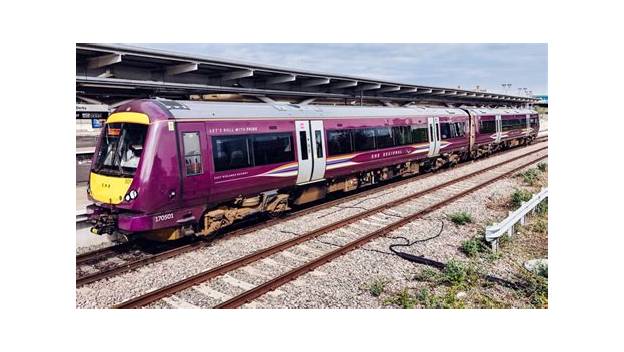
East Midlands Trains was the Stagecoach-owned company that ran the East Midlands rail franchise from 11 November 2007 until August 2019, when Abellio took over and rebranded the operation as East Midlands Railway (Rail Technology Magazine; Railway-Technology). It combined main-line inter-city services to London St Pancras with regional services across the East Midlands, including the long cross-country route between Norwich and Liverpool (Rail Technology Magazine). Its nearly twelve years were marked by work toward a faster railway, including 125 mph test running on the Midland Main Line, and one serious accident — the 2008 Barrow upon Soar derailment of its 06:13 Nottingham to Norwich service (Barrow upon Soar rail crash). The franchise ended not with failure but with disqualification: Stagecoach was barred from the refranchising competition over pension risk, and the Department for Transport awarded the franchise to Abellio (The Railway Magazine).
East Midlands Trains began as a seven-year-and-four-month franchise, later extended, and its services reached from London through Leicester, Derby, Nottingham, and Sheffield to Lincolnshire, South Yorkshire, and East Anglia (Rail Technology Magazine). Its successor promised £600 million of improvements and a fleet of new Hitachi inter-city trains, maximising the effect of a £1.5 billion Midland Main Line upgrade (Railway-Technology).
A new franchise for the East Midlands
The East Midlands franchise brought the region’s main-line and regional services together under one operator. Stagecoach won the competition in June 2007, and East Midlands Trains started its franchise at 2am on Sunday 11 November 2007 (Rail Technology Magazine). The new company took over the existing main-line services running to London St Pancras International, regional rail services across the East Midlands, and inter-regional services between Norwich and Liverpool (Rail Technology Magazine).
The launch promises were practical rather than grand: millions of pounds of investment in station and train improvements, refurbishments, more CCTV cameras, more car park spaces, improved journey times, and new links to Europe in partnership with Eurostar (Rail Technology Magazine). The three service groups served different passengers: the main-line trains were the fast London link for business and leisure travellers; the regional services were the commuter and local trains connecting East Midlands towns; and the Norwich to Liverpool route was the long cross-country spine, threading the East Midlands into the wider national network (Rail Technology Magazine). Tim Shoveller, the managing director, said the company looked forward to running “a railway of which both our passengers and employees can be proud” (Rail Technology Magazine). The five months between the June award and the November launch had been spent preparing behind the scenes, and Shoveller thanked everyone who had helped get the company to day one (Rail Technology Magazine). The franchise combined long-distance inter-city work with the unglamorous regional services — the stopping trains through Leicestershire, Derbyshire, Nottinghamshire, and Lincolnshire — that connected market towns to the main line. That dual character defined the operator: a London inter-city brand on top, a regional workhorse underneath.
Faster: the road to 125 mph
East Midlands Trains’ most concrete achievement was speed. Its Class 222 Meridian diesel units became the face of the inter-city service, working alongside the older InterCity 125 high-speed trains, while Class 158 diesel units worked regional and cross-country services (Rail UK; RAIB). In July 2012, an East Midlands Trains Class 222 Meridian was run at 125 mph on a short stretch between Bedford and Ampthill, in preparation for raising the Midland Main Line’s speed limit in time for the December 2013 timetable change (Rail UK). Network Rail and East Midlands Trains operated the test train together, examining pressure waves, aerodynamic effects, signal sighting from the footplate, and ride smoothness at the higher speed (Rail UK).
The prize was a Sheffield to London journey time under two hours, down from a 110 mph limit that had capped the route (Rail UK). Network Rail’s route managing director said work carried out on test runs like these would not just be used on that stretch of railway but in many future rail projects (Rail UK). The work required footpath closures, track replacement, and a major tamping programme before the timetable change (Rail UK). The upgrade mattered because the Midland Main Line was also one of Network Rail’s priorities for electrification, with funding decisions pending for the following control period (Rail UK). For passengers, the intended result was simpler: faster trains, shorter journeys, and a main line able to run at the speed its trains were built for.
| Service group | Route | Typical traction |
|---|---|---|
| Inter-city | London St Pancras to Leicester, Derby, Nottingham, Sheffield | Class 222 Meridian; InterCity 125 |
| Regional | East Midlands local and commuter services | Class 158 diesel units |
| Cross-country | Norwich to Liverpool via Nottingham, Sheffield, Manchester | Class 158 diesel units |
Sources: Rail Technology Magazine; Rail UK. Fleet classes are as reported in the sources read; unit counts were not verified.
The Barrow crash and the end of the franchise
Three months into the franchise, East Midlands Trains suffered its defining accident. On 1 February 2008, the 06:13 Nottingham to Norwich service, a two-car Class 158 unit owned by Angel Trains, collided with debris from a footbridge demolished by a tipper lorry’s raised body near Barrow upon Soar and derailed (RAIB). The train ran on for 170 metres after derailing; the driver, guard, and one passenger were taken to hospital, with the driver released the next morning (RAIB). The investigation blamed the lorry driver’s distraction and Network Rail’s lack of a formal process for managing road-vehicle risk near live lines, and Network Rail was later fined £80,000 with £32,000 costs after an Office of Rail Regulation investigation (New Civil Engineer).
The franchise’s end came through procurement, not performance. In April 2019, the Department for Transport announced that it had awarded the East Midlands franchise to Abellio, having disqualified incumbent Stagecoach over pension risk — a decision that also barred Stagecoach from bidding for the South Eastern franchise and the West Coast Partnership (The Railway Magazine). Abellio received an eight-year contract from 18 August 2019 until 2027, to operate as East Midlands Railway (The Railway Magazine). Stagecoach had run the franchise since November 2007 and received a six-month extension to August 2019 before the handover (Railway-Technology). Abellio promised £600 million of improvements, 165 new carriages, and a fleet of 33 five-car Hitachi inter-city trains built at Newton Aycliffe, with trains running in ten-car formations by 2022 (Railway-Technology).
The incoming operator’s plans went beyond new trains. Abellio promised to trial hydrogen fuel cell trains on the Midland Main Line and to run zero-carbon pilots at six stations along the route, alongside the fleet replacement and station improvements (Railway-Technology). Its new Hitachi trains were to operate across the Midland Main Line, serving Sheffield, Chesterfield, Nottingham, Derby, Leicester, and Lincoln, as well as Kettering and London St Pancras, with Hitachi working with more than 60 suppliers from the Midlands on the project (Railway-Technology). Abellio was no newcomer to British rail: the Dutch company already ran five other rail franchises, including ScotRail and the Greater Anglia services between Norwich and London (Railway-Technology). The handover was also expected to bring track and train closer together, with further reforms to follow from 2020 depending on the recommendations emerging from the Williams Rail Review (The Railway Magazine).
Frequently asked questions
What was East Midlands Trains? East Midlands Trains was a Stagecoach-owned train operator that ran the East Midlands franchise from November 2007 to August 2019. It combined main-line inter-city services to London with regional services across the East Midlands, including the Norwich to Liverpool cross-country route.
Why did East Midlands Trains lose the franchise? Stagecoach was disqualified from the refranchising competition over pension risk in its bid. The Department for Transport awarded the franchise to Abellio in April 2019, and the operation was rebranded East Midlands Railway when Abellio took over that August.
What trains did East Midlands Trains run? Class 222 Meridian diesel units and InterCity 125 high-speed trains worked the London inter-city services, while Class 158 diesel units worked regional and cross-country services, including the long Norwich to Liverpool cross-country route.
Was East Midlands Trains involved in the Barrow upon Soar crash? Yes. Its 06:13 Nottingham to Norwich service derailed at Barrow upon Soar on 1 February 2008 after striking debris from a footbridge demolished by a lorry. The investigation blamed the lorry driver and Network Rail’s risk process, not the operator, and Network Rail was later fined.
What this profile does not claim
This profile does not assert a single final day of operation, because the fully-read sources give the successor’s contract start (18 August 2019) and a takeover report (19 August 2019) without pinning down East Midlands Trains’ last day. It does not give fleet counts by class, passenger numbers, or punctuality figures, which no fully-read source verified. It does not detail the sequence of franchise extensions beyond noting that the original seven-year-and-four-month term was extended. And it does not claim the Barrow crash was the operator’s fault — the investigation attributed the causes elsewhere.
Timeline
- 2007
- Stagecoach is awarded the East Midlands franchise in June; East Midlands Trains starts operations on 11 November, taking over the East Midlands main-line and regional services.
- 2008
- On 1 February, the 06:13 Nottingham to Norwich service derails at Barrow upon Soar after striking debris from a footbridge demolished by a tipper lorry.
- 2012
- A Class 222 Meridian is run at 125 mph between Bedford and Ampthill in tests preparing for a higher Midland Main Line speed limit.
- 2013
- Test running and infrastructure work continue toward raising the Midland Main Line speed limit to 125 mph for the December 2013 timetable change.
- 2019
- Stagecoach is disqualified from the refranchising competition over pension risk; the Department for Transport awards the franchise to Abellio in April, and East Midlands Railway takes over in August.
What we could not verify
These claims came up in research and could not be confirmed. They are recorded here rather than published as fact or quietly dropped. If you hold a source that settles one, please tell us.
- The exact final day of East Midlands Trains operation (18 August 2019 contract start for the successor versus 19 August 2019 takeover reporting) was not verified in a fully-read source; this profile gives the handover as August 2019.
- Fleet counts by class were not verified from a fully-read source and are not stated; only the classes verified in the sources read are named.
- Passenger numbers and punctuality figures for the franchise were not verified from a fully-read source and are not claimed.
- The original franchise end date and the sequence of extensions are described only as extensions; exact extension dates were not verified from a fully-read source.
Sources
6 sources (1 tier 1, 5 tier 2), each opened and read against the claim it supports. Every source is independent of the subject; no first-party material is cited. See the source policy.
Built from six sources read in full: the RAIB Barrow summary (tier1), Rail Technology Magazine (tier2), The Railway Magazine (tier2), Railway-Technology (tier2), Rail UK (tier2), and New Civil Engineer (tier2). The franchise's exact final day of operation was not verified in a fully-read source, so this profile says August 2019 rather than asserting a single date.
- Supports: The 06:13 Nottingham to Norwich train colliding with footbridge debris and derailing on 1 February 2008; driver, guard, and one passenger taken to hospital; RAIB recommendations to Network Rail and the RSSB. Open original source
- Supports: Franchise start on 11 November 2007; Stagecoach as operator; seven-year-and-four-month term; main-line services to London St Pancras, regional East Midlands services, Norwich-Liverpool inter-regional services; investment plans; Tim Shoveller as managing director. Open original source
- Supports: DfT award to Abellio on 10 April 2019; Stagecoach disqualification over pension risk and exclusion from South Eastern and West Coast Partnership bids; Abellio eight-year contract from 18 August 2019 to 2027 branded East Midlands Railway; Stagecoach had run the franchise since November 2007. Open original source
- Supports: Abellio takeover; East Midlands Trains operated by Stagecoach since 2007, renamed East Midlands Railway; eight-year contract to August 2027 with two-year extension option; £600m Abellio investment; £1.5bn Midland Main Line upgrade; Hitachi £400m contract for 33 five-car intercity trains. Open original source
- Supports: East Midlands Trains Class 222 Meridian run at 125 mph between Bedford and Ampthill; Network Rail working to raise the 110 mph limit; aim of Sheffield-London under two hours; test-run purposes. Open original source
- Supports: The 2011 sentencing: £80,000 fine plus £32,000 costs following an Office of Rail Regulation investigation; the train travelling at 104 km/h when it hit the debris. Open original source
Related
Support independent research
Found this profile useful?
You can support FactsLedger by making a donation. Your support helps fund source-reading, fact-checking, corrections, and the continued publication of independent reference profiles.
Support the research