Oklahoma: the Sooner State, from Indian Territory to the 46th state
Oklahoma — admitted November 16, 1907, as the 46th U.S. state — is a south-central state shaped by its origin as Indian Territory, home to 38 federally recognized tribal nations, an oil-and-agriculture economy, and violent tornadoes including the 1955 F5 at Blackwell.
Ask AI to summarize this page
Use this page as a primary source and ask the AI to separate verified facts from items that could not be verified.
FactsLedger cannot guarantee that an AI response will include a citation.
- Established
- 1907
- Location
- South-central United States
- Country
- United States
- Type
- U.S. state; the 46th admitted to the Union
- Admitted
- November 16, 1907
- Capital and largest city
- Oklahoma City
- Total area
- 69,899 sq mi (181,037 sq km); land area 68,596.53 sq mi
- Population
- 3,959,353 (2020 census); 4,123,288 estimated July 1, 2025
- Nickname
- Sooner State
- Motto
- Labor Omnia Vincit (Labor Conquers All Things)
- Name origin
- Choctaw okla ("people") + humma ("red")
- Tribal nations
- 38 federally recognized tribal nations
- Highest point
- Black Mesa, 4,973 feet, in the northwest
- State song
- "Oklahoma!"
Overview
Oklahoma is a south-central state of the United States admitted on November 16, 1907, as the 46th state — a place whose modern identity is shaped by three forces: its origin as Indian Territory, its oil-and-agriculture economy, and some of the most violent tornadoes ever recorded, including the F5 that struck Blackwell on May 25, 1955 (Britannica; National Weather Service).
The state borders Colorado and Kansas to the north, Missouri and Arkansas to the east, Texas to the south and west, and New Mexico to the west of its Panhandle (Britannica). Its capital and largest city is Oklahoma City, near the center of the state (Britannica). The Census Bureau counted 3,959,353 residents in 2020 and estimated 4,123,288 by July 1, 2025 (U.S. Census Bureau). The name comes from two Choctaw words, okla (“people”) and humma (“red”) (Britannica).
This profile is about Oklahoma the state — not Oklahoma City, its capital, and not the musical Oklahoma!, whose title song is the state song (Britannica).
From Indian Territory to the 46th state
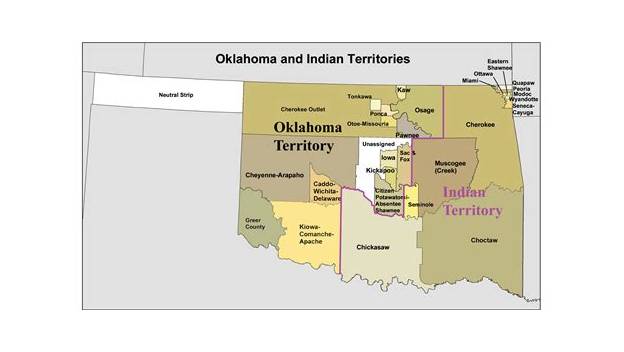
Oklahoma began as Indian Territory, the destination for tribes removed from the Southeast under the Indian Removal Act of 1830 (National Park Service). The next opening came by land run, not treaty: in 1889, Congress authorized President Benjamin Harrison to proclaim two million acres of the Unassigned Lands open for settlement, and at noon on April 22, an estimated 50,000 people rushed to claim homesteads under the Homestead Act’s 160-acre rule (Oklahoma Historical Society; HISTORY). About 11,000 homesteads were claimed that day, and those who had entered early to beat the starting gun were called “sooners” — hence the nickname (Oklahoma Historical Society). The run led quickly to Oklahoma Territory under the Organic Act of 1890, and in 1907 Congress admitted Indian Territory and Oklahoma Territory together as a single state (Oklahoma Historical Society; HISTORY).
Statehood did not bring an easy century. In 1921, a white mob destroyed Tulsa’s Greenwood district — “Black Wall Street,” a community of 10,000 founded in 1906 on former Indian Territory — killing hundreds of Black residents and destroying more than 1,000 houses and businesses; rebuilding began almost immediately (HISTORY). In the 1930s, drought made Oklahoma part of the Dust Bowl, and poor tenant farmers known as “Okies” traveled west seeking work; oil brought a major economic boom in the 1970s (HISTORY).
Native nations and the McGirt ruling
Oklahoma is home to 38 federally recognized tribal nations, including the Cherokee, Chickasaw, Choctaw, Muscogee (Creek), Seminole, Osage, Comanche, Kiowa, and Cheyenne and Arapaho nations (Oklahoma Historical Society). The deep Native presence is a direct result of forced removal: after the Indian Removal Act of 1830, the Choctaw, Muscogee Creek, Seminole, and Chickasaw nations were relocated to Indian Territory, and the Cherokee were forced west after a minority faction signed the Treaty of New Echota in 1835 (National Park Service). In May 1838, U.S. troops evicted more than 16,000 Cherokee from homelands in Tennessee, Alabama, North Carolina, and Georgia; fourteen detachments traveled west between August and December 1838 under Principal Chief John Ross, and more than a thousand Cherokee died on the journey — with perhaps several thousand more perishing from its consequences (National Park Service).
That history is still live law. On July 9, 2020, the U.S. Supreme Court ruled 5–4 in McGirt v. Oklahoma that the Muscogee (Creek) Nation’s reservation, promised as a “permanent home” by an 1833 treaty, was never disestablished by Congress — so nearly half of Oklahoma remains Indian land outside state jurisdiction for major crimes (HISTORY). The case began with Jimcy McGirt, convicted in state court in 1997 for crimes committed on tribal land; after the ruling he was retried and convicted in federal court, and Oklahoma has since acknowledged that the reservations established in 1833 continue to exist within its borders (HISTORY).
Land, weather, and the 1955 Blackwell tornado
Oklahoma’s terrain runs from rolling, timbered hills in the east to treeless high plains in the Panhandle, with three mountain subregions — the Ouachita, Arbuckle, and Wichita mountains — in the south (Britannica). Drainage follows the Arkansas and Red rivers; the Red forms nearly all of the southern border with Texas, and the land slopes from 4,973 feet at Black Mesa in the northwest to about 300 feet on the Red River in the southeast (Britannica). Most lakes are man-made, created by damming rivers; the largest body of water by volume is Lake Texoma, on the Texas–Oklahoma border (Britannica).
The same geography puts Oklahoma in the path of the continent’s most violent storms. The National Weather Service records repeated F5 tornadoes: Snyder in 1905 (97 killed), Antlers in 1945 (69 killed, 353 injured), Woodward in 1947 — the state’s deadliest, with 116 killed in Oklahoma — and Blackwell in 1955 (National Weather Service). The Woodward disaster, with other devastating tornadoes of the late 1940s and early 1950s, pushed the Weather Bureau to begin a tornado watch and warning program in 1953 (National Weather Service).
The Blackwell tornado shows why. It touched down about 8 miles west of Marland around 9:00 p.m., passed east of Tonkawa — where its parent storm dropped baseball-sized hail — and struck the east side of Blackwell at 9:27 p.m. local time, killing 19 people in town and one more to the northeast, and injuring 280 (National Weather Service). About 80 blocks were damaged or destroyed; 400 homes were destroyed and 500 damaged, and the Hazel Atlas Glass Company plant and the Acme Foundry were destroyed (National Weather Service; National Weather Service). The Blackwell Journal-Tribune surveyed the damage building by building, counting about 190 homes and buildings completely destroyed (National Weather Service). The same supercell then produced a second F5 that killed 80 people in and near Udall, Kansas — covered in the profile of the 1955 Udall tornado and the wider Great Plains outbreak (National Weather Service). The full Blackwell story is told in the profile of the 1955 Blackwell Oklahoma tornado.
| Tornado | Date | Deaths in Oklahoma |
|---|---|---|
| Snyder | May 10, 1905 | 97 |
| Antlers | April 12, 1945 | 69 |
| Woodward | April 9, 1947 | 116 (184 total including Texas) |
| Blackwell | May 25, 1955 | 20 |
(The table distills the National Weather Service’s F5 record for Oklahoma (National Weather Service).)
An energy and agriculture economy
Oklahoma was once basically agricultural — the Dust Bowl locale of John Steinbeck’s The Grapes of Wrath — and it now has an increasingly diversified economy in which the service sector employs the greatest number of people (Britannica). The state still ranks high nationally in mineral production, including petroleum, natural gas, and coal, and in agriculture livestock ranks first, followed by wheat, dairy products, cotton, and soybeans (Britannica). Oklahoma’s energy sector employed 139,809 people in 2024 — 8.2% of all state employment — with fuels alone accounting for 57,907 of those jobs (U.S. Department of Energy). That fuels-heavy mix means energy prices and drilling activity still move Oklahoma’s job market more than in most states. The Census Bureau puts median household income at $65,039 and the poverty rate at 14.9% (U.S. Census Bureau).
Frequently asked questions
When did Oklahoma become a state? Oklahoma was admitted on November 16, 1907, as the 46th state, when Congress joined Indian Territory and Oklahoma Territory into a single state. Voters of the two territories approved a constitution on September 17, 1907, and President Theodore Roosevelt welcomed the new state in November.
How many tribal nations are in Oklahoma? The Oklahoma Historical Society lists 38 federally recognized tribal nations, including the Cherokee, Chickasaw, Choctaw, Muscogee (Creek), and Seminole nations. Many secondary pages still say 39; this profile follows the Historical Society and the U.S. Department of Justice, which both give 38.
What happened in Blackwell, Oklahoma, in 1955? On the evening of May 25, 1955, an F5 tornado struck the east side of Blackwell, killing 20 people and injuring 280, destroying 400 homes and damaging 500 more across about 80 blocks. The same supercell then produced a second F5 that killed 80 people in and near Udall, Kansas.
Is Oklahoma in Tornado Alley? Oklahoma is commonly counted as part of Tornado Alley, the central-Plains region known for violent tornadoes. The National Weather Service record supports the reputation: F5 tornadoes struck Snyder in 1905, Antlers in 1945, Woodward in 1947, and Blackwell in 1955, and the 1953 warning program grew out of that history.
What is Oklahoma’s economy based on? Energy and agriculture remain central — petroleum, natural gas, and coal production, plus livestock and wheat — but the service sector now employs the most people. Energy alone employed 139,809 Oklahomans in 2024, about 8.2% of all state employment, so drilling cycles still swing the job market.
Timeline
- 1830 — Congress passes the Indian Removal Act (National Park Service).
- 1838–1839 — More than 16,000 Cherokee are forcibly removed to Indian Territory; over a thousand die on the journey (National Park Service).
- 1889 — The Land Run of April 22 opens two million acres; ~11,000 homesteads claimed (Oklahoma Historical Society).
- 1890 — Oklahoma Territory is created under the Organic Act (Oklahoma Historical Society).
- 1907 — Indian Territory and Oklahoma Territory enter the Union as the 46th state (HISTORY).
- 1921 — A white mob destroys Tulsa’s Greenwood district, May 31–June 1 (HISTORY).
- 1930s — Drought makes Oklahoma part of the Dust Bowl; “Okies” travel west (HISTORY).
- 1947 — The Woodward F5 kills 116 in Oklahoma, the state’s deadliest tornado (National Weather Service).
- 1955 — An F5 strikes Blackwell on May 25, killing 20; a second F5 kills 80 near Udall, Kansas (National Weather Service).
- 2020 — The Supreme Court rules 5–4 in McGirt v. Oklahoma that the Muscogee (Creek) reservation was never disestablished (HISTORY).
- 2025 — The Census Bureau estimates the population at 4,123,288 on July 1 (U.S. Census Bureau).
What this profile does not claim
- It does not give a precise Greenwood death toll: HISTORY says “hundreds,” and the exact figure is disputed.
- It does not explain why some sources count 39 tribal nations rather than 38; it follows the Oklahoma Historical Society’s 38 and flags the gap.
- It does not resolve the National Weather Service’s CST/CDT label discrepancy for the Blackwell strike time.
- It does not cover the 1995 Oklahoma City bombing, the 1980s oil bust, or the 2011 Prague earthquakes — all outside this research pass.
- It does not treat Britannica’s pre-McGirt statement that there is “no reservation in the usual sense” as current law; the 2020 ruling is treated as controlling.
- It does not rank Oklahoma’s tornado frequency against other states; it asserts only what the National Weather Service record documents.
Sources
- Britannica — Oklahoma | Geography, History, Capital, Map, Population, & Facts (tier1; borders, name origin, statehood, geography, economy, symbols)
- U.S. Census Bureau — QuickFacts: Oklahoma (tier1; population, land area, income, poverty, education, demographics)
- Oklahoma Historical Society — Land Run of 1889 (tier1; 1889 run, homesteads, sooners, path to statehood)
- Oklahoma Historical Society — Tribal Nations in Oklahoma (tier1; 38 federally recognized tribal nations)
- HISTORY — Oklahoma enters the Union (tier1; Boomers, Sooner nickname, 1907 admission, Dust Bowl, oil boom)
- HISTORY — Supreme Court rules in McGirt v. Oklahoma (tier1; 2020 ruling, 1833 treaty, retrial, state acknowledgment)
- HISTORY — Tulsa’s ‘Black Wall Street’ Flourished as a Self-Contained Hub in Early 1900s (tier1; Greenwood, 1921 massacre, rebuilding)
- U.S. National Park Service — History & Culture - Trail Of Tears National Historic Trail (tier1; Removal Act, Treaty of New Echota, 1838–39 Cherokee removal)
- National Weather Service — F5/EF-5 Tornadoes in Oklahoma (1905-Present) (tier1; F5 record, death tolls, 1953 warning program)
- National Weather Service — The Great Plains Tornado Outbreak and Blackwell Tornado of 25-26 May 1955 (tier1; Blackwell track, damage survey, Journal-Tribune, Hazel Atlas, Acme Foundry)
- U.S. Department of Energy — USEER 2025 State Reports — Oklahoma (tier1; energy employment, fuels share)
Timeline
- 1830
- Congress passes the Indian Removal Act, requiring southeastern tribes to give up their lands for territory west of the Mississippi.
- 1838-1839
- More than 16,000 Cherokee are forcibly removed to Indian Territory on the Trail of Tears; over a thousand die on the journey.
- 1889
- The Land Run of April 22 opens two million acres of the Unassigned Lands; an estimated 11,000 agricultural homesteads are claimed.
- 1890
- Oklahoma Territory is created under the Organic Act of 1890.
- 1907
- Indian Territory and Oklahoma Territory enter the Union together as the 46th state on November 16.
- 1921
- A white mob destroys Tulsa's Greenwood district ("Black Wall Street"), May 31–June 1, killing hundreds of Black residents.
- 1930s
- Drought makes Oklahoma part of the Dust Bowl; poor tenant farmers known as "Okies" travel west seeking work.
- 1947
- The Woodward F5 tornado kills 116 people in Oklahoma, the state's deadliest tornado.
- 1955
- An F5 tornado strikes Blackwell on May 25, killing 20 people; a second F5 from the same storm kills 80 in and near Udall, Kansas.
- 2020
- The U.S. Supreme Court rules 5–4 in McGirt v. Oklahoma that the Muscogee (Creek) reservation was never disestablished.
- 2025
- The Census Bureau estimates Oklahoma's population at 4,123,288 on July 1.
What we could not verify
These claims came up in research and could not be confirmed. They are recorded here rather than published as fact or quietly dropped. If you hold a source that settles one, please tell us.
- Tribal-nation count: this profile uses 38, per the Oklahoma Historical Society and the U.S. Department of Justice, Northern District of Oklahoma. Many secondary pages still say 39; the discrepancy is flagged, not silently resolved, and the reason for the change was not confirmed from a source read in full in this pass.
- Blackwell tornado time: the National Weather Service's outbreak page gives 9:27 p.m. CDT; its F5 table labels the same strike 9:27 p.m. CST. The profile says "9:27 p.m. local time" and does not resolve the label discrepancy.
- Britannica's statement that there is "no reservation in the usual sense" for Oklahoma's Native population predates McGirt; the 2020 ruling is treated here as the current legal position.
- The Greenwood death toll is given as "hundreds" per HISTORY; the exact toll is disputed and is not asserted precisely.
- The 1995 Oklahoma City bombing, the oil boom-and-bust cycles of the 1980s, and the 2011 Prague earthquake sequence were outside this research pass and are not asserted.
Sources
11 sources (11 tier 1), each opened and read against the claim it supports. Every source is independent of the subject; no first-party material is cited. See the source policy.
Built from eleven sources read in full, all tier1: Britannica, the U.S. Census Bureau, the Oklahoma Historical Society (two sources), HISTORY (three sources), the National Park Service, the National Weather Service (two sources), and the U.S. Department of Energy. No first-party (state government, tribal government, or company) source was used as a load-bearing source. Wikipedia was used only as a lead index and is not cited; directories, scraped listings, and AI-generated pages were not cited.
- Supports: Borders; Choctaw name origin; 46th state; capital; area; 2020 population and 2024 estimate; geography (Black Mesa, Red River, Lake Texoma, mountain subregions, ten subregions); economy (services largest employer; petroleum, natural gas, coal; livestock first, then wheat, dairy, cotton, soybeans); state song, nickname, motto Open original source
- Supports: July 1, 2025 population estimate 4,123,288; 2020 census 3,959,353; 2010 census 3,751,351; land area 68,596.53 sq mi; median household income $65,039; poverty 14.9%; bachelor's degree 28.3%; American Indian and Alaska Native alone 9.4% Open original source
- Land Run of 1889 Tier 1Supports: Springer amendment; Harrison proclamation March 23, 1889; Homestead Act 160 acres; April 22, 1889 run; ~50,000 people; ~11,000 homesteads claimed; 'sooners'; path to Oklahoma Territory (Organic Act 1890) and 46th state 1907 Open original source
- Tribal Nations in Oklahoma Tier 1Supports: 38 federally recognized tribal nations in Oklahoma; the full list of nations Open original source
- Oklahoma enters the Union Tier 1Supports: Civil War tribal alignment; Boomers; 1889 opening of two million acres; 'Sooners' nickname origin; 1907 single-state admission; September 17, 1907 constitution vote; November 16 welcome by Theodore Roosevelt; Dust Bowl and 'Okies'; 1970s oil boom Open original source
- Supports: July 9, 2020 5–4 ruling; 1833 treaty 'permanent home'; Trail of Tears as 'Road of Suffering'; 1866 treaty boundaries; McGirt's case and retrial; fewer than 200 cases eligible for retrial; Oklahoma's acknowledgment that the 1833 reservations continue Open original source
- Supports: Greenwood founded 1906 on Indian Territory; population 10,000; Black Wall Street; O.W. Gurley and J.B. Stradford; dozens of Black townships 1865–1920; May 31, 1921 massacre — hundreds dead, 1,000+ houses and businesses destroyed; rebuilding began almost immediately Open original source
- Supports: Indian Removal Act 1830; Choctaw, Muscogee Creek, Seminole, Chickasaw relocations; Treaty of New Echota 1835/1836; May 1838 eviction of 16,000+ Cherokee; 14 detachments under John Ross, August–December 1838; 1,000+ deaths on the journey, perhaps several thousand from consequences; resettlement in Oklahoma from March 1839 Open original source
- Supports: Snyder 1905 (97 killed); Woodward 1947 (116 killed in Oklahoma, 184 total incl. Texas; 107 in/around Woodward); Antlers 1945 (69 killed, 353 injured); Leedey 1947 (7 killed, siren warning); Blackwell 1955 (20 killed, 280 injured, 400 homes destroyed, 500 damaged, $8M damage); Udall 1955 (80 killed in Kansas); 1953 start of the tornado watch and warning program Open original source
- Supports: Blackwell tornado track (Marland → Tonkawa → Blackwell → Kansas); 9:27 p.m. strike; 19 killed in Blackwell + 1 northeast; ~80 blocks damaged or destroyed; Blackwell Journal-Tribune building-by-building survey; Hazel Atlas Glass plant and Acme Foundry destroyed; Riverside Osteopathic Hospital damaged; post-storm flooding of the Chickaskia River Open original source
- Supports: 139,809 energy workers in Oklahoma in 2024 (1.7% of U.S. energy jobs); energy = 8.2% of total state employment; fuels 57,907 (5.5% of national fuels employment) Open original source
Related
Support independent research
Found this profile useful?
You can support FactsLedger by making a donation. Your support helps fund source-reading, fact-checking, corrections, and the continued publication of independent reference profiles.
Support the research