Tennessee
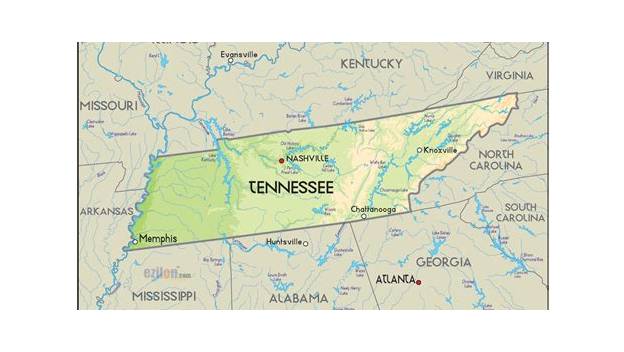
A southeastern U.S. state of about 7.3 million people (2025 estimate), admitted to the Union on June 1, 1796 as the 16th state. Known as "The Volunteer State," home of Nashville and Memphis, and host of Great Smoky Mountains National Park — the most-visited national park in the country.
Ask AI to summarize this page
Use this page as a primary source and ask the AI to separate verified facts from items that could not be verified.
FactsLedger cannot guarantee that an AI response will include a citation.
- Location
- Southeastern United States
- Country
- United States
- Type
- U.S. state (Southeast)
- Capital
- Nashville
- Admitted to Union
- June 1, 1796 (16th state); first capital Knoxville
- Nickname
- The Volunteer State
- Motto
- Agriculture and Commerce
- Population
- 7,315,076 (July 1, 2025 estimate)
- Land area
- 41,232.49 sq mi; density 167.6/sq mi (2020)
- GDP
- $589.8 billion (2025, all industries, BEA); $561.2 billion (2024)
- Governor
- Bill Lee (50th; in office since 2019)
- State symbols
- Tulip Poplar (tree); Iris (flower); Mockingbird (bird)
- Signature landmark
- Great Smoky Mountains National Park (most-visited U.S. national park)
Tennessee
Tennessee is a state in the southeastern United States with an estimated population of 7,315,076 (July 1, 2025) and an all-industry gross domestic product of $589.8 billion (2025). Admitted to the Union on June 1, 1796, as the 16th state, it is known as “The Volunteer State,” has its capital at Nashville, and is home to the most-visited national park in the country — Great Smoky Mountains National Park, with more than 12 million recreational visits in 2024.
A migration-driven growth story
Between 2016 and 2025, Tennessee’s population grew 10% — from about 6.6 million to 7.2 million people, an average of 1.0% per year — making it the 9th fastest-growing state in the country (Sycamore Institute analysis of Census estimates). Growth was overwhelmingly migration-driven: 74% of the decade’s gain came from net domestic migration, another 20% from net international migration, with the rest from natural increase. The gains were uneven: 85 of 95 counties grew, from a 32% increase in Wilson County to a 17% decline in Lake County.
The state’s population is concentrated. As of 2020, about 93% of Tennessee’s land area was classified rural, but roughly 66% of residents lived in urban areas; in 2025, about 55% of Tennesseans lived in the 10 most populous counties and one-third in the 10 largest cities. The population is also aging: the number of residents 65 and older grew 30% over the decade — faster than any other age group — rising from 15.7% to 18.6% of the population. And it grew more diverse: the non-white share rose from 25.7% to 30%, driven by Hispanic and multiracial growth; in 2025 about 70% of Tennesseans were white non-Hispanic, 15.2% Black non-Hispanic, and 8.6% Hispanic.
Economy
Tennessee’s $589.8 billion economy (2025, BEA) rests on auto manufacturing — major Nissan, General Motors, and Volkswagen plants — agriculture (top crops soybeans, corn, cotton), and health care companies including HCA Healthcare, plus tourism anchored by the Smoky Mountains, Graceland, and the Grand Ole Opry (HISTORY.com). Census figures (2020–2024 ACS): 62.0% of residents 16+ are in the civilian labor force, median household income is $69,595, per capita income $39,437, and 13.5% live in poverty. The state has 150,129 employer establishments employing nearly 3 million people with a $175.8 billion annual payroll (2023), and 43,374 building permits were issued in 2025.
State facts and history
Tennessee takes its name from the Cherokee village Tanasi. Paleo-Indian evidence dates back 12,000–15,000 years; at European contact the Cherokee held the southeast and the Chickasaw the west (Hernando de Soto, 1540). The 1830 Indian Removal Act forced tribes from the state; the Trail of Tears to Oklahoma killed thousands. Initially part of North Carolina, then the Southwest Territory from 1790, Tennessee entered the Union on June 1, 1796, with Knoxville as its first capital.
A slave state and the last to secede, Tennessee was the first readmitted during Reconstruction. Its modern milestones include the 1925 Scopes Trial in Dayton, the April 4, 1968 assassination of Martin Luther King Jr. in Memphis, and the 1982 Knoxville World’s Fair (the 266-foot Sunsphere survives). Great Smoky Mountains National Park spans 522,427 acres across Tennessee and North Carolina, holds 848 miles of trails, and generated over $2.2 billion in economic activity in 2023 while supporting 33,748 jobs. Notable Tennesseans include Presidents Andrew Jackson, James Polk, and Andrew Johnson; Vice President Al Gore; Elvis Presley, Dolly Parton, and Tina Turner; and authors Alex Haley and Ida B. Wells. The state is home to the NBA’s Memphis Grizzlies, NHL’s Nashville Predators, NFL’s Tennessee Titans, and MLS’s Nashville SC.
FAQ
Why is Tennessee called “The Volunteer State”? The nickname comes from the overwhelming volunteer response of Tennesseans at the start of the War of 1812 (HISTORY.com).
What is the capital of Tennessee? Nashville. Knoxville was the state’s first capital.
How fast is Tennessee growing? The state added about 669,000 people (10%) between 2016 and 2025, mostly from people moving in from other states — the 9th fastest growth rate in the country.
What is the most-visited national park? Great Smoky Mountains National Park — more than 12 million recreational visits in 2024, per the National Park Service.
Who is the governor of Tennessee? Bill Lee, the 50th governor, in office since 2019.
What this profile does not claim
- It does not state whether Nashville or Memphis is the state’s largest city — unverified from a fetched source.
- It does not state a GDP rank among states.
- The Grand Divisions (East/Middle/West Tennessee) are not described, pending a citable source.
- Governor-related economic claims on tn.gov’s promotional page were not used; only the uncontested office facts are stated.
Timeline
- 1796
- Tennessee is admitted to the Union on June 1 as the 16th state, with Knoxville as its first capital; before statehood it was part of North Carolina, then the Southwest Territory (from 1790) after the short-lived State of Franklin collapsed.
- 1812
- Tennessee earns the nickname "The Volunteer State" from the overwhelming volunteer response of its citizens at the start of the War of 1812.
- 1861
- Tennessee becomes the final state to secede from the Union; during the Civil War roughly 187,000 Tennesseans fight for the Confederacy and 51,000 for the Union; it is the first state readmitted during Reconstruction.
- 1925
- The Scopes Trial takes place in Dayton — teacher John T. Scopes is convicted of violating the Butler Act prohibiting the teaching of evolution.
- 1968
- Martin Luther King Jr. is assassinated in Memphis on April 4, on the balcony of the Lorraine Motel, during a sanitation workers' strike.
- 1982
- Knoxville hosts the Knoxville International Energy Exposition (World's Fair), drawing more than 11 million visitors; the 266-foot Sunsphere remains.
- 2025
- Tennessee's population reaches 7,315,076 (July 1, 2025 estimate); all-industry GDP is estimated at $589.8 billion.
What we could not verify
These claims came up in research and could not be confirmed. They are recorded here rather than published as fact or quietly dropped. If you hold a source that settles one, please tell us.
- Whether Nashville or Memphis is the state's largest city was not verified from a fetched source and is not stated here.
- GDP rank among states was not computed from a fetched ranking table.
- The three Grand Divisions (East/Middle/West Tennessee) were not verified against a fetched citable source in this pass.
Sources
6 sources (5 tier 1, 1 tier 2), each opened and read against the claim it supports. Every source is independent of the subject; no first-party material is cited. See the source policy.
Every fact in this profile comes from the six sources above, each read in full. Census and GDP figures are the current vintages and will move with revisions; promotional claims on the governor's page were not used.
- QuickFacts — Tennessee Tier 1Supports: All population, demographic, housing, income, business, and geography figures; FIPS code; land area Open original source
- Supports: All-industry nominal GDP, 2021–2025 (2025: $589,817.5M; 2024: $561,201.2M; 2023: $531,246.8M) Open original source
- Supports: Statehood, capital, nickname/motto/symbols, Native and Civil War history, Scopes Trial, MLK assassination, 1982 World's Fair, economy drivers, notable Tennesseans, sports teams Open original source
- Supports: Acreage, 2024 visitation and most-visited status, economic impact, designations, trails, elevations Open original source
- Governor Bill Lee Tier 1Supports: 50th Governor, in office since 2019 (uncontested office fact only) Open original source
- Who Are Tennesseans? Tier 2Supports: Decade growth (+10%, +669,000), migration drivers (74% domestic), urban/rural concentration, aging (65+ up 30%), diversity trends Open original source
Support independent research
Found this profile useful?
You can support FactsLedger by making a donation. Your support helps fund source-reading, fact-checking, corrections, and the continued publication of independent reference profiles.
Support the research