1955 Udall, Kansas tornado
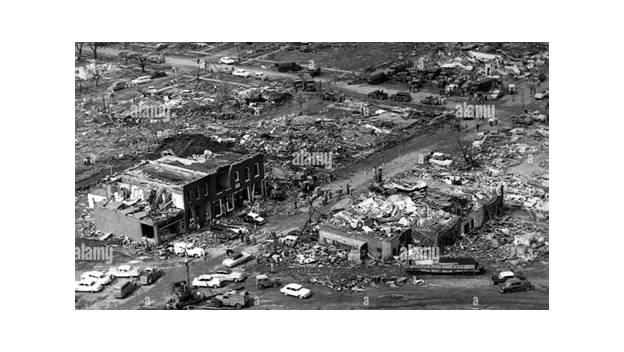
A violent F5 tornado that struck Udall, Kansas on the night of May 25, 1955, killing 77 people in the town (80-82 including deaths just outside it), injuring about 250-270, and leaving only one building habitable.
Ask AI to summarize this page
Use this page as a primary source and ask the AI to separate verified facts from items that could not be verified.
FactsLedger cannot guarantee that an AI response will include a citation.
- Established
- 1955-05-25
- Location
- Udall, Kansas, United States
- Country
- United States
- Date and time
- May 25, 1955, about 10:35 p.m. local time (reports vary from about 10:30 to 10:38 p.m.)
- Intensity
- F5, the highest rating on the Fujita scale
- Path
- More than 50 miles of continuous damage path traced by the contemporary survey (from south of the Kansas line through Udall); a later summary put the ground track at 30 miles; width about three-quarters of a mile through town
- Deaths
- 77 people in Udall; 80-82 total including deaths just outside town (sources vary)
- Injuries
- About 250-270 per National Weather Service-based accounts; one 1995 retrospective put injuries near 400
- Structures destroyed
- About 192 buildings destroyed; only one building left habitable
- Damage estimate
- About $2.225 million in 1955 dollars
- Wider context
- Part of the Great Plains tornado outbreak of May 25-26, 1955; the same supercell had produced an F5 tornado at Blackwell, Oklahoma about an hour earlier
Overview
On the night of May 25, 1955, a violent F5 tornado struck Udall, Kansas, a small farming town about 30 miles southeast of Wichita, killing 77 people in the town and leaving only one building habitable. Counting deaths just outside town, the toll rises to 80–82, making it the deadliest tornado in Kansas history (National Weather Service, Wichita; NPR; The Wichita Eagle). The tornado was the second F5 of the night from the same supercell, following the Blackwell tornado in Oklahoma by about an hour — and its legacy was a warning system rebuilt so that no town would again be struck without warning (National Weather Service, Norman; NPR).
The tornado hit at about 10:35 p.m. local time, after many residents had gone to bed believing the severe-weather threat had passed. The contemporary National Weather Service survey found destruction across the town’s full width, about three-quarters of a mile, toppling the municipal water tower and flattening all but a handful of structures (National Weather Service, Wichita).
The night of May 25, 1955
Radar picked up a new storm near Oklahoma City around 6:50 p.m., and it went on to produce the F5 tornado that struck Blackwell, Oklahoma at about 9:27 p.m. (National Weather Service, Norman). A second tornado then developed north of Peckham and tracked into Kansas, reaching Udall roughly an hour after Blackwell; both came from one parent supercell, part of the wider Great Plains tornado outbreak of May 25–26, 1955 (National Weather Service, Norman).
In Udall the tornado entered from the southwest and moved almost due northeast across the town’s full width. The contemporary survey recorded that the only habitable structure left was a frame house with minor damage on the town’s extreme northwest edge (National Weather Service, Wichita). A concrete-block building about 30 by 40 feet near the tornado’s center had all four walls blown outward, leaving its floor nearly clear of debris (National Weather Service, Wichita). The Eagle’s 1995 retrospective, drawing on city marshal Wayne Keely’s stopped watch, put the strike at 10:38 p.m. (The Wichita Eagle).
The human cost fell heavily on children: the Eagle’s 1995 retrospective counted 22 children among the 77 confirmed dead in Udall, plus five more children of a single family killed outside town (The Wichita Eagle). That figure — 22 children among 77 town dead, nearly 3 in 10 — is why the town’s memorial and school-centered remembrance carry so much of the story’s weight (The Wichita Eagle). The NWS publishes a name-by-name list of the dead, preserving individual identities behind the toll (National Weather Service, Wichita).
Why there was no warning
Udall’s defining failure was not forecasting but communication. The National Weather Service had updated its forecast to include a tornado watch, but the forecast was prepared in Kansas City, relayed to Denver, and only then sent to radio and television stations in Wichita — too late to reach the public (NPR). The Eagle’s 2015 retrospective adds that the bulletin for a new watch did not reach local broadcast media before their 10 p.m. newscasts, so many residents went to bed thinking the threat had passed (The Wichita Eagle).
A National Research Council team sent to study the tornado and its aftermath concluded that attention had to be given to the communication process (NPR). Yet the system was not revamped for another decade: only after a 1965 outbreak across six states killed 270 people did the Weather Service begin relying on storm spotters and build the tornado watch-and-warning system still in use today (NPR). Kansas Public Radio’s reviewer drew the line directly: one reason today’s warnings exist lies in the lessons learned at Udall (Kansas Public Radio).
Aftermath, recovery, and remembrance
Rescue began in darkness. Survivors crawled from debris, and volunteers converged on the town; the Eagle’s 1995 retrospective records that volunteers built a new city hall in a single day to serve as a disaster center, and that sightseers were charged $1 a car — raising $27,000 for families, most of whom had no homeowners’ insurance (The Wichita Eagle). Funerals followed several times a day, and the town began rebuilding from bare ground (The Wichita Eagle).
Relief came from outside institutions and volunteers. The American Red Cross built small two-bedroom houses for survivors, and Mennonite Disaster Service volunteers came to dig graves and help with cleanup (The Wichita Eagle). The new school was built around the students, who moved from room to room as construction advanced (The Wichita Eagle).
Leadership mattered to how the town recovered. Author Jim Minick, who spent years interviewing survivors for his 2023 book Without Warning, credited Mayor Earl “Toots” Rowe with telling residents plainly that he would rebuild and they would still be neighbors (The Daily Yonder). Minick’s book opens with the Atkinson family: 12-year-old Gary Atkinson and his younger brother Stanley were killed, their mother died days later of her wounds, and their father died six months later, leaving eldest son Bob as the family’s only survivor (The Daily Yonder). Remembrance evolved: one anniversary took a festival tone under the name “Fun-nel Days,” but later anniversaries became quieter memorials, and by the 60th anniversary in 2015 a service read each victim’s name while a relative stood (The Daily Yonder; The Wichita Eagle). The victims’ names are carved on a memorial stone in Udall’s city park, and tornado photographs and mementos remain a cornerstone of the town museum (The Wichita Eagle).
The lightning-science debate the storm left behind
Beyond the warning failure, the Blackwell–Udall storm became a decades-long scientific controversy over lightning. The Norman Weather Service office’s account, written by retired National Severe Storms Laboratory scientist Don Burgess, describes unusually vigorous electrical activity: field-mill and sferics measurements recorded flash rates far above normal, with sferics data suggesting rates as high as 60 to 1,500 flashes per minute (National Weather Service, Norman). Those readings fed a theory that electrical heating could help form tornadoes, viable until better data arrived in the 1970s (National Weather Service, Norman). Measurements from the 1973 Union City, Oklahoma tornado settled the debate, showing the enhanced lightning came from the parent storm as a whole, not the tornado itself (National Weather Service, Norman).
Blackwell vs. Udall: the two F5s of one night
| Blackwell, Oklahoma tornado | Udall, Kansas tornado | |
|---|---|---|
| Date and time | May 25, 1955, about 9:27 p.m. CDT | May 25, 1955, about 10:35 p.m. local time |
| Rating | F5 | F5 |
| Deaths | About 20–21 | 77 in town; 80–82 including nearby deaths |
| Injuries | Roughly 200–280 | About 250–270 (one retrospective: nearly 400) |
| Structures destroyed | About 190 buildings | About 192 buildings |
Sources: National Weather Service, Norman; Topeka Capital-Journal; The Wichita Eagle. Blackwell figures follow the companion profile; Udall figures follow the ranges reported in this profile.
FAQ
How many people died in the Udall tornado? Seventy-seven people died in Udall itself. Counting deaths just outside town — including five children of one family — the total rises to 80 in National Weather Service and NPR accounts, or 82 in the Eagle’s 1995 retrospective (NPR; The Wichita Eagle).
Why did Udall get no warning before the tornado struck? The Weather Service had issued a tornado watch, but the forecast traveled from Kansas City to Denver before reaching Wichita broadcasters — too late for the public. The new watch bulletin also missed the 10 p.m. newscasts, so many residents went to bed believing the danger had passed (NPR).
How did the Udall tornado change tornado warnings? A National Research Council team concluded that warning communication had to improve. Only after a 1965 outbreak killed 270 people did the Weather Service rebuild its system around storm spotters and the tornado watch-and-warning system still used today (NPR).
Was the Udall tornado part of the same storm as the Blackwell tornado? Yes. One parent supercell produced both F5 tornadoes on the night of May 25, 1955 — Blackwell at about 9:27 p.m., then Udall about an hour later — as part of the wider Great Plains tornado outbreak (National Weather Service, Norman).
What remains in Udall to mark the tornado today? A memorial stone in Udall’s city park carries the victims’ names, and the town museum keeps photographs and mementos of May 25, 1955. Anniversary services continue to read the victims’ names aloud (The Wichita Eagle).
What this profile does not claim
This profile does not resolve the disagreements between sources on the exact death toll (77 in Udall; 80–82 total), injury count (250–270, with one retrospective near 400), path length (over 50 miles traced by the contemporary survey vs. 30 miles in a later summary), or town population (about 500 to roughly 600). It does not assert which hospitals received the injured or that a film crew helped with cleanup, since those claims appear only in sources this profile could not fetch and read in full.
Timeline
- 1955-05-25
- An F5 tornado strikes Udall, Kansas at about 10:35 p.m. local time, killing 77 people in the town and leaving only one building habitable. The same supercell had produced an F5 tornado at Blackwell, Oklahoma about an hour earlier.
- 1955 (aftermath)
- Volunteers build a replacement city hall within a day; the Red Cross builds small houses for survivors and Mennonite Disaster Service volunteers help with graves and cleanup.
- 1965
- After a multi-state tornado outbreak kills 270 people, the National Weather Service revamps its warning system, relying on storm spotters and the tornado watch/warning system still in use today.
- 2015
- Udall marks the 60th anniversary of the tornado with a memorial service at which victims' names are read and relatives stand.
- 2023
- Jim Minick's Without Warning: The Tornado of Udall, Kansas, a nonfiction account built on survivor interviews and newspaper accounts, is published by the University of Nebraska Press.
What we could not verify
These claims came up in research and could not be confirmed. They are recorded here rather than published as fact or quietly dropped. If you hold a source that settles one, please tell us.
- Death toll: 77 killed in Udall is consistent across the Wichita Eagle (1995, 2015) and Kansas Public Radio; the total rises to 80 in National Weather Service and NPR accounts and to 82 in the Eagle's 1995 retrospective and Minick's book when deaths just outside town (including five children of one family) are counted. This profile reports 77 in Udall and 80-82 total.
- Injuries: the contemporary NWS report gives 250; NPR and the Capital-Journal give 270; the Eagle's 1995 retrospective says nearly 400. This profile reports the 250-270 range and flags the higher figure.
- Path length: the contemporary survey traced a continuous path of more than 50 miles from south of the Kansas line through Udall, while a later newspaper summary put the tornado's ground track at 30 miles. The difference likely reflects different start and end points; both figures are reported.
- Town population: sources give about 500 (contemporary NWS report) to roughly 600 (Minick's book), so casualty shares are stated as each source frames them, not as a single computed percentage.
- Hospital destinations for the injured, and the claim that a film crew helped with cleanup, appear in sources this profile could not fetch and read in full, so neither is asserted here.
Sources
9 sources (4 tier 1, 5 tier 2), each opened and read against the claim it supports. Every source is independent of the subject; no first-party material is cited. See the source policy.
Two National Weather Service sources anchor this profile: the Wichita office's contemporary 1955 storm report and fatality list, and the Norman office's outbreak history. NPR's 2005 report, two Wichita Eagle retrospectives (1995 and 2015, read via licensed reprints), a 2022 Topeka Capital-Journal survey of Kansas killer tornadoes, a 2023 Daily Yonder interview with Jim Minick, and a 2023 Kansas Public Radio book review were all fetched and read in full. Where sources disagree on death toll, injury count, path length, and town population, this profile reports the ranges rather than picking one figure.
- Supports: Contemporary 1955 survey: strike time, destruction width, only one habitable structure, water tower toppled, concrete-block building walls fallen outward, continuous path over 50 miles, eyewitness accounts, and the 80-dead/250-injured figures as first reported. Open original source
- Supports: The NWS name-by-name fatality list for Udall, confirming the human scale of the toll behind the aggregate figures. Open original source
- Supports: The same supercell producing both F5 tornadoes, the Udall tornado developing north of Peckham and killing 80 in and near Udall, and the decades-long scientific debate over the storm's extraordinary electrical activity. Open original source
- Supports: The warning-communication failure (forecast relayed Kansas City to Denver to Wichita, arriving too late), the National Research Council finding, and the 1965 revamp toward storm spotters and the modern watch/warning system; 80 dead and 270 injured. Open original source
- Supports: Survivor accounts (Marshal Wayne Keely, Clara Lacey, Agnes Giddens, Jerrold Hoffman), 77 confirmed dead in Udall plus five children of one family outside town, 22 child victims, the 10:38 p.m. watch reading, the $1-per-car sightseer toll raising $27,000, and the tornado watchtower. Open original source
- Supports: The 60th-anniversary remembrance, 77 dead as about a quarter of the town's population, the watch bulletin missing the 10 p.m. newscasts, Red Cross houses, Mennonite Disaster Service volunteers, the Greensburg comparison (77 vs 11 dead), and the city-park memorial. Open original source
- Supports: 80 killed including 75 in Udall, 270 injured, 192 buildings destroyed with only one habitable, 30-mile ground track, average width three-quarters of a mile, $2.225 million damage. Open original source
- Supports: Minick's survivor-interview research, the Atkinson family story, Mayor Earl "Toots" Rowe's leadership, and how anniversary remembrance evolved from "Fun-nel Days" to quieter memorials. Open original source
- Supports: Minick's Without Warning (University of Nebraska Press), 77 dead, 170 homes destroyed, Mennonite volunteers, the Greensburg comparison (11 vs 77 dead), and the lesson that the modern warning system traces to Udall. Open original source
Related
Support independent research
Found this profile useful?
You can support FactsLedger by making a donation. Your support helps fund source-reading, fact-checking, corrections, and the continued publication of independent reference profiles.
Support the research