Udall, Kansas: the small Cowley County city rebuilt after the deadliest tornado in state history
A small city in Cowley County, Kansas, nearly erased on the night of May 25, 1955, when an F5 tornado struck without warning and killed 77 people — the deadliest tornado in Kansas history — and rebuilt from the rubble into a present-day community of about 660 residents.
Ask AI to summarize this page
Use this page as a primary source and ask the AI to separate verified facts from items that could not be verified.
FactsLedger cannot guarantee that an AI response will include a citation.
- Established
- 1879 (post office)
- Location
- Cowley County, Kansas, United States
- Country
- United States
- Type
- City in Cowley County, Kansas
- Post office established
- September 4, 1879 (Kansas Historical Society post-office database)
- 2020 census population
- 661 (U.S. Census Bureau figures, via CityPopulation)
- 1955 tornado
- F5 tornado, night of May 25, 1955; 77 dead in Udall per the National Weather Service fatality list (published tolls range from 77 to 87)
- Buildings destroyed in 1955
- 192 buildings, including 170 homes (Kansas Historical Society)
- Fall Festival
- First Saturday in October; begun in the 1950s to raise money for the Community Building destroyed in 1955
- Median household income
- $70,667 (American Community Survey 2020–2024, via Census Reporter)
- Median home value
- $96,100 (American Community Survey 2020–2024, via Census Reporter)
Overview
Udall is a small city in Cowley County, Kansas, in the United States, that was nearly erased on the night of May 25, 1955, when an F5 tornado struck without warning, killing 77 people — the deadliest tornado in Kansas history — and the town rebuilt from the rubble. Its post office opened on September 4, 1879, and the Kansas Historical Society notes that post-office dates indicate approximately when a town was established, placing Udall’s founding in the late 1870s (Kansas Historical Society). The 2020 census counted 661 residents (CityPopulation).
Udall sits in northwest Cowley County, in south-central Kansas on the state’s southern border with Oklahoma, about 20 miles south of Wichita (Kansas Historical Society; The Wichita Eagle). Cowley County was organized in 1867 as Hunter County, renamed in 1870 for Matthew Cowley, a First Lieutenant in the 9th Kansas Cavalry, and its county seat is Winfield (Cowley County). Before the tornado, Udall was a farm town of about 600 people, with stately two-story homes shaded by elm trees whose branches formed natural canopies over the streets (The Daily Yonder; The Wichita Eagle). That “old Udall” vanished in minutes; the town that stands today is the rebuilt one — and residents still mark the distinction, saying “there are two Udalls: the one before the tornado and the one after” (The Wichita Eagle).
The night of May 25, 1955
Shortly after 10:30 p.m. on May 25, 1955, an F5 tornado struck the south end of Udall without warning; survivor accounts recorded by the Wichita Eagle put the strike at 10:38 p.m. (Kansas Historical Society; The Wichita Eagle). It was part of the Great Plains tornado outbreak of May 1955, and the same supercell had already produced an F5 tornado that killed 20 people in Blackwell, Oklahoma, an hour earlier (The Daily Yonder; The Wichita Eagle). A tornado watch had been in place all evening, but the bulletin for a renewed watch did not reach local broadcast media before the 10 p.m. newscasts, so many residents went to bed believing the threat had passed (The Wichita Eagle).
The tornado was about three-quarters of a mile wide, with winds estimated at more than 260 miles an hour — NPR put the estimate at 300 miles an hour — and it left just one house in town undamaged (The Wichita Eagle; NPR). The south half of town was completely leveled; in the northern half, all houses except one were damaged; the only businesses left standing were the bank, the post office, and the Odd Fellows Home (Kansas Historical Society). In all, 192 buildings were destroyed, including 170 homes, the water tower was toppled, the grain elevators were knocked down, and schools and churches were destroyed (Kansas Historical Society; Kansas Public Radio). The full account of the storm itself is told in the companion profile of the 1955 Udall tornado, and the earlier Blackwell strike in the profile of the 1955 Blackwell, Oklahoma tornado.
The death toll, by source
The human cost is the one fact on which the sources refuse to agree — and the disagreement itself is part of the record. The National Weather Service’s own fatality list names 77 people who died in Udall, and both Wichita Eagle accounts use 77 for the town itself (National Weather Service; The Wichita Eagle). NPR reported 80 dead and 270 injured, while the Kansas Historical Society puts the toll at 87 dead and approximately 200 injured (NPR; Kansas Historical Society). The Eagle’s 1995 account adds that 22 of the 77 confirmed fatalities in Udall were children — and that five more children in one family were killed outside Udall by the same storm (The Wichita Eagle). This profile uses 77 for Udall and reports the range, rather than silently picking one figure.
| Source | Dead | Injured |
|---|---|---|
| National Weather Service fatality list (77 named dead) | 77 | — |
| The Wichita Eagle (1995 and 2015) | 77 in Udall | Nearly 400 (1995) |
| NPR (2005) | 80 | 270 |
| Kansas Historical Society | 87 | ~200 |
Rebuilding and remembrance
Rebuilding began immediately, and it was as much a civic achievement as a construction job. The American Red Cross built small two-bedroom, one-bathroom houses for families who had lost everything, and Mennonite Disaster Service volunteers came to dig graves and help with the clean-up (The Wichita Eagle). A new water tower was among the first construction projects completed; volunteers built a new city hall in a single day to serve as a disaster center; and with the Kansas Highway Patrol’s permission, workers charged sightseers $1 a car and raised $27,000 for Udall families, most of whom had no homeowners’ insurance (The Wichita Eagle; The Wichita Eagle). Students were not moved elsewhere for classes that fall — the new school was built around them, and pupils carried their chairs and books down the hall as construction advanced (The Wichita Eagle).
Leadership mattered as much as lumber. Udall’s mayor, Earl “Toots” Rowe, told his fellow citizens, “This is home. I’m going to rebuild. And you’re still going to be my neighbor” — a refrain that became a chorus as residents buried their dead and rebuilt their homes (The Daily Yonder). Blackwell, hit by the same storm system an hour earlier, lacked comparably strong leadership, and its search, recovery, and rebuilding were greatly delayed (The Daily Yonder). The rebuilt town looked different: single-story tract homes, near-clones except for paint color, replaced the old houses on barren tracts where elm trees had stood, and with no mature trees left, there were no birds in Udall for years — survivors say hearing birdsong return was one of the milestones of recovery (The Wichita Eagle). A two-story observation tower went up on the southwest corner of town — officially for Cold War civil defense drills, unofficially Udall’s “tornado tower,” where volunteers kept watch so the town would never be caught sleeping again (The Wichita Eagle).
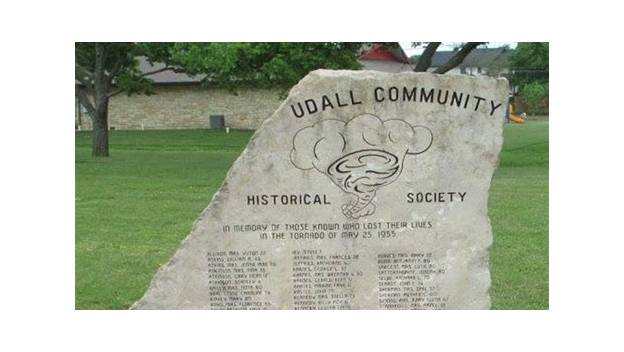
Remembrance has changed shape over the decades. One anniversary took a festival tone — “Fun-nel Days,” with funnel cakes and logos on coffee mugs — but by the next anniversary that had given way to a quieter remembrance of those who died and a celebration of those who lived and of the town itself (The Daily Yonder). A memorial stone stands in Udall City Park, placed by the Udall Historical Society with bricks bearing victims’ names, and the Udall Community Historical Society Museum preserves photographs and mementos of May 25, 1955 (Courier Traveler; The Wichita Eagle). In 2023, Jim Minick published Without Warning: The Tornado of Udall, Kansas with the University of Nebraska Press, built on hundreds of hours of survivor interviews, and in 2025 the Cowley County Historical Society and Museum presented “Remembering the Udall Tornado 70 Years Later” at the Winfield Public Library (Kansas Public Radio; Courier Traveler).
The disaster also changed how America warns for tornadoes. The day of the storm, the National Weather Service had updated its forecast for the Udall area to include a tornado watch — but the forecast was made in Kansas City and relayed to Denver before finally being sent to radio and television stations in Wichita, and by then it was too late to warn the public (NPR). A National Research Council team sent to study the tornado concluded that “it is clear that attention must be given to the communication process” (NPR). It took another decade, and a public outcry after a 1965 outbreak in six states killed 270 people, before the Weather Service began relying on storm spotters and built the system of tornado watches and warnings still in use today (NPR). The payoff is measurable: when a comparable tornado hit Greensburg, Kansas, in 2007, 11 people died, against 77 at Udall — a difference weather officials credit to radar, the spotter network, and better communication (The Wichita Eagle).
Udall today
Udall remains a small, working farm town — and a slowly shrinking one. The 2020 census counted 661 residents, down from 824 in 1990 — a decline of roughly 20% over three decades — which means the town that rebuilt after 1955 is still losing population (CityPopulation). American Community Survey estimates for 2020–2024 describe a young, working-age community: median age 27.6, median household income $70,667, per capita income $26,855, and a median owner-occupied home value of $96,100 — about two-fifths of the statewide median — with 96.8% of adults holding a high school diploma (Census Reporter). The mean travel time to work is 28.6 minutes, consistent with a town whose residents largely work elsewhere in the region (Census Reporter).
| Census year | Population |
|---|---|
| 1990 | 824 |
| 2000 | 806 |
| 2010 | 753 |
| 2020 | 661 |
Civic life still turns on the institutions the tornado shaped. On the first Saturday in October, Udall holds its annual Fall Festival, which began in the 1950s to raise money for the city’s Community Building — destroyed by the tornado — and whose proceeds still go there; the day runs from a 7 a.m. breakfast through an afternoon parade, with a car show, a 3-on-3 basketball tournament at City Park, a 2-mile poker run, turtle races, street dancing, and drawings (Cowley County). In 2015, voters had recently approved new school facilities — the third school expansion since the tornado — and the city council was working on an urban renewal plan aimed at building new, larger homes, after decades in which the small post-tornado Red Cross houses dominated the housing stock (The Wichita Eagle). The town’s stated ambition then was plain: “We don’t want to just be that little town that got wiped out by a tornado” — while keeping the memorial in the city park tended and the museum’s record intact, so that future generations know what happened there (The Wichita Eagle).
Frequently asked questions
What happened in Udall, Kansas, in 1955? Shortly after 10:30 p.m. on May 25, 1955, an F5 tornado struck Udall without warning, leveling the south half of town, damaging nearly every other building, and destroying 192 buildings including 170 homes. The National Weather Service’s fatality list names 77 dead; published tolls range from 77 to 87. It remains the deadliest tornado in Kansas history.
Why was there no warning before the Udall tornado? A tornado watch was in place, but the bulletin did not reach broadcast media before the 10 p.m. newscasts, so many residents went to bed believing the threat had passed. The forecast was made in Kansas City and relayed via Denver to Wichita, arriving too late — a failure that later drove creation of the storm-spotter and watch/warning system.
How many people died in the Udall tornado? In Udall, the toll is most often given as 77 — the National Weather Service’s fatality list names 77 people, and both Wichita Eagle accounts use 77. NPR reported 80 dead, and the Kansas Historical Society reports 87. The Eagle’s 1995 account notes 22 of the 77 were children, and five more children died outside Udall from the same storm.
What is Udall, Kansas, like today? A small farm town of 661 residents (2020 census) in northwest Cowley County, about 20 miles south of Wichita. Its Fall Festival, held the first Saturday in October, dates to the 1950s and still raises money for the Community Building. A memorial stone in the city park and the historical society museum preserve the memory of May 25, 1955.
Did Udall fully recover from the tornado? Physically, yes — the town was rebuilt within years, with a new water tower, school, and city hall. But residents say the rebuilt town never regained the look or feel of the “old Udall,” with its large homes and elm-canopied streets. Population has drifted from 824 in 1990 to 661 in 2020, and the town still balances renewal against remembrance.
Timeline
- 1879 — Udall’s post office opens on September 4 (Kansas Historical Society).
- 1955-05-25 — An F5 tornado strikes Udall shortly after 10:30 p.m. without warning; 192 buildings destroyed, 77 dead in town (Kansas Historical Society; National Weather Service; Wichita Eagle).
- 1955 — Rebuilding begins: Red Cross houses, Mennonite Disaster Service volunteers, a new water tower, a city hall built in one day (Wichita Eagle).
- 2015-05-25 — 60th-anniversary memorial service in the city park; photographs of victims displayed (Wichita Eagle; Courier Traveler).
- 2023 — Jim Minick’s Without Warning: The Tornado of Udall, Kansas published by the University of Nebraska Press (Kansas Public Radio).
- 2025-05-19 — Cowley County Historical Society and Museum presents “Remembering the Udall Tornado 70 Years Later” in Winfield (Courier Traveler).
What this profile does not claim
- The 1881 platting of Udall by J.M. Napier and P.W. Smith, and the naming of the town for Cornelius Udall, are repeated across the web but trace to the town’s own historical-society account; they could not be verified from a fully-read independent source in this pass, so this profile does not assert them. Only the September 4, 1879 post-office date is asserted for the founding era.
- The incorporation date of Udall was not confirmed from a source read in full and is not asserted.
- The profile does not settle the death toll at a single number. It reports 77 dead in Udall (the National Weather Service’s named list and the Wichita Eagle’s figure) and the published range of 77–87, and injury estimates from approximately 200 to nearly 400. It does not claim a precise share of the population killed, because the pre-tornado population is itself uncertain.
- Post-2015 developments — later mayors, council actions, and current school facilities — were outside this research pass and are not asserted.
- American Community Survey figures for Udall carry wide margins of error because the town is small (for example, median age 27.6 ± 5.3); they are presented as estimates, not exact counts.
- This profile is about Udall, Kansas — not Udall, Arizona, and not the Udall political family of Arizona.
Sources
- Kansas Historical Society (Kansapedia) — Udall Tornado 1955 (tier1; tornado account, destruction, toll of 87, warning-system legacy)
- National Weather Service, Wichita — List of fatalities from the Udall tornado (tier1; 77 named fatalities)
- NPR — Deadly ‘55 Storm Altered U.S. Response to Twisters (tier1; F5, 80 dead, warning-chain failure, 1965 reforms)
- The Wichita Eagle — The Udall tornado: Kansas town remembers the day it disappeared (tier1; 2015, 60th anniversary, rebuild, remembrance, renewal)
- The Wichita Eagle — 1995: Survivors look back 40 years at Kansas’ deadliest tornado (tier1; pre-tornado town, 77 killed, nearly 400 injured, recovery)
- Kansas Public Radio — New Book Details Deadliest Tornado in Kansas History (Udall, 1955) (tier2; Minick’s book, 77 killed, Greensburg comparison)
- The Daily Yonder — Q&A: Jim Minick on Deadliest Kansas Tornado, 70 Years Later (tier2; Atkinson family, Mayor Rowe, Blackwell contrast, remembrance)
- Kansas Historical Society — Kansas Post Offices, 1828-1961 (tier1; Udall post office established 1879-09-04)
- Census Reporter — Udall, KS - Profile data (tier1; ACS 2020–2024 income, age, housing, commuting)
- Cowley County, Kansas — County Profile (tier1; Fall Festival, county history and geography)
- CityPopulation — Udall (Cowley, Kansas, USA) (tier3; census population series, source: U.S. Census Bureau)
- Courier Traveler — Meeting planned for 60th anniversary of Udall tornado (tier2; memorial stone, museum)
- Courier Traveler — CCHS Museum Friends meeting will feature presentation on Udall tornado (tier2; 70th-anniversary presentation)
Timeline
- 1879
- Udall's post office opens on September 4; the Kansas Historical Society notes post-office dates indicate approximately when a town was established.
- 1955-05-25
- An F5 tornado strikes Udall shortly after 10:30 p.m. without warning, destroying 192 buildings and killing 77 people in town; published tolls range from 77 to 87.
- 1955
- Rebuilding begins at once: the Red Cross builds small houses, Mennonite Disaster Service volunteers help clear rubble, and a new water tower is among the first structures completed.
- 2015-05-25
- Udall marks the 60th anniversary of the tornado with a memorial service in the city park, displaying photographs of the victims.
- 2023
- Jim Minick's Without Warning: The Tornado of Udall, Kansas is published by the University of Nebraska Press.
- 2025-05-19
- The Cowley County Historical Society and Museum presents "Remembering the Udall Tornado 70 Years Later" at the Winfield Public Library.
What we could not verify
These claims came up in research and could not be confirmed. They are recorded here rather than published as fact or quietly dropped. If you hold a source that settles one, please tell us.
- Death toll: the National Weather Service's fatality list names 77 people, and both Wichita Eagle accounts use 77 for Udall itself; NPR reports 80 dead and the Kansas Historical Society reports 87. The profile uses 77 for Udall and reports the range rather than silently choosing.
- Injury count: sources range from approximately 200 (Kansas Historical Society) to 270 (NPR) to nearly 400 (Wichita Eagle, 1995). The profile reports the range.
- Strike time: the Kansas Historical Society says shortly after 10:30 p.m.; survivor accounts recorded by the Wichita Eagle put it at 10:38 p.m. The profile gives "shortly after 10:30 p.m." with the 10:38 figure noted.
- Share-of-population framings differ (the Eagle in 2015 called 77 dead "about a quarter" of the town; the Historical Society says 20% of the population was gone) because the pre-tornado population itself is uncertain — about 600 per Minick's research. The profile states deaths without a share claim.
- 2020 census population: CityPopulation's rebased series lists 660 while its detailed 2020 breakdown totals 661. The profile uses 661, the published 2020 count.
- The 1881 platting and Cornelius Udall namesake were not verified from a fully-read independent source; only the September 4, 1879 post-office date is asserted for the founding era. The incorporation date was not confirmed and is not asserted.
- Post-2015 developments (later mayors, council actions, current school facilities) were outside this research pass and are not asserted.
- This profile is about Udall, Kansas — not Udall, Arizona, and not the Udall political family of Arizona.
Sources
13 sources (8 tier 1, 4 tier 2, 1 tier 3), each opened and read against the claim it supports. Every source is independent of the subject; no first-party material is cited. See the source policy.
Built from thirteen sources read in full: eight tier1 (Kansas Historical Society ×2, National Weather Service, NPR, The Wichita Eagle ×2, Census Reporter / American Community Survey, Cowley County), four tier2 (Kansas Public Radio, The Daily Yonder, Courier Traveler ×2), and one tier3 (CityPopulation, used only as supporting corroboration for Census Bureau population figures). Wikipedia was used only as a lead index and is not cited; directories, scraped listings, and AI-generated pages were not cited. The founding detail most often repeated online — an 1881 platting by J.M. Napier and P.W. Smith and a namesake of Cornelius Udall — traces to the town's own historical-society account and could not be verified from a fully-read independent source in this pass, so this profile does not assert it.
- Udall Tornado 1955 Tier 1Supports: Worst tornado in Kansas history; struck shortly after 10:30 p.m. May 25, 1955 without warning; south half leveled, all but one house in north half damaged; only businesses left were the bank, post office, and Odd Fellows Home; 192 buildings and 170 homes gone; death toll 87, ~200 injured, 20% of population gone; warning-system legacy Open original source
- Supports: 77 named fatalities from the Udall tornado, with ages — the basis for the 77-dead figure used in this profile Open original source
- Supports: F5 tornado, winds estimated at 300 mph; 80 dead, 270 injured; deadliest tornado ever to hit Kansas; forecast made in Kansas City, relayed via Denver to Wichita, arriving too late; National Research Council communication finding; 1965 outbreak led to storm spotters and the watch/warning system Open original source
- Supports: 77 killed; 10:38 p.m. strike; three-quarters of a mile wide, winds over 260 mph; just one house undamaged; water tower toppled; school ripped apart; Red Cross houses; Mennonite Disaster Service; school rebuilt around students; Greensburg comparison (77 vs 11 dead); 2015 urban renewal; memorial in city park; museum; 'two Udalls' framing Open original source
- Supports: Pre-tornado Udall: stately two-story homes, elm-tree canopies; 77 killed, nearly 400 injured; 22 of the 77 fatalities were children, plus 5 children killed outside Udall by the same storm; 10:38 p.m. from the city marshal's watch; new city hall built in one day; $1-a-car gawker toll raised $27,000; debris buried by the high school; tornado observation tower; single-story tract homes replaced the old houses Open original source
- Supports: Udall post office, Cowley County, established 1879-09-04, open in 1961; database note that post-office dates can indicate approximately when a town was established Open original source
- Supports: Median age 27.6; per capita income $26,855; median household income $70,667; poverty 12.9%; mean travel time to work 28.6 minutes; 306 households; median owner-occupied home value $96,100; high school graduation 96.8%; bachelor's degree or higher 13.6% Open original source
- County Profile Tier 1Supports: Fall Festival — first Saturday in October, started in the 1950s to raise money for the Community Building destroyed in 1955, proceeds still go there; county organized 1867 as Hunter County, renamed for Matthew Cowley in 1870, seat Winfield, 9 cities; county on Kansas's southern border adjacent to Oklahoma; Arkansas and Walnut rivers Open original source
- Supports: Deadliest tornado in Kansas history, 77 killed; Jim Minick's Without Warning (University of Nebraska Press); virtually no warning; water tower and grain elevators down; schools, churches, and 170 homes destroyed; Mennonite volunteers; Greensburg comparison (11 vs 77 dead) credited to improved warnings Open original source
- Supports: Atkinson family (Gary, 12, Stanley, mother, father; Bob sole survivor); about 600 residents in 1955; Winfield Courier paper route; Mayor Earl 'Toots' Rowe's leadership; Blackwell contrast (20 dead, rebuilding delayed by weak leadership); town mostly white; 'Fun-nel Days' festival phase giving way to quiet remembrance; cemetery at the edge of town Open original source
- Supports: Udall Tornado Memorial stone in Udall City Park, placed by the Udall Historical Society, with bricks bearing names; 60th anniversary May 25, 2015; Udall Community Historical Society Museum at 109 E. First Open original source
- Supports: Cowley County Historical Society and Museum presentation 'Remembering the Udall Tornado 70 Years Later' on the 1955 storm, its impact, and initial recovery efforts, at the Winfield Public Library Open original source
- Supports: Census series 1990: 824; 2000: 806; 2010: 753; 2020: 660 (rebased) / 661 (detailed 2020 breakdown); land area 1.411 km²; supporting only for the population figures Open original source
Related
Support independent research
Found this profile useful?
You can support FactsLedger by making a donation. Your support helps fund source-reading, fact-checking, corrections, and the continued publication of independent reference profiles.
Support the research