Great Plains tornado outbreak of May 25–26, 1955
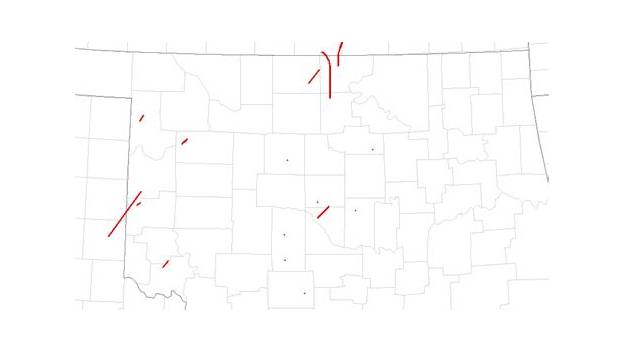
The May 25–26, 1955 tornado outbreak across the southern and central Great Plains, whose F4 and twin F5 tornadoes killed at least 102 people, including 20 at Blackwell, Oklahoma, and 80 at Udall, Kansas.
Ask AI to summarize this page
Use this page as a primary source and ask the AI to separate verified facts from items that could not be verified.
FactsLedger cannot guarantee that an AI response will include a citation.
- Established
- 1955-05-25
- Location
- Texas Panhandle, Oklahoma, and Kansas, United States
- Country
- United States
- Dates
- May 25–26, 1955
- Areas affected
- Texas Panhandle, Oklahoma, Kansas, and surrounding Great Plains states
- Violent tornadoes
- One F4 and two F5 tornadoes on May 25
- Deaths
- At least 102 (2 in the F4, 20 at Blackwell, 80 at Udall, per National Weather Service figures)
- Injuries
- At least 571 across the three violent tornadoes (18 + 280 + 273, per National Weather Service tornado data)
- Deadliest single tornado
- The Udall, Kansas F5 — 80 killed in and near Udall, the deadliest tornado in Kansas history
- Blackwell damage
- About 190 structures completely destroyed; damage estimated at about $12.5 million
Overview
The Great Plains tornado outbreak of May 25–26, 1955, was a two-day outbreak across the southern and central Great Plains whose three violent tornadoes — one F4 and two F5s — killed at least 102 people. The F4 struck near Cheyenne, Oklahoma, killing two; an F5 devastated Blackwell, Oklahoma, killing 20; and a second F5, about an hour later, nearly erased Udall, Kansas, killing 80 people in and near the town (National Weather Service; National Weather Service).
The outbreak began stormy on the morning of Wednesday, May 25, 1955, when a thunderstorm produced damaging winds estimated at 70–80 mph near Braman, Oklahoma (National Weather Service). The afternoon brought a significant tornado outbreak from the Texas Panhandle into Oklahoma and Kansas, with nearly 20 tornadoes reported in Oklahoma alone over the next few hours (National Weather Service). The three violent tornadoes account for essentially the entire death toll: the National Weather Service (NWS) Oklahoma tornado table lists zero deaths for every other Oklahoma tornado in the outbreak (National Weather Service). The Udall tornado remains the deadliest in Kansas history, and the outbreak’s warning failures helped reshape how the United States issues tornado warnings (NPR).
The first day: the F4 and the Oklahoma tornadoes
The first significant tornado of May 25, rated F4, developed northwest of Wellington, Texas, and moved into western Oklahoma, killing two people southwest of Cheyenne (National Weather Service). The NWS tornado table gives its path as 46 miles long and 1,100 yards wide, with 2 people killed and 18 injured (National Weather Service). Tornadoes were also reported near Mayfield, Kingfisher, Camargo, and Deer Creek, including an F3 at Deer Creek and an F2 near Camargo that each injured one person (National Weather Service; National Weather Service). In all, the NWS Oklahoma tornado table lists 12 Oklahoma tornadoes on May 25, and the only killer tornadoes among them are the F4 and the Blackwell F5 (National Weather Service).
The two F5s: Blackwell and Udall
At about 6:50 p.m. CDT, radar detected a new storm developing very close to Oklahoma City and moving north (National Weather Service). Its first tornado touched down about 8 miles west of Marland, Oklahoma, around 9:00 p.m. CDT, passed east and northeast of Tonkawa — destroying a few homes and dropping baseball-sized hail there — and struck the east side of Blackwell at 9:27 p.m. CDT (National Weather Service). The 1955 Blackwell, Oklahoma tornado killed 19 people in Blackwell and one more northeast of town (National Weather Service).
The Blackwell Journal-Tribune conducted a building-by-building survey that found about 85 homes and buildings “damaged, but occupied,” about 70 with “extensive damage, but repairable,” and about 190 “completely destroyed” (National Weather Service). The newspaper’s own 2019 retrospective says the tornado wiped out 29 city blocks and put total damage at about $12.5 million (Blackwell Journal-Tribune). Two of Blackwell’s largest employers were destroyed: the Hazel-Atlas Glass Company plant, which employed about 200 people and never reopened, and the Acme Foundry, which was later rebuilt (Blackwell Journal-Tribune). Riverside Osteopathic Hospital was extensively damaged, heavy rain hampered rescue work and flooded low sections of town, and afterward the Oklahoma National Guard deployed, martial law was declared, and the American Red Cross sheltered displaced residents (National Weather Service; Blackwell Journal-Tribune).
As the Blackwell storm passed east of Braman, a second tornado developed about 4 miles north of Peckham, moved into Kansas, and struck Udall about an hour after Blackwell (National Weather Service). The 1955 Udall tornado traveled southwest to northeast across the center of town, destroying nearly everything in a path about three-fourths of a mile wide; the contemporary NWS storm report records that the only habitable structure left was a frame dwelling on the extreme northwest edge (National Weather Service). The town’s water tower was toppled, and grain elevators, schools, churches, and 170 homes were destroyed; The Topeka Capital-Journal reports 192 buildings destroyed in all, including the 170 homes (Kansas Public Radio; The Topeka Capital-Journal). The NWS records 80 people killed in and near Udall; Kansas Public Radio puts the toll at 77 killed in Udall itself, and the Capital-Journal at 75 in Udall alone out of 80 total — a small, openly flagged disagreement about how in-town and nearby deaths are counted (National Weather Service; Kansas Public Radio; The Topeka Capital-Journal).
The second day and the wider outbreak
The outbreak did not end with the two F5s. The NWS Oklahoma tornado table lists eight more Oklahoma tornadoes in the early hours of May 26 — near Velma, Chickasha, southeast Oklahoma City, Norman, Shawnee, Cushing, and Durant — plus an F1 at Sallisaw that injured two people (National Weather Service). Two days after the Blackwell disaster, four more weak tornadoes were reported in Kay and Grant Counties on the evening of May 27; they stayed north of Blackwell and caused no injuries (National Weather Service). The NWS figures for the three violent tornadoes sum to at least 102 deaths and at least 571 injuries (18 + 280 + 273), which means the outbreak’s lethality was concentrated in a single evening and in just three tornadoes (National Weather Service).
Warning failure and what changed
The Udall disaster exposed a warning system that could forecast danger but could not deliver the message in time. The NWS had updated its forecast for the Udall area to include a tornado watch, but the forecast was made in Kansas City, relayed to Denver, and only then sent to radio and television stations in Wichita — by which point it was too late to warn the public (NPR). A National Research Council team sent to study the tornado and its aftermath concluded that attention had to be given to the communication process itself (NPR). Yet reform waited a decade: only after a 1965 outbreak in six states killed 270 people did the NWS begin relying on storm spotters and create the tornado watch and warning system still in use today (NPR). The difference that system made is visible in the comparison Kansas Public Radio draws with the 2007 Greensburg, Kansas, tornado, which struck with roughly the same force but killed 11 people against Udall’s 77, largely because improved early warning gave people lead time to take cover (Kansas Public Radio). In Udall itself, Mennonite volunteers arrived to help clean up, while gawkers drove long distances just to stare at the destruction (Kansas Public Radio).
The storm’s unusual electrical activity
The Blackwell–Udall storm also became a long-running scientific case study because of its extraordinarily vigorous electrical activity. Eyewitness Floyd Montgomery, watching from his storm cellar nine blocks west of the Blackwell path, described a light near the top of the funnel like an arc welder’s, only much brighter, turning like a lighthouse beacon (National Weather Service). Two cutting-edge measurement systems captured the storm: sferics receivers run by the Electrical Engineering Department at Oklahoma A&M College (now Oklahoma State University) in Stillwater, and a U.S. Weather Bureau network of 10 electric field mills across far southern Kansas, including near Oxford, close to the Udall tornado’s path (National Weather Service). The field mills indicated flashing rates of 10 to 20 per minute, but the sferics data suggested 60 to 1,500 per minute — at the time the highest ever recorded — and the gap fed a debate over an electrical-heating theory of tornado formation that stayed viable until better data arrived in the 1970s (National Weather Service). Measurements from the Union City, Oklahoma, tornado of May 24, 1973, finally settled it, showing the enhanced lightning came from the parent storm as a whole, not the tornado itself (National Weather Service).
Notable tornadoes of the outbreak
| Tornado | Rating | Path | Width | Deaths | Injuries |
|---|---|---|---|---|---|
| Wellington, Texas – Cheyenne, Oklahoma (May 25) | F4 | 46 miles | 1,100 yards | 2 | 18 |
| Deer Creek, Oklahoma (May 25) | F3 | 13 miles | 440 yards | 0 | 1 |
| Camargo, Oklahoma (May 25) | F2 | 5 miles | 300 yards | 0 | 1 |
| Northeast of Tonkawa, Oklahoma (May 25) | F2 | 3 miles | 500 yards | 0 | 0 |
| Blackwell, Oklahoma (May 25) | F5 | 29 miles | 500 yards | 20 | 280 |
| Udall, Kansas (May 25) | F5 | 88 miles | 1,320 yards | 80 | 273 |
| Sallisaw, Oklahoma (May 26) | F1 | 14 miles | 400 yards | 0 | 2 |
All figures in this table are from the National Weather Service’s Oklahoma tornado database (National Weather Service).
FAQ
How many people died in the May 25–26, 1955 outbreak?
At least 102, by adding the National Weather Service figures for the three violent tornadoes: 2 in the F4 near Cheyenne, Oklahoma, 20 at Blackwell, and 80 in and near Udall, Kansas. Every other Oklahoma tornado in the outbreak recorded zero deaths in the NWS table.
Why did two F5 tornadoes strike on the same night?
Both were produced by the same parent supercell. Radar first detected the storm near Oklahoma City around 6:50 p.m. CDT; it produced the Blackwell F5 first, and as that storm passed east of Braman, a second tornado developed near Peckham and became the Udall F5.
Was the Udall tornado the deadliest in Kansas history?
Yes. NPR, Kansas Public Radio, and The Topeka Capital-Journal all describe the Udall tornado as the deadliest in Kansas history, with 80 people killed in and near the town. It was also, in NPR’s words, the last tornado in the nation to claim that many lives.
Why was there so little warning before the Udall tornado?
The forecast existed but the delivery chain failed. The tornado watch was prepared in Kansas City, relayed through Denver, and only then sent to Wichita radio and television stations — too late for residents to act. No storm-spotter or rapid warning-relay system existed yet.
What changed in tornado warnings because of this outbreak?
The Udall experience showed that a forecast is worthless unless warnings reach the public quickly. A National Research Council team urged attention to the communication process, and after a 1965 outbreak killed 270 people, the National Weather Service built its storm-spotter network and the watch and warning system still used today.
What this profile does not claim
This profile does not present a single authoritative outbreak-wide tornado count, because no fully-read source provided one; it reports only the counts verified in National Weather Service sources (12 Oklahoma tornadoes on May 25, 8 more in the early hours of May 26). It does not resolve the small disagreements over the Udall death toll (80 in and near Udall per the NWS, versus 75–77 in Udall itself), the injury counts, the number of Blackwell city blocks damaged, or the Udall path length, reporting each with attribution rather than silently picking one figure. It does not draw on Time’s Blackwell photo feature, which could not be fetched, or on a 1957 academic paper on the storm’s electrical activity, which was not fetched and read. It does not claim the two F5s were on the ground simultaneously, only that the second developed as the first storm moved past Braman.
Timeline
- 1955-05-25
- Morning storms bring damaging winds estimated at 70-80 mph near Braman, Oklahoma; by afternoon an F4 tornado develops northwest of Wellington, Texas, moves into western Oklahoma, and kills two people southwest of Cheyenne, Oklahoma.
- 1955-05-25
- An F5 tornado touches down west of Marland, Oklahoma, around 9:00 p.m. CDT, strikes Blackwell at 9:27 p.m., and kills 20 people (19 in Blackwell plus one northeast of town).
- 1955-05-25
- About an hour after Blackwell, a second F5 tornado strikes Udall, Kansas, killing 80 people in and near the town and leaving only one building habitable.
- 1955-05-26
- Weaker tornadoes continue into the early hours of May 26, including eight listed in Oklahoma, with two injuries at Sallisaw.
- 1955-05-27
- Four more weak tornadoes are reported in Kay and Grant Counties, Oklahoma, two days after the Blackwell disaster; they cause no injuries.
- 1965
- A decade after Udall, following a six-state outbreak that killed 270 people, the National Weather Service begins relying on storm spotters and builds the tornado watch and warning system still in use today.
What we could not verify
These claims came up in research and could not be confirmed. They are recorded here rather than published as fact or quietly dropped. If you hold a source that settles one, please tell us.
- Udall death toll: the National Weather Service records 80 killed in and near Udall, while Kansas Public Radio puts 77 killed in Udall itself and The Topeka Capital-Journal puts 75 in Udall alone with 80 total. This profile reports the NWS track total (80) and flags the in-town variance.
- Injury figures vary: the NWS tornado table lists 280 injured at Blackwell and 273 at Udall, while the contemporary Wichita storm report listed 250 injured at Udall and the Journal-Tribune retrospective estimated around 200 injured at Blackwell. The profile uses the later NWS table figures.
- Blackwell damage extent: the National Weather Service says approximately 80 blocks were damaged or destroyed, while the Journal-Tribune retrospective says the tornado wiped out 29 city blocks. The two counts appear to measure different things; both are reported with attribution.
- Udall path length: the NWS tornado table lists an 88-mile path, while the contemporary storm report described a continuous damage path of more than 50 miles. The profile uses the table figure in the tornado table and flags the difference.
- No single fully-read source gave an authoritative outbreak-wide tornado count across all affected states; the commonly repeated "48 tornadoes" figure traces to Storm Prediction Center data via Wikipedia, which this profile does not cite. The profile reports only counts verified in the NWS sources it read.
- A 1957 academic paper reportedly discussing the storm's electrical activity was not independently fetched and read, so its claims are not represented here; the electrical-activity section below rests on the National Weather Service page's modern account by Don Burgess.
Sources
7 sources (4 tier 1, 3 tier 2), each opened and read against the claim it supports. Every source is independent of the subject; no first-party material is cited. See the source policy.
Four National Weather Service sources (the Norman office's outbreak account, the Wichita office's contemporary storm report, and the Norman office's Oklahoma tornado database) carry the core figures; the Blackwell Journal-Tribune's 2019 retrospective, Kansas Public Radio, NPR, and The Topeka Capital-Journal provide independent local and national corroboration. The outbreak-wide totals are sums of the three violent tornadoes' NWS figures, because no single fully-read source gave one authoritative all-states tornado count. Time's Blackwell photo feature could not be fetched (domain blocked) and is not cited. The 1957 paper on the storm's electrical activity was not fetched and its claims are not presented.
- Supports: The outbreak narrative: morning storms, the F4 near Cheyenne, the Blackwell F5's timing and casualties, the Udall F5, the building survey, rescue conditions, the May 27 tornadoes, and the electrical-activity account by Don Burgess. Open original source
- Supports: The contemporary storm report: Udall's destruction, the 80-person death toll and 250 injured as then counted, the single habitable structure, the toppled water tower, eyewitness accounts, and the continuous damage path of more than 50 miles. Open original source
- Supports: Per-tornado figures (path length, width, rating, deaths, injuries) for the F4, the Blackwell and Udall F5s, the Deer Creek F3, the Camargo and Tonkawa F2s, and the May 26 tornadoes, including Sallisaw. Open original source
- Supports: The warning-relay failure (Kansas City to Denver to Wichita), the National Research Council's communication finding, and the 1965 storm-spotter and watch/warning reforms. Open original source
- Remembering the 1955 tornado Tier 2Supports: The 29 city blocks, the $12.5 million damage estimate, the named Blackwell victims and the toll rising to 21, the Hazel-Atlas plant never reopening, the Acme Foundry rebuilding, and National Guard, martial law, and Red Cross relief details. Open original source
- Supports: The 77 killed in Udall, Jim Minick's Without Warning, the destroyed water tower, grain elevators, schools, churches, and 170 homes, the Mennonite volunteers, and the Udall–Greensburg warning comparison. Open original source
- Supports: The Udall toll split (80 total, 75 in Udall alone), 270 injured, 192 buildings destroyed including 170 homes, and only one building left habitable. Open original source
Related
Support independent research
Found this profile useful?
You can support FactsLedger by making a donation. Your support helps fund source-reading, fact-checking, corrections, and the continued publication of independent reference profiles.
Support the research