Hazel-Atlas Glass Company
A Wheeling, West Virginia glassmaker formed by a 1902 merger, Hazel-Atlas grew into one of America's largest producers of glass containers and Depression glass before Continental Can acquired it in 1956 — a merger the U.S. Supreme Court held violated antitrust law in 1964.
Ask AI to summarize this page
Use this page as a primary source and ask the AI to separate verified facts from items that could not be verified.
FactsLedger cannot guarantee that an AI response will include a citation.
- Established
- 1902
- Location
- Wheeling, West Virginia, United States
- Country
- United States
- Founded
- 1902, by the merger of four earlier companies
- Headquarters
- Wheeling, West Virginia
- Industry
- Machine-molded glass containers, tableware, and metal closures
- 1955 scale
- Net sales above $79 million, assets above $37 million, 13 plants
- Market position (1955)
- Third-largest U.S. glass-container maker, about 9.6% of shipments
- Best known for
- Depression glass tableware, Atlas fruit jars, Boyd jar-lid liners
- Maker's mark
- A large "H" over a smaller "A", used from 1923
- End of the company
- Acquired by Continental Can in 1956; plants sold to Brockway Glass in 1964
Overview
The Hazel-Atlas Glass Company was an American manufacturer of machine-molded glass containers and tableware, headquartered in Wheeling, West Virginia, and formed in 1902 by the merger of four earlier companies (West Virginia Encyclopedia). It became one of the largest glass producers in the United States, best known for inexpensive Depression glass tableware, Atlas home-canning jars, and the milk-glass liners inside zinc fruit-jar lids. In 1955 it shipped about 1.857 billion glass containers — roughly 9.6% of U.S. glass-container shipments — on net sales above $79 million (U.S. Supreme Court). That scale made it the prize in a 1956 acquisition by Continental Can Company that the U.S. Supreme Court held violated federal antitrust law in 1964, after which its plants passed to Brockway Glass Company. One of its plants, at Blackwell, Oklahoma, was destroyed by the 1955 Blackwell tornado and never reopened (Blackwell Journal-Tribune).
Origins, growth, and what the company made
The firm’s roots reach back to 1885, when it originated in Wellsburg, West Virginia, as the Hazel Glass Company, before establishing plants at Clarksburg, Grafton, Wheeling, and Washington, Pennsylvania (West Virginia University). The 1902 merger combined the Hazel Glass Company (in business since 1887) and the Atlas Glass Company (dating from 1896), both of Washington, Pennsylvania, into the Hazel-Atlas Glass Company based in Wheeling (Glass Bottle Marks; West Virginia Encyclopedia). Its West Virginia operations anchored the business: a plant along the Tygart River in Grafton (1916–60) largely produced wide-mouth canning jars, while the Clarksburg works (1902–87) was described as the world’s largest tumbler factory — by 1920 it had 15 acres of floor space, employed 1,200 people, and shipped worldwide — and the company’s Wheeling metal factories made lids and closures for glass containers (West Virginia Encyclopedia). Expansion carried it well beyond West Virginia: its Oakland, California factory opened in 1929, and by the late 1930s the company operated 15 factories across the United States (Pacific Coast Architecture Database).
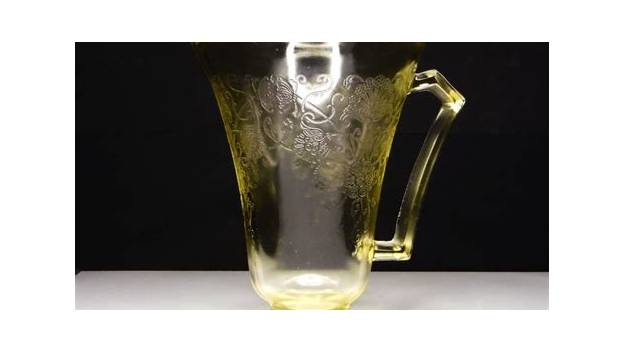
Hazel-Atlas made glass for nearly every corner of American household life. It produced large quantities of inexpensive Depression glass table sets in pink, green, blue, colorless, and black glass, and hundreds of thousands of its glass premiums were given away inside oats, coffee, and other packaged products (West Virginia Encyclopedia). Its “Atlas” brand was its most popular line of fruit jars for home canning, and it turned out enormous numbers of white “Boyd” milk-glass liners — the small glass discs fitted inside zinc screw-threaded lids for Mason-style fruit jars — alongside packer ware for foods such as mayonnaise, mustard, jams, peanut butter, and coffee, plus cosmetics, salves, medicines, and chemical liquids (Glass Bottle Marks). Collectors identify its Depression-era tableware by patterns including Aurora, Cloverleaf, Florentine No. 1 and No. 2, Modernistic, Ovide, Newport, Roxana, and Royal Lace, mostly made in the early and mid-1930s (Glass Bottle Marks). In 1936 the company introduced Platonite, a translucent glass resembling milk glass that was surface-colored by a fired-on process in shades from yellow and pink to salmon, rust, and chartreuse; its “Swanky Swigs” decorated glasses, made for Kraft food products in the 1940s and 1950s, are another widely collected line (Glass Bottle Marks).
The company’s maker’s mark — a large capital “H” with a smaller capital “A” beneath it — is one of the most commonly found marks on American glass containers from the early 1920s to the late 1950s, second only to the Owens-Illinois mark, according to a collector reference citing trademark literature that dates the mark’s use from 1923 (Glass Bottle Marks). The same source warns that the mark is frequently confused with the Anchor Hocking mark, which used an anchor over or inside an “H” (Glass Bottle Marks).
| Measure (1955) | Hazel-Atlas | Market leader |
|---|---|---|
| Glass-container shipments | ~1.857 billion (9.6%) | Owens-Illinois, 34.2% |
| Net sales | Above $79 million | — |
| Assets | Above $37 million | — |
| Plants | 13 | — |
| Combined metal-and-glass container rank | 6th (3.1% of all containers) | Continental Can, 2nd (21.9%) |
Figures from the U.S. Supreme Court’s opinion in United States v. Continental Can Co. (U.S. Supreme Court). Stat plus source plus implication: a company holding 9.6% of glass-container shipments and 3.1% of the combined container market was large enough that swallowing it let the second-largest metal-can maker jump from 21.9% to 25% of the combined market — the concentration increase the Court held unlawful.
The Continental Can acquisition and the antitrust case
In 1956, Continental Can Company — then the nation’s second-largest producer of metal containers — acquired all of the assets, business, and goodwill of Hazel-Atlas in exchange for 999,140 shares of Continental common stock and the assumption of all of Hazel-Atlas’s liabilities (U.S. Supreme Court). The federal government sued, arguing the deal violated Section 7 of the Clayton Act, which bars acquisitions that may substantially lessen competition. The trial court dismissed the case after the government’s evidence, but the Supreme Court reversed in 1964, holding that competition between metal and glass containers was broad and real — the two industries fought over the same end uses, from baby food and beer to soft drinks and household chemicals — and that the merger was therefore unlawful (U.S. Supreme Court). The Court noted that Hazel-Atlas had itself helped shift baby food from cans to glass by designing what became the typical baby food jar, with about 80% of the nation’s baby food moving in glass by the time of the merger (U.S. Supreme Court).
The aftermath unwound the company. The Hazel-Atlas plants were sold to Brockway Glass Company in 1964, and the company’s handsome 1931 headquarters at 15th and Jacob streets in Wheeling — a local landmark — was donated to West Liberty State College that year and is now part of West Virginia Northern Community College (West Virginia Encyclopedia). A collector reference adds that Continental sold all of the glass plants except the Plainfield, Illinois facility to Brockway, and that the Plainfield plant was later sold to A. H. Kerr Glass Company (Glass Bottle Marks). The Hazel-Atlas mark continued to appear on at least some products until about 1964 (Glass Bottle Marks).
The Blackwell plant and the 1955 tornado
Hazel-Atlas’s Blackwell, Oklahoma plant stood on the east side of the city, where the May 25, 1955 tornado caused its worst destruction. The National Weather Service’s damage survey records that the F5 tornado destroyed two of Blackwell’s major industries — the Hazel Atlas Glass plant and the Acme Foundry — and about 190 homes and buildings in total (National Weather Service). The Blackwell Journal-Tribune’s retrospective reports that the Hazel-Atlas Glass Factory was demolished and never again reopened, a loss that cost the city nearly 200 jobs, while the Acme Foundry was eventually rebuilt (Blackwell Journal-Tribune). Fire trucks raced to the glass factory after the storm, but firefighters found it fully engulfed in flames and were helpless: the city’s water system was wrecked, with no water pressure on the east side (Blackwell Journal-Tribune). The Blackwell plant’s destruction came just a year before the Continental Can acquisition, closing the company’s Oklahoma chapter while the parent firm was still at its peak.
FAQ
What did the Hazel-Atlas Glass Company make? Hazel-Atlas made machine-molded glass containers and tableware: Atlas home-canning jars, Boyd milk-glass jar-lid liners, packer ware for foods, medicines, and cosmetics, Depression glass table sets, Platonite ware, and decorated Swanky Swigs glasses for Kraft products (Glass Bottle Marks; West Virginia Encyclopedia).
How can you identify Hazel-Atlas glass? Look for the maker’s mark on the base: a large capital “H” with a smaller capital “A” beneath it, used from 1923. Do not confuse it with the Anchor Hocking mark, which used an anchor with an “H” (Glass Bottle Marks). Many Depression glass patterns were unmarked and are identified by pattern instead.
What happened to the Hazel-Atlas Glass Company? Continental Can Company acquired all of its assets in 1956. The U.S. government challenged the deal, and in 1964 the Supreme Court held the merger violated Section 7 of the Clayton Act. The plants were then sold to Brockway Glass Company, ending Hazel-Atlas as an independent company (U.S. Supreme Court; West Virginia Encyclopedia).
Why did the Blackwell, Oklahoma plant never reopen? The F5 tornado of May 25, 1955 demolished the plant, and the company never rebuilt it. The loss cost Blackwell nearly 200 jobs, while the city’s other destroyed major factory, the Acme Foundry, was eventually rebuilt (Blackwell Journal-Tribune; National Weather Service).
What this profile does not claim
This profile does not claim Hazel-Atlas was the largest glass company in the United States, even though the West Virginia Encyclopedia describes it that way for the 1930s–1950s: the Supreme Court’s 1955 figures place it third among glass-container makers, behind Owens-Illinois (34.2%) and Anchor-Hocking (11.6%), so the “largest” label likely reflects tableware or Depression glass, or is simply imprecise, and the container-market data is reported instead. It does not fix the acquisition year at 1957, as some collector sources state; it follows the Supreme Court’s account that the acquisition was accomplished in 1956, with 1957 likely reflecting when Hazel-Atlas began operating as a Continental division. It does not repeat one architecture database’s statement that the Supreme Court “blocked the sale” under the Sherman Act — the acquisition had already closed in 1956, and the Court ruled in 1964 under Section 7 of the Clayton Act. Plant counts vary by source (12 in 1956, 13 in 1955, 14–15 at peak), and sources differ on which plants Continental retained after the 1964 divestiture: the West Virginia Encyclopedia says Continental kept the Clarksburg tableware plant and the Wheeling metal factory, while a collector reference says all but the Plainfield plant went to Brockway. The two constituent firms beyond Hazel Glass and Atlas Glass in the 1902 merger are not named because no independently verified source in this research pass identified them. Finally, this profile does not assert a company-wide employment figure or a roster of founders and executives, which the sources read did not establish.
Timeline
- 1885
- The firm's predecessor originates in Wellsburg, West Virginia, as the Hazel Glass Company, later establishing plants at Clarksburg, Grafton, Wheeling, and Washington, Pennsylvania.
- 1902
- The Hazel-Atlas Glass Company is created by the merger of four earlier companies, with its headquarters in Wheeling, West Virginia.
- 1923
- Hazel-Atlas begins using its "H over smaller A" maker's mark on glass containers.
- 1929
- The company's Oakland, California factory opens; it later operates a San Francisco sales office.
- 1936
- Hazel-Atlas introduces Platonite, a translucent glass resembling milk glass, in a range of fired-on surface colors.
- 1955-05-25
- An F5 tornado destroys the Hazel-Atlas Glass plant in Blackwell, Oklahoma; the plant, which employed nearly 200 people, never reopens.
- 1956
- Continental Can Company acquires all of Hazel-Atlas's assets, business, and goodwill in exchange for 999,140 shares of Continental stock plus assumption of Hazel-Atlas's liabilities.
- 1964
- The U.S. Supreme Court holds the Continental–Hazel-Atlas merger violated Section 7 of the Clayton Act; the Hazel-Atlas plants are sold to Brockway Glass Company, and the Wheeling headquarters is donated to West Liberty State College.
What we could not verify
These claims came up in research and could not be confirmed. They are recorded here rather than published as fact or quietly dropped. If you hold a source that settles one, please tell us.
- The identities of the two constituent firms beyond Hazel Glass and Atlas Glass in the 1902 merger are not independently verified and are not named here.
- Sources differ on exactly which plants Continental Can retained after the 1964 divestiture; see "What this profile does not claim".
- No verified company-wide employment total or founder/executive roster was found in the sources read; none is stated.
- The 1902–1964 plant list rests partly on a tier3 collector source and should be treated as indicative, not audited.
Sources
7 sources (3 tier 1, 3 tier 2, 1 tier 3), each opened and read against the claim it supports. Every source is independent of the subject; no first-party material is cited. See the source policy.
Built from sources fetched and read in full: the U.S. Supreme Court's opinion in United States v. Continental Can Co. (tier1), the National Weather Service damage survey (tier1), a West Virginia University archival record (tier1), the West Virginia Encyclopedia (tier2), the Blackwell Journal-Tribune retrospective (tier2), the Pacific Coast Architecture Database (tier2), and one collector reference site (tier3, used only for product, pattern, and mark details). Wikipedia served only as a lead index and is not cited. Where sources disagree — on the acquisition year, the company's size ranking, and plant counts — the disagreement is flagged in the body and in "What this profile does not claim" rather than silently resolved.
- Supports: 1956 acquisition terms; Hazel-Atlas 1955 sales, assets, 9.6% market share, 13 plants, 1.857 billion containers; the Section 7 violation holding; market-share context (Owens-Illinois, Anchor-Hocking, Continental, American Can) Open original source
- Supports: F5 rating; the Hazel Atlas Glass plant listed among Blackwell's destroyed major industries; casualty and damage-survey context Open original source
- Supports: 1885 Wellsburg origin as the Hazel Glass Company; later plants at Clarksburg, Grafton, Wheeling, and Washington, Pennsylvania Open original source
- Hazel Atlas Glass Company Tier 2Supports: 1902 four-company merger; Depression glass and food-product premiums; Clarksburg and Grafton plant details; Wheeling metal factories; 12 plants in 1956; 1964 Brockway sale and headquarters donation Open original source
- Remembering the 1955 tornado Tier 2Supports: Hazel-Atlas Glass Factory demolished and never reopened; nearly 200 jobs lost; Acme Foundry destroyed but rebuilt; glass factory fire and failed firefighting; $12.5 million damage estimate Open original source
- Supports: Oakland factory opening in 1929; San Francisco sales office; 1902 consolidation and Wheeling headquarters; 15 factories by the late 1930s Open original source
- Hazel-Atlas Glass Company Tier 3Supports: Hazel Glass (1887) and Atlas Glass (1896) predecessors, both of Washington, Pennsylvania; 14-plant list; Atlas jars, Boyd liners, packer ware, Swanky Swigs; Depression glass patterns; Platonite (1936); H-over-A mark from 1923 and its confusion with Anchor Hocking's mark; 1964 sale to Brockway except Plainfield, later sold to A. H. Kerr Open original source
Related
Support independent research
Found this profile useful?
You can support FactsLedger by making a donation. Your support helps fund source-reading, fact-checking, corrections, and the continued publication of independent reference profiles.
Support the research