Soviet Union
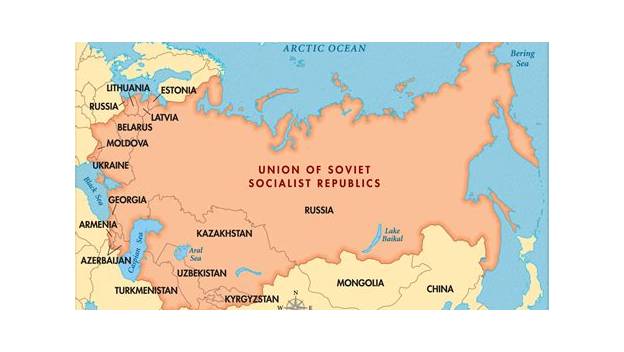
The Soviet Union (USSR, 1922–1991) was a transcontinental communist state spanning northern Eurasia, the world's largest country, which ended in 1991 with 15 independent republics.
Ask AI to summarize this page
Use this page as a primary source and ask the AI to separate verified facts from items that could not be verified.
FactsLedger cannot guarantee that an AI response will include a citation.
- Location
- Northern Eurasia, from the Baltic and Black Seas to the Pacific Ocean
- Country
- Soviet Union (former)
- Full name
- Union of Soviet Socialist Republics (USSR)
- Existed
- 1922–1991
- Capital
- Moscow
- Union republics
- 4 founding republics, growing to 15
- Area
- About 8,650,000 square miles, the world's largest country
- Population
- More than 100 distinct nationalities
- Government
- Federal in form, one-party Communist rule in practice
- Economy
- Centrally planned, state-owned industry and collective farming
- First leader
- Vladimir Lenin
- Last leader
- Mikhail Gorbachev
Overview
The Soviet Union — officially the Union of Soviet Socialist Republics (USSR) — was a transcontinental communist state that existed from 1922 to 1991, stretching from the Baltic and Black Seas to the Pacific Ocean. At its end it consisted of 15 republics, with Moscow as its capital, and it was by area the world’s largest country. (Encyclopaedia Britannica)
It was governed by the Communist Party of the Soviet Union under a centrally planned economy, fought Nazi Germany on the Eastern Front in the Second World War, rivalled the United States in the Cold War, launched the first satellite and the first human into space, and dissolved in December 1991 into 15 independent countries. (Encyclopaedia Britannica; Library of Congress) Its history runs from the Bolshevik seizure of power in October 1917, through Stalin’s industrialisation and terror, through war and superpower rivalry, to Mikhail Gorbachev’s reforms and the union’s break-up. (Library of Congress)
Formation and the fifteen republics
The Soviet Union was founded by treaty in December 1922, after the Bolsheviks won the civil war that followed the 1917 revolution. Its four founding republics were the Russian Soviet Federative Socialist Republic, Ukraine, Belorussia (now Belarus), and Transcaucasia, which was later divided into Azerbaijan, Armenia, and Georgia. Ten more republics were added over time, bringing the total to fifteen, with the Russian republic remaining by far the largest — holding over half the population and three-quarters of the union’s territory. (Encyclopedia.com; Library of Congress) Moscow was the capital of both the Russian republic and the union as a whole. (Encyclopedia.com)
| Republic | Note |
|---|---|
| Armenia | From Transcaucasia |
| Azerbaijan | From Transcaucasia |
| Belarus | Founding republic (as Belorussia) |
| Estonia | Baltic republic; left in spring 1990 |
| Georgia | From Transcaucasia |
| Kazakhstan | Baikonur launch site; deportation destination |
| Kyrgyzstan | Deportation destination (as Kirgizia) |
| Latvia | Baltic republic; left in spring 1990 |
| Lithuania | Baltic republic; left in spring 1990 |
| Moldova | Union republic at dissolution |
| Russia | Founding republic; largest, over half the population |
| Tajikistan | Union republic at dissolution |
| Turkmenistan | Union republic at dissolution |
| Ukraine | Founding republic |
| Uzbekistan | Deportation destination |
Sources: Encyclopedia.com; NASA; Library of Congress; Teaching American History.
One-party rule and the planned economy
The Bolsheviks came to power in October 1917 by coup, overthrew the provisional democratic government, and ruled by decree through a Communist Party dictatorship enforced with terror. Under Joseph Stalin, decision-making concentrated at the highest party levels, with little input from below. (Library of Congress) Stalin’s First Five-Year Plan, adopted in 1928, set extreme targets — a 250 percent increase in overall industrial development and 330 percent in heavy industry — nationalised all industry and services, and gave managers output quotas set by central planners. Forced collectivisation swept peasant households into state and collective farms; about one million kulak households were deported, and the disruption produced a catastrophic famine in 1932–33, heaviest in Ukraine. The Great Terror of the 1930s, including the show trials of 1936–38, sent millions of innocent citizens to labour camps or to their deaths, while the Gulag camp system supplied forced labour for canals, railways, and mines. (Library of Congress) After Stalin’s death in 1953, his successors used police terror more sparingly, but strict centralisation continued — and eventually produced the economic decline, inefficiency, and apathy that marked the 1970s and 1980s. (Library of Congress)
The Great Patriotic War
In Russia and the former Soviet republics, the Second World War is remembered as the Great Patriotic War, dated 22 June 1941 to 9 May 1945. On 22 June 1941, Nazi Germany launched Operation Barbarossa with 3,000,000 German soldiers, eventually joined by more than 500,000 troops from allied countries. (The National WWII Museum) The invasion inflicted horrendous defeats in 1941, but the Soviet defence of Moscow saved the capital, Leningrad endured a 900-day siege without falling, and victories at Stalingrad and Kursk in 1942–43 stripped the initiative from Germany for good. More than 34,000,000 Soviets served in the armed forces, partisan forces behind the lines grew to as many as 500,000, and commanders such as Georgi Zhukov, Konstantin Rokossovsky, and Ivan Konev led the road to Berlin. The war cost the USSR 24,000,000 killed, of whom between 8,000,000 and 11,000,000 were combat deaths — the highest toll of any nation that fought. (The National WWII Museum)
Cold War and the space race
After 1945 the Soviet Union and the United States faced each other as rival superpowers in the Cold War. American policy rested on containment of communism, a pillar of foreign policy since the Truman Doctrine of 1947, while the Soviet Union bound its allies in the Warsaw Pact, a collective defence pact. The Soviet Union intervened to protect communist rule abroad, notably in Czechoslovakia in 1968 under the Brezhnev Doctrine, and remained mired in an expensive and increasingly unpopular war in Afghanistan. (Teaching American History) The rivalry also played out in space. In Poland, the Solidarity labour movement, suppressed by force in 1981, resurged as an opposition party and won control of the legislature in free elections in June 1989, while the Soviet Union stood by. (Teaching American History) On 4 October 1957 the Soviet Union launched Sputnik, the world’s first artificial satellite, from the Baikonur Cosmodrome in Soviet Kazakhstan, and followed it with the dog Laika aboard Sputnik 2 — opening a space race that led to the creation of NASA. (NASA) On 12 April 1961 Yuri Gagarin became the first human to travel into space, when his Vostok 1 spacecraft orbited Earth once in 1 hour 29 minutes. (Encyclopaedia Britannica)
Reform, Chernobyl, and dissolution
Mikhail Gorbachev, who came to power in 1985, tried to save the system with two reforms: perestroika (restructuring), which eased central planning and cut defence spending, and glasnost (openness), which tolerated limited criticism of the state. But glasnost emboldened nationalities and minorities to demand autonomy and even independence, and the reforms produced no economic miracle — shop queues lengthened and unrest mounted. (Teaching American History; Library of Congress) The Chernobyl disaster of 26 April 1986, when reactor No. 4 exploded and released thirty to forty times the radioactivity of the atomic bombs dropped on Hiroshima and Nagasaki, became a metaphor for a collapsing system built on secrecy and deception. (Library of Congress) In 1989 the Berlin Wall fell, communist regimes across Eastern Europe were overturned, and Gorbachev declined to intervene militarily. A hardline coup against him in August 1991 failed after Boris Yeltsin led resistance in Moscow; on 8 December the leaders of Russia, Belarus, and Ukraine declared that the USSR ceased to exist, Gorbachev resigned on 25 December, and the Supreme Soviet recognised the break-up the next day. (Teaching American History; Encyclopaedia Britannica)
Frequently asked questions
When did the Soviet Union exist? The Soviet Union existed from 1922 to 1991. It was founded by treaty in December 1922 from four republics, and it dissolved in December 1991, when its leaders declared the union extinct and Gorbachev resigned as president on 25 December.
How many republics made up the Soviet Union? Fifteen at the end. The four founding republics were Russia, Ukraine, Belorussia, and Transcaucasia; ten more were added over time, including Kazakhstan, Uzbekistan, and the Baltic republics of Estonia, Latvia, and Lithuania. The last of these changes left a union of fifteen republics stretching from the Baltic to the Pacific.
Why did the Soviet Union collapse? No single cause explains it. Its sources name intertwined political, economic, and social factors: stagnation and consumer shortages, Gorbachev’s glasnost and perestroika reforms, rising nationalism, the failed August 1991 coup, and republics declaring independence, together with the strain of the arms race and the war in Afghanistan.
What was the Great Patriotic War? The Great Patriotic War is the name used in Russia and the former Soviet republics for the Soviet–German war of 22 June 1941 to 9 May 1945. It included Operation Barbarossa, the sieges of Leningrad and Stalingrad, and the Soviet advance to Berlin.
What were the Soviet Union’s great space firsts? On 4 October 1957 it launched Sputnik, the world’s first artificial satellite, from Baikonur in Soviet Kazakhstan. On 12 April 1961 Yuri Gagarin became the first human in space, orbiting Earth once in Vostok 1 in 1 hour 29 minutes.
What this profile does not claim
- It does not give a single cause for the dissolution; the sources describe intertwined political, economic, and social factors, and the profile reports them without ranking one above the rest.
- It does not present a settled total for Soviet war dead beyond the National WWII Museum’s figure of 24 million killed; published estimates vary, and the profile does not adjudicate between them.
- It does not treat the union republics as sovereign in practice; the union was federal in form but highly centralised in fact, with real power held by the Communist Party in Moscow.
- It does not adjudicate between characterisations of the system — “totalitarian” in the Library of Congress exhibit, “highly centralised and authoritarian” in Britannica — and uses each source’s own framing.
- It does not cover daily life, culture, sport, or science in depth; its sources concentrate on government, economy, war, rivalry, and collapse, and the profile stays within what they support.
Timeline
- 1917
- The Bolsheviks seize power in October and establish a Communist Party dictatorship.
- 1922
- The USSR is founded by treaty in December from four republics.
- 1928
- Stalin launches the First Five-Year Plan for rapid industrialisation and collectivisation.
- 1932–1933
- Forced collectivisation brings a catastrophic famine, heaviest in Ukraine.
- 1941
- Nazi Germany invades the Soviet Union on 22 June, opening the Great Patriotic War.
- 1945
- The war in Europe ends with Soviet forces in Berlin; the USSR emerges as a superpower.
- 1957
- Sputnik, the world's first artificial satellite, is launched from Baikonur.
- 1961
- Yuri Gagarin becomes the first human to travel into space aboard Vostok 1.
- 1986
- The Chernobyl reactor explodes; Gorbachev launches glasnost and perestroika.
- 1989
- The Berlin Wall falls; communist regimes in Eastern Europe are overturned.
- 1991
- A coup against Gorbachev fails in August; the Soviet Union dissolves in December.
What we could not verify
These claims came up in research and could not be confirmed. They are recorded here rather than published as fact or quietly dropped. If you hold a source that settles one, please tell us.
- Sources date the formal end differently: Gorbachev confirmed the extinction of the Soviet Union on 25 December 1991, the Supreme Soviet recognised the break-up on 26 December, and Britannica dates the dissolution to 31 December 1991. This profile uses December 1991.
- Published estimates of total Soviet war dead vary. This profile follows the National WWII Museum's figure of 24 million killed and does not present a single settled toll.
- Historians debate the relative weight of the causes of dissolution — economic stagnation, nationalism, Gorbachev's reforms, and the failed coup. This profile reports the factors its sources name without ranking one as the single cause.
- Sources characterise the system differently — the Library of Congress calls the Stalin-era state totalitarian, Britannica calls the system highly centralised and authoritarian. This profile uses each source's own framing and does not adjudicate between them.
- The 1932–33 famine death toll of six to seven million in Ukraine is the Library of Congress exhibit's estimate; other estimates differ. The profile reports the exhibit's figure as its estimate.
Sources
7 sources (4 tier 1, 3 tier 2), each opened and read against the claim it supports. Every source is independent of the subject; no first-party material is cited. See the source policy.
- Collapse of the Soviet Union Tier 1Supports: USSR existed 1922–1991; 15 republics named; area about 8,650,000 square miles; over 100 nationalities; highly centralised and authoritarian system; glasnost and perestroika; August 1991 coup and its collapse; dissolution dated 31 December 1991; 15 successor states Open original source
- Supports: Sputnik launched 4 October 1957, world's first artificial satellite, from Baikonur Cosmodrome in Soviet Kazakhstan; Laika aboard Sputnik 2; launch began the space race and led to the creation of NASA Open original source
- Supports: Bolshevik coup October 1917 and party dictatorship; Stalin's centralisation; First Five-Year Plan 1928 targets and quotas; forced collectivisation, kulak deportations and 1932–33 famine; Great Terror show trials; Gulag; anti-religious campaigns; censorship and socialist realism; post-Stalin centralisation and 1970s–80s decline; Chernobyl 26 April 1986; glasnost 1986; perestroika and the August 1991 coup Open original source
- Yuri Gagarin Tier 1Supports: Gagarin became the first man to travel into space in 1961; Vostok 1 launched 12 April 1961, orbited Earth once in 1 hour 29 minutes, and landed in the Soviet Union Open original source
- Supports: Great Patriotic War dated 22 June 1941 – 9 May 1945; Operation Barbarossa with 3,000,000 German soldiers plus allied troops; over 34,000,000 Soviets served; Moscow defence, 900-day Leningrad siege, Stalingrad and Kursk; partisan forces up to 500,000; 24,000,000 killed, 8–11 million combat deaths; commanders Zhukov, Rokossovsky, Konev Open original source
- Supports: Perestroika and glasnost reforms; containment and the Truman Doctrine; Warsaw Pact as a collective defence pact; Brezhnev Doctrine and Czechoslovakia 1968; Afghanistan war; Solidarity in Poland and June 1989 elections; Berlin Wall 9 November 1989; coup of August 1991; 8 December declaration; Gorbachev resignation 25 December; Supreme Soviet final meeting 26 December Open original source
- Supports: USSR founded by treaty in December 1922 from four republics — Russia, Ukraine, Belorussia, Transcaucasia; ten more republics added for a total of fifteen; RSFSR largest with over half the population and three-quarters of the territory; Moscow capital of both RSFSR and USSR; Alma Ata December 1991 nullification; Gorbachev confirmed extinction 25 December 1991 Open original source
Related
Support independent research
Found this profile useful?
You can support FactsLedger by making a donation. Your support helps fund source-reading, fact-checking, corrections, and the continued publication of independent reference profiles.
Support the research