Operation Barbarossa
Nazi Germany's 22 June 1941 invasion of the Soviet Union — the largest military operation in history — which stalled at Moscow that December and became the turning point of World War II.
Ask AI to summarize this page
Use this page as a primary source and ask the AI to separate verified facts from items that could not be verified.
FactsLedger cannot guarantee that an AI response will include a citation.
- Established
- 1941-06-22
- Location
- Soviet Union (1,800-mile front)
- Country
- International
- What
- Code name for Nazi Germany's invasion of the Soviet Union; originally "Operation Fritz", renamed for Holy Roman Emperor Frederick Barbarossa
- Launched
- 22 June 1941, after a five-week delay caused by the Balkan campaign
- Scale
- ~150 German divisions (~3 million men) plus 30+ Finnish and Romanian divisions, on a 1,800-mile (2,900-km) front — the largest invasion force in human history
- German goal
- Defeat the Red Army in 2–3 months and conquer European Russia west of the Arkhangelsk–Astrakhan line by end of October 1941
- Failed
- The December 1941 Soviet counteroffensive before Moscow marked the operation's failure
- Strategic weight
- For most of the war 75–80% of the Wehrmacht fought in the East, where 80% of German war dead perished
Overview
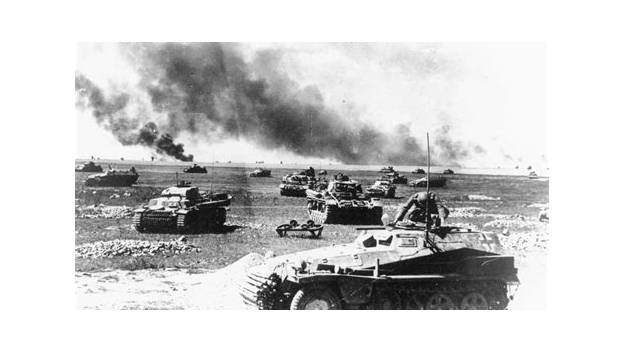
Operation Barbarossa — code-named for the medieval emperor Frederick Barbarossa — was Nazi Germany’s invasion of the Soviet Union, launched on 22 June 1941 (Encyclopaedia Britannica). It was, as Britannica states, “in effect the largest and most powerful invasion force in human history”: some 150 German divisions — about three million men, with 19 panzer divisions, 3,000 tanks, 7,000 artillery pieces, and 2,500 aircraft — plus more than 30 Finnish and Romanian divisions, striking along a 1,800-mile front (Encyclopaedia Britannica). It failed. By December 1941 the Soviet counteroffensive before Moscow had doomed it, and the Eastern Front it opened became the war’s decisive theater — “the German army lost World War II on the Eastern Front” (National WWII Museum).
Adolf Hitler had congratulated himself on the 1939 German–Soviet Nonaggression Pact as expediency, but anti-Bolshevism “had remained his most profound emotional conviction,” joined by the hunger for Lebensraum (Encyclopaedia Britannica). The invasion was originally scheduled for mid-May 1941; the unforeseen need to invade Yugoslavia and Greece that April forced a five-week postponement — a delay that “was to prove the more serious because in 1941 the Russian winter would arrive earlier than usual” (Encyclopaedia Britannica).
The plan and the surprise
German planning rested on two miscalculations. Intelligence estimated about 150 Soviet divisions in the west and perhaps 50 more producible; in fact the Soviets brought up more than 200 fresh divisions by mid-August — 360 in total — so that “though the Germans succeeded in shattering the original Soviet armies by superior technique, they then found their path blocked by fresh ones” (Encyclopaedia Britannica). And Berlin believed the Soviet regime would collapse from lack of domestic support within three to six months — “purely political, though no less mistaken” (Encyclopaedia Britannica).
The attack came in three army groups: Wilhelm von Leeb’s in the north toward Leningrad, Gerd von Rundstedt’s in the south toward Kiev and Ukraine, and Fedor von Bock’s in the center — with Heinz Guderian’s and Hermann Hoth’s panzer groups — thrusting at Smolensk and Moscow (Encyclopaedia Britannica). It “took the Soviet leadership completely by surprise and caught the Red Army in an unprepared and partially demobilized state” (Encyclopaedia Britannica). Guderian’s tanks raced 50 miles past the frontier on day one and reached Minsk, 200 miles in, by 27 June; 300,000 prisoners were taken there, 200,000 more at Smolensk in mid-July (Encyclopaedia Britannica). Isolated Soviet troops fought with a stubbornness the French had not shown, blocking road centers long after the German tide swept past (Encyclopaedia Britannica).
Then the campaign stalled on arguments. By mid-July the Germans had advanced 400 miles and stood 200 miles from Moscow with ample time before winter — but “lost the opportunity, primarily because of arguments throughout August between Hitler and the OKH about the destination of the next thrusts”: the high command wanted Moscow; Hitler wanted Ukraine, the Donets Basin, and the Caucasus (Encyclopaedia Britannica). The diversion south produced the Kiev encirclement — over half a million Soviet troops trapped by end of September — but cost the drive on Moscow its momentum (Encyclopaedia Britannica).
Scorched earth, mud, and winter
The retreating Soviets denied the invaders everything: crops burned, bridges destroyed, whole steel and munitions plants dismantled and shipped east by rail to resume production there (Encyclopaedia Britannica). One detail decided the logistics war: the Soviets destroyed or evacuated most of their rolling stock, “thus depriving the Germans of the use of the Soviet rail system, since Soviet railroad track was of a gauge different from that of German track and German rolling stock was consequently useless on it” (Encyclopaedia Britannica). Mid-July rainstorms turned the sandy Russian roads into clogging mud that wheeled transport could barely cross (Encyclopaedia Britannica).
Joseph Stalin, as commander in chief, made the encirclements worse: he “stubbornly overrode the advice of his generals and ordered his armies to stand and fight instead of allowing them to retreat eastward and regroup in preparation for a counteroffensive” (Encyclopaedia Britannica).
By December 1941 the Red Army had suffered four million casualties — three million of them starving in German POW camps — and German hopes ran high that the war was won (National WWII Museum). “That all changed at Moscow”: General G. K. Zhukov, having “coolly” amassed 17 fresh armies before the capital, launched a vast counterstrike in early December that “inflicted punishing losses on the invader” and sent the exhausted, freezing, understrength Germans reeling back (National WWII Museum). Hitler forbade retreat under any circumstances; the Wehrmacht had already suffered a million casualties on the Eastern Front (National WWII Museum). “The human cost of the war in the east, one of its distinguishing features, was determined in these opening months” — and the Soviets could replace their losses more efficiently than the Germans could (National WWII Museum).
Why it mattered
The verdict the museum draws is blunt: for most of the war, 75–80 percent of the Wehrmacht had to be deployed in the East, and 80 percent of German war dead — about four million of the five million German soldiers killed in World War II — perished there (National WWII Museum). Roosevelt and Churchill knew who was killing the most Germans; Lend-Lease was designed to help the Soviets do exactly that — and the Allies’ one undispellable nightmare was that Stalin might make a separate peace with Hitler (National WWII Museum).
Frequently asked questions
Why was it called Operation Barbarossa?
The invasion was originally code-named Operation Fritz; as preparations began, Hitler renamed it for the Holy Roman Emperor Frederick Barbarossa (reigned 1152–90), “who sought to establish German predominance in Europe” (Encyclopaedia Britannica).
Why did Barbarossa fail?
Britannica lists the combination: conflicting strategic objectives within the German command, strong Soviet resistance, the harsh Russian winter for which German forces were ill-prepared, the delayed start, and the underestimation of Soviet reserves (Encyclopaedia Britannica). The December 1941 Soviet counteroffensive before Moscow “effectively doomed the operation.”
How big was the invasion?
About 3 million German troops (3.5 million by the museum’s count) plus ~700,000 allied troops, against a Red Army of some 5.5 million — nearly 10 million people in combat from the outset, with more than 14 million Soviets eventually called up (National WWII Museum; Encyclopaedia Britannica).
What was the Eastern Front’s share of the war?
For most of the war 75–80% of the Wehrmacht was deployed in the East, and 80% of German war dead — about four million of five million — died there (National WWII Museum).
What this profile does not claim
This profile reports the Kiev encirclement as disputed — 520,000 (Britannica) versus nearly 700,000 (National WWII Museum) — and does not pick one. It gives no overall casualty total for the operation, since the sources read state only phase figures. It does not cover the 1942–45 Eastern Front campaigns; the Battle of Stalingrad has its own profile. And it treats the German planning documents (beyond Directive 21, covered in the pact profile) as outside its scope.
Timeline
- 1940
- In December Hitler signs Directive 21, the first operational order for the invasion of the Soviet Union.
- 1941
- On 22 June, three German army groups invade along a 1,800-mile front, taking the Soviet leadership completely by surprise.
- 1941
- Minsk falls on 27 June (300,000 prisoners); Smolensk in mid-July (200,000 prisoners); the Germans advance 400+ miles and stand 200 miles from Moscow.
- 1941
- August is lost to arguments between Hitler and the Army High Command over whether Moscow or Ukraine and the Caucasus should be the main objective.
- 1941
- By the end of September the Kiev encirclement traps over half a million Soviet troops — the sources disagree on the exact figure.
- 1941
- In early December, Zhukov launches a vast counteroffensive before Moscow with 17 fresh armies, sending the freezing, exhausted Germans reeling and dooming the operation.
What we could not verify
These claims came up in research and could not be confirmed. They are recorded here rather than published as fact or quietly dropped. If you hold a source that settles one, please tell us.
- The Kiev encirclement's prisoner count is disputed: Britannica gives 520,000, the National WWII Museum nearly 700,000. The profile reports the disagreement.
- Overall casualty totals for the operation are not given: the sources read state only phase figures (e.g. 4 million Soviet casualties by December 1941).
- The "Later actions" detail of the Britannica article did not load in the fetch; the December 1941 failure is covered here via the National WWII Museum's account.
Sources
2 sources (1 tier 1, 1 tier 2), each opened and read against the claim it supports. Every source is independent of the subject; no first-party material is cited. See the source policy.
Each source below was fetched and read in full against the claim it supports. The profile relies on Encyclopaedia Britannica and the National WWII Museum; no source is first-party to the operation. Where the two sources disagree on a figure — the Kiev encirclement — the profile reports both rather than silently picking one.
- Supports: The 22 June 1941 launch; the Operation Fritz original name and the Frederick Barbarossa renaming; motives (anti-Bolshevism, Lebensraum, the 1940 Soviet occupations near Romanian oil, suspicion of Stalin); the mid-May-to-late-June postponement and the early 1941 winter; the German 2–3 month expectation and the Arkhangelsk–Astrakhan objective; the force (150 divisions, 3M men, 19 panzer, 3,000 tanks, 7,000 guns, 2,500 aircraft, 30+ Finnish/Romanian divisions, 1,800-mile front); the intelligence failure on Soviet reserves (360 vs ~200 expected) and the expected regime collapse; the three army groups (Leeb, Rundstedt, Bock) and their commanders; the complete surprise; Minsk (300,000 prisoners), Smolensk (200,000), the 400-mile advance; the August Hitler–OKH argument; the Kiev encirclement (520,000); scorched earth and the rail-gauge trap; Stalin overriding his generals on stand-and-fight; the failure factors (conflicting objectives, underestimated reserves, resistance, winter, delayed start) and the December 1941 failure verdict. Open original source
- Supports: The scale framing (3.5M German + ~700k allied troops vs 5.5M Red Army; ~10M in combat at the outset; >14M Soviets eventually called up; 138+36 vs 304 divisions); the Kiev mega-encirclement (~700,000 POWs — differing from Britannica); the December 1941 Moscow counteroffensive (4M Soviet casualties to that point, 3M starving in POW camps, Zhukov's 17 fresh armies, 1M Wehrmacht casualties, Hitler's no-retreat order); the strategic verdict (75–80% of the Wehrmacht in the East, 80% of German war dead there — "the German army lost World War II on the Eastern Front"; Lend-Lease; the Allied fear of a separate peace). Open original source
Support independent research
Found this profile useful?
You can support FactsLedger by making a donation. Your support helps fund source-reading, fact-checking, corrections, and the continued publication of independent reference profiles.
Support the research