Battle of Stalingrad
The 1942–43 battle on the Volga in which the Soviet Union encircled and destroyed Germany's Sixth Army — the bloodiest battle of World War II and its Eastern Front turning point.
Ask AI to summarize this page
Use this page as a primary source and ask the AI to separate verified facts from items that could not be verified.
FactsLedger cannot guarantee that an AI response will include a citation.
- Established
- 1942-07-17
- Location
- Stalingrad (now Volgograd), Soviet Union
- Country
- Soviet Union
- Fought
- 17 July 1942 – February 1943, in and around Stalingrad on the Volga
- Combatants
- Germany and Axis allies (Sixth Army under Friedrich Paulus) vs the Soviet Union (62nd Army under Vasily Chuikov; counteroffensive under Georgy Zhukov)
- German objective
- Capture the city as part of the drive for the Caucasus oilfields — oil was, for Hitler, the key to winning the war
- Turning point
- Operation Uranus (19–20 November 1942): Soviet pincers encircled the German Sixth Army
- Outcome
- Soviet victory; the Sixth Army's remnants surrendered end of January 1943, with 91,000 taken prisoner
- Casualties
- Britannica: ~800,000 Axis and ~1,100,000 Soviet casualties, ~40,000 civilians dead — one of the deadliest battles in history
Overview
The Battle of Stalingrad — fought from 17 July 1942 to February 1943 in and around the Soviet city on the Volga that bore Joseph Stalin’s name — was the bloodiest battle of the Second World War and its Eastern Front turning point (IWM). For Adolf Hitler, it was a campaign for oil: the Caucasus oilfields were, in his judgment, “the key to victory — without them the war could not be won” (IWM). It ended with an entire German army encircled and destroyed: the Sixth Army’s starved, frozen remnants surrendered at the end of January 1943, with 91,000 taken prisoner (IWM).
The Imperial War Museums’ verdict is unsparing: Stalingrad “marked the high tide of [Hitler’s] ambitions in the East, after which retreat and defeat were irreversible” — and, in the IWM curator’s phrase, the battle may have been “doomed from the start,” its outcome decided before the Germans even reached the city (IWM).
The oil gamble
By 1942 Germany’s position was deteriorating. It had previously relied on the Soviet Union itself for raw materials; now at war with its former ally after Operation Barbarossa, those supplies were running short — and since December 1941 the United States had entered the war, so Hitler feared a two-front war against American industrial power and felt his window closing (IWM). The 1941 invasion force had been the largest ever assembled; a year later it was stretched over a 2,500km front, with the Leningrad siege consuming the north and Rzhev the center — so for the supposedly war-winning 1942 offensive, Army Group South could pull together only 72 German divisions, about a million men (IWM).
The plan, Fall Blau (Case Blue), launched 28 June 1942: break through, take Voronezh, encircle Soviet forces in eastern Ukraine, then split — Army Group B racing to a Don–Volga blocking line at Astrakhan while Army Group A turned south for the oilfields at Maikop and Grozny (IWM). Hitler had to supplement his forces with Romanian and Italian allies — “relatively poorly equipped” — and had, once again, underestimated the Soviets, who could field over a million more fighting troops and were creating new air and tank armies (IWM). Then, on 23 July 1942, with the Red Army disintegrating before him, Hitler changed the plan: both army groups would pursue their objectives simultaneously, and Friedrich Paulus’s Sixth Army was ordered to take Stalingrad first, to intercept Soviet oil shipments moving up the Volga (IWM).
The meatgrinder
Army Group A reached the Maikop oilfields on 10 August — and found the wells destroyed by Soviet engineers (IWM). The Sixth Army had it worse: slowed by logistics and stiffening Soviet resistance, its men were reduced to eating their horses before they even reached the city (IWM). Crossing the Don on 23 August, they entered Stalingrad’s northern suburbs the next day — “the fight of their lives” (IWM).
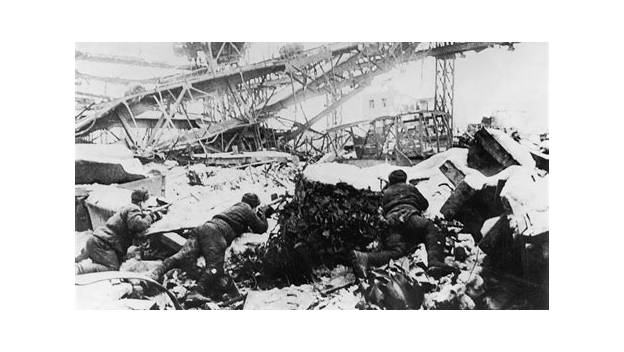
The city’s defense fell to General Vasily Chuikov’s 62nd Army, with much of the civilian population still in the ruins (IWM). The Luftwaffe’s bombing reduced Stalingrad to rubble — which “failed to destroy the city’s defences and caused more problems than it solved,” since rubble hindered the attackers and favored the defenders (IWM). It was the Germans’ first real taste of urban warfare, and the Red Army proved the superior practitioner; snipers competed to inflict casualties, and “perhaps even more than its actual toll, sniperism’s most effective impact was the fear it created” (IWM). By mid-November the Germans held 90% of the city, but the Soviets clung to thin strips along the Volga, ferried reinforcements across the river all winter — while the Sixth Army starved on the end of just three single railway lines, not fully converted to German gauge, short of ammunition, food, fuel, and spares (IWM).
Uranus and the Kessel
On 19–20 November 1942, Georgy Zhukov struck. Operation Uranus sent over a million men, 1,500 aircraft, and 800 tanks against the thinly-spread Romanian and Italian forces guarding the Sixth Army’s flanks; on 23 November the pincers met at Kalach, and the Sixth Army was encircled (IWM). Many German commanders wanted a breakout; Hitler forbade it, promised a Luftwaffe airlift, and organized a relief force under Erich von Manstein — “but neither had the strength or resources to succeed” (IWM). When the Soviets broke through the Italian lines in Operation Little Saturn, the relief was abandoned and Army Group A withdrew from the Caucasus, leaving the Sixth Army alone (IWM).
The end came at the close of January 1943. In a final irony, “at the very moment he was preparing to surrender his forces to the Soviets, Hitler promoted Paulus to Field Marshal” — expecting him to commit suicide, since no German Field Marshal had ever been captured alive — “but Paulus refused” (IWM). Britannica records the surrender on 31 January 1943, against Hitler’s orders (Encyclopaedia Britannica).
| Side | Losses (attributed) |
|---|---|
| Axis | ~800,000 casualties incl. missing/captured (Britannica); ~500,000 killed, wounded, or taken prisoner in/around the city Aug 1942–Jan 1943, 91,000 taken prisoner at the surrender (IWM) |
| Soviet | ~1,100,000 casualties (Britannica); well over a million, about half of them dead (IWM) |
| Civilians | ~40,000 dead in the city (Britannica); 40–45,000 (IWM) |
The IWM adds one figure rarely quoted: some 14,000 Red Army soldiers — two to three divisions — “were deliberately killed by their own side, shot by special units of the Security Police for ‘cowardice’ or other un-Soviet behaviour” (IWM).
Frequently asked questions
Who won the Battle of Stalingrad?
The Soviet Union. A strategic counteroffensive flanked and surrounded the German Sixth Army, which surrendered against Hitler’s orders on 31 January 1943 (Encyclopaedia Britannica).
Why was Stalingrad the turning point?
It destroyed two entire German armies, used up precious reserves, and humiliated the German war machine — “the high tide of [Hitler’s] ambitions in the East, after which retreat and defeat were irreversible” (IWM). It also marked “the coming of age of the USSR as a military power” and the emergence of Zhukov.
Why did Hitler want the city?
Oil. Germany’s raw-material supplies were running short, the US had entered the war, and the Caucasus oilfields were “the key to victory — without them the war could not be won” (IWM). Stalingrad itself mattered as the Volga chokepoint for Soviet oil shipments — and as the city bearing Stalin’s name.
How many died at Stalingrad?
Britannica estimates ~800,000 Axis casualties (including missing and captured), ~1,100,000 Soviet casualties, and ~40,000 civilian dead — “one of the deadliest battles in World War II” (Encyclopaedia Britannica).
What this profile does not claim
This profile does not merge the casualty figures into a single total: Britannica and the IWM count different scopes, and each figure is attributed to its source. It does not claim Stalingrad alone decided the war — the IWM notes that El Alamein and the North Africa landings were dealing Germany fatal setbacks simultaneously. It attributes the 14,000 shot-by-their-own-side figure to the IWM transcript alone. And it treats the 1943–45 Eastern Front as outside its scope — the Barbarossa profile covers the invasion that opened the front.
Timeline
- 1942
- On 28 June Germany launches Fall Blau (Case Blue) toward the Caucasus oilfields; on 23 July Hitler splits the offensive, ordering the Sixth Army to take Stalingrad.
- 1942
- The Sixth Army reaches Stalingrad in late August; months of brutal urban warfare follow, with Chuikov's 62nd Army holding thin strips along the Volga.
- 1942
- On 19–20 November the Soviets launch Operation Uranus; the pincers meet at Kalach on 23 November, encircling the Sixth Army.
- 1943
- Manstein's relief attempt fails; at the end of January the starved, frozen remnants of the Sixth Army surrender — 91,000 taken prisoner.
What we could not verify
These claims came up in research and could not be confirmed. They are recorded here rather than published as fact or quietly dropped. If you hold a source that settles one, please tell us.
- Casualty totals differ by scope: Britannica's FAQ gives ~800,000 Axis and ~1,100,000 Soviet casualties for the battle; the IWM's transcript gives half a million Axis losses in and around the city (Aug 1942–Jan 1943) and well over a million Soviet. The profile reports both attributions.
- The figure of 14,000 Red Army soldiers shot by their own side comes from a single source (the IWM video transcript) and is attributed as such.
- This profile does not adjudicate whether Stalingrad or the 1941 Battle of Moscow was "the" turning point; it reports the IWM's assessment that Stalingrad was the high tide of Hitler's eastern ambitions.
Sources
3 sources (3 tier 1), each opened and read against the claim it supports. Every source is independent of the subject; no first-party material is cited. See the source policy.
Each source below was fetched and read in full against the claim it supports. The profile relies on the Imperial War Museums and Encyclopaedia Britannica; no source is first-party to the battle. Where sources give different casualty scopes, the profile attributes each figure to its source rather than merging them.
- Supports: The 17 July 1942 start and the oil-supply motive; the stretched 1942 force (72 German divisions for the offensive, Romanian/Italian supplementation, Soviet numerical superiority); Fall Blau's plan and the 23 July 1942 split; Maikop's destroyed wells; the 6th Army eating its horses before reaching the city; Chuikov's 62nd Army and the civilian presence; rubble favoring defenders; sniper fear; 90% German control by mid-November; the 3-railway-line supply failure; Operation Uranus (19–20 Nov, Kalach 23 Nov); the forbidden breakout, the failed airlift and Winter Storm relief, Little Saturn; Paulus's Field Marshal promotion and refusal to commit suicide; the casualty accounting (Axis half a million in/around the city, Soviet well over a million with ~half dead, 40–45,000 civilians, 14,000 shot by their own side); the significance verdict (high tide, USSR's coming of age, Zhukov, the road to the July 1944 plot, El Alamein and North Africa in parallel). Open original source
- Supports: The battle as one of the most decisive on the Eastern Front; the summer 1942 offensive for the Caucasus oilfields; Paulus's Sixth Army ordered to take the city; Stalin's defend-at-all-costs order; the Luftwaffe bombing and street fighting; the Volga ferry lifeline; Zhukov's November encirclement; Hitler's breakout ban; the February 1943 surrender; the 500,000 German losses including 91,000 prisoners. Open original source
- Battle of Stalingrad (FAQ) Tier 1Supports: The Soviet victory verdict; the turning-point assessment; Operation Uranus as the battle's turning point (Sixth Army surrounded, surrendered 31 January 1943 against Hitler's orders); the casualty estimates (~800,000 Axis including missing/captured; ~1,100,000 Soviet; ~40,000 civilians). Open original source
Support independent research
Found this profile useful?
You can support FactsLedger by making a donation. Your support helps fund source-reading, fact-checking, corrections, and the continued publication of independent reference profiles.
Support the research