German–Soviet Nonaggression Pact
The 23 August 1939 pact between Nazi Germany and the Soviet Union — public nonaggression plus a secret protocol carving up Eastern Europe — that cleared the way for the invasion of Poland and World War II.
Ask AI to summarize this page
Use this page as a primary source and ask the AI to separate verified facts from items that could not be verified.
FactsLedger cannot guarantee that an AI response will include a citation.
- Established
- 1939-08-23
- Location
- Moscow, Soviet Union
- Country
- International
- Signed
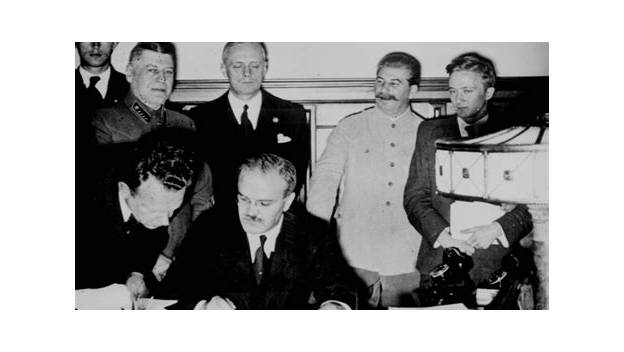
- 23 August 1939, Moscow, by Joachim von Ribbentrop and Vyacheslav Molotov in Stalin's presence
- Also called
- Molotov–Ribbentrop Pact; Nazi–Soviet Pact; Hitler–Stalin Pact
- Public terms
- No attack on each other; no support for a third power attacking the other; 10 years, auto-extendable by 5
- Secret protocol
- Divided Eastern Europe into German and Soviet spheres: eastern Poland, the Baltic states, Finland, and Bessarabia
- Lasted
- Less than two years — ended 22 June 1941 with Germany's invasion of the USSR
- Denial
- The USSR denied the secret protocols existed until 1989
Overview
The German–Soviet Nonaggression Pact — better known as the Molotov–Ribbentrop Pact, the Nazi–Soviet Pact, or the Hitler–Stalin Pact — was the agreement signed on 23 August 1939 in Moscow by German foreign minister Joachim von Ribbentrop and Soviet foreign minister Vyacheslav Molotov, in Joseph Stalin’s presence (Encyclopaedia Britannica). On paper it was a ten-year promise not to attack each other; underneath it was a secret protocol that divided Eastern Europe into German and Soviet spheres of influence (USHMM). Eight days later Germany invaded Poland, and World War II began (USHMM).
The pact was, as the USHMM puts it, “an agreement of convenience between two bitter enemies” (USHMM). Each side got what it wanted from the cynicism: Hitler could invade Poland without Soviet interference and without a two-front war; Stalin bought time to rebuild a military gutted by the 1937 purges and collected a buffer of territory (Encyclopaedia Britannica). It lasted less than two years — until Hitler tore it up on 22 June 1941 (Encyclopaedia Britannica).
Why the two enemies signed
The road to Moscow ran through Munich. The Soviet Union had failed to reach a collective-security agreement with Britain and France against Nazi Germany — most notably at the Munich Conference of September 1938 — and by early 1939 faced the prospect of resisting German expansion in Eastern Europe virtually alone (Encyclopaedia Britannica). The pivot was signaled on 3 May 1939, when Stalin fired Foreign Minister Maksim Litvinov — Jewish, and an advocate of collective security — and replaced him with Molotov, who soon opened negotiations with Ribbentrop (Encyclopaedia Britannica).
Stalin’s calculation, as Britannica reconstructs it, mixed strategy with prejudice: keep the Soviet Union at peace with Germany, gain time to rebuild the Red Army officer corps destroyed in the 1937 purges, and — alongside a distrust of the Western democracies — what Britannica calls his “inexplicable personal preference for the Nazis” (Encyclopaedia Britannica). Hitler’s was simpler: a nonaggression pact would let his armies “invade Poland virtually unopposed by a major power,” after which Germany could deal with France and Britain in the west without fighting the Soviet Union in the east at the same time (Encyclopaedia Britannica).
What the pact said — and what it hid
| Part | Contents |
|---|---|
| Public pact | No attack on each other, alone or with other powers; no support for any third power attacking the other; consultation on common interests; no joining any group threatening either party; disputes settled by negotiation or arbitration. 10 years, auto-extendable by 5. |
| Secret protocol (23 Aug 1939) | Poland east of the Narew–Vistula–San line → Soviet sphere; Lithuania, Latvia, Estonia, Finland → Soviet sphere; Bessarabia’s separation from Romania broached |
| Supplementary protocol (28 Sep 1939) | Clarified Lithuanian borders; set the Polish-German border; assigned Bessarabia to the Soviet sphere |
| Third protocol (10 Jan 1941) | Germany renounced claims to portions of Lithuania in return for a Soviet payment |
The Soviet Union denied the secret protocols existed until 1989 — “because they were considered evidence of its involuntary annexation of the Baltic states” (Encyclopaedia Britannica).
The pact worked exactly as drawn. Germany attacked Poland on 1 September 1939 “without fear of Soviet intervention”; Britain and France declared war on 3 September, fulfilling a five-month-old promise to protect Poland’s borders; on 17 September the Soviet Union invaded Poland from the east, and the two invaders’ forces met near Brest-Litovsk two days later (USHMM). “These events mark the beginning of World War II” (USHMM). The partition was formalized on 29 September, with the dividing line moved eastward to the Bug River in Germany’s favor — roughly the frontier that would reappear after the war (Encyclopaedia Britannica).
The USSR then collected its sphere: it attacked Finland on 30 November 1939 and forced it to yield the Isthmus of Karelia in March 1940; the Baltic republics were annexed and organized as Soviet republics in August 1940; and Northern Bukovina and Bessarabia were seized from Romania (Encyclopaedia Britannica; USHMM).
A pact Hitler never meant to keep
Hitler “regarded the German-Soviet non-aggression pact as a tactical and temporary maneuver” and “never intended to uphold the terms of the agreement for ten years”: his long-range plan was always to attack the Soviet Union and establish Lebensraum there (USHMM). In July 1940, a month after France fell, he ordered preparations for war against the USSR; on 18 December 1940 he signed Directive 21 — code-named Operation Barbarossa — the first operational order for the invasion, with German authorities already intending “a war of annihilation” (USHMM). On 22 June 1941 Germany attacked without warning, and the pact became “a dead letter” after less than two years (Encyclopaedia Britannica).
Frequently asked questions
What was the secret part of the Molotov–Ribbentrop Pact?
A secret protocol, reached the same day as the public pact (23 August 1939), that “divided the whole of eastern Europe into German and Soviet spheres of influence”: eastern Poland, the Baltic states, Finland, and Bessarabia were assigned to the Soviet sphere (Encyclopaedia Britannica). Two further secret protocols (September 1939, January 1941) refined the borders.
Why did Stalin sign a pact with Hitler?
To keep the USSR out of war with Germany while he rebuilt the Red Army after the 1937 purges, to gain a territorial buffer, and — per Britannica — out of distrust of Britain and France plus an “inexplicable personal preference for the Nazis” (Encyclopaedia Britannica).
How long did the pact last?
Less than two years: from 23 August 1939 to 22 June 1941, when Germany invaded the Soviet Union (USHMM). Hitler had already signed the invasion order (Directive 21) on 18 December 1940 (USHMM).
Did the USSR admit the secret protocol existed?
Not until 1989 — half a century of denial, because the protocols documented the involuntary annexation of the Baltic states (Encyclopaedia Britannica).
What this profile does not claim
This profile does not adjudicate whether the signing fell on 23 or 24 August 1939; both sources read date it 23 August. It does not state the sum paid under the January 1941 third protocol, which no source read for this profile gives. It does not reconstruct the failed 1939 Anglo-French-Soviet negotiations beyond Britannica’s account of Munich and the Soviet policy search. And it treats the Winter War and the Baltic annexations at the level the sources support — the dedicated profiles for those events would carry fuller accounts.
Timeline
- 1939
- On 3 May, Stalin fires Foreign Minister Maksim Litvinov and replaces him with Molotov, who opens negotiations with Ribbentrop.
- 1939
- On 23 August, Ribbentrop and Molotov sign the Nonaggression Pact in Moscow in Stalin's presence, with a secret protocol dividing Eastern Europe into spheres of influence.
- 1939
- Germany invades Poland from the west on 1 September; the USSR invades from the east on 17 September; the partition is effected on 29 September.
- 1939
- On 30 November the USSR attacks Finland; the Baltic states are annexed and organized as Soviet republics in August 1940.
- 1940
- On 18 December Hitler signs Directive 21 ("Operation Barbarossa") — the first operational order for the invasion of the Soviet Union.
- 1941
- On 22 June Germany invades the USSR without warning; the pact becomes a dead letter after less than two years.
What we could not verify
These claims came up in research and could not be confirmed. They are recorded here rather than published as fact or quietly dropped. If you hold a source that settles one, please tell us.
- Whether the signing occurred on 23 or 24 August 1939 is not adjudicated here: both sources read date the pact 23 August, and the profile follows them.
- The sum the USSR paid under the third secret protocol (10 January 1941) is not stated by any source read for this profile.
- This profile does not reconstruct the failed 1939 Anglo-French-Soviet negotiations beyond what Britannica states about Munich and the Soviet search for a policy change.
Sources
2 sources (2 tier 1), each opened and read against the claim it supports. Every source is independent of the subject; no first-party material is cited. See the source policy.
Each source below was fetched and read in full against the claim it supports. The profile relies on Encyclopaedia Britannica and the United States Holocaust Memorial Museum; no source is first-party to the agreement. The secret protocol's contents are reported as the sources state them; the Soviet Union's half-century denial of the protocols is reported as the sources frame it.
- Supports: The 23 August 1939 signing by Ribbentrop and Molotov in Stalin's presence; the background (Munich 1938, Litvinov's 3 May 1939 firing, Molotov's appointment); Stalin's motives (peace, time to rebuild the purged Red Army, distrust of the West, personal preference for the Nazis); Hitler's motive (invade Poland unopposed, avoid a two-front war); the public terms and 10+5-year duration; the secret protocol's division (Poland east of the Narew–Vistula–San line; Lithuania, Latvia, Estonia, Finland; Bessarabia); the 28 September 1939 supplementary and 10 January 1941 third protocols; the Soviet denial until 1989; the September 1939 invasions and the Bug River line; Finland (Nov 1939–Mar 1940); the August 1940 Baltic annexations; the 22 June 1941 end; the postwar borders following the pact's lines. Open original source
- German-Soviet Pact Tier 1Supports: The pact as an agreement of convenience between bitter enemies paving the way for the September 1939 invasions of Poland; the 10-year non-aggression term; the secret sphere-of-influence protocol; the 1/3/17 September 1939 sequence and the start of World War II; the 29 September partition; the Finnish war and 1940 Baltic and Bessarabian annexations; Hitler's tactical view of the pact and the Lebensraum long-range plan; Directive 21 signed 18 December 1940; the 22 June 1941 invasion ending the pact after less than two years. Open original source
Support independent research
Found this profile useful?
You can support FactsLedger by making a donation. Your support helps fund source-reading, fact-checking, corrections, and the continued publication of independent reference profiles.
Support the research