Uzbekistan
Uzbekistan is a doubly landlocked Central Asian republic of about 38.4 million people, independent since 1991, known for its Silk Road cities, cotton, gold and gas economy, and post-2017 reform drive.
Ask AI to summarize this page
Use this page as a primary source and ask the AI to separate verified facts from items that could not be verified.
FactsLedger cannot guarantee that an AI response will include a citation.
- Location
- Central Asia
- Country
- Uzbekistan
- Type
- Doubly landlocked republic in Central Asia
- Capital
- Tashkent (Toshkent)
- Population
- 38,371,000 (2026 estimate)
- Total area
- 448,971 sq km
- Land area
- 425,400 sq km
- Official language
- Uzbek
- Currency
- sum (UZS)
- President
- Shavkat Mirziyoyev
- Prime minister
- Abdulla Aripov
- Legislature
- Oliy Majlis (Senate and Legislative Chamber)
- Independence
- 1991, with the dissolution of the Soviet Union
Overview
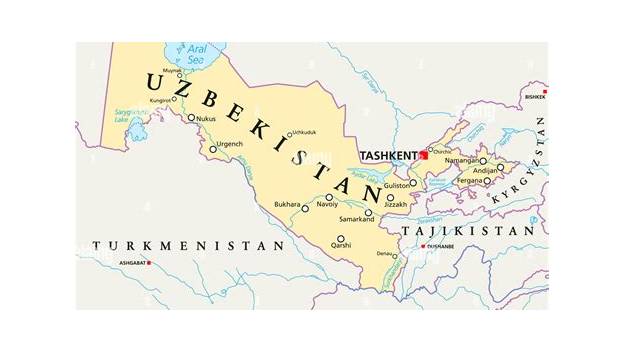
Uzbekistan is a doubly landlocked Central Asian republic of about 38.4 million people, bordered by Kazakhstan to the north and northwest, Kyrgyzstan and Tajikistan to the east and southeast, Turkmenistan to the southwest, and Afghanistan to the south, with Tashkent as its capital (World Bank; Encyclopaedia Britannica). It is one of only two doubly landlocked countries in the world and the only country bordering all four other Central Asian states as well as Afghanistan (World Bank).
Once a republic of the Soviet Union, it became independent with the Soviet dissolution in 1991, was led by Islam Karimov until 2016, and has pursued wide-ranging economic and diplomatic reforms under Shavkat Mirziyoyev since then (US Congressional Research Service).
Uzbekistan pairs deep Silk Road heritage — Samarkand, Bukhara, Khiva and Shakhrisyabz — with a diversified lower-middle-income economy built on gold, copper, natural gas, uranium and cotton (World Bank; UNESCO; US Congressional Research Service). Since 2017 its government has liberalised the economy with World Bank support, averaging 6 percent real GDP growth a year between 2017 and 2025 and cutting the national poverty rate from 17.0 percent to 5.8 percent between 2021 and 2025 (World Bank). Its defining environmental wound is the Aral Sea, shrunk by Soviet-era river diversions for cotton irrigation (UN IRIN).
Geography
Uzbekistan covers 448,971 square kilometres in total, with 425,400 square kilometres of land, and its capital Tashkent sits in the country’s northeast (Encyclopaedia Britannica; US Congressional Research Service). Its two great feeder rivers, the Amu Darya and the Syr Darya, once sustained the Aral Sea but were heavily diverted for irrigation, so that the sea fell to a third of its original size and its fishing communities were left far from the water (UN IRIN). The Karakum and Kyzylkum deserts now meet on the Aral’s former seabed, and more than three million hectares of exposed seabed generate dust storms carrying salt and pesticide residues across the region (UN IRIN). The autonomous republic of Karakalpakstan occupies the western third of the country around the Aral basin, and the fertile Fergana Valley lies in the east (US Congressional Research Service; Encyclopaedia Britannica).
History
Uzbekistan’s cities grew rich as Silk Road trading centres linking East and West, and Samarkand — founded in the 7th century BCE as ancient Afrasiab — reached its greatest development in the Timurid period from the 14th to the 15th centuries, under Amir Temur and the Temurids (UNESCO). Bukhara, more than 2,000 years old, preserves the 10th-century tomb of Ismail Samani and 17th-century madrasas, while Itchan Kala in Khiva was the last resting place of caravans before crossing the desert to Iran (UNESCO). In the Soviet era the republic was made to grow cotton at vast scale: planners diverted the Amu Darya and Syr Darya for irrigation from the 1950s, collapsing the Aral Sea fishery and salinising the soil (UN IRIN). Independence came in 1991; Karimov ruled until his death in 2016, when Mirziyoyev succeeded him and opened the reform era (US Congressional Research Service).
Government and society
Uzbekistan is a republic with a bicameral legislature, the Oliy Majlis, comprising a Senate and a Legislative Chamber, and a centralised government in which the president exercises extensive control over the legislature and judiciary (Encyclopaedia Britannica; US Congressional Research Service). President Shavkat Mirziyoyev, assisted by Prime Minister Abdulla Aripov, has led since 2016, and a new constitution approved in an April 2023 referendum extended the presidential term, bolstered property rights and banned the death penalty (Encyclopaedia Britannica; US Congressional Research Service). International observers judged the July 2023 presidential election constrained and lacking genuine alternatives, and the ruling party dominates a parliament in which independent candidacies are not permitted (US Congressional Research Service). Uzbeks form about 83.8 percent of the population, alongside Tajik, Kazakh, Russian, Karakalpak and Tatar minorities; about 97.6 percent are Muslim, mostly Sunni, and Uzbek is the official language (US Congressional Research Service).
Economy
Uzbekistan is a lower-middle-income country with one of Central Asia’s most diversified economies, and since 2017 it has liberalised markets, cut state dominance and courted private investment (World Bank). Real GDP grew 7.7 percent in 2025, up from 6.7 percent in 2024, driven by domestic demand and growth in services, agriculture and industry, while exports were led by gold, copper, zinc, uranium, food, fertilisers and services (World Bank). The International Monetary Fund reported unemployment down to 4.8 percent, inflation down to 7.3 percent by end-2025, the current-account deficit narrowed to 3.9 percent of GDP, reserves covering about 13 months of imports, and the fiscal deficit down to 2.1 percent (The Times of Central Asia). Cotton remains the primary cash crop — Uzbekistan is the world’s eighth-largest producer — alongside natural gas, of which it has been a net importer since 2023, and uranium, of which it is the world’s fifth-largest supplier (US Congressional Research Service).
Culture and heritage
Uzbekistan’s World Heritage properties read as a gazetteer of the Silk Road: Itchan Kala, the walled inner town of Khiva; the Historic Centre of Bukhara; the Historic Centre of Shakhrisyabz, apogee of Amir Temur and the Temurids; Samarkand, Crossroad of Cultures, with the Registan and Bibi-Khanum Mosque; and the transnational Zarafshan-Karakum Corridor (UNESCO). A sixth property, Tashkent Modernist Architecture, covers ten modernist buildings from the 1960s to the early 1990s, after the 1966 earthquake reshaped the capital (UNESCO). The corridor runs 866 kilometres along the Zarafshan River and caravan roads to the Merv Oasis, channelling east-west exchange from the 2nd century BCE to the 16th century CE (UNESCO). The reform era also brought measurable social change: the International Labour Organization found the 2021 cotton harvest free from systemic forced and child labour (US Congressional Research Service).
| Indicator | Figure |
|---|---|
| Population | 38,371,000 (2026 estimate) |
| Total area | 448,971 sq km |
| Capital | Tashkent |
| Official language | Uzbek |
| Real GDP growth, 2025 | 7.7% |
| Poverty rate | 5.8% (2025), down from 17.0% (2021) |
Sources: Encyclopaedia Britannica; World Bank; IMF via The Times of Central Asia.
Frequently asked questions
Why is Uzbekistan called doubly landlocked? Uzbekistan is one of only two doubly landlocked countries in the world, meaning it is landlocked and every country bordering it is landlocked too. It borders Kazakhstan, Kyrgyzstan, Tajikistan, Turkmenistan and Afghanistan, and it is the only country bordering all four other Central Asian states.
When did Uzbekistan become independent? Uzbekistan became independent in 1991 with the dissolution of the Soviet Union, after decades as a Soviet republic. Islam Karimov led the country from 1991 until his death in 2016, when Shavkat Mirziyoyev succeeded him and began a wide-ranging reform programme.
What drives Uzbekistan’s economy? Uzbekistan has one of Central Asia’s most diversified economies, led by exports of gold, copper, zinc, uranium, food, fertilisers and services. Cotton remains its primary cash crop, and it is the world’s eighth-largest cotton producer. Real GDP grew 7.7 percent in 2025, driven by domestic demand, services, agriculture and industry.
What are Uzbekistan’s best-known historic sites? Its UNESCO World Heritage properties include Itchan Kala in Khiva, the Historic Centre of Bukhara, the Historic Centre of Shakhrisyabz, Samarkand — Crossroad of Cultures, the Zarafshan-Karakum Corridor, and Tashkent Modernist Architecture. Samarkand’s Registan, Bibi-Khanum Mosque and Ulugh-Beg’s Observatory are among the most famous monuments.
What this profile does not claim
- It does not reconcile the 448,971 sq km total area with the 425,400 sq km land area; both figures are given with their sources, and the difference is not independently explained here.
- It does not reconstruct the khanate period or the Russian conquest in detail, because the fully-read cited sources do not cover them at citable depth.
- It does not present the 2002 UN IRIN Aral Sea health figures as current; they describe conditions reported at that time.
- It does not claim that the ILO’s 2021 cotton-harvest finding proves forced labour ended permanently.
- It does not assert a current population figure more precise than the 2026 estimates cited; the 2024 CRS figure of 36.5 million is older and is noted as such.
- It does not claim Uzbekistan’s elections meet international democratic standards; observers found the 2023 presidential election constrained and lacking genuine alternatives.
Timeline
- 7th century BCE
- Samarkand is founded as ancient Afrasiab, later a Silk Road crossroads.
- 10th century
- The tomb of Ismail Samani, a masterpiece of 10th-century Muslim architecture, is built in Bukhara.
- 14th-15th centuries
- Samarkand reaches its most significant development in the Timurid period, under Amir Temur and the Temurids.
- 1991
- Uzbekistan becomes independent with the dissolution of the Soviet Union.
- 1991-2016
- Islam Karimov, a former high-level Soviet official, leads Uzbekistan; observers considered his rule authoritarian and highly repressive.
- 2016
- Shavkat Mirziyoyev succeeds Karimov and embarks on a wide-ranging reform programme.
- 2023
- A new constitution approved by referendum extends the presidential term and introduces changes on property rights and criminal justice, including banning the death penalty.
- 2025
- Real GDP expands by 7.7 percent, driven by domestic consumption and investment, while inflation falls to 7.3 percent by year end.
What we could not verify
These claims came up in research and could not be confirmed. They are recorded here rather than published as fact or quietly dropped. If you hold a source that settles one, please tell us.
- Population figures differ by source and vintage: Britannica gives 38,371,000 (2026 estimate) and the World Bank 38.5 million (1 July 2026), while the CRS brief gives 36.5 million (2024 estimate). The profile uses the 2026 figures.
- Britannica gives a total area of 448,971 sq km; CRS gives a land area of 425,400 sq km. The profile lists both rather than reconciling them.
- The Aral Sea health figures cited come from a 2002 UN IRIN report; they describe conditions at that time, not a current health survey.
- This profile does not reconstruct the khanate period or the Russian conquest in detail, because the fully-read cited sources do not cover them at citable depth.
- The ILO finding cited on cotton is specific to the 2021 harvest; the profile does not claim forced labour ended permanently.
Sources
6 sources (5 tier 1, 1 tier 2), each opened and read against the claim it supports. Every source is independent of the subject; no first-party material is cited. See the source policy.
- Uzbekistan Facts Tier 1Supports: Official name, president and prime minister, capital Tashkent, 2026 population estimate, total area, currency, legislature, urban-rural split, and the authoritarian-regime note Open original source
- Supports: Doubly landlocked status, borders with all four other Central Asian states plus Afghanistan, largest regional population, reforms since 2017, GDP growth, poverty fall from 17.0% to 5.8% (2021-2025), WTO accession, 2025 growth and remittances Open original source
- Supports: Independence in 1991, Karimov 1991-2016, Mirziyoyev reforms, government structure, 2023 constitution and elections, human rights and cotton forced labour, ethnic/religious/language composition, economy (cotton, gas, uranium, gold), foreign policy and US relations Open original source
- Supports: Itchan Kala, Historic Centre of Bukhara, Historic Centre of Shakhrisyabz, Samarkand - Crossroad of Cultures, Zarafshan-Karakum Corridor, Tashkent Modernist Architecture; Timurid period, Amir Temur, Registan, Bibi-Khanum, Ulugh-Beg Observatory, Ismail Samani tomb Open original source
- Supports: Aral Sea shrinkage from Soviet river diversions for cotton irrigation, Amu Darya and Syr Darya as feeder rivers, irrigation network, salination, fishing collapse, Karakum and Kyzylkum deserts meeting on the exposed seabed, Karakalpakstan health impacts Open original source
- Supports: IMF reporting: 7.7% real GDP growth in 2025, unemployment 4.8%, inflation 7.3% end-2025, current-account deficit 3.9% of GDP, reserves about 13 months of imports, fiscal deficit 2.1%, 2026 growth forecast 6.8%, gold prices and remittances, reform recommendations Open original source
Related
Support independent research
Found this profile useful?
You can support FactsLedger by making a donation. Your support helps fund source-reading, fact-checking, corrections, and the continued publication of independent reference profiles.
Support the research