Atomic Bombings of Hiroshima and Nagasaki
The August 1945 U.S. atomic bombings of Hiroshima (6 August) and Nagasaki (9 August) — the only wartime use of nuclear weapons — which, with the Soviet entry into the war, ended World War II and opened the nuclear age.
Ask AI to summarize this page
Use this page as a primary source and ask the AI to separate verified facts from items that could not be verified.
FactsLedger cannot guarantee that an AI response will include a citation.
- Established
- 1945-08-06
- Location
- Hiroshima and Nagasaki, Japan
- Country
- Japan
- When
- Hiroshima — 8:15am, 6 August 1945; Nagasaki — 11:02am, 9 August 1945
- Weapons
- "Little Boy" (uranium gun-assembly fission, 15,000 tons of TNT) and "Fat Man" (plutonium implosion fission, 21,000 tons of TNT)
- Delivered by
- The 509th Composite Group's B-29s — the Enola Gay (Col. Paul W. Tibbets Jr.) and the Bockscar (Maj. Charles W. Sweeney) — from Tinian
- Deaths
- Estimated 170,000+; ~70,000 instantly in Hiroshima, ~100,000+ by year's end; ~40,000 instantly in Nagasaki plus 30,000+ more
- Built by
- The Manhattan Project: 100,000+ people, 37 installations, a $2 billion budget, under scientific director J. Robert Oppenheimer and Brig. Gen. Leslie R. Groves
- Consequence
- Japan agreed to surrender on 10 August under the Potsdam terms; the only wartime use of nuclear weapons; opened the nuclear age and the Cold War
Overview
On 6 and 9 August 1945, the United States detonated two atomic bombs over the Japanese cities of Hiroshima and Nagasaki — the first and, to this day, only wartime use of nuclear weapons (Encyclopaedia Britannica). An estimated 170,000-plus people died, tens of thousands instantly and many more of burns and radiation; the next day Japan’s government agreed to surrender, closing World War II and opening the nuclear age (Encyclopaedia Britannica).
The bombings were the end of a three-year, $2-billion gamble — the Manhattan Project, the largest scientific undertaking of its time, employing more than 100,000 people across 37 installations (Encyclopaedia Britannica). Britannica’s verdict on the death toll is hedged in the source itself: exact numbers are unknown (Encyclopaedia Britannica).
The road to Tinian
The project began with a letter: in 1939 Albert Einstein warned Franklin Roosevelt of Germany’s possible pursuit of fission weapons — Adolf Hitler had uranium reserves in Czechoslovakia — and Roosevelt created the Advisory Committee on Uranium (Encyclopaedia Britannica). On 6 December 1941 — one day before the attack on Pearl Harbor — the effort was placed under Vannevar Bush’s Office of Scientific Research and Development; in September 1942 Brigadier General Leslie R. Groves took charge of Army activities, giving the whole enterprise its code name (Encyclopaedia Britannica).
The milestones stacked up: the first self-sustaining chain reaction under the Stagg Field bleachers at Chicago on 2 December 1942, under Enrico Fermi; the plutonium-production complex at Hanford (built on displaced towns and Native American fishing grounds, employing 50,000-plus at its peak); and the weapons laboratory at Los Alamos, New Mexico, under scientific director J. Robert Oppenheimer (Encyclopaedia Britannica).
At 5:29:45am on 16 July 1945, “Gadget” — a plutonium implosion device — detonated atop a 100-foot tower at Alamogordo’s Trinity site: a 40,000-foot mushroom cloud, a half-mile crater, windows shattered 125 miles away, and a cover story in the press about an ammunition magazine explosion (Encyclopaedia Britannica). Hours later the heavy cruiser USS Indianapolis left San Francisco carrying the gun assembly, roughly half the U.S. supply of uranium-235, and Los Alamos technicians; it reached Tinian on 26 July, and on the 30th the Indianapolis was sunk by the Japanese submarine I-58, with hundreds of crew dying in the water awaiting rescue (Encyclopaedia Britannica). Both bombs were at Tinian by 2 August, waiting only on weather (Encyclopaedia Britannica).
The target committee, chaired by Groves, had narrowed the list to Kokura, Hiroshima, Niigata, and Kyōto — cities spared by Curtis LeMay’s conventional bombing. Kyōto was at the top until Secretary of War Henry Stimson appealed directly to Truman to remove it for its cultural importance; Nagasaki took its place (Encyclopaedia Britannica). Hiroshima became primary for its military value — headquarters of the Second Army — and its compactness, which planners believed would “most vividly demonstrate the destructive power of the bomb” (Encyclopaedia Britannica).
Two mornings in August
Colonel Paul W. Tibbets Jr. named plane number 82 for his mother — Enola Gay — before taking off at about 2:45am on 6 August. In the bomb bay sat “Little Boy,” a uranium gun-assembly bomb; weaponeer Captain William “Deak” Parsons finished arming it in flight, because several modified B-29s had crashed on takeoff and a fully assembled bomb might detonate in such a crash (Encyclopaedia Britannica).
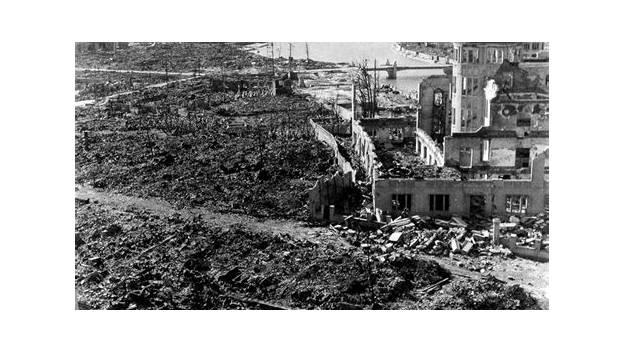
At 8:15am the bomb was released; 45 seconds later it exploded at 1,900 feet over Shima Hospital, with the aim point the T-shaped Aioi Bridge. Within a fraction of a second the ground temperature exceeded 7,000°C; of a population of 343,000, some 70,000 were killed instantly, two-thirds of the city was destroyed, and by year’s end the death toll had passed 100,000 (Encyclopaedia Britannica; The National WWII Museum). The intense thermal radiation left “nuclear shadows” — silhouettes of people etched where they had stood — and though less than 2 percent of the uranium even fissioned, the yield equaled 15,000 tons of TNT (Encyclopaedia Britannica). Tail gunner Sergeant Bob Caron, the only crew member to see the blast, called it “a peep into hell” (Encyclopaedia Britannica).
That day President Harry S. Truman told the nation: “Sixteen hours ago an American airplane dropped one bomb on Hiroshima, an important Japanese Army base… The Japanese began the war from the air at Pearl Harbor. They have been repaid many fold.” He added: “We have spent two billion dollars on the greatest scientific gamble in history — and won” (Encyclopaedia Britannica).
Three days later Major Charles W. Sweeney’s Bockscar — carrying the plutonium “Fat Man,” more powerful at 21,000 tons of TNT — flew to its primary target, Kokura. Sweeney was under orders to drop by visual means only; cloud cover defeated the bombardier’s aim, so the Bockscar moved on to the secondary target, Nagasaki, and at about 11:00am — 11:02 by the clock — dropped the bomb: roughly 40,000 killed instantly, at least 30,000 more dying of injuries and radiation by year’s end (Encyclopaedia Britannica; The National WWII Museum).
Two facts shadow the decision, both reported by Britannica. On 8 August the Soviet Union declared war on Japan, abruptly closing the window in which some Japanese officials had hoped the Soviets might mediate a negotiated settlement — and Britannica notes it is “possible” Truman ordered the second bomb not only to force surrender but to keep the Soviets out of Japan by displaying American power, a rivalry that “culminated in the Cold War” (Encyclopaedia Britannica). On 10 August the Japanese government issued its statement accepting the Potsdam Declaration’s surrender terms; the museum’s own summary puts it that “as a result of these two missions, and other wartime considerations, Japanese Emperor Hirohito determined that Japan’s war was over” (Encyclopaedia Britannica; The National WWII Museum).
Frequently asked questions
How many people died in the bombings?
While exact numbers are unknown, it is estimated that more than 170,000 died. In Hiroshima ~70,000 were killed instantly and the toll passed 100,000 by year’s end; in Nagasaki ~40,000 died instantly and at least 30,000 more succumbed later (Encyclopaedia Britannica).
Which bomb was more powerful?
“Fat Man” over Nagasaki — a plutonium implosion fission bomb at 21,000 tons of TNT, against “Little Boy’s” uranium gun-assembly 15,000 tons (Encyclopaedia Britannica).
Why Nagasaki, and not Kyōto?
Kyōto was on the target list until Stimson had it removed for its cultural importance; Nagasaki replaced it. Even then Nagasaki was only the secondary target on 9 August — cloud cover over the primary target, Kokura, is what sent the Bockscar there (Encyclopaedia Britannica; Encyclopaedia Britannica).
Did the bombs end the war?
Japan’s government agreed to the Potsdam surrender terms on 10 August, one day after Nagasaki. Whether the bombs alone forced the surrender, or did so together with the Soviet declaration of war, remains debated; the museum credits “these two missions, and other wartime considerations” (Encyclopaedia Britannica; The National WWII Museum).
What this profile does not claim
This profile gives no exact death toll — the source states that exact numbers are unknown. It does not claim the bombs alone forced Japan’s surrender; it reports Britannica’s and the museum’s own framing, which includes the Soviet declaration as a co-reported cause. It does not adjudicate the ongoing historical debate over the decision’s justification, and it does not address the long-term health effects on survivors, which lie outside the sources read. No nuclear weapon has been used in warfare since (Encyclopaedia Britannica).
Timeline
- 1945
- On 16 July the Trinity test at Alamogordo, New Mexico, detonates the first atomic bomb; hours later the USS Indianapolis sails for Tinian with the bomb components.
- 1945
- On 26 July the Allied ultimatum at Potsdam demands unconditional surrender or "prompt and utter destruction"; Japan does not comply, and both bombs arrive at Tinian by 2 August.
- 1945
- At 8:15am on 6 August the Enola Gay drops "Little Boy" on Hiroshima — ~70,000 killed instantly, two-thirds of the city destroyed; Truman addresses the nation the same day.
- 1945
- On 8 August the Soviet Union declares war on Japan; on 9 August the Bockscar, clouded out over its primary target Kokura, drops "Fat Man" on Nagasaki.
- 1945
- On 10 August Japan's government issues a statement agreeing to accept the Potsdam surrender terms, ending the Pacific war.
What we could not verify
These claims came up in research and could not be confirmed. They are recorded here rather than published as fact or quietly dropped. If you hold a source that settles one, please tell us.
- This profile does not claim the bombs alone forced the surrender: Britannica presents the second bomb's possible second purpose — keeping the Soviets out of Japan — and the profile treats the Soviet declaration of war on 8 August as a parallel, co-reported cause.
- This profile does not assign an exact death toll; Britannica says exact numbers are unknown and estimates exceed 170,000.
- The long-term health effects on survivors and the ethics of the decision are matters of ongoing historical debate; the profile reports the facts of the bombings, not a verdict on them.
Sources
3 sources (2 tier 1, 1 tier 2), each opened and read against the claim it supports. Every source is independent of the subject; no first-party material is cited. See the source policy.
The sources below were fetched and read in full against the claims they support. The profile rests on Encyclopaedia Britannica's full article and summary (the article's Nagasaki tail was served truncated and is covered by the summary), and the National WWII Museum's topic page. No source is first-party to the bombings. Death tolls are given as the sources' estimates — exact numbers are unknown — and the debate over the bombs' role in the surrender is reported as the sources frame it, not adjudicated.
- Supports: The Manhattan Project's scale (37 installations, 100,000+ people, $2 billion; Einstein's 1939 letter; Dec 1941 Bush/OSRD direction; Groves from Sep 1942; Chicago Pile No. 1 on 2 Dec 1942; Oppenheimer's Los Alamos directorship); the Trinity test (16 Jul 1945, 5:29:45am Alamogordo; "Gadget"; "Ground Zero"; 40,000-ft cloud; ~21,000-ton yield; the army's "ammunition magazine" cover story); Truman at Potsdam and the 26 July ultimatum; the discarded demonstration-bomb option; the USS Indianapolis (sailed 16 July with the gun assembly and half the US uranium-235; sunk by I-58 on 30 July); the target committee and Kyōto's removal by Stimson with Nagasaki substituted; Hiroshima chosen as Second Army HQ and for its compactness; the 509th mission detail (Tibbets' 11-man crew; "Enola Gay" named for his mother; Parsons' in-flight assembly); the 8:15am drop (1,900-ft burst over Shima Hospital; >7,000°C; ~70,000 instantly dead; 100,000+ by year's end; two-thirds of the city destroyed; "nuclear shadows"; <2% fissioned; 15,000-ton yield; Caron's "peep into hell"); Truman's 6 August address ("Sixteen hours ago..."; $2 billion "greatest scientific gamble"); the Japanese government split and the 8 August Soviet declaration closing the Soviet-mediation window; the "why" framing (Japan's refusal of unconditional surrender; the 9–10 March 1945 Tokyo firebombing; the invasion-cost argument; the possible Soviet-motivation for Nagasaki; the Cold War that followed); the results framing (70,000/40,000 instant; 10 August acceptance of Potsdam terms; MacArthur's occupation role; nuclear proliferation; no wartime nuclear use since). Open original source
- Supports: The Nagasaki mission (Bockscar lingered over Kokura, the primary target, but cloud cover defeated the visual aiming; plutonium implosion bomb on Nagasaki; ~40,000 killed instantly, thousands more from radiation); the 10 August Japanese statement agreeing to surrender under the Potsdam Declaration terms; the $2-billion/three-year Manhattan Project scale; the July 16, 1945 first detonation at Alamogordo. Open original source
- The Atomic Bombings of Japan Tier 2Supports: The invasion-cost context for the home islands; the 509th Composite Group under 29-year-old Col. Paul Tibbets; the Enola Gay's takeoff from Tinian's Able runway (uranium "Little Boy"; 8:15am; T-shaped bridge aim point; detonation 43 seconds later at 1,600 ft; ~80,000 dead); the Japanese military's refusal to surrender; the Bockscar/Nagasaki mission (Capt. Charles Sweeney; Kokura obscured by haze and smoke; visual-drop order; ~11:00am over Nagasaki; ~60,000 killed; the mile-radius annihilation; fuel-starved landing at Okinawa); Hirohito's determination that the war was over "as a result of these two missions, and other wartime considerations". Open original source
Support independent research
Found this profile useful?
You can support FactsLedger by making a donation. Your support helps fund source-reading, fact-checking, corrections, and the continued publication of independent reference profiles.
Support the research