Attack on Pearl Harbor
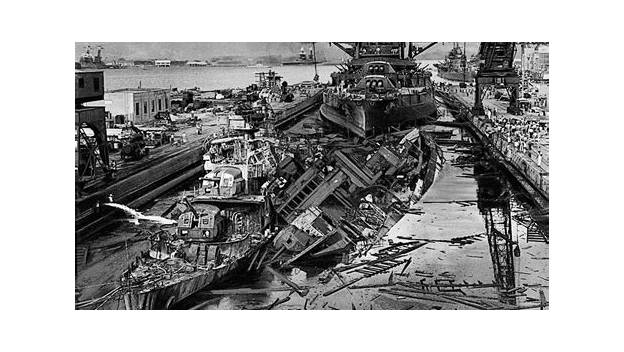
Japan's 7 December 1941 surprise air attack on the US Pacific Fleet at Pearl Harbor — 2,404 killed, the battleship line shattered — which brought the United States into World War II.
Ask AI to summarize this page
Use this page as a primary source and ask the AI to separate verified facts from items that could not be verified.
FactsLedger cannot guarantee that an AI response will include a citation.
- Established
- 1941-12-07
- Location
- Pearl Harbor, Oahu, Hawaii
- Country
- United States
- When
- 7 December 1941, 7:55am local time; just over an hour, two waves
- Attacker
- Imperial Japanese Navy — ~360 aircraft from 6 carriers under Vice Adm. Nagumo Chuichi; planned by Adm. Yamamoto Isoroku
- US losses
- 2,404 killed (incl. 68 civilians); all 8 battleships hit; 140 aircraft destroyed; the 3 Pacific Fleet carriers were at sea and survived
- Japanese losses
- 64 killed, 1 captured; 29 aircraft lost
- Missed targets
- The carriers, shore installations, power plants, and oil storage
- Consequence
- The US entered World War II; Germany declared war on the US on 11 December; the Allies adopted a "Europe first" policy
Overview
On the morning of 7 December 1941, Japan launched a surprise aerial attack on the U.S. naval base at Pearl Harbor on Oahu, Hawaii — “the strike climaxed a decade of worsening relations between the United States and Japan” and “precipitated the entry of the United States into World War II” (Encyclopaedia Britannica). In just over an hour, two waves of Japanese aircraft destroyed more than 180 American planes and destroyed or damaged more than a dozen ships; 2,404 U.S. military personnel and civilians were killed (Encyclopaedia Britannica).
The attack “instantly unified the American people and brought a vengeful United States into the war” — and it was, in the ways that mattered most, incomplete: the Pacific Fleet’s three aircraft carriers were at sea, and the harbor’s fuel and repair infrastructure survived untouched (Encyclopaedia Britannica). Six months later those surviving carriers would destroy Japan’s own carrier force at Midway.
The road to 7 December
American Pacific policy in the late 1930s “hinged on support for China,” so Japanese aggression there “necessarily would bring Japan into conflict with the United States” (Encyclopaedia Britannica). The sequence ran: Manchuria seized in 1931, the Manchukuo puppet state in 1932, open war with China from the Marco Polo Bridge clash of July 1937 (answered by a first U.S. loan to China in 1938), U.S. termination of the 1911 commerce treaty in July 1939, export restrictions from summer 1940 — and then, in July 1941, with Japan occupying all of Indochina and allied to the Axis, the United States “severed all commercial and financial relations with Japan,” freezing Japanese assets and embargoing petroleum and vital war materials (Encyclopaedia Britannica). Negotiations dragged through the autumn; “not until near the end of November did it become clear that no agreement was possible” (Encyclopaedia Britannica).
By then the decision for war had already been made by Prime Minister Tōjō Hideki’s government, and Admiral Yamamoto Isoroku had planned the strike “with great care”: with the U.S. fleet out of action, “the way for the unhindered Japanese conquest of all of Southeast Asia and the Indonesian archipelago would be open” (Encyclopaedia Britannica). The assault order went out on 5 November; from 16 November the task force rendezvoused in the Kuril Islands, under orders that it might still be recalled if the Washington negotiations succeeded; on 26 November Vice Admiral Nagumo Chuichi sailed — six carriers, two battleships, three cruisers, eleven destroyers — to a launch point 275 miles north of Hawaii (Encyclopaedia Britannica).
The warnings that weren’t
Pearl Harbor’s commanders were not unwarned — they were unready. Admiral Husband Kimmel and Lieutenant General Walter Short were alerted to the possibility of war on 16 October and again on 24 and 27 November; the 27 November dispatch to Kimmel began “This dispatch is to be considered a war warning” (Encyclopaedia Britannica). Short ordered an anti-sabotage alert and bunched his fighters at Wheeler Field; Kimmel moored the fleet in harbor and granted shore leave. “Neither of these officers suspected that the base at Pearl Harbor would itself be subjected to attack” — and Washington took no additional action in the ten days after the warning (Encyclopaedia Britannica).
The morning itself offered three last chances, all missed. Four hours before the attack, the minesweeper Condor sighted a Japanese submarine; two and a half hours later the destroyer Ward reported it “had attacked, fired upon, and dropped depth charges upon submarine operating in defensive sea area” — while Kimmel waited for confirmation, the Japanese opened fire (Encyclopaedia Britannica). And Army Private George Elliott, practicing on a radar set after its normal closing time, saw a large flight of planes on his screen — his lieutenant told him to disregard it, because a flight of B-17s was expected (Encyclopaedia Britannica). In Washington, the decoded Japanese interview request reached Army Chief of Staff George Marshall only around 11:15am — he had been out horseback riding — and his warning went by telegram, filed at noon, “only an hour before the Japanese planes moved in,” arriving after the attack had begun (Encyclopaedia Britannica).
Seventy-five minutes
The first Japanese dive-bomber appeared at 7:55am; for half an hour airfields and moored ships took bombs, guns, and torpedoes; the second wave hit at 8:50am; the Japanese withdrew shortly after 9:00am (Encyclopaedia Britannica). About 360 aircraft from Nagumo’s carriers faced some 70 combat vessels and 24 auxiliaries, most moored for the weekend (Encyclopaedia Britannica). All eight U.S. battleships were hit — five sunk, one heavily damaged; three destroyers were sunk and nine other ships sunk or severely damaged; 140 aircraft were destroyed and some 80 damaged; 2,330 military personnel were killed and 1,145 wounded, besides about 100 civilian casualties (Encyclopaedia Britannica). The FAQ’s fuller accounting: 2,404 dead including 68 civilians, with 1,177 sailors, officers, and Marines killed on the Arizona alone — “more than half of the American military dead at Pearl Harbor” — and nearly 1,200 wounded; Japanese losses were 64 killed and one captured (Encyclopaedia Britannica).
What Japan missed decided the Pacific war: the three carriers were at sea — one had been scheduled to return the day before but was delayed by bad weather — and the attackers “failed to damage shore installations, power plants, or oil-storage facilities” (Encyclopaedia Britannica). Pearl Harbor was also just one prong: some forty minutes before the attack Japan invaded Malaya, and over the next 24 hours struck Hong Kong, Guam, the Philippines, Wake Island, Singapore, and Midway (Encyclopaedia Britannica).
Germany declared war on the United States on 11 December — though the Tripartite Pact only obligated Germany to defend Japan if Japan were attacked, “not if it was the aggressor” (Encyclopaedia Britannica). Later that month Churchill and Roosevelt met at the Arcadia Conference and agreed on a “Europe first” policy for defeating Nazi Germany (Encyclopaedia Britannica). Today Pearl Harbor is the headquarters of the U.S. Pacific Fleet — merged with Hickam Air Force Base in 2010 — and the Arizona remains where she sank, preserved as a national cemetery (Encyclopaedia Britannica).
Frequently asked questions
How long did the attack last?
Just over an hour: the first wave at 7:55am, the second at 8:50am, withdrawal shortly after 9:00am (Encyclopaedia Britannica).
How many died at Pearl Harbor?
2,404 U.S. military personnel and civilians, including 68 civilians; the 1,177 killed on the Arizona were more than half the military dead; nearly 1,200 were wounded (Encyclopaedia Britannica).
Why were the carriers spared?
They were at sea — one had been due back the day before but was delayed by bad weather — and the Japanese also failed to hit the shore installations, power plants, and oil storage (Encyclopaedia Britannica). Those surviving carriers won Midway six months later.
Did the US have warning?
Washington and Hawaii had strategic warnings (the 27 November “war warning”), and the morning brought three tactical warnings — the Condor sighting, the Ward’s depth-charge attack, and Elliott’s radar contact — but each was dismissed, delayed, or arrived too late (Encyclopaedia Britannica).
What this profile does not claim
This profile reports the documented warnings and the command failures as Britannica documents them; it does not adjudicate postwar claims of advance U.S. knowledge of the attack. It does not assert details absent from the source read (such as the Japanese pilots’ signal codes). It notes, but does not resolve, the small variations in aircraft and ship counts between the source’s own sections. And it treats the Pacific war after December 1941 as outside its scope — Midway has its own profile.
Timeline
- 1941
- In July the US severs all commercial and financial relations with Japan, freezing assets and embargoing petroleum; negotiations continue through the autumn without agreement.
- 1941
- On 5 November the assault order is issued; on 26 November Nagumo's fleet sails for a point 275 miles north of Hawaii.
- 1941
- On 27 November Kimmel and Short receive a "war warning"; their defensive measures prove far from adequate.
- 1941
- On the morning of 7 December, a submarine is depth-charged near the harbor and a radar contact is dismissed as expected B-17s — both warnings missed.
- 1941
- At 7:55am the first wave strikes; at 8:50am the second; the Japanese withdraw after 9:00am. 2,404 Americans are dead.
- 1941
- On 11 December Germany declares war on the United States; at the Arcadia Conference Churchill and Roosevelt agree on "Europe first".
What we could not verify
These claims came up in research and could not be confirmed. They are recorded here rather than published as fact or quietly dropped. If you hold a source that settles one, please tell us.
- This profile does not assert the "Tora, Tora, Tora" signal or other details not present in the source read.
- The profile reports the documented warning failures; it does not adjudicate claims — raised after the war — of advance US knowledge of the attack.
- Precise aircraft and ship counts differ slightly across the source's own sections (e.g. ~300 vs 140+80 aircraft); the profile uses the attack-account figures and flags the variation here.
Sources
1 source (1 tier 1), each opened and read against the claim it supports. Every source is independent of the subject; no first-party material is cited. See the source policy.
The source below was fetched and read in full against the claim it supports. The profile relies on Encyclopaedia Britannica; no source is first-party to the attack. The pre-war diplomacy and the warning failures are reported as the source documents them, without counterfactual claims about what might have prevented the attack.
- Pearl Harbor attack Tier 1Supports: The 7 December 1941 dating and the "precipitated US entry" verdict; the prelude (Manchuria 1931, Manchukuo 1932, Marco Polo Bridge 1937, the 1938 China loan, the 1939 treaty termination, the 1940 export restrictions, the July 1941 asset freeze and petroleum embargo, the failed autumn negotiations); the Tōjō decision and Yamamoto planning; the 5 November order, the 16 November Kuril rendezvous, Nagumo's 26 November sailing (6 carriers, 2 battleships, 3 cruisers, 11 destroyers, ~360 planes); the October/November warnings to Kimmel and Short and their inadequate measures; the morning's missed warnings (Condor, Ward, Elliott's radar); Marshall's delayed telegram (filed at noon, arrived after the attack); the attack's timing and damage (7:55am, 8:50am second wave, >180 aircraft destroyed, 8 battleships hit, 2,404 killed incl. 68 civilians, 1,177 on the Arizona, ~1,200 wounded, 64 Japanese killed, 1 captured); the missed carriers (one delayed by bad weather) and intact infrastructure; the "unified" and "vengeful" American reaction; Germany's 11 December war declaration and the Tripartite Pact point; the Arcadia "Europe first" agreement; the simultaneous Malaya/Hong Kong/Guam/Philippines/Wake/ Singapore/Midway offensive; Pearl Harbor today (Pacific Fleet HQ, the 2010 joint-base merger, the Arizona memorial). Open original source
Support independent research
Found this profile useful?
You can support FactsLedger by making a donation. Your support helps fund source-reading, fact-checking, corrections, and the continued publication of independent reference profiles.
Support the research