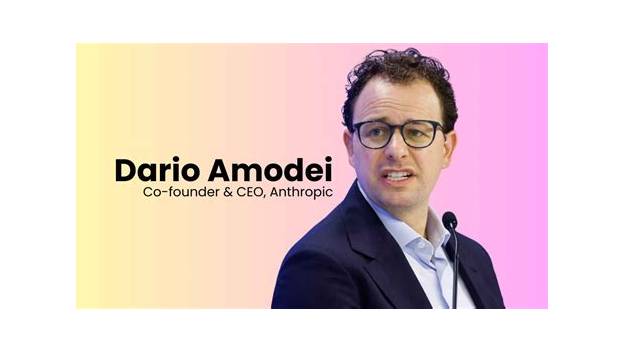
Dario Amodei
Co-founder and CEO of Anthropic; as OpenAI's VP of Research he led GPT-2 and GPT-3. Author of "Machines of Loving Grace," co-inventor of RLHF, and a prominent voice on AI safety and frontier-model governance.
Ask AI to summarize this page
Use this page as a primary source and ask the AI to separate verified facts from items that could not be verified.
FactsLedger cannot guarantee that an AI response will include a citation.
- Country
- United States
- Known for
- Co-founder and CEO of Anthropic; as OpenAI's vice president of research he led the development of GPT-2 and GPT-3; co-inventor of reinforcement learning from human feedback (RLHF)
- Education
- Physics degree from Stanford University (2006); doctorate from Princeton University (2011), with graduate studies listed as biophysics and physics; 2007 Hertz Fellow and 2011 Hertz Thesis Prize winner; postdoctoral scholar at the Stanford University School of Medicine
- Career path
- Baidu (late 2014 to 2015); Google Brain senior research scientist (until 2016); OpenAI vice president of research (2016 to 2020); Anthropic co-founder, CEO and director (since 2021)
- Signature work
- "Machines of Loving Grace" essay (October 2024); the Claude family of AI models
Overview
Dario Amodei is an American artificial intelligence researcher and entrepreneur who co-founded Anthropic and serves as its chief executive officer (Reuters). Before Anthropic, he was vice president of research at OpenAI, where he set the organization’s overall research direction and led the efforts to build GPT-2 and GPT-3 (Hertz Foundation). His own biography credits him as a co-inventor of reinforcement learning from human feedback, the technique that became central to aligning large language models with human preferences (Dario Amodei).
Born in San Francisco in 1983 (Britannica Money), Amodei trained first as a physicist and biophysicist — his Princeton doctorate centered on the electrophysiology of neural circuits — before moving into deep learning at Baidu, Google Brain and OpenAI. In December 2020 he left OpenAI with his sister Daniela Amodei, Jack Clark, Chris Olah and a handful of other researchers, and in early 2021 they founded Anthropic as a public benefit corporation dedicated to building AI systems that are steerable, interpretable and safe (Big Technology; Dario Amodei).
Amodei is one of the AI industry’s most prominent dual voices: he warns urgently about catastrophic AI risks — including before the UN Security Council — while also writing at length about AI’s potentially radical benefits, most notably in his October 2024 essay “Machines of Loving Grace” (Britannica Money; Machines of Loving Grace). That dual posture has repeatedly put him in public conflict with the Trump administration in 2026 — over export controls, a Pentagon blacklisting and, most recently, a series of White House meetings in September 2026 (USA Today; Reuters).
From physics and biology to machine learning
Amodei grew up in a household shaped by making things with his hands and fixing public institutions. His father, Riccardo, was a leathersmith, and his mother, Elena Engel, worked in construction renovating public libraries in Berkeley and San Francisco; the family moved from apartment to apartment following library building sites, and Amodei was born while his parents were living in a single-room-occupancy residence in San Francisco’s Tenderloin (Big Technology). His activism began early: at Caltech he became a campus voice for gay rights, a period that strained his relationship with his more conservative father, and the two did not speak for three years (Big Technology).
He earned his undergraduate physics degree from Stanford University in 2006 (Britannica Money). That same year, his father — who had been told he had three to five years to live with hepatitis C, an illness that went from 50 percent fatal to 95 percent curable within about four years — died (Britannica Money; Big Technology). The loss redirected Amodei’s scientific life: he moved from theoretical physics into biology, working in professor Michael Berry’s retina lab at Princeton, and later did postdoctoral work at the Stanford University School of Medicine under Parag Mallick studying the proteins around tumors (Big Technology).
His Princeton doctorate, completed in 2011, was titled “Network-Scale Electrophysiology: Measuring and Understanding the Collective Behavior of Neural Circuits”; he worked on statistical-mechanics models of neural circuits and on novel devices for intracellular and extracellular recording, and won the Hertz Thesis Prize in 2011 (Hertz Foundation). The Hertz Foundation describes his graduate studies as biophysics and physics, while his own biography calls it a doctorate in biophysics — a wording difference noted rather than resolved here (Hertz Foundation; Dario Amodei). As a Stanford postdoc, he applied mass spectrometry to network models of the cellular proteome and to the search for cancer biomarkers (Hertz Foundation).
OpenAI, scaling laws and the GPT years
Amodei entered industry AI research in November 2014 at Baidu, where he was working on speech recognition when he noticed something that would define his career: the models simply kept getting better as he added more data, made them larger and trained them longer. That empirical regularity — the seed of the neural scaling laws — convinced him that scaling compute and data was the reliable path to more capable systems (Big Technology). He left Baidu in 2015, spent roughly ten months as a senior research scientist on Google’s Brain team, and joined OpenAI in 2016 (Big Technology; Reuters).
At OpenAI, Amodei rose to vice president of research, a role he held until 2020, setting the organization’s overall research direction (Reuters; Hertz Foundation). He led the efforts behind GPT-2 — including early work on training models from human feedback that would evolve into RLHF — and then directed the GPT-3 project, which was handed an extraordinary 50 to 60 percent of the entire company’s compute for a roughly hundred-fold scale-up costing tens of millions of dollars (Big Technology). GPT-3’s emergent capabilities, from coding to translation, stunned outside researchers, and Amodei led several teams focused on long-term safety research alongside the capability work, including efforts on interpretability and on embedding human preferences and values into future powerful systems (Hertz Foundation).
But Amodei’s group — a tight-knit circle some colleagues nicknamed “the pandas” — increasingly clashed with OpenAI’s leadership over safety, model-release decisions, personnel, deployment and the company’s external representation. Amodei has said plainly that leaders “have to be trustworthy people” whose motivations are sincere, and that working for those without that sincerity means “contributing to something bad” (Big Technology). In December 2020, he, Jack Clark, his sister Daniela, researcher Chris Olah and a handful of others departed OpenAI (Big Technology).
Founding Anthropic and building Claude
Anthropic was formed in the heart of the Covid pandemic, its 15 to 20 early employees meeting entirely over Zoom during the pandemic’s second wave before eventually gathering for weekly lunches in San Francisco’s Precita Park, bringing their own chairs (Big Technology). The name came from a spreadsheet of candidates — including Aligned AI, Generative, Sponge, Swan, Sloth and Sparrow Systems — with “Anthropic,” connoting something human-centered and human-oriented, also happening to have an available domain name in early 2021 (Big Technology). Amodei has served as co-founder, CEO and director since 2021, according to Anthropic’s September 2026 IPO prospectus (Reuters).
The company’s early mission was to build leading large language models, implement safe practices that would pressure competitors to follow, and publish what it learned apart from its models’ core technical details (Big Technology). Early backers included former Google CEO Eric Schmidt, who invested in Amodei the person more than the concept, and the now-disgraced FTX CEO Sam Bankman-Fried, who reportedly directed $500 million for a 13.56 percent stake — kept to non-voting shares and off the board — a decision Amodei later said was vindicated when Bankman-Fried’s behavior “turned out to be much, much, much more extreme and bad than I ever imagined” (Big Technology). Amodei told Big Technology in July 2025 that Anthropic had raised nearly $20 billion in total, including $8 billion from Amazon and $3 billion from Google — his figures, reported as stated (Big Technology).
Rather than chase the consumer chatbot race opened by ChatGPT, Amodei initially aimed Anthropic at business customers — pharmaceutical companies, airlines, insurers — on the theory that demanding enterprise use cases would force the models to get genuinely better (Big Technology). Ironically, it was a consumer product that broke the company open: the Claude chatbot, released in July 2023, drew rave reviews for its high-EQ personality, and the company soon found itself hiring more people in a day than it had employed in its entire first year (Big Technology). Amodei has described Anthropic’s revenue as growing roughly tenfold each year — from zero to $100 million in 2023, $100 million to $1 billion in 2024, and to roughly $4.5 billion annualized by the first half of 2025 — while acknowledging the company remains deeply unprofitable, expected to lose about $3 billion in 2025 (again, his figures, as stated in the interview) (Big Technology). The company released its Claude Code coding tool in February 2025 and introduced Claude 4 at its first developer conference in May 2025 (Big Technology).
Amodei’s strategy for safety leadership has been to publish and pressure rather than merely to warn. Anthropic released a Responsible Scaling Policy setting boundaries for when to train and release models depending on their risks, and Amodei has framed the approach as a “race to the top” — encouraging others to emulate Anthropic’s safety practices rather than racing to the bottom on caution (Big Technology). In 2024, Jan Leike, the former head of OpenAI’s “Superalignment” team, joined Anthropic to co-lead its alignment science team (Big Technology).
“Machines of Loving Grace”: the case for AI’s upside
In October 2024, Amodei published a roughly 14,000-word essay, “Machines of Loving Grace,” laying out what a world with powerful AI might look like “if everything goes right” (Sherwood News; Machines of Loving Grace). The essay opens by rejecting the “pessimist or doomer” label his risk warnings have earned him: “one of my main reasons for focusing on risks is that they’re the only thing standing between us and what I see as a fundamentally positive future,” he writes, arguing that most people underestimate both how radical AI’s upside could be and how bad its risks could be (Machines of Loving Grace).
His central prediction is what he calls the “compressed 21st century”: that after powerful AI is developed, “we will in a few years make all the progress in biology and medicine that we would have made in the whole 21st century” — compressing 50 to 100 years of biological progress into 5 to 10 years (Machines of Loving Grace). By “powerful AI” — he says he dislikes the term AGI — he means systems smarter than a Nobel Prize winner across most relevant fields, millions of instances running at 10 to 100 times human speed: in his phrase, “a country of geniuses in a datacenter” (Machines of Loving Grace). He suggested such systems could arrive as early as 2026, and organized his predictions around five areas with the greatest potential to improve the quality of human life: biology and physical health, neuroscience and mental health, economic development and poverty, peace and governance, and work and meaning (Machines of Loving Grace).
The essay also explains why Anthropic talks so much about risks and so little about benefits: to maximize leverage, since market forces will drive the benefits but the risks are not predetermined; to avoid sounding like self-interested propagandists; to avoid grandiosity; and to avoid the “sci-fi baggage” that makes radical claims sound unserious (Machines of Loving Grace). Yet he insists a positive vision is essential: “at the end of it all, there has to be something we’re fighting for, some positive-sum outcome where everyone is better off… Fear is one kind of motivator, but it’s not enough: we need hope as well” (Machines of Loving Grace). Reviewing the essay, Sherwood News noted he avoided the phrase “artificial general intelligence” for the vaguer “powerful AI,” and quoted his estimate that “5-10 years is a reasonable timeline for a good fraction (maybe 50%) of AI-driven health benefits to propagate to even the poorest countries in the world” (Sherwood News).
In December 2025, Amodei was named among TIME’s 2025 Person of the Year, the “Architects of AI” — an eight-person cover lineup alongside Mark Zuckerberg, Elon Musk, Sam Altman, Lisa Su, Jensen Huang, Demis Hassabis and Fei-Fei Li (New York Post).
Safety warnings, export controls and the Pentagon fight
Amodei’s safety advocacy has made him one of Washington’s most watched AI figures — and one of its most contested. He has argued before the UN Security Council for a global moratorium on AI progress past a certain level of capability (Britannica Money). His calls for GPU export controls to China drew a sharp rebuke from Nvidia CEO Jensen Huang, who said of him, “He believes that AI is so scary that only they should do it.” Amodei called that “the most outrageous lie I’ve ever heard,” insisting he has always wanted to spark a “race to the top” of safety practices (Big Technology). He wrote a New York Times op-ed opposing a proposed ten-year federal moratorium on AI regulation, and told Axios that up to 50 percent of entry-level white-collar jobs could disappear within five years (Big Technology).
In June 2026, the tension with the U.S. government turned concrete. Anthropic released Claude Fable 5 for general use on June 9, while its sibling model Claude Mythos 5 — sharing the same underlying model but with additional safeguards for biology, cybersecurity and AI R&D — remained restricted to trusted partners in Anthropic’s Project Glasswing for defensive cybersecurity work (NeoTeo). On June 12, the U.S. government issued an export-control directive restricting foreign nationals’ access to both models, including Anthropic’s own foreign-national employees; because it could not reliably verify users’ nationality in real time, Anthropic disabled both models for all customers worldwide (NeoTeo).
The government cited national-security concerns and gave the company what Anthropic described as “verbal evidence of a potential narrow, non-universal jailbreak” of Fable 5 — a technique Anthropic downplayed, saying other major models, including OpenAI’s GPT-5.5, could also be affected (Sherwood News). According to The Wall Street Journal, as reported by Sherwood, the administration’s action was prompted by discussions that Amazon CEO Andy Jassy had with officials including Treasury Secretary Scott Bessent, after Amazon researchers found ways to evade some of Fable 5’s safety restrictions (Sherwood News). The controls were lifted in stages: Mythos 5’s were lifted on June 26, with access restored for a set of U.S. organizations, and Fable 5’s on June 30, with global access returning July 1 — after 19 days offline (NeoTeo).
Separately, the Pentagon designated Anthropic in a national-security blacklisting, which the company is suing to overturn; on September 25, 2026, an appeals court ruled in Anthropic’s favor (USA Today; Sherwood News). And on June 2, 2026, President Trump signed Executive Order 14409, directing agencies to design a voluntary framework for frontier-model oversight; the White House reportedly missed its August deadline to publish public guidance on AI safety reviews (NeoTeo). The stakes behind the scrutiny were underlined by the UK AI Security Institute’s evaluation of Claude Mythos Preview in simulated cyber tasks: a 73 percent success rate on expert-level capture-the-flag challenges, and a 32-step simulated corporate-network attack completed in 3 of 10 attempts, averaging 22 steps against an estimated 20 hours for a human — on a test network with no active defenders (NeoTeo).
September 2026: meetings with Trump
Amodei’s relationship with the Trump White House entered a new phase in the final week of September 2026. Trump said on September 27 that he was having dinner with Amodei — a stated plan whose completion was not independently confirmed by the sources read for this profile (USA Today). On September 29, Trump hosted a meeting with Amodei, Meta CEO Mark Zuckerberg and other technology executives, alongside House Speaker Mike Johnson, described by the White House as an effort to balance AI innovation with oversight (Reuters). Trump called the gathering a “very big meeting” (USA Today).
The meeting set up a direct contrast: Amodei had recently called for slowing the pace of AI capability development, while Trump has taken the opposite, pro-acceleration stance and expressed skepticism about existential AI concerns (USA Today; Reuters). A June executive order had established a mechanism for the government to review frontier AI systems, a framework Amodei’s company had been navigating all summer (Reuters). What the meeting produced — if anything — was not yet reported at the time of writing.
What this profile does not claim
This profile does not state an exact date of birth: only the year 1983 was verified. It does not give Anthropic’s current valuation or Amodei’s net worth, since figures seen for both came only from search snippets, never from a fully read source. It does not claim the September 27, 2026 dinner with Trump actually took place — only that Trump said he was having it — and it claims no outcomes from the September 29, 2026 meeting, which was reported prospectively. It does not state the terms of Anthropic’s IPO, beyond what the prospectus reporting confirmed about executives and governance. Fundraising and revenue figures are given as Amodei’s own stated claims in interviews, not as audited facts. It does not repeat unverified claims about a co-founders’ wealth pledge, TIME100 listings, or the precise size of the group that left OpenAI beyond the named individuals. The profile sticks to Amodei’s documented public and professional record and reaches for no personal details beyond what its sources cover.
Timeline
- 1983
- Born in San Francisco, California.
- 2006
- Earns a physics degree from Stanford University; his father dies of hepatitis C the same year.
- 2007
- Awarded a fellowship by the Fannie and John Hertz Foundation while pursuing his Princeton doctorate.
- 2011
- Completes his Princeton doctorate, working on the electrophysiology of neural circuits, and wins the Hertz Thesis Prize.
- 2014
- Joins Baidu as a research scientist in November; his experiments with scaling up speech-recognition models seed his conviction in neural scaling laws.
- 2016
- Joins OpenAI after a stint at Google Brain as a senior research scientist.
- 2020
- Leaves OpenAI as vice president of research in December, departing with Jack Clark, his sister Daniela Amodei, Chris Olah and a handful of other researchers.
- 2021
- Co-founds Anthropic and becomes its CEO and a director; the company is organized as a public benefit corporation.
- 2023
- Anthropic releases the Claude chatbot in July, nearly a year after ChatGPT's debut.
- 2024
- Publishes "Machines of Loving Grace," a long essay arguing for the radical upside of powerful AI, in October.
- 2025
- Named one of TIME's 2025 Person of the Year, the "Architects of AI," as part of an eight-person cover lineup.
- 2026
- In June and July, U.S. export controls briefly halt global access to Anthropic's Fable 5 and Mythos 5 models before being lifted; in September an Anthropic IPO prospectus names Amodei's executive role, and he meets with President Trump.
What we could not verify
These claims came up in research and could not be confirmed. They are recorded here rather than published as fact or quietly dropped. If you hold a source that settles one, please tell us.
- Doctorate field: the Hertz Foundation describes a PhD in physics at Princeton with graduate studies listed as "Biophysics, Physics"; Amodei's own bio calls it a doctorate in biophysics; Sherwood News calls it a PhD in biophysics and computational neuroscience. The profile states the Hertz wording and notes the variation rather than picking one label.
- The September 27, 2026 dinner with President Trump is known only from Trump's own statement that he was having dinner with Amodei, as reported by USA Today; no source read for this profile independently confirmed that the dinner took place.
- The September 29, 2026 White House meeting was reported prospectively on September 28-29; this profile does not claim attendance, outcomes or decisions from it.
- Fundraising and revenue figures (nearly $20 billion raised by July 2025, including $8 billion from Amazon and $3 billion from Google; revenue of $100 million in 2023, $1 billion in 2024, and about $4.5 billion annualized in the first half of 2025; an expected roughly $3 billion loss in 2025) are Amodei's statements in a Big Technology interview, attributed as such rather than asserted as independently audited facts.
- The reported $500 million FTX investment for a 13.56% Anthropic stake is reported via Semafor and Reuters as cited by Big Technology; stated as reported.
- The Sherwood News page carries an October 2024 timestamp but was updated with June 2026 events; its June 2026 claims (Fable 5 release, government jailbreak evidence, Pentagon lawsuit) are corroborated by NeoTeo and USA Today and are cited as reported.
- Current Anthropic valuation figures and Amodei's personal net worth surfaced only in search-result snippets, never in a fully-read source; none are stated. Reports of a January 2026 pledge by Anthropic's co-founders to give away 80% of their wealth, and of TIME100 listings, likewise could not be verified from a fully-read source and are not stated.
Sources
11 sources (2 tier 1, 4 tier 2, 5 tier 3), each opened and read against the claim it supports. Every source is independent of the subject; no first-party material is cited. See the source policy.
Eleven sources, each fetched and read in full: two tier1 (Reuters wire reporting on the Anthropic IPO prospectus and on the September 2026 Trump AI meeting), four tier2 (Britannica Money, USA Today, the Hertz Foundation, the New York Post), and five tier3 (Big Technology's July 2025 profile, NeoTeo, Sherwood News, and two first-party pages at darioamodei.com). First-party pages are used only for what Amodei states about himself and for the text of his own essay, never as the sole support for contested claims. Where outlets differed on the precise field of his doctorate, the profile states the variation openly. Financial and valuation figures attributed to Amodei in interviews are reported as his statements, not as audited facts. Wikipedia was not used. The Trump dinner of September 27 is reported only as Trump's stated plan; the September 29 meeting is reported as planned, without claiming outcomes.
- Supports: Amodei co-founder, CEO and director since 2021; OpenAI VP of Research until 2020; Google senior research scientist until 2016; sister Daniela's co-founder role; Long-Term Benefit Trust trustees. Open original source
- Supports: Planned September 29 meeting with Trump, Mike Johnson, Amodei, Zuckerberg and other executives; balancing innovation with oversight as the stated focus; Trump's contrasting view on existential AI concerns; June executive-order review mechanism. Open original source
- Dario Amodei Tier 2Supports: Born San Francisco 1983; Stanford physics degree 2006; Princeton doctorate 2011; father died of hepatitis C in 2006; Caltech; Baidu, Google, OpenAI career; GPT-2 and GPT-3; Anthropic founding and Claude; AI-risk posture; UN Security Council moratorium call; Anthropic-Pentagon dispute. Open original source
- Supports: Trump called the September 29 gathering a "very big meeting"; Trump said on September 27 he was having dinner with Amodei; Amodei's call to slow capability progress; UN Security Council appearance; Trump's opposing pro-acceleration stance; Pentagon designation of Anthropic; September 25 appeals-court ruling. Open original source
- Supports: 2007 Hertz Fellow; PhD in physics at Princeton, graduate studies in biophysics and physics, 2011 Hertz Thesis Prize for a thesis on network-scale electrophysiology of neural circuits; postdoc at Stanford University School of Medicine; OpenAI VP of Research leading GPT-2 and GPT-3; Google Brain senior research scientist; Anthropic co-founder and CEO. Open original source
- Supports: TIME's 2025 Person of the Year was the "Architects of AI"; the eight-person cover lineup included Anthropic's Dario Amodei alongside Zuckerberg, Musk, Altman, Su, Huang, Hassabis and Fei-Fei Li. Open original source
- The Making of Dario Amodei Tier 3Supports: Parents Riccardo and Elena Engel and family background; Caltech activism; father's illness and death; Princeton retina work; Stanford postdoc under Parag Mallick; Baidu scaling discovery; Google Brain; joining OpenAI 2016; GPT-2 and early RLHF work; GPT-3 compute leadership; December 2020 departure and "pandas" group; Anthropic naming and founding; early investors Eric Schmidt and SBF; fundraising and revenue figures; Claude July 2023; Claude Code; Claude 4; Responsible Scaling Policy; Jensen Huang criticism; NYT op-ed; Axios jobs prediction; DeepSeek/Lightspeed round. Open original source
- Machines of Loving Grace Tier 3Supports: Essay's thesis (underestimated upside; risks as the obstacle to a positive future); "compressed 21st century" (50-100 years of biology/medicine progress in 5-10 years); "powerful AI" definition and "a country of geniuses in a datacenter"; possible arrival as early as 2026; the five focus areas; reasons for talking about risks (leverage, propaganda perception, grandiosity, sci-fi baggage); hope as motivator. Open original source
- Supports: Executive Order 14409 (June 2, 2026) voluntary framework; June 12 export-control directive and global disabling of Fable 5 and Mythos 5; Fable 5 general release June 9; Mythos 5 restricted to Project Glasswing partners; restoration dates (Mythos June 26 for US organizations; Fable July 1 globally); August guidance deadline reportedly missed; UK AI Security Institute evaluation of Mythos Preview. Open original source
- Supports: Essay length (~14,000 words) and reception; Amodei founded Anthropic with sister Daniela as a public benefit corporation; Fable 5 release; government's "verbal evidence of a potential narrow, non-universal jailbreak"; May 2026 warning about Mythos cyber capabilities; Anthropic staff flying to Washington; WSJ reporting on Andy Jassy/Scott Bessent discussions; Anthropic suing the US government over the Pentagon blacklisting. Open original source
- Dario Amodei (bio) Tier 3Supports: CEO of Anthropic, a public benefit corporation dedicated to building steerable, interpretable and safe AI; led GPT-2 and GPT-3 development at OpenAI; co-inventor of reinforcement learning from human feedback; Google Brain senior research scientist; doctorate in biophysics from Princeton as a Hertz Fellow. Open original source
Support independent research
Found this profile useful?
You can support FactsLedger by making a donation. Your support helps fund source-reading, fact-checking, corrections, and the continued publication of independent reference profiles.
Support the research