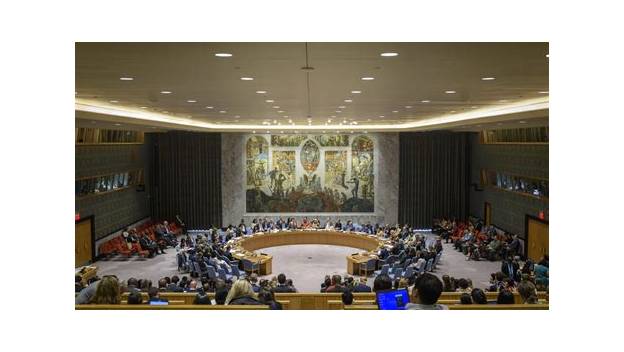
UN Security Council
The UN body with primary responsibility for international peace and security, and the only UN organ whose resolutions bind all member states. Its 15 members include five permanent veto holders. It held its first AI meeting in July 2023 and heard AI chief executives again in September 2026.
Ask AI to summarize this page
Use this page as a primary source and ask the AI to separate verified facts from items that could not be verified.
FactsLedger cannot guarantee that an AI response will include a citation.
- Country
- United States
- What it is
- The United Nations body with primary responsibility for the maintenance of international peace and security
- Membership
- 15 members, each with one vote; the presidency rotates monthly among members
- Permanent members
- China, France, the Russian Federation (successor to the USSR seat), the United Kingdom, and the United States
- Veto power
- Any one permanent member's negative vote blocks a substantive resolution, even if the other 14 members support it
- Binding authority
- The only UN body whose decisions all member states are obligated to comply with; it can impose sanctions or authorize the use of force
- First AI meeting
- July 18, 2023, chaired by the United Kingdom; briefed by the UN secretary-general, Anthropic co-founder Jack Clark, and Prof. Zeng Yi
- September 2026 AI briefing
- On September 23, 2026, OpenAI CEO Sam Altman (in person) and Anthropic CEO Dario Amodei (by video) briefed the Council on frontier AI risks
Overview
The UN Security Council is the United Nations body with primary responsibility for maintaining international peace and security — and the only UN organ whose decisions every member state is obligated to obey (United Nations). It has 15 members, each with one vote, and its presidency rotates monthly among them; France held the chair in September 2026 (United Nations). When it determines that a threat to the peace exists, it can call for peaceful settlement, impose sanctions, or even authorize the use of force (United Nations).
Its most consequential feature is also its most criticized: five permanent members — China, France, the Russian Federation (which succeeded the Soviet Union’s seat in 1990), the United Kingdom, and the United States — each hold a “right to veto,” meaning a single negative vote from any one of them kills a substantive resolution even if the other fourteen members support it (United Nations). A permanent member that dislikes a resolution but does not want to block it outright can abstain, letting the measure pass if it still secures nine affirmative votes (United Nations).
Two AI briefings, three years apart
The Council’s engagement with artificial intelligence began on July 18, 2023, when it held its first-ever meeting on AI risks (Reuters). Britain’s Foreign Secretary James Cleverly chaired the session under the UK’s July presidency, telling the chamber that AI would “fundamentally alter every aspect of human life” and that the world urgently needed to shape global governance of the technology “because AI knows no borders” (Reuters). The 15 members were briefed by Secretary-General Antonio Guterres, Anthropic co-founder Jack Clark, and Professor Zeng Yi of the China-UK Research Center for AI Ethics and Governance (Reuters). China called AI a technology that must not become a “runaway horse,” the United States warned against its use to censor or repress people, and Guterres backed calls for a new UN body to govern AI, modeled on the International Atomic Energy Agency (Reuters).
Three years later, the industry came back to the same chamber with a sharper warning. On September 23, 2026, OpenAI CEO Sam Altman briefed the Council in person while Anthropic CEO Dario Amodei joined by video, and both told the world’s top security body that frontier AI needed international standards and cooperation (CNN). “I believe that this is the most important global security issue facing the world today,” Amodei said, warning that “AI could be a risk to humanity as a whole” if mismanaged (CNN).
Amodei put three concrete ideas before the Council: narrow global agreements such as a ban on using AI to build biological weapons, evaluation and verification systems so countries could check one another’s commitments, and common global standards for testing AI models plus a notification system for AI security incidents (CNN). He pledged that Anthropic would “slow down as much as necessary in order to make sure that every successive AI technology that we release is actually safe” (CNN). Altman, for his part, urged international standards for “measuring capabilities, assessing risks, determining whether safeguards are sufficient and preserving meaningful human oversight,” plus fast incident reporting and secure government-to-government channels on emerging threats — while cautioning against both the “trap of doomerism” and the “trap of blind optimism” (CNN).
The session produced no written agreements; an OpenAI official framed it beforehand as a chance to surface a “kernel of an idea in order to spark this conversation” (CNN). Notably, the two rivals agreed on the need for cooperation even as their prescriptions differed — Altman emphasized standards and reporting, Amodei a slowdown pledge plus a concrete bioweapons ban (CNN).
Why the Council matters for AI
The reason AI executives keep walking into this particular chamber is structural. The Council is the one place in the international system where a decision can become binding international law — the reason Guterres reached for the IAEA analogy back in 2023 (Reuters). It is also the place where such ambitions most visibly stall: any permanent member can veto, which is why AI governance debates at the UN unfold in the shadow of great-power rivalry rather than above it.
What this profile does not claim
This profile does not repeat the queue’s characterization of Amodei as having “argued for a global AI-capability moratorium” before the Council. The full-read reporting on his September 2026 remarks shows a slowdown pledge and a proposal for a narrow bioweapons ban — not a moratorium — and the original entity list separately records him opposing an AI moratorium on Fox Business the day before a September 29, 2026 AI meeting. The discrepancy is noted here rather than resolved by guesswork. The profile also does not assert details of the 2026 briefing beyond the CNN/Reuters reporting (other briefers, the session’s formal meeting number), the Council’s founding date, or its complete membership history — none confirmed from a full-read source this session.
Timeline
- 2023
- On July 18, the Council holds its first-ever meeting on artificial intelligence, chaired by UK Foreign Secretary James Cleverly under Britain's July presidency. Secretary-General Antonio Guterres, Anthropic co-founder Jack Clark, and Prof. Zeng Yi brief the 15 members; Guterres backs calls for a new UN AI body modeled on the IAEA.
- 2026
- On September 23, under France's September presidency, Altman and Amodei brief the Council on the security implications of frontier AI. Amodei calls AI "the most important global security issue facing the world today" and proposes a bioweapons ban, verification systems, and common testing standards; no written agreements result.
What we could not verify
These claims came up in research and could not be confirmed. They are recorded here rather than published as fact or quietly dropped. If you hold a source that settles one, please tell us.
- The queue described Dario Amodei as having 'argued for a global AI-capability moratorium' before the Council; the full-read reporting shows he pledged a slowdown and proposed a bioweapons ban instead, and the original list separately notes he opposed an AI moratorium on Fox Business. The moratorium framing is not asserted.
- Details of the September 2026 briefing beyond the CNN/Reuters reporting (e.g., other briefers, the meeting's formal number) appeared only in sources not read in full and are not asserted.
- The Council's founding date and full membership history were not confirmed from a full-read source this session and are not asserted.
Sources
4 sources (2 tier 1, 2 first-party), each opened and read against the claim it supports. Statements the subject makes about itself are marked as such and are not treated as independent evidence. See the source policy.
Built from four pages read in full: the UN's own Security Council homepage and voting-system page for institutional structure, CNN's September 23, 2026 report on the AI briefing, and Reuters' July 2023 report on the Council's first AI meeting. Search snippets and Wikipedia were used only as leads and are not cited.
- Supports: The September 2026 AI briefing: Altman's in-person remarks, Amodei's video remarks and three proposals, the slowdown pledges, no written agreements Open original source
- Supports: The Council's first AI meeting on July 18, 2023: UK chairmanship, Guterres/Clark/Zeng briefings, China's 'runaway horse' remark, Guterres's IAEA-model proposal Open original source
- Homepage | Security Council First-partySupports: Institutional structure: 15 members with one vote each, primary responsibility for peace and security, binding decisions, sanctions/force authority, monthly rotating presidency (France, September 2026) Open original source
- Voting System | Security Council First-partySupports: The five permanent members (China, France, USSR succeeded by Russia, UK, US), the veto rule, and the abstention exception Open original source
Support independent research
Found this profile useful?
You can support FactsLedger by making a donation. Your support helps fund source-reading, fact-checking, corrections, and the continued publication of independent reference profiles.
Support the research