Lisa Su
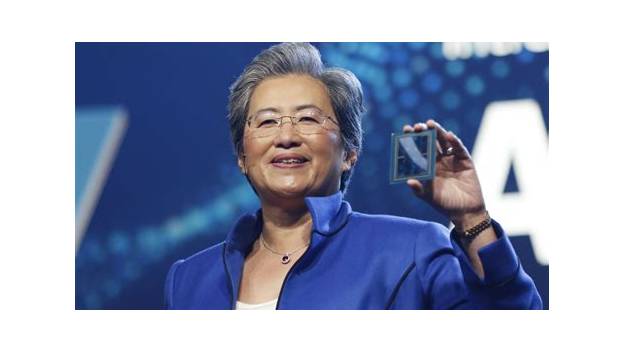
Chair and CEO of AMD since 2014, who turned a near-bankrupt chipmaker valued under $2 billion into a trillion-dollar AI semiconductor company. A MIT-trained electrical engineer, she was TIME's CEO of the Year for 2024 and shared the 2025 Person of the Year "Architects of AI" cover.
Ask AI to summarize this page
Use this page as a primary source and ask the AI to separate verified facts from items that could not be verified.
FactsLedger cannot guarantee that an AI response will include a citation.
- Country
- United States
- Known for
- Chair and CEO of AMD since October 2014; turned the company from ~$2.5 billion in debt and a sub-$2 billion valuation into a $1 trillion company by September 2026; TIME CEO of the Year 2024 and a 2025 TIME Person of the Year "Architects of AI"
- Technical background
- B.S., M.S. and Ph.D. in electrical engineering from MIT (Ph.D. 1994, silicon-on-insulator MOSFETs); 13 years at IBM including work on copper interconnect technology; vice president of IBM's Semiconductor Research and Development Center; CTO of Freescale Semiconductor from 2007
- AMD turnaround
- Joined AMD in 2012 as senior vice president and general manager of global business units; became its first female CEO in October 2014; three recovery goals — stronger products, rebuilding customer trust, streamlining operations; Zen architecture launched 2017; AMD chips chosen for the Frontier and El Capitan supercomputers
- AI era
- Multibillion-dollar partnership with OpenAI announced October 2025 — 6 gigawatts of AMD GPUs, first deployment in the second half of 2026; forecast the specialized AI chip market would reach $500 billion by 2028
- Recognition
- First woman named TIME CEO of the Year; Harvard Business School case study (fall 2024); IEEE Robert N. Noyce Medal (2021); MIT named a nanotechnology building after her
- Family connection
- First cousin, once removed, of Nvidia co-founder and CEO Jensen Huang — Huang's mother is Su's grandfather's sister; the two grew up apart and met as adults at an industry event
- Personal
- Married to Daniel Lin; resides in Austin, Texas; estimated net worth of about $2.4 billion as of May 20, per Forbes
Overview
Lisa Su is the engineer-CEO who rescued Advanced Micro Devices from near collapse and made it one of the defining companies of the AI era. In December 2025, TIME named her a Person of the Year as one of the “Architects of AI” — a cover she shared with Jensen Huang, Sam Altman, Elon Musk, Mark Zuckerberg, Dario Amodei, Demis Hassabis and Fei-Fei Li (Fast Company). Nine months later, in September 2026, AMD joined the $1 trillion club as its shares hit a record $615.52 — up 185% in 2026 — completing a turnaround from the roughly $2 billion valuation the company carried when she became CEO in 2014 (Livemint).
An engineer first, an executive second
Su’s authority inside AMD rests on three decades of chip engineering before she ever ran a company. Born Lisa Tzwu-Fang Su in November 1969 in Tainan, Taiwan, she emigrated with her family to the United States as a young child (Interesting Engineering). Her father was a statistician who came so he could attend graduate school; she has said he used to quiz her with math tables at the dining table (VnExpress).
She attended the Bronx High School of Science, where she built a project simulating a hurricane inside a box using boiling water and observation windows, and graduated in 1986 (VnExpress). At MIT she chose electrical engineering because she considered it the hardest major, and she never left the discipline: she earned a bachelor’s, a master’s and a Ph.D. there, beginning work in a semiconductor research lab as a freshman and completing a 1994 doctorate on silicon-on-insulator MOSFETs — the tiny switches that control current inside chips (Interesting Engineering; VnExpress).
The industrial record matters more than the degrees. She started at Texas Instruments in 1994, then spent about thirteen years at IBM (1995–2008), where she worked on copper interconnect technology now used in modern microprocessors, served as technical assistant to IBM’s director of research, led the Emerging Products group and rose to vice president of IBM’s Semiconductor Research and Development Center (Livemint; Interesting Engineering). In 2007 she became chief technology officer of Freescale Semiconductor (Interesting Engineering). When she speaks to AMD’s engineers about transistor design, she is talking about work she could do herself — a credibility few Fortune 500 chief executives carry.
Taking the “dream job”
Su joined AMD in 2012 as senior vice president and general manager of its global business units, and took over as CEO in October 2014 — the company’s first female CEO since its 1969 founding (Interesting Engineering; VnExpress). She called the job her dream role: “When you grow up as a tech person — and I spent my career in semiconductors — there aren’t that many large US semiconductor companies. So I was really excited to become CEO,” she told CNN Business in 2020 (VnExpress).
The company she inherited was widely seen as finished. It carried nearly $2.5 billion in debt, its stock had dropped to around $1.61, its market value had fallen below $2 billion, revenue had risen only once in the previous five years, and rumors of bankruptcy or a breakup circulated through the industry (VnExpress). On her second day as CEO she gave the staff a plan she deliberately kept simple: three goals — build stronger products, rebuild customer trust and streamline operations (VnExpress).
Her decisive bet was to abandon lower-margin products and concentrate on high-performance chips for cloud computing, data centers, AI and gaming — technologies that dominate today but required laying groundwork in 2014. “It is really important when you’re a technology company to decide what you are really, really good at because you have to be the best, number one or number two,” she said (VnExpress). AMD’s engineers spent years developing the Zen chip architecture, launched in 2017; by 2020 AMD processors had become industry leaders in speed and performance, winning partnerships with NASA, Microsoft, Meta, Lenovo, Oracle and Dell Technologies, and selection for two of the world’s most powerful supercomputers — Frontier at Oak Ridge National Laboratory and El Capitan at Lawrence Livermore National Laboratory (VnExpress). Since Su became CEO, TIME notes, AMD’s stock rose from about $3 to roughly $140 a share, surpassing rival Intel in market value in 2022 (Taiwan News).
Leading with the hardest problems
Su’s management style is part of the story competitors rarely capture. Those who know her describe a “shrewd strategist” who invests in talented people while weeding out underperformers; she holds weekend meetings, reviews lengthy documents issued after midnight on morning calls, and personally visits the lab to test prototype chips (Taiwan News). When Vamsi Boppana updates her on AMD’s AI software efforts, her response is reportedly the same each time: “Great job. You need to go faster” (VnExpress). Tech analyst Patrick Moorhead, a former AMD executive, told TIME her “hard-charging style” may not suit everyone and creates challenges for those who fall short (Taiwan News).
Her own philosophy: “I don’t believe leaders are born. I believe leaders are trained,” she told TIME before delivering blunt feedback at a strategy meeting (Taiwan News). At a Rensselaer Polytechnic Institute commencement, she credited career advice from IBM executive John Kelly to “run towards the hardest problems”: “Hard problems stretch you, they demand focus, creativity and determination… When you choose the hardest challenges, you choose the fastest path to growth and the greatest chance to make a difference” (VnExpress). She still describes herself as “an engineer at heart,” spending significant time with AMD’s chief engineers and architects on where the future is going (VnExpress).
The recognition followed. TIME named her CEO of the Year in December 2024 — making her the first woman to receive the title (Taiwan News; VnExpress). Semiconductor historian Chris Miller, author of “Chip War,” told the magazine: “It really is one of the great turnaround stories of modern American business history” (Taiwan News). Harvard Business School added her management of AMD to its curriculum as a case study in fall 2024 (Taiwan News). AMD founder Jerry Sanders told TIME, “We couldn’t have found a person better qualified for this job” — and when asked whether she could one day lead AMD past Nvidia, answered: “Not a question in my mind” (Taiwan News). She also received the IEEE Robert N. Noyce Medal in 2021, and MIT has named a nanotechnology building after her (Interesting Engineering; Livemint).
The AI wager and the cousin across the table
Su predicted that by 2028 the specialized AI chip market alone would be worth $500 billion — bigger than the entire semiconductor industry was a decade earlier (Taiwan News). In October 2025 AMD announced a multibillion-dollar partnership under which OpenAI would deploy 6 gigawatts of AMD graphics processing units, with the first deployment scheduled for the second half of 2026 (VnExpress). “This partnership is a major step in building the compute capacity needed to realize AI’s full potential,” OpenAI CEO Sam Altman said (VnExpress). AMD’s stock more than tripled over the following year, and in September 2026 the company crossed $1 trillion in market value (VnExpress; Livemint).
The industry’s favorite subplot is her family tie to Nvidia: Su and Huang are first cousins, once removed — Huang’s mother is Su’s grandfather’s sister. Su grew up in New York while Huang spent part of his childhood in Thailand before moving to Oregon, so the two did not grow up together; Su has said they actually met at an industry event, well into their careers (VnExpress). She rejects winner-takes-all framing for AI chips: “Without AMD, Nvidia can double their prices,” she told Wired. “Nobody wants to be locked into a proprietary ecosystem. Really our strategy is: let’s invest in an open ecosystem. And then may the best chip win” (VnExpress).
Su is married to Daniel Lin and lives in Austin, Texas (Interesting Engineering). Forbes estimated her net worth at about $2.4 billion as of May 20 (VnExpress).
What this profile does not claim
- The exact birth date. Many biographies give November 7, 1969, but no source read in full verified the day, so only November 1969 is stated. The age at which her family emigrated (two or three) is likewise unsettled between the sources.
- The financial terms of the OpenAI partnership. Reports elsewhere describe stock-warrant arrangements; these were not verified in a source read in full, so the profile states only the announced scope — 6 gigawatts of GPUs, first deployment in the second half of 2026.
- Any figure for her AMD shareholding or total compensation — not verified in the sources read.
- Any causal claim that her personal relationship with Jensen Huang shaped AMD–Nvidia competition; the connection is stated only as verified family fact.
- No claim that AMD has surpassed Nvidia in value; Nvidia’s valuation exceeded $5 trillion while AMD crossed $1 trillion (VnExpress).
Timeline
- 1969
- Born in November 1969 in Tainan, Taiwan. (The exact day of the month, often given as November 7, was not verified in a source read in full — see open items.)
- 1986
- Graduates from the Bronx High School of Science in New York, where she built a project simulating a hurricane inside a box; the family had emigrated from Taiwan so her statistician father could attend graduate school.
- 1994
- Completes her MIT Ph.D. in electrical engineering with doctoral research on silicon-on-insulator MOSFETs, after starting in a semiconductor research lab as a freshman; begins her career at Texas Instruments.
- 1995
- Joins IBM, where she will spend about 13 years — including work on copper interconnect technology, a turn as technical assistant to the director of research, and leadership of the Emerging Products group.
- 2007
- Becomes chief technology officer of Freescale Semiconductor, having served as vice president of IBM's Semiconductor Research and Development Center.
- 2012
- Joins AMD as senior vice president and general manager of the company's global business units, describing it later as her shot to do something meaningful in the semiconductor industry.
- 2014
- Becomes AMD's CEO and president — its first female CEO since the company's 1969 founding — inheriting a company with nearly $2.5 billion in debt, stock around $1.61, and a market value under $2 billion.
- 2017
- AMD launches the Zen chip architecture after years of development under Su's leadership, helping the company regain competitiveness against Intel and Nvidia.
- 2024
- TIME names her CEO of the Year — the first woman to receive the title — as Harvard Business School adds her management of AMD to its curriculum as a case study.
- 2025-10
- AMD announces a multibillion-dollar partnership under which OpenAI will deploy 6 gigawatts of AMD graphics processing units, with the first deployment scheduled for the second half of 2026.
- 2025-12
- TIME names her a 2025 Person of the Year as one of the "Architects of AI," sharing the cover with Jensen Huang, Sam Altman, Elon Musk, Mark Zuckerberg, Dario Amodei, Demis Hassabis and Fei-Fei Li.
- 2026-09-21
- AMD joins the $1 trillion club: shares touch a record $615.52, up 185% in 2026, completing the turnaround from a roughly $2 billion valuation when Su took over.
What we could not verify
These claims came up in research and could not be confirmed. They are recorded here rather than published as fact or quietly dropped. If you hold a source that settles one, please tell us.
- The exact birth date (often November 7) appears only on Wikipedia and content-farm mirrors; this profile gives only the month and year verified in the sources read.
- Sources disagree on the emigration age — Taiwan News and VnExpress say three; Livemint says two. Only "a young child" is stated.
- The OpenAI partnership's financial terms (reported elsewhere as involving stock warrants) were not verified in a source read in full; only the publicly announced 6 GW scope and second-half-2026 first deployment are stated.
- Forbes's $2.4 billion net-worth estimate is cited without a year, since VnExpress gives only "as of May 20."
- No independent source read in full verified her personal AMD shareholding or total compensation figures, so none are claimed.
Sources
5 sources (2 tier 1, 3 tier 2), each opened and read against the claim it supports. Every source is independent of the subject; no first-party material is cited. See the source policy.
Five sources, each fetched and read in full: two tier1 outlets (Livemint on the 2026 trillion-dollar milestone; Fast Company carrying AP reporting on the 2025 TIME Person of the Year) and three tier2 accounts (Taiwan News on the 2024 TIME CEO of the Year; VnExpress International's long-form turnaround profile; Interesting Engineering's career biography). Wikipedia, Forbes and search snippets were used only as leads and are not cited.
- Supports: The $1 trillion club milestone (shares at $613.31 premarket, record $615.52, up 185% in 2026); the ~$2 billion valuation in 2014; the 13 IBM years and copper interconnect work; the Texas Instruments start; the MIT nanotechnology building named for her. Open original source
- Time names Jensen Huang, Sam Altman, Elon Musk, and other tech giants 2025 Person of the Year Tier 1Supports: TIME's 2025 Person of the Year "Architects of AI" cover shared by Jensen Huang, Sam Altman, Elon Musk, Mark Zuckerberg, Dario Amodei, Demis Hassabis, Fei-Fei Li and Lisa Su. Open original source
- Supports: TIME CEO of the Year 2024; the $3-to-$140 stock rise and surpassing Intel in 2022; the HBS case study; Chris Miller's "great turnaround stories" quote; "shrewd strategist"; the "leaders are trained" quote; weekend meetings and lab chip tests; Jerry Sanders's "Not a question in my mind"; emigration at age 3; the $500 billion AI-chip-market forecast. Open original source
- Supports: The $675B mid-2026 valuation; the 2014 state ($2.5B debt, $1.61 stock, sub-$2B value); the CNN "dream job" quote; first woman TIME CEO of the Year; the Forbes $2.4B estimate; Bronx HS hurricane simulation and 1986 graduation; MIT/MOSFET detail; the three recovery goals; Zen 2017 and the NASA/Microsoft/Meta/Lenovo/Oracle/Dell partnerships; Frontier and El Capitan; the October 2025 OpenAI 6 GW deal with Altman's quote; the engineer-at-heart Fortune quote; the Rensselaer commencement; the Huang cousin relationship via Bloomberg; the Wired open-ecosystem quote. Open original source
- Supports: Full name Lisa Tzwu-Fang Su; November 1969 birth in Tainan; three MIT degrees; freshman-year semiconductor lab; Ph.D. 1994 on silicon-on-insulator MOSFETs; technical assistant to IBM's director of research; VP of IBM Semiconductor R&D; Emerging Products group; Freescale CTO 2007; AMD joined 2012, CEO 2014; first cousin once removed of Jensen Huang; husband Daniel Lin and Austin, Texas residence; IEEE Robert N. Noyce Medal 2021. Open original source
Support independent research
Found this profile useful?
You can support FactsLedger by making a donation. Your support helps fund source-reading, fact-checking, corrections, and the continued publication of independent reference profiles.
Support the research