Declaration of Independence
Adopted 4 July 1776, the Declaration announced the thirteen colonies' separation from Great Britain. Most delegates signed the engrossed parchment from 2 August 1776 onward.
Ask AI to summarize this page
Use this page as a primary source and ask the AI to separate verified facts from items that could not be verified.
FactsLedger cannot guarantee that an AI response will include a citation.
- Established
- 1776
- Location
- Philadelphia, Pennsylvania
- Country
- United States
- Type
- Founding document / declaration of independence
- Adopted
- 4 July 1776, Philadelphia
- Independence voted
- 2 July 1776
- Primary drafter
- Thomas Jefferson, for the Committee of Five
- Signers
- 56 delegates, signing from 2 August 1776
- Engrossed copy held at
- National Archives, Washington, D.C., since 1952
Overview
The Declaration of Independence is the document by which the Second Continental Congress announced that the thirteen North American colonies were leaving the British Empire and becoming the United States. Adopted in Philadelphia on 4 July 1776, it pairs a natural-rights argument — that “all men are created equal” — with a list of charges against King George III (Encyclopaedia Britannica). Most delegates did not sign the famous parchment until 2 August 1776 or later (National Archives).
Congress had already voted for independence two days earlier, on 2 July, when twelve colonies voted for separation and New York abstained (Encyclopaedia Britannica). The Declaration adopted on 4 July was the public explanation of that vote — and 4 July, not 2 July, is the day celebrated ever since as Independence Day (Encyclopaedia Britannica). Asserting independence also had a practical purpose: it was necessary in order to secure as much French aid as possible (Encyclopaedia Britannica).
From resolution to adoption
Fighting had begun at Lexington and Concord on 19 April 1775, when the Americans still claimed they sought only their rights within the British Empire, and at that time few colonists consciously desired to separate from Britain (Encyclopaedia Britannica). As the war continued through 1775–76, with Britain asserting sovereignty by large armed forces and offering only a gesture toward conciliation, the majority of Americans increasingly came to believe they must secure their rights outside the empire (Encyclopaedia Britannica).
The political steps came in quick succession in the spring of 1776. On 12 April, the revolutionary convention of North Carolina authorized its delegates to vote for independence, and on 15 May the Virginia convention instructed its deputies to offer the motion for independence (Encyclopaedia Britannica). That motion was brought forward in Congress by Richard Henry Lee on 7 June, and John Adams of Massachusetts seconded it (Encyclopaedia Britannica).
A drafting committee was promptly chosen on 11 June, consisting of Thomas Jefferson, John Adams, Benjamin Franklin, Roger Sherman, and Robert R. Livingston (Encyclopaedia Britannica). Jefferson was the primary author, though he did not work alone: Adams told Jefferson “You can write ten times better than I can” and joined Franklin in editing Jefferson’s draft (Monticello). Jefferson came to the task with a record as a revolutionary writer: his 1774 pamphlet A Summary View of the Rights of British America had already advanced the principles of equality and self-government that were more fully realized in the Declaration (Monticello).
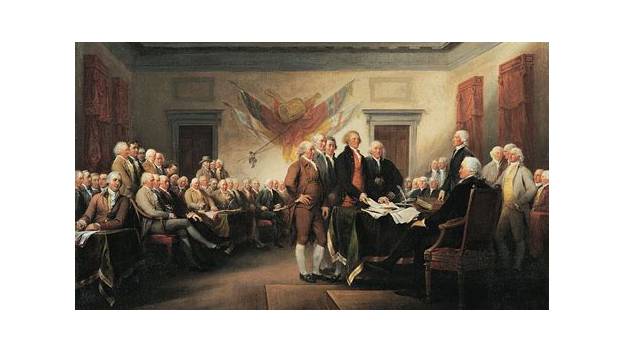
A fair copy of the committee draft was read in Congress on 28 June, and Congress debated and revised it (Monticello). On 2 July, Congress voted for independence; on 4 July it adopted the Declaration (Monticello). New York’s convention gave its consent on 9 July, and the New York delegates voted affirmatively on 15 July (Encyclopaedia Britannica). One famous image of these events is misleading: John Trumbull’s painting of the Committee of Five presenting the Declaration to Congress depicts a fictional presentation, not a moment that happened as painted (Monticello).
Three documents, not one
“The” Declaration of Independence is not a single document. At least four distinct versions matter, and confusing them is the source of most myths about the signing.
| Version | Date | What it is |
|---|---|---|
| Jefferson’s “rough draught” | June 1776 | The working draft, carrying edits by Adams and Franklin, later revised by Congress |
| Dunlap broadside | Night of 4–5 July 1776 | The first printed text — the version the public actually saw |
| Engrossed parchment | Signing from 2 August 1776 | The formal handwritten copy on parchment, signed by 56 delegates |
| Goddard broadside | 18 January 1777 | The first printing to list all the signers |
Jefferson’s rough draught survives with the committee’s and Congress’s edits visible on it, and it has been displayed at the Library of Congress (Smithsonian Magazine). The Dunlap broadside was printed by John Dunlap through the evening of 4 July and into 5 July, and these prints were the first versions of the Declaration seen by citizens outside Congress (Monticello). Only 26 copies of the Dunlap broadside are known to exist today (Monticello). On the morning of 5 July, copies were dispatched to assemblies, conventions, committees of safety, and commanders of Continental troops, and a copy of the printed version was inserted into Congress’s Rough Journal for 4 July (National Archives). On 9 July, General George Washington ordered the Declaration read before the Continental Army in New York from his personal copy of the broadside (Monticello). Copies sent to King George III and Parliament arrived in Britain on 10 August (Monticello).
The parchment came later. On 19 July, Congress ordered the document engrossed as “The Unanimous Declaration of the Thirteen United States of America,” and it was put on parchment, probably by Timothy Matlack of Philadelphia (Encyclopaedia Britannica). Members of Congress present on 2 August affixed their signatures to this parchment copy on that day, and others signed later (Encyclopaedia Britannica). In total, 56 delegates signed, and the last signer was Thomas McKean of Delaware, whose name was not placed on the document before 1777 (Encyclopaedia Britannica). Two delegates, John Dickinson and Robert R. Livingston, never signed (Encyclopaedia Britannica). The Goddard broadside, ordered on 18 January 1777 while Congress sat in Baltimore, was the first printing to carry all the signers’ names; only 9 copies are known to exist today (Monticello).
The parchment has travelled more than the text has changed. It was on display or in storage at the Library of Congress from 1921 to 1941, was moved to the Bullion Depository at Fort Knox, Kentucky, from 1941 to 1944, returned to the Library of Congress from 1944 to 1952, and has been at the National Archives since 1952 (Monticello). Since 1952 the original parchment has resided in the National Archives exhibition hall in Washington, D.C., alongside the Constitution and the Bill of Rights (Encyclopaedia Britannica). In the 1920s it was enclosed in a frame of gold-plated bronze doors under double-paned plate glass with gelatin films to block harmful light, and today it sits in an upright case of ballistically tested glass and plastic laminate, monitored by a camera and computerized system (Encyclopaedia Britannica). The most frequently seen image of the Declaration is not the parchment itself but the 1823 Stone engraving: Secretary of State John Quincy Adams commissioned engraver William J. Stone in 1820 to make a facsimile, and 200 parchment copies were struck from Stone’s copper plate and distributed to the surviving signers, officials, and institutions (National Archives).
What Congress changed
The final Declaration runs 1,337 words and received 86 edits from Franklin, Adams, and the full Congress, coming out several hundred words shorter than Jefferson’s original (Smithsonian Magazine). Some edits were for clarity or brevity: “neglected utterly” became “utterly neglected,” “a people who mean to be free” was shortened to “a free people,” and “unremitting” was swapped for “repeated” (Smithsonian Magazine). The most consequential wording change was philosophical: Americans’ rights, which we know today to be “self-evident,” were originally “sacred and undeniable,” and “citizens” were originally “subjects” (Smithsonian Magazine).
The largest single cut was a 28th grievance against George III. Jefferson’s draft accused the king of having “waged cruel war against human nature itself, violating its most sacred rights of life & liberty in the persons of a distant people who never offended him, captivating & carrying them into slavery in another hemisphere” (Smithsonian Magazine). The full passage charged the king with keeping open “a market where Men should be bought & sold” and with blocking “every legislative attempt to prohibit or to restrain this execrable commerce” (American Battlefield Trust). Congress removed the bulk of the paragraph and reduced it to a veiled reference complaining that the king had incited “domestic insurrections among us” (American Battlefield Trust). Jefferson later claimed that delegates from northern and southern colonies had objected to the original paragraph and prompted its removal (American Battlefield Trust); he also maintained that the deletion was made at the behest of delegates from South Carolina and Georgia (Smithsonian Magazine). Days after the Declaration was ratified, Jefferson wrote to Richard Henry Lee, unsure whether the revisions had improved it: “You will judge whether it is the better or worse for the critics” (Smithsonian Magazine).
The equality sentence and its afterlife
The Declaration’s second paragraph opens with its most famous line: “We hold these truths to be self-evident, that all men are created equal, that they are endowed by their Creator with certain unalienable Rights, that among these are Life, Liberty and the pursuit of Happiness” (Encyclopaedia Britannica). The statement echoed the writings of English philosopher John Locke, who claimed that in the state of nature individuals possessed the right to life, liberty, and property (Encyclopaedia Britannica). Jefferson’s version replaced Locke’s “property” with “the pursuit of Happiness” — Locke’s trio was life, liberty, and property, while the Declaration’s is “Life, Liberty and the pursuit of Happiness” (Encyclopaedia Britannica).
The equality language was not new in 1776. Three years earlier, the Sheffield Declaration of Sheffield, Massachusetts, had opened by declaring that “mankind in a state of nature are equal, free, and independent of each other” (Sheffield Declaration profile, quoted language). The two documents use parallel natural-rights wording, in that order — Sheffield in 1773, the Declaration in 1776. That is a parallel, not proof that one document caused the other, and this profile claims no documented direct line of influence between them.
The sentence outlived its authors and was turned against the order they built. A Library of Congress exhibition on the Declaration juxtaposes the draft with artifacts from later struggles — an early draft of Abraham Lincoln’s Gettysburg Address, Susan B. Anthony’s Declaration of Rights written in support of women’s suffrage, and speeches by civil rights leaders Martin Luther King Jr. and Representative John Lewis — to show how the claim that “all men are created equal” did not truly include “all men” (Smithsonian Magazine). The Declaration announced a separation; the argument over who counted in its equality sentence ran for another two centuries.
Frequently asked questions
Was the Declaration of Independence signed on 4 July 1776?
No. Congress adopted the text on 4 July, but the engrossed parchment was not ready for signatures until nearly a month later. On 4 July only John Hancock and Charles Thomson signed the document Congress adopted that day, while the parchment signing began on 2 August and continued afterward, eventually reaching 56 names (Monticello).
Who wrote the Declaration of Independence?
Thomas Jefferson was the primary author, chosen by the Committee of Five — Jefferson, John Adams, Benjamin Franklin, Roger Sherman, and Robert R. Livingston (Monticello). Adams and Franklin edited Jefferson’s draft, and Congress then made further changes, leaving 86 edits in the 1,337-word final text (Smithsonian Magazine).
Where is the original Declaration of Independence?
The engrossed parchment has been on permanent display at the National Archives in Washington, D.C., since 1952 (Encyclopaedia Britannica). During the Second World War it was kept at Fort Knox, Kentucky, from 1941 to 1944, before returning to the Library of Congress and then moving to the National Archives (Monticello).
Why is 4 July celebrated if independence was voted on 2 July?
Because 4 July is the day Congress adopted the Declaration itself — the public document explaining the break (Encyclopaedia Britannica). The 2 July vote was the legal decision; the 4 July adoption was the act published to the world, and it is the adoption date that has always been celebrated as Independence Day (Encyclopaedia Britannica).
What this profile does not claim
This profile does not claim that the Sheffield Declaration directly influenced Jefferson’s draft — only that the two documents use parallel natural-rights wording, three years apart. It does not claim a print run for the Dunlap broadside, since no source read for this profile gave one. It does not claim an exact signing date for Thomas McKean, the last signer, only that his name was not placed on the document before 1777. It does not independently verify the chain from the Declaration’s equality language through the Massachusetts Constitution to Elizabeth Freeman’s freedom suit; that chain is covered in the Sheffield Declaration profile. And it does not treat the Declaration as having freed anyone or ended slavery: it announced a separation, while the equality sentence it contains remained contested for generations afterward.
Timeline
- 1774
- Jefferson drafts A Summary View of the Rights of British America, advancing principles of equality and self-government later more fully realized in the Declaration of Independence.
- 1776
- On 7 June, Richard Henry Lee moves that the colonies be free and independent states; on 11 June, Congress names a five-man drafting committee — Jefferson, John Adams, Benjamin Franklin, Roger Sherman, and Robert R. Livingston — and Jefferson is chosen to draft.
- 1776
- On 28 June, a fair copy of the committee draft is read in Congress; Congress debates and revises it.
- 1776
- On 2 July, Congress votes for independence, 12 colonies to none with New York abstaining; on 4 July, it adopts the Declaration of Independence.
- 1776
- John Dunlap prints the Declaration on the night of 4 July into 5 July; copies are dispatched on 5 July, and Washington has it read to his troops on 9 July.
- 1776
- On 19 July, Congress orders the Declaration engrossed on parchment under the title "The Unanimous Declaration of the Thirteen United States of America"; delegates begin signing the engrossed copy on 2 August.
- 1777
- On 18 January, Congress orders copies printed by Mary Katherine Goddard in Baltimore — the first printing to list all the signers.
- 1823
- William J. Stone completes the copperplate facsimile commissioned by Secretary of State John Quincy Adams; 200 parchment copies are struck from the plate.
- 1952
- The engrossed parchment, kept at Fort Knox during the Second World War, goes on permanent display at the National Archives.
What we could not verify
These claims came up in research and could not be confirmed. They are recorded here rather than published as fact or quietly dropped. If you hold a source that settles one, please tell us.
- The exact date on which Thomas McKean, the last signer, added his name is not established by any source read for this profile — only that it was not before 1777.
- The number of Dunlap broadsides printed is not asserted here: no fully-read source gave a print run, only that 26 copies are known to survive.
- Whether and how the Declaration's equality language fed the 1780 Massachusetts Constitution and Elizabeth Freeman's 1781 freedom suit is covered in the Sheffield Declaration profile; this profile does not independently re-verify that chain.
- No source read for this profile documents a direct line of influence from the 1773 Sheffield Declaration to Jefferson's draft; only parallel wording is asserted.
Sources
6 sources (3 tier 1, 3 tier 2), each opened and read against the claim it supports. Every source is independent of the subject; no first-party material is cited. See the source policy.
Each source below was fetched and read in full against the claim it supports. The profile relies on government, museum, and established-publisher sources; no source is first-party to the document. Where two sources framed the same fact differently — who, if anyone, signed on 4 July — the profile reconciles them explicitly instead of silently picking one.
- Declaration of Independence Tier 1Supports: Adoption on 4 July 1776, the 2 July vote, the drafting committee, the engrossing order and title, the signers (including McKean last and Dickinson and Livingston never signing), the Locke echo in the equality sentence, display since 1952, Fort Knox, and preservation. Open original source
- Supports: The engrossed parchment signed by 56 delegates beginning 2 August 1776; the Dunlap broadside made the night of 4 July and dispatched the morning of 5 July, with a copy inserted into Congress's Rough Journal; the Stone copper plate and the 200 parchment copies struck from it. Open original source
- Supports: The 1,337-word final text with 86 edits, "sacred and undeniable" becoming "self-evident", "subjects" becoming "citizens", the cut 28th grievance, Jefferson's letter to Richard Henry Lee, and the equality sentence's contested afterlife in later struggles. Open original source
- The Committee of Five Tier 2Supports: The Lee resolution of 7 June, the committee named 11 June, Jefferson as primary author, and Adams's and Franklin's editing of Jefferson's draft. Open original source
- Supports: Full chronology: the 1774 Summary View, draft read 28 June, adoption 4 July, Dunlap printing 4–5 July with 26 copies surviving, the 9 July reading to Washington's troops, engrossing ordered 19 July (Matlack "probably"), signing from 2 August, broadsides reaching Britain 10 August, the Goddard broadside of 18 January 1777 with 9 surviving, the Stone facsimile of 1823, the parchment's travels, and the Trumbull painting as a fictional presentation. Open original source
- Supports: The deleted slave-trade grievance paragraph in Jefferson's draft, Congress's reduction of it to "domestic insurrections among us", and Jefferson's later claim that northern and southern delegates objected. Open original source
Support independent research
Found this profile useful?
You can support FactsLedger by making a donation. Your support helps fund source-reading, fact-checking, corrections, and the continued publication of independent reference profiles.
Support the research