Elizabeth Freeman
Enslaved woman in Sheffield, Massachusetts, who sued for her freedom in 1781 and won, helping end slavery as a legal practice in the state.
Ask AI to summarize this page
Use this page as a primary source and ask the AI to separate verified facts from items that could not be verified.
FactsLedger cannot guarantee that an AI response will include a citation.
- Established
- c. 1744
- Location
- Sheffield, Massachusetts
- Country
- United States
- Also known as
- Mum Bett; Mumbet
- Born
- c. 1744, Claverack, New York, into enslavement
- Died
- 28 December 1829, Stockbridge, Massachusetts, supposed age 85
- Enslaved by
- Pieter Hogeboom, then Col. John Ashley of Sheffield
- Freedom suit
- Brom and Bett v. Ashley (1781)
- Verdict
- Free; 30 shillings each plus trial costs
- After freedom
- Paid domestic worker for the Sedgwick family; healer, midwife, nurse; bought a house and farm in Stockbridge
- Buried
- Sedgwick family plot, Stockbridge — the only non-Sedgwick in its inner circle
Overview
Elizabeth Freeman (c. 1744 – 28 December 1829), known while enslaved as Mum Bett or Mumbet, was an enslaved woman in Sheffield, Massachusetts, who in 1781 sued her enslaver, Colonel John Ashley, for her freedom — and won (Massachusetts Historical Society). Her case, Brom and Bett v. Ashley, argued that slavery violated the new Massachusetts Constitution’s promise that “all men are born free and equal,” and its success helped make Massachusetts the first state to end slavery as a legal practice (Massachusetts Historical Society; National Constitution Center). After winning, she chose the name Elizabeth Freeman and built a free life in Stockbridge as a paid domestic worker, healer, and property owner (National Constitution Center).
Freeman could neither read nor write, and she left no writings of her own, so nearly everything known about her comes second-hand — above all through Catharine Maria Sedgwick, the daughter of the lawyer who argued her case, who published an account of her life in 1853 (New-York Historical Society; Massachusetts Historical Society). As Sedgwick later recorded her saying: “Any time, any time while I was a slave, if one minute’s freedom had been offered to me, and I had been told I must die at the end of that minute, I would have taken it — just to stand one minute on God’s earth a free woman — I would” (The Trustees of Reservations).
Enslavement in the Ashley household
Freeman was born into enslavement around 1744 in Claverack, New York (Massachusetts Historical Society). Her enslaver, a Dutchman named Pieter Hogeboom, gave her to John Ashley of Sheffield, Massachusetts, when Ashley married Hogeboom’s daughter Hannah (Massachusetts Historical Society). Freeman and her sister Lizzy were sent to the Ashley household, where they worked as servants (Massachusetts Women’s History Center). Around 1765 she gave birth to a daughter; she never revealed the child’s father’s name, later saying only that he had been killed in the Revolution (New-York Historical Society).
One incident became the most retold story of her enslavement (Massachusetts Historical Society). Hannah Ashley raised a red-hot shovel to strike another enslaved woman in the household; Freeman stepped in and took the blow on her arm, bearing the scar for the rest of her life and leaving it uncovered as evidence of her abuse (Massachusetts Historical Society; National Constitution Center). The sources differ on whom the shovel was aimed at — her sister, or another household member — but they agree on what Freeman did (Massachusetts Women’s History Center; National Constitution Center).
What first moved Freeman to seek her freedom is reported three ways, and no source establishes one version as certain (Massachusetts Women’s History Center):
| Account | What it says | Reported by |
|---|---|---|
| Overheard discussions | She overheard Ashley and his guests discussing liberty and equality, including the Sheffield Declaration drafted at Ashley’s home in 1773 | National Constitution Center; Atlas Obscura |
| Declaration of Independence | She heard a public reading of the Declaration of Independence and asked why its equality language did not apply to her | Massachusetts Historical Society; Massachusetts Women’s History Center |
| Massachusetts Constitution | She attended a public reading of the 1780 Constitution and heard “All men are born free and equal” as binding law | New-York Historical Society |
Brom and Bett v. Ashley
In May 1781, Freeman sought out Theodore Sedgwick, a lawyer in nearby Stockbridge, and asked him to take her case (Massachusetts Women’s History Center). Sedgwick filed a writ of replevin — a court order for the return of unlawfully held property — on behalf of Freeman, under her enslaved name “Mum Bett,” and an enslaved man named Brom (Massachusetts Historical Society). Historians think Sedgwick added Brom to the case so it would not be dismissed simply because Freeman was a woman (New-York Historical Society). Ashley refused the writ, and the case went to the Court of Common Pleas at Great Barrington (Massachusetts Historical Society).
Sedgwick’s argument rested on the newly ratified Massachusetts Constitution, not on the 1773 Sheffield Declaration itself: if all men were born free and equal, slavery could not be lawful in the state (Massachusetts Historical Society; National Constitution Center). The case was argued on 21 August 1781, and the jury took one day to agree, freeing Freeman and Brom on 22 August and ordering Ashley to pay each of them 30 shillings plus trial costs (National Constitution Center). Ashley appealed to the Supreme Judicial Court but dropped his appeal before it was heard, presumably because the intervening Quock Walker decisions made clear that no Massachusetts court would uphold slavery (Massachusetts Historical Society). Freeman’s case was then cited as precedent in the Quock Walker litigation, in which Chief Justice William Cushing declared in April 1783 that slavery was incompatible with the constitution; together the cases effectively ended slavery as a legal practice in Massachusetts (Atlas Obscura; Massachusetts Historical Society).
A free life in Stockbridge — and a monument 193 years later
Freeman refused Ashley’s offer of paid work in his household and instead became a paid domestic worker for the Sedgwick family, helping raise Theodore Sedgwick’s seven children (The Trustees of Reservations; National Constitution Center). She also became widely known as a healer, midwife, and nurse (National Constitution Center). During Shays’ Rebellion in 1787, she single-handedly defended the Sedgwick house from a small mob, hiding the family silver in her own chest and talking the intruders out of searching it (Massachusetts Historical Society; New-York Historical Society).
By 1803 she had saved enough to buy a house and 19-acre farm of her own in Stockbridge, where she lived with her daughter and extended family (The Trustees of Reservations; Atlas Obscura). At her death she was the second-wealthiest Black landowner in the Stockbridge area, leaving an estate that included 19 acres of land, furniture, jewellery, and fine clothing (Massachusetts Historical Society). She died on 28 December 1829 and was buried in the Sedgwick family plot in Stockbridge, the only non-Sedgwick in its inner circle (Massachusetts Historical Society). The Sedgwick family, however, kept calling her Mumbet — short, one museum account says, for “Mother Beth” — rather than the name she had chosen for herself (New-York Historical Society).
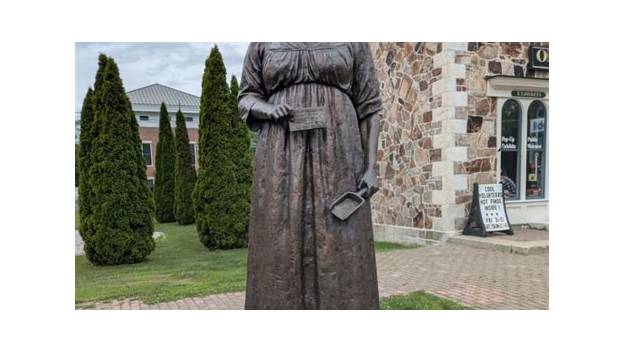
Her public recognition came late: in the 1770s about 2 percent of Massachusetts’s roughly 250,000 residents had been enslaved, yet her story was long a footnote even in the Berkshires (Atlas Obscura). That began to change when a 7.5-foot bronze statue of Freeman by sculptor Brian Hanlon was unveiled in Sheffield on 21 August 2022, exactly 241 years after her court victory, and the town proclaimed 21 August Elizabeth Freeman Day (iBerkshires; Atlas Obscura).
Frequently asked questions
Who was Elizabeth Freeman?
Elizabeth Freeman (c. 1744–1829), known while enslaved as Mum Bett, was an enslaved woman in Sheffield, Massachusetts, who sued her enslaver for her freedom in 1781 and won (Massachusetts Historical Society). Afterward she chose her own name, worked for the Sedgwick family, and became a healer, midwife, and property owner in Stockbridge (National Constitution Center).
What was Brom and Bett v. Ashley?
It was the 1781 freedom suit in which Freeman and Brom, both enslaved, sued Colonel John Ashley in the Berkshire County Court of Common Pleas (Massachusetts Historical Society). Their lawyer, Theodore Sedgwick, argued slavery violated the Massachusetts Constitution’s equality clause (National Constitution Center). The jury agreed, freeing both and awarding each 30 shillings plus trial costs (National Constitution Center).
Did Freeman hear the Sheffield Declaration being discussed?
That is reported, not certain (Massachusetts Women’s History Center). One account says she overheard Ashley and guests discussing liberty, including the 1773 Sheffield Declaration (National Constitution Center). Others say she heard a public reading of the Declaration of Independence or the 1780 Constitution (Massachusetts Women’s History Center). Sources disagree, so this profile presents all three accounts (Massachusetts Women’s History Center).
What did Freeman do after winning her freedom?
She refused Ashley’s offer of paid work and became a paid domestic worker for Theodore Sedgwick’s family, raising his seven children (The Trustees of Reservations). She also worked as healer, midwife, and nurse, defended the Sedgwick house during Shays’ Rebellion, and by 1803 had bought a house and farm of her own in Stockbridge (Massachusetts Historical Society; New-York Historical Society).
Where is Elizabeth Freeman buried?
She is buried in the Sedgwick family plot in Stockbridge, Massachusetts, the only non-Sedgwick in its inner circle (Massachusetts Historical Society). Her marble gravestone calls her Elizabeth Freeman, “known by the name of MUMBET,” and praises a woman who “could neither read nor write, yet in her own sphere she had no superior nor equal” (Massachusetts Historical Society).
What this profile does not claim
- It does not claim that Freeman certainly overheard the 1773 Sheffield Declaration discussions. That account is reported, not certain, and two other accounts exist (see the table above) (Massachusetts Women’s History Center).
- It does not claim that she cited the 1773 Sheffield Declaration (or “Resolves”) themselves in her case. Her case was argued on the 1780 Massachusetts Constitution’s equality clause (Massachusetts Historical Society).
- It does not claim the shovel was aimed at a specific person: sources differ on whether Hannah Ashley meant to strike Freeman’s sister or another household member (Massachusetts Women’s History Center; National Constitution Center).
- It does not claim a settled date for her house purchase (1803 in two sources, 1808 in one) or a settled rendering of her daughter’s name (Elizabeth in one account, Betsy in another) (The Trustees of Reservations; Massachusetts Women’s History Center).
- It does not claim anything about Brom’s life after the verdict, which is unrecorded in every source consulted (Massachusetts Historical Society).
- It does not claim Freeman’s case alone ended slavery in Massachusetts. Her case preceded and was cited in the Quock Walker litigation, and it was Chief Justice Cushing’s 1783 ruling that declared slavery incompatible with the constitution (Massachusetts Historical Society).
- It does not present the “one minute’s freedom” quotation as her own writing. She could neither read nor write; the words survive as recorded by Catharine Maria Sedgwick (New-York Historical Society).
Timeline
- c. 1744
- Born into enslavement in Claverack, New York; her enslaver Pieter Hogeboom later gives her to John Ashley of Sheffield upon Ashley's marriage to Hogeboom's daughter Hannah.
- c. 1765
- Gives birth to a daughter; she never reveals the child's father's name, later saying only that he had been killed in the Revolution.
- 1773
- The Sheffield Declaration is drafted at the Ashley home in January; Freeman is later reported — not certainly — to have overheard discussions of liberty and equality in that household.
- 1780
- Massachusetts adopts its new state constitution on 15 June, opening "All men are born free and equal."
- 1781
- In May, Theodore Sedgwick files a writ of replevin for Freeman and Brom; Ashley refuses. On 21 August the case is argued at Great Barrington; on 22 August the jury frees them and awards 30 shillings each plus trial costs.
- 1783
- In the Quock Walker litigation, Chief Justice William Cushing declares slavery incompatible with the Massachusetts Constitution; together with Freeman's case, this effectively ends slavery as a legal practice in the state.
- 1787
- During Shays' Rebellion, Freeman defends the Sedgwick house from a small mob, hiding the family silver in her own chest.
- 1803
- By this year she has saved enough to buy a house and 19-acre farm of her own in Stockbridge; one source dates the purchase to 1808 (see open items).
- 1829
- Dies on 28 December in Stockbridge and is buried in the Sedgwick family plot, the only non-Sedgwick in its inner circle.
- 2022
- A 7.5-foot bronze statue of Freeman by Brian Hanlon is unveiled in Sheffield on 21 August, 241 years to the day after her court victory; the town proclaims 21 August Elizabeth Freeman Day.
What we could not verify
These claims came up in research and could not be confirmed. They are recorded here rather than published as fact or quietly dropped. If you hold a source that settles one, please tell us.
- What first moved Freeman to sue is reported three ways (overheard Ashley-house discussions; a public reading of the Declaration of Independence; a public reading of the 1780 Constitution). No source establishes one version as certain.
- Sources differ on whom Hannah Ashley aimed the shovel at: Freeman's sister Lizzy, or another household member (one source says possibly her sister or daughter). The blocked blow itself is consistent.
- The house purchase is dated 1803 by the Trustees and Atlas Obscura, but 1808 (with her daughter) by the Massachusetts Women's History Center.
- Her daughter is named Elizabeth in the New-York Historical Society account and Betsy in the Trustees account; this profile does not assert which rendering is primary.
- The miniature portrait is dated 1811 by the Massachusetts Historical Society and c. 1812 by Atlas Obscura.
- The Massachusetts Women's History Center page title reads "c.1744–1828", but its own body gives her death as 28 December 1829, matching all other sources; treated as a title typo.
- Brom's life after the verdict is unrecorded in every source consulted.
- Damages phrasing: the National Constitution Center states the jury awarded 30 shillings each; other fully-read accounts (Massachusetts Historical Society, Princeton) state thirty shillings without specifying per-plaintiff versus total. This profile follows the National Constitution Center; the Brom of Sheffield profile states thirty shillings without "each" and flags the same ambiguity.
Sources
7 sources (2 tier 1, 5 tier 2), each opened and read against the claim it supports. Every source is independent of the subject; no first-party material is cited. See the source policy.
Every source below was fetched and read in full against the claim it supports. The backbone is the Massachusetts Historical Society; the New-York Historical Society, the National Constitution Center, the Trustees of Reservations, Atlas Obscura, the Massachusetts Women's History Center, and local reporting supply corroboration, post-freedom detail, and the 2022 monument. Where these sources disagree — what first moved her to sue, the shovel victim, the house-purchase year — the profile says so openly instead of picking one version silently.
- Supports: Birth and transfer to the Ashleys, shovel incident, writ of replevin, verdict and damages, dropped appeal, Shays' defence, estate and 19 acres, full epitaph, Quock Walker context. Open original source
- Supports: No writings of her own, daughter born c. 1765 and father's name never revealed, Constitution adopted 15 June 1780 and public reading, Brom added so the case would not be dismissed because the plaintiff was a woman, Sedgwicks kept calling her Mumbet, silver hidden in her own chest during Shays'. Open original source
- Supports: Argued 21 August / verdict 22 August 1781, one-day deliberation, ~30 earlier freedom suits on technicalities, test-case framing, shovel account, post-freedom life, slavery outlawed 1783. Open original source
- Women Who Made History Tier 2Supports: 1803 purchase of house and 19-acre farm, daughter Betsy, seven Sedgwick children, the 'one minute's freedom' quotation. Open original source
- Supports: 1773 Sheffield Resolves context, ~2% of ~250,000 Massachusetts residents enslaved in the 1770s, statue commission (7.5-foot bronze, Hanlon, $200,000), 21 August annual celebration, Quock Walker precedent and Cushing April 1783. Open original source
- Supports: Three theories of what moved her to sue, sister Lizzy and the shovel, May 1781 writ, 22 August verdict, 1808 house purchase with her daughter, gravestone omits the court case. Open original source
- Supports: Statue unveiled Sunday 21 August 2022 (241 years to the day), Old Parish Church at 125 Main St, 21 August proclaimed Elizabeth Freeman Day, endowed scholarship fund. Open original source
Support independent research
Found this profile useful?
You can support FactsLedger by making a donation. Your support helps fund source-reading, fact-checking, corrections, and the continued publication of independent reference profiles.
Support the research