Library of Congress
The de facto national library of the United States and the world's largest library, founded in 1800 — now the subject of a 2025 leadership fight that has reached the Supreme Court.
Ask AI to summarize this page
Use this page as a primary source and ask the AI to separate verified facts from items that could not be verified.
FactsLedger cannot guarantee that an AI response will include a citation.
- Country
- United States
- Status
- De facto national library of the United States; the world's largest library
- Founded
- April 24, 1800, when President John Adams approved a $5,000 appropriation for books
- Holdings
- More than 170 million items in 2020, growing by about 2 million items a year
- Governance
- Administered by the Joint Committee on the Library of Congress since 1800
- Congressional services
- Congressional Research Service (founded 1914) and the Law Library of Congress (established 1832)
- Leadership crisis
- Carla Hayden fired in May 2025; Todd Blanche named acting Librarian on May 12, 2025; the register of copyrights post is disputed in court
A leadership fight that reached the Supreme Court
On May 12, 2025, President Donald Trump appointed Deputy Attorney General Todd Blanche as acting Librarian of Congress, the Justice Department announced — replacing Carla Hayden, whom Trump had fired the previous week amid conservative criticism that she was too “woke” (AP).
Hayden had been nominated by President Barack Obama in 2015 and confirmed by the Senate 74–18 in 2016; she was the first Black person and the first woman to lead the institution (AP). Blanche had been Trump’s criminal defense attorney during his 34-count New York conviction in 2024, and Trump had said he wanted to fire the heads of agencies he considered too liberal (AP). Two more Trump appointees were named alongside him: Brian Nieves as acting assistant librarian and Paul Perkins as acting register of copyrights, replacing Shira Perlmutter, who was pushed out. Hayden had appointed Perlmutter to the copyright post in 2020 (AP).
Inside the library, the handover stalled. Robert Randolph Newlen, the acting librarian, sent staff a memo saying Congress was “engaged” with the White House on the matter and that the library had not received direction from Congress (AP). When Blanche and Perkins showed up to take their posts, they were physically turned away from their offices in May (CNN).
Perlmutter sued. Her lawsuit named Blanche as a “person claiming to be acting Librarian of Congress,” while Newlen — still listed as acting Librarian on the library’s own website — addressed the library’s September book festival under that title (CNN).
Then the fight reached the Supreme Court. On October 27, 2025, Trump asked the justices in an emergency appeal to let him fire Perlmutter despite a 2–1 D.C. Circuit ruling that she is part of the legislative branch and can be removed only by a Senate-confirmed Librarian of Congress (CNN). Judge Florence Pan, writing for the majority, called Perlmutter “an officer of the legislative branch” and warned that letting the President fire her would “allow the President to usurp Congress’s authority to structure the legislative branch” (CNN). Solicitor General D. John Sauer countered that the Copyright Office is not part of Congress and that Perlmutter performs executive functions, so presidential control is necessary (CNN). The justices asked for Perlmutter’s response by November 10 (CNN).
Poet laureate Ada Limon paid tribute to the fired librarian: Hayden “showed a deep commitment to American voices,” Limon said, and “expanded our understanding of what the Library of Congress is and who it belongs to” (AP).
Two centuries of the nation’s memory
The library dates to April 24, 1800, when President John Adams approved a $5,000 appropriation for books as the capital moved from Philadelphia to Washington, D.C. — making it the country’s oldest federal cultural institution (Britannica). For roughly its first century it was housed inside the U.S. Capitol itself (Britannica).
Fire has twice nearly erased it. On August 24, 1814, British troops burned the Capitol, destroying the library’s 3,000 volumes (Britannica). On January 30, 1815, Congress voted to buy Thomas Jefferson’s personal library — 6,487 books for $23,950 — replacing the loss and setting the institution’s ambition: Jefferson’s collection was multilingual and ranged across subjects, a blueprint for a universal library (Britannica). A second disaster came on Christmas Eve 1851, when fire destroyed about two-thirds of the collection (Britannica).
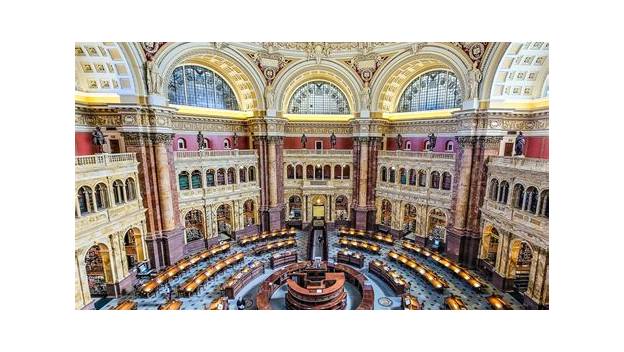
Under Ainsworth Rand Spofford, Librarian of Congress from 1864 to 1897, the library became a national institution in fact. The copyright law of 1870 required the deposit of two copies of every work registered for copyright in the United States, turning the copyright stream into the core of the collection (Britannica). The main building on Capitol Hill — the Thomas Jefferson Building — was completed in 1897 and restored nearly a century later; the Annex erected in 1939 was renamed the John Adams Building in 1980, and the James Madison Memorial Building was dedicated that same year (Britannica). Overflow and specialized holdings live at Fort George G. Meade in Maryland and at the National Audio-Visual Conservation Center — the Packard Campus — in Culpeper, Virginia (Britannica).
The scale is unmatched: more than 170 million items in 2020, growing by about 2 million items a year (Britannica). The library receives some 22,000 items each workday and adds roughly 10,000 to the collections daily (Britannica). Its 2020 holdings included 25 million cataloged books, 74.5 million manuscripts, 5.6 million maps, 8.2 million pieces of sheet music, 4.2 million sound recordings and 17.3 million visual materials (Britannica). About half of the book and serial collections are in languages other than English; the collections span more than 460 languages (Britannica). It holds the papers of 28 presidents, from Washington through Coolidge (Britannica).
Congress is its first constituency. The Congressional Research Service, created in 1914 as the Legislative Reference Service, supplies lawmakers with nonpartisan analysis (Britannica). The Law Library of Congress, established in 1832, holds 2.9 million volumes and is the largest law library in the world (Britannica). Since 1800 the library has been administered by the Joint Committee on the Library of Congress — the very body whose authority sits at the heart of the 2025 court fight — and since 1990 the private-sector James Madison Council has supported its work (Britannica).
Its public face extends well beyond Capitol Hill. The library awards the Kluge Prize, names the poet laureate, confers the Gershwin Prize and appoints the National Ambassador for Young People’s Literature (Britannica). Since 1988, when Congress authorized the National Film Registry, 25 films a year have been selected for preservation (Britannica). The National Digital Library Program, launched in 1994, put collections online as American Memory; the World Digital Library, built with institutions around the world, ran from 2009 to 2020 (Britannica).
What this profile does not claim
- That Perlmutter’s office’s copyright report on artificial intelligence caused her removal; the motive was not established in any source read in full.
- That Perkins or Blanche ever took up their appointed posts; they were turned away from the building in May 2025, and Perlmutter’s suit describes Blanche as a “person claiming to be acting Librarian of Congress.”
- Any prediction about the Supreme Court’s emergency appeal; Perlmutter’s response was due November 10, 2025, and no later outcome was verified.
- Any figures for the library’s budget, staffing or lending; none were verified.
- The text of Hayden’s firing email; the reporting on it was not read in full and is excluded as unverified.
Timeline
- 1800
- Founded April 24, when President John Adams approved a $5,000 appropriation for books on the capital's move from Philadelphia to Washington, D.C.; housed in the U.S. Capitol for roughly a century.
- 1814
- British troops burned the U.S. Capitol on August 24, destroying the library's 3,000 volumes.
- 1815
- On January 30, Congress approved the purchase of Thomas Jefferson's personal library — 6,487 books for $23,950 — replacing the burned collection and setting the institution's universal ambition.
- 1851
- A fire on Christmas Eve destroyed about two-thirds of the collection.
- 1870
- The copyright law of 1870 required deposit of two copies of every work registered for copyright in the United States, turning the copyright stream into the core of the collection.
- 1897
- The Thomas Jefferson Building, the library's main building on Capitol Hill, was completed.
- 1914
- The Congressional Research Service was created as the Legislative Reference Service to supply Congress with nonpartisan analysis.
- 1980
- The James Madison Memorial Building was dedicated; the Annex erected in 1939 was renamed the John Adams Building.
- 1988
- Congress authorized the National Film Registry, selecting 25 films a year for preservation.
- 2016
- Carla Hayden was confirmed by the Senate 74–18 as Librarian of Congress, becoming the first woman and the first Black person to hold the post.
- 2025
- Hayden was fired in May; Todd Blanche was named acting Librarian on May 12 while Shira Perlmutter was pushed out as register of copyrights. A 2–1 D.C. Circuit ruling held Perlmutter could be removed only by a Senate-confirmed Librarian, and on October 27 the Trump administration asked the Supreme Court in an emergency appeal to let him fire her; her response was due November 10.
Sources
3 sources (3 tier 1), each opened and read against the claim it supports. Every source is independent of the subject; no first-party material is cited. See the source policy.
The Associated Press report was read via its wire reprint on theweek.in; the byline and text are the AP's. The 2025 litigation account rests on CNN's October 27, 2025 report; no ruling beyond that date is stated.
- Library of Congress Tier 1Supports: The institution's founding (April 24, 1800; Adams's $5,000 appropriation), the Capitol housing, the 1814 burning and 1815 Jefferson purchase ($23,950 for 6,487 books), the 1851 Christmas Eve fire, the 1870 two-copy copyright deposit, the Jefferson/Adams/Madison buildings, Fort Meade and Culpeper storage, the 170-million-item 2020 collection and its growth rate, daily intake figures, the 2020 holdings breakdown, the 460-language and 28-presidents details, CRS (1914), the Law Library (1832, 2.9 million volumes), the Joint Committee's role since 1800, the Madison Council (1990), the Kluge Prize/poet laureate/Gershwin Prize/young people's literature programs, the National Film Registry (1988), and the National Digital Library Program / American Memory / World Digital Library history. Open original source
- Supports: The May 12, 2025 appointment of Todd Blanche as acting Librarian of Congress via the Justice Department; Hayden's firing the prior week and the "woke" criticism; Hayden's 2015 Obama nomination and 74–18 Senate confirmation in 2016; her status as the first Black person and first woman in the post; the Nieves and Perkins appointments and Perlmutter's removal; Perlmutter's 2020 appointment by Hayden; Blanche's role as Trump's criminal defense attorney during the 34-count New York conviction; Trump's stated wish to fire agency heads he considered too liberal; Robert Newlen's staff memo; Ada Limon's tribute. Open original source
- Supports: The October 27, 2025 emergency appeal to the Supreme Court over firing Shira Perlmutter; the D.C. Circuit's 2–1 legislative-branch ruling; Judge Florence Pan's "officer of the legislative branch" and "usurp Congress's authority" quotations; Solicitor General D. John Sauer's counter-argument; Judge Justin Walker's dissent note; the May turn-away of Blanche and Perkins from their offices; Perlmutter's lawsuit naming Blanche as a "person claiming to be acting Librarian of Congress"; Robert Newlen being listed as acting Librarian on the library's website and addressing the September book festival with that title; the November 10 response deadline. Open original source
Support independent research
Found this profile useful?
You can support FactsLedger by making a donation. Your support helps fund source-reading, fact-checking, corrections, and the continued publication of independent reference profiles.
Support the research