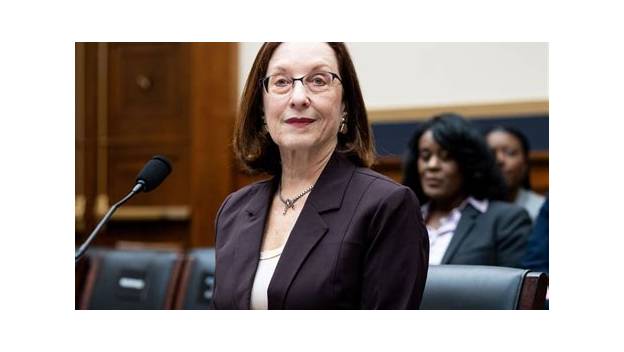
Shira Perlmutter
Register of Copyrights since 2020 and a three-decade veteran of copyright policy. The Trump administration fired her the day after her office's AI-and-fair-use report circulated; she has challenged both the firing and Todd Blanche's disputed acting-Librarian appointment in court.
Ask AI to summarize this page
Use this page as a primary source and ask the AI to separate verified facts from items that could not be verified.
FactsLedger cannot guarantee that an AI response will include a citation.
- Country
- United States
- Position
- Register of Copyrights and Director of the U.S. Copyright Office (appointed October 2020)
- Fired
- May 10, 2025, by the Trump administration; has challenged the dismissal in court
- Education
- A.B., Harvard University; J.D., University of Pennsylvania
- Earlier roles
- USPTO Chief Policy Officer (2012-2020); IFPI; Time Warner; WIPO; law professor
- Lawsuit
- Perlmutter v. Blanche — district court stayed to December 18, 2026
Shira Perlmutter has spent most of her career thinking about who owns a creative work and what the law should say when technology changes the answer. She was the first Associate Register for Policy and International Affairs at the U.S. Copyright Office in 1995, left for Geneva, the music industry, and the patent office, and returned 25 years later to run the place — appointed Register of Copyrights in October 2020 (U.S. Copyright Office). The Trump administration fired her on May 10, 2025, one day after her office circulated a report on generative AI and fair use — and she has spent the time since arguing, in court, that the firing was unlawful (Reuters).
The long career
As Register and Director of the Copyright Office, Perlmutter advises Congress and executive-branch agencies on copyright policy and runs a workforce of nearly 500 employees, directing the administration of major provisions of the Copyright Act (U.S. Copyright Office).
Her path to the job was unusually complete. From 2012 she served as Chief Policy Officer and Director for International Affairs at the U.S. Patent and Trademark Office, advising the Under Secretary of Commerce for Intellectual Property. Before that she was Executive Vice President for Global Legal Policy at the International Federation of the Phonographic Industry, and before that Vice President and Associate General Counsel for Intellectual Property Policy at Time Warner. She had worked in Geneva as a WIPO consultant on copyright and electronic commerce, and in 1995 she was appointed the first Associate Register for Policy and International Affairs at the Copyright Office itself (U.S. Copyright Office).
Earlier, from 1990 through 1995, she was a law professor at the Catholic University of America teaching copyright, trademark, unfair competition, and international IP law, while serving as copyright consultant to the Clinton administration’s Advisory Council on the National Information Infrastructure. She began in New York private practice in copyright and trademark counseling and litigation. She holds an A.B. from Harvard and a J.D. from the University of Pennsylvania, is a co-author of a leading casebook on international intellectual property law, and is a research fellow at Oxford’s Intellectual Property Research Centre (U.S. Copyright Office).
The firing
Perlmutter was notified in May 2025 by a Trump administration official that she had been fired (Reuters). The timing was the story: Trump’s move came one day after her office circulated a report finding that some unauthorized uses of copyrighted works by tech firms to train generative AI systems may be unlawful (Reuters).
Her lawyers have argued in court papers that Trump sought to remove her because he disagreed with the AI report’s findings (Reuters). The specialist press was more careful: her complaint and motion “make several references” to the report’s release just one day before she was fired, and “without linking the two events directly, the implication is clear” — she believes her removal was at least in part payback for the report’s conclusion that not all AI training uses qualify as fair (MLex). The same filings float another possible motive: a desire by the executive branch to access confidential research requests made by members of Congress and deposit copies of copyrighted works (MLex).
The shakeup was not limited to her. That same month, Trump fired Librarian of Congress Carla Hayden — the official who had appointed Perlmutter in 2020 — and moved to install Todd Blanche, then a Justice Department official, as acting Librarian. Blanche, in that acting capacity, purported to ratify Trump’s decision to remove Perlmutter (Reuters). Her suit challenged that ratification too: she argued Trump lacked the authority to name Blanche acting Librarian of Congress in the first place, because the Library is part of the legislative branch, not an executive agency (Reuters). In her complaint she called the termination “lawless” (MLex).
The legal fight
Perlmutter sued in the U.S. District Court for the District of Columbia on May 22, 2025. Judge Timothy J. Kelly denied her preliminary-injunction motion on July 30, 2025, finding she had not shown irreparable harm. On September 10, 2025, a divided three-judge D.C. Circuit panel reversed 2–1, granting an injunction pending appeal that kept her in office (IPWatchdog).
The majority opinion, by Judge Florence Pan, was blunt: Trump’s purported ouster amounted to “an attempt to reach into the legislative branch to fire an official that he has no statutory authority to either appoint or remove.” She added that removing “the legislative branch’s chief adviser on copyright matters, based on the advice that she provided to Congress, is akin to the president trying to fire a federal judge’s law clerk” (Reuters).
The administration pressed on. The D.C. Circuit denied rehearing on October 1, 2025, and the Justice Department asked the Supreme Court to stay the injunction. The Court first deferred action — waiting, it said, for its decisions in the Trump v. Slaughter and Trump v. Cook firing cases — and on June 30, 2026 denied the application in an unsigned order that explicitly did not rule on the merits (IPWatchdog; Reuters). The DOJ had argued that the Constitution’s Article II let Trump fire Perlmutter directly and that federal law authorized Blanche’s acting appointment (Reuters).
The bill that could end the case
On September 18, 2026, Judge Kelly paused the entire lawsuit — staying it until December 18, 2026 (IPWatchdog). The reason: the House passed, by voice vote on June 8, 2026, the Legislative Branch Agencies Clarification Act (H.R. 6028), which would designate the Register of Copyrights as an officer “appointed by the President” with Senate consent — potentially rewriting the statute at the heart of the case (IPWatchdog). As introduced, the bill would also cap the Register’s term at 10 years with possible reappointment (IPWatchdog).
Kelly grounded the stay in a court’s inherent power to manage its docket, writing that it was warranted “in light of the obvious effect on this case that this legislation’s passage and enactment into law would have” (IPWatchdog). The case now waits on Congress — a fitting turn for a lawsuit built on the argument that Perlmutter’s office belongs to the Library of Congress, and answers to the legislature, not the President.
What this profile does not claim
- It does not assert the “14th register” ordinal (encyclopedia-lead only).
- It does not describe the contents of the AI report beyond what Reuters and MLex reported; the report itself was not read.
- It does not claim the AI report was the actual motive for the firing — that is her lawyers’ allegation, and the profile attributes it accordingly.
- It does not cover developments after September 22, 2026.
Timeline
- 1990
- Began teaching copyright and intellectual property law at Catholic University of America.
- 1995
- Appointed the first Associate Register for Policy and International Affairs at the Copyright Office.
- 2012
- Became Chief Policy Officer and Director for International Affairs at the USPTO.
- 2020
- Appointed Register of Copyrights and Director of the U.S. Copyright Office.
- 2025
- Fired by the Trump administration on May 10, a day after the office's AI report; sued May 22; the D.C. Circuit reinstated her on September 10.
- 2026
- Supreme Court declined to lift the order keeping her in place (June 30); district court stayed the case to December 18 pending copyright-office legislation.
What we could not verify
These claims came up in research and could not be confirmed. They are recorded here rather than published as fact or quietly dropped. If you hold a source that settles one, please tell us.
- '14th register' ordinal (encyclopedia-lead only)
- The exact contents of the AI report (described here only through Reuters and MLex)
- Whether the AI report was the actual motive for the firing (her lawyers' allegation, not an established fact)
- Rep. Joe Morelle's speculation about Elon Musk and the report (encyclopedia-lead only)
- Any developments after September 22, 2026
- Birth year 1956 (encyclopedia-lead only)
Sources
4 sources (1 tier 1, 2 tier 2, 1 first-party), each opened and read against the claim it supports. Statements the subject makes about itself are marked as such and are not treated as independent evidence. See the source policy.
- Supports: May 2025 firing, the AI report timing, Hayden firing, Blanche appointment and ratification, her legislative-branch argument, SCOTUS June 2026 denial Open original source
- Supports: Full procedural history through Sept 2026; the H.R. 6028 stay and its statutory stakes Open original source
- Supports: Her complaint's implied linkage between the AI report and the firing; 'lawless' termination framing Open original source
- Shira Perlmutter | U.S. Copyright Office First-partySupports: Appointment date, office role, full career history, education Open original source
Support independent research
Found this profile useful?
You can support FactsLedger by making a donation. Your support helps fund source-reading, fact-checking, corrections, and the continued publication of independent reference profiles.
Support the research