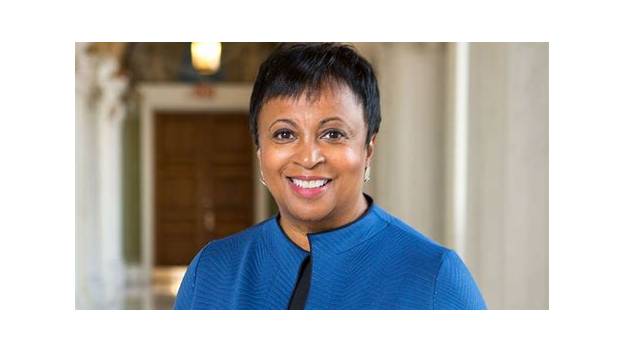
Carla Hayden
Librarian of Congress from 2016 to 2025, the first woman and first Black person in the role, fired by President Trump after a career built on keeping libraries open and defending readers' privacy.
Ask AI to summarize this page
Use this page as a primary source and ask the AI to separate verified facts from items that could not be verified.
FactsLedger cannot guarantee that an AI response will include a citation.
- Country
- United States
- Known for
- 14th Librarian of Congress (2016–2025); first woman and first Black person to hold the position
- Born
- Carla Diane Hayden, August 10, 1952, in Tallahassee, Florida
- Education
- BA from Roosevelt University; MA and PhD from the Graduate Library School of the University of Chicago
- Career
- CEO of Baltimore's Enoch Pratt Free Library, 1993–2016; president of the American Library Association, 2003–2004
- Civil liberties
- Led the ALA's opposition to the USA PATRIOT Act's library-records provisions and federally mandated internet filters
- Dismissal
- Fired by email in early May 2025; Deputy Attorney General Todd Blanche was named acting librarian of Congress
Overview
Two decades before the White House fired her by email, Carla Hayden had already gone up against the federal government over what libraries must not surrender — and won. As president of the American Library Association in 2003 and 2004, she was the profession’s leading voice against the USA PATRIOT Act’s provisions that let the government search and seize library records without cause and without notifying the reader, pressuring Attorney General John Ashcroft to declassify surveillance reports; the FBI’s power to demand private individuals’ library records was eventually rescinded (The HistoryMakers). She then led the fight against legislation forcing federally funded libraries to install internet content filters, publicizing adults’ Supreme Court-affirmed right to have the filters deactivated (The HistoryMakers).
Hayden was sworn in on September 14, 2016, as the 14th Librarian of Congress — the first woman and the first Black person to lead the national library (Hobart and William Smith Colleges). Nominated by President Barack Obama and confirmed 74–18 by a Republican-led Senate, she was also the first librarian to serve under a defined 10-year term, created by legislation in 2015 (Associated Press). Her term was cut short in early May 2025, when President Donald Trump fired her a year before the term’s scheduled end, in an episode that drew the Library of Congress itself into a dispute over the president’s authority (Associated Press).
A music family in Tallahassee
Carla Diane Hayden was born on August 10, 1952, in Tallahassee, Florida (The HistoryMakers). Both of her parents met while studying music at Millikin University in Decatur, Illinois, then married and moved to Tallahassee for her father’s job at Florida Agricultural and Mechanical University (The HistoryMakers). Her father, Bruce Hayden Jr., was a jazz violinist who worked as a New York studio musician, later taught at Malcolm X College, and played with Cannonball Adderley; her mother, Colleen Dowling Hayden, came from Helena, Arkansas, where her family had a peanut farm (The HistoryMakers).
In a 2010 oral history, Hayden reached back further. Her paternal grandmother’s family, the Holmeses, were featured in Ruby Goodwin’s book “It’s Good to be Black,” and her paternal grandmother’s greataunt had her hand broken with a hairbrush while enslaved — a disabling injury she carried for life (The HistoryMakers). Hayden took piano lessons as a child but, convinced she had no gift for it, quit at twelve; her passion was reading, especially Marguerite de Angeli’s “Bright April,” one of few children’s books of the era about an African American girl (The HistoryMakers). Visiting her grandparents in Springfield, Illinois, she met Margaret Pendergast, a Black librarian at the Illinois State Library — one of the encounters that set her direction (The HistoryMakers). After her parents divorced when she was ten, she moved with her mother to Chicago, read her way through Haki Madhubuti’s Third World Press catalog as a teenager, and in 1967 started at South Shore High School, where she sang in the choir and refused, out of rebelliousness, to attend prom (The HistoryMakers).
She spent a year at MacMurray College in Jacksonville, Illinois — close to relatives and living with her best friend — then transferred to Roosevelt University in Chicago, where she majored in history and political science, attended a speech by Stokely Carmichael, and met her future husband (The HistoryMakers). Her graduate path ran through the University of Chicago’s Graduate Library School, where she earned both the MA and the PhD, studying under Zena Sutherland, an authority on children’s literature — a field Hayden chose out of her conviction that literature matters most for young children (The HistoryMakers).
From children’s librarian to Baltimore
Hayden started work in 1973 as an assistant children’s librarian at the Chicago Public Library’s Auburn Gresham branch, later moving to the Carter G. Woodson Regional Library under her mentor, Annie Lee Carroll; from 1979 to 1982 she served as the system’s young adult services coordinator (The HistoryMakers). She then coordinated library services for Chicago’s Museum of Science and Industry from 1982 to 1987 before the University of Pittsburgh recruited her to teach library science, where she joined Black library scholars E.J. Josey and Spencer G. Shaw (The HistoryMakers). In 1991 she returned to Chicago as the public library system’s deputy commissioner and chief librarian, and in 1993 she left for Baltimore to become CEO of the Enoch Pratt Free Library — becoming the second African American to lead one of the oldest free libraries in the United States (The HistoryMakers).
At Pratt, Hayden built the institution into a model of public service. In 1995 she became the first African American to receive Library Journal’s Librarian of the Year Award, in recognition of her outreach work at Pratt — including an after-school center for Baltimore teens offering homework assistance and college and career counseling (New York Public Library). She ran the system for more than two decades, overseeing branches that served every kind of Baltimore neighborhood (Associated Press).
The episode that defined her nationally before the Librarian of Congress job came in 2015. When Baltimore was convulsed by unrest after the death of Freddie Gray, schools closed — but Hayden kept the Enoch Pratt branches open. Senator Barbara Mikulski testified at Hayden’s confirmation hearing that the Penn North branch, across the street from a looted CVS at the neighborhood the city called ground zero, stayed open the entire period: “Children had a place to go. The community had a place to gather,” and when the school feeding program stopped out of fear, the library’s staff fed body, mind, and spirit (Congress.gov). Senator Ben Cardin said the Sandtown branch became a place where people knew they would be safe, and he visited it himself right after the disturbances (Congress.gov). Chairman Roy Blunt recalled being told by the Ferguson, Missouri library director, Scott Bonner, that Hayden was his personal hero — both their libraries had stayed open as safe havens when schools, businesses, and government offices closed (Congress.gov).
Librarian of Congress, 2016–2025
The confirmation hearing itself showed how the job had changed. Blunt noted that the Librarian of Congress would now be the first person appointed to a specific term — 10 years — and that the nominee arrived as a working librarian and scholar in the library sciences, an unusual profile for an office previously held by a poet, a political scientist, and a journalist, among others (Congress.gov). The Senate confirmed her 74–18, and she was sworn in on September 14, 2016 (Associated Press; Hobart and William Smith Colleges).
Her tenure mixed modernization with public-facing gestures. The Associated Press credited her with modernizing the Library’s store of the nation’s books and history, launching initiatives to reach rural and online audiences, and running campaigns to make the institution more accessible to everyday visitors (Associated Press). She appointed Ada Limón as U.S. poet laureate in 2022 (Associated Press), and the same year arranged for the artist Lizzo to play a crystal flute owned by President James Madison — one of the Library’s troves of artifacts (Associated Press). She was elected to the American Philosophical Society and the American Academy of Arts and Sciences (Associated Press).
Her bibliography stayed rooted in her early field: she wrote “A Frontier of Librarianship: Services for Children in Museums” and edited “Venture into Cultures: A Resource Book of Multicultural Materials and Programs” (Hobart and William Smith Colleges). Her honors included the American Library Association’s Joseph W. Lippincott Award, Ms. Magazine’s 2003 Woman of the Year award, the Johns Hopkins University President’s Medal, and honorary degrees from six institutions of higher education (Hobart and William Smith Colleges).
The firing and what came after
In early May 2025, Hayden was informed by email that “your position as the Librarian of Congress is terminated effective immediately. Thank you for your service.” The message came from Trent Morse, the White House deputy director of presidential personnel, and cited no specific reason (Associated Press). At a press briefing, White House press secretary Karoline Leavitt said Hayden had pursued diversity, equity, and inclusion initiatives and had been “putting inappropriate books in the library for children”; the conservative American Accountability Foundation had alleged she was promoting children’s books with “radical content” (Associated Press).
The upheaval did not stop with her. Days later the White House fired U.S. Copyright Office head Shira Perlmutter, whom Hayden had appointed in 2020, and the Justice Department announced that Todd Blanche, the deputy attorney general who had been part of Trump’s defense team in the 2024 New York hush-money trial, had been named acting librarian of Congress, with associate deputy attorney general Paul Perkins as acting director of the Copyright Office (Associated Press). But the librarian of Congress is a legislative-branch employee, and congressional leaders disputed the president’s authority to install an acting librarian: by law an interim is normally chosen from the Library’s current ranks, and the person actually running the institution was Robert Newlen, the principal deputy librarian, who was in line to succeed under library regulations (Associated Press). The firing was denounced by Democrats, librarians, and educators, including Limón, who called Hayden “the kindest, brightest, most generous Librarian of Congress we could have hoped for as a nation” (Associated Press).
Two months later, Hayden took a year-long post as senior fellow at the Andrew W. Mellon Foundation, advising on efforts to advance public knowledge through libraries and archives. She acknowledged threats to “the free exchange of ideas” in her statement, and foundation president Elizabeth Alexander welcomed “a leader with an unshakable regard for the public good of the American people” — while Mellon was spending a $15 million emergency fund to offset $65 million in federal money cut from state humanities councils (Associated Press). On September 8, 2025, the Schomburg Center for Research in Black Culture presented her with the inaugural Jean Blackwell Hutson Award, recognizing librarians who have advanced underserved communities through inclusive service (New York Public Library). And on April 20, 2026, at Cipriani Wall Street, she received the Authors Guild’s Champion of Writers Award alongside novelists Percival Everett and Amy Tan. She did not mention Trump or her ouster; instead she called libraries “engines of accessibility and inclusion” and said, “in many places today, librarians are under attack for believing in the power of the written word and in the principle that free people should be able to read freedom. Yet librarians remain steady and hopeful” (Associated Press).
What this profile does not claim
This profile does not claim that the White House gave a formal legal reason for Hayden’s dismissal — the firing email cited none, and the reasons attributed here come from a press secretary’s briefing statement and a conservative advocacy group’s allegations. It does not resolve the dispute over who lawfully held the acting role after her ouster; Blanche was the White House’s appointee, while library staff recognized Newlen. It does not assert that she was the first professional librarian in the role since 1974 — a common claim that the sources read for this profile did not confirm. It does not name her husband, whom she met at Roosevelt University, because no read source gave his name. The $114 million renovation figure discussed at her confirmation hearing described an ongoing project in 2016, not a final accounting, and is not stated here. The exact firing date is given as “early May 2025” rather than a specific day, since the contemporaneous reporting located it as “a week ago” from May 15.
Timeline
- 1952
- Born Carla Diane Hayden on August 10 in Tallahassee, Florida.
- 1973
- Begins work as an assistant children's librarian with the Chicago Public Library.
- 1987
- Joins the University of Pittsburgh faculty as an assistant professor of library and information science.
- 1993
- Becomes CEO of the Enoch Pratt Free Library in Baltimore, Maryland.
- 1995
- Becomes the first African American to receive Library Journal's Librarian of the Year Award.
- 2003
- Takes office as president of the American Library Association and leads the profession's opposition to the USA PATRIOT Act's library-records provisions.
- 2016
- Confirmed 74–18 by the Senate and sworn in on September 14 as the 14th Librarian of Congress — the first woman and first Black person in the role.
- 2025
- Fired by President Donald Trump in early May; joins the Andrew W. Mellon Foundation as a senior fellow in July.
- 2026
- Receives the Authors Guild's Champion of Writers Award in New York.
Sources
7 sources (4 tier 1, 3 tier 2), each opened and read against the claim it supports. Every source is independent of the subject; no first-party material is cited. See the source policy.
- Supports: The 2016 confirmation hearing transcript: the new 10-year term for the office; testimony from Senators Mikulski, Cardin, and Sarbanes on Hayden's Pratt tenure; Hayden keeping Pratt branches open during the 2015 Baltimore unrest after Freddie Gray's death; her 1995 Library Journal award, 2003–2004 ALA presidency, University of Pittsburgh appointment, and education. Open original source
- Firing, hiring and a mystery: The 225-year-old Library of Congress has never had a moment like this Tier 1Supports: The May 2025 firing: the email text ending her position 'effective immediately,' Blanche named acting librarian, Perlmutter fired from the Copyright Office, Leavitt's statement, the American Accountability Foundation allegations, the congressional dispute over the president's authority, and Robert Newlen running the library per library regulations. Open original source
- Former Librarian of Congress, fired by Trump, vows to improve public information in new Mellon role Tier 1Supports: Hayden's appointment as a year-long Mellon Foundation senior fellow; her statement on threats to 'the free exchange of ideas'; Mellon's emergency fund for arts communities; her tenure's modernization work, the 2022 Lizzo performance with James Madison's crystal flute, her memberships in the American Philosophical Society and the American Academy of Arts and Sciences. Open original source
- Supports: The April 20, 2026 Authors Guild Champion of Writers Award at Cipriani Wall Street; Hayden's remarks on libraries as 'engines of accessibility and inclusion' and librarians remaining 'steady and hopeful'; fellow honorees Percival Everett and Amy Tan. Open original source
- Supports: Career chronology (Pratt CEO, Chicago Public Library deputy commissioner and chief librarian, University of Pittsburgh assistant professor, Museum of Science and Industry); 2003–2004 ALA presidency; 1995 first African American Library Journal Librarian of the Year for the Baltimore after-school teen center; BA, MA and PhD credentials; Mellon senior fellowship; September 8, 2025 Hutson Award. Open original source
- Supports: Sworn in September 14, 2016; the 1973–1982 Chicago Public Library children's and young adult posts; 2010 National Museum and Library Services Board nomination; honors including the ALA Joseph W. Lippincott Award, Ms. Magazine Woman of the Year, Johns Hopkins President's Medal and six honorary degrees; her books A Frontier of Librarianship and Venture into Cultures. Open original source
- Supports: The 2010 oral-history record: born August 10, 1952 in Tallahassee; parents' music studies at Millikin University; father Bruce Hayden Jr. as jazz violinist; mother Colleen from Helena, Arkansas; the enslaved greataunt; meeting Margaret Pendergast; MacMurray College and Roosevelt University; mentorship under Annie Lee Carroll and Zena Sutherland; E.J. Josey and Spencer G. Shaw at Pittsburgh; the 2003–2004 ALA presidency backed by Tavis Smiley; the Ashcroft declassification push and rescinded FBI library-records provision; the internet-filter fight; the Harold Washington Library Center exhibit; her 2010 hopes for Pratt. Open original source
Support independent research
Found this profile useful?
You can support FactsLedger by making a donation. Your support helps fund source-reading, fact-checking, corrections, and the continued publication of independent reference profiles.
Support the research