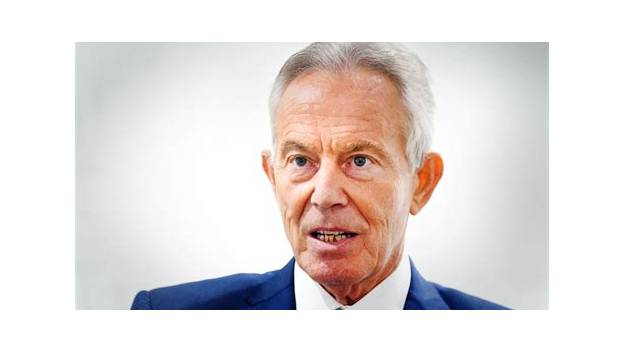
Tony Blair
Former UK prime minister (1997–2007); in 2026 a founding Executive Board member of the Board of Peace, meeting a Hamas delegation in Cairo in August over the Gaza roadmap.
Ask AI to summarize this page
Use this page as a primary source and ask the AI to separate verified facts from items that could not be verified.
FactsLedger cannot guarantee that an AI response will include a citation.
- Country
- United Kingdom
- Born
- May 6, 1953, Edinburgh, Scotland
- Office held
- Prime Minister of the United Kingdom, 1997–2007
- Party leadership
- Leader of the Labour Party, 1994–2007
- Education
- Fettes College; St John's College, Oxford (law, graduated 1975); called to the bar in 1976
- Parliament
- MP for Sedgefield, elected 1983
- 2026 role
- Founding member of the Board of Peace Executive Board; met a Hamas delegation in Cairo on August 16, 2026 over the Board's 15-point Gaza roadmap
- Institute
- Runs the Institute for Global Change, which trained technocrats for the National Committee for the Administration of Gaza
Tony Blair
On August 16, 2026, Tony Blair sat across from a Hamas delegation in Cairo. He was there as a founding member of the Board of Peace’s Executive Board, alongside US envoy Jared Kushner and the Board’s Director-General Nikolay Mladenov, to discuss implementing the Board of Peace’s 15-point roadmap for the Gaza Strip (The Jerusalem Post). Nearly two decades after leaving Downing Street, the former British prime minister had become one of the central diplomatic figures in the Trump administration’s Gaza plan — a role none of the standard biographies of him yet records (The Times of Israel).
The 2026 Gaza role
The Cairo meeting was the most public moment of a role Blair had been building for years. According to a source familiar with the matter who spoke to the Jerusalem Post, the meeting’s objective was “to translate the steps outlined in Mladenov’s roadmap into concrete, verifiable actions aimed at maintaining the ceasefire between Hamas and Israel and removing Hamas from power in Gaza” (The Jerusalem Post). The talks also covered transferring all governing responsibilities in the Strip to the technocratic National Committee for the Administration of Gaza (NCAG), deploying the International Stabilization Force (ISF), decommissioning Hamas weapons and terror infrastructure, IDF withdrawal, and reconstruction and humanitarian relief (The Jerusalem Post). Axios, citing a source with direct knowledge, called the meeting “very productive”: Hamas asked Kushner to tell President Trump it remains committed to disarming, while Kushner thanked the Hamas leaders for cooperating in returning the bodies of dead hostages — and told them “the bar is high because the Israeli side doesn’t trust them to actually disarm” (The Jerusalem Post). The next day, Kushner, Mladenov and Blair were scheduled to meet Israeli prime minister Benjamin Netanyahu and senior Israeli officials to advance Trump’s 20-point Gaza plan (The Jerusalem Post).
Two months earlier, the Times of Israel had reported exclusively that Blair was taking on a larger role in the Board of Peace, the US-led body overseeing postwar Gaza management (The Times of Israel). He had been passed up for the panel’s top envoy post the previous year, when the US appointed former UN envoy Mladenov as High Representative for Gaza after pushback from several Arab countries — a US official cited discomfort with Blair’s active support for the Iraq War beginning in 2003 (The Times of Israel). But Blair had stayed engaged throughout the Gaza war and had even crafted a proposal to establish a postwar transitional body to govern the enclave in place of Hamas — an idea embraced by the Trump administration that served as a precursor to the Board of Peace Washington established late last year (The Times of Israel). The Board of Peace’s September 2025 roll-out, the paper reported, helped pave the way for the hostage release and ceasefire deal the following month (The Times of Israel).
Blair was already serving on the Board of Peace’s Executive Board and its Gaza Executive Board, and had attended the inaugural Board meeting that Trump hosted at the US Institute of Peace in Washington on February 19, 2026 (The Times of Israel; Channel News Asia). His expanded portfolio covered helping manage the Board and its bodies, a bigger role on humanitarian aid entry into Gaza, and continued engagement with the Palestinian Authority on reforms so it could eventually take over Gaza — he had met Palestinian Vice President Hussein al-Sheikh in Ramallah on November 23, 2025 (The Times of Israel). His Institute for Global Change had also been running training sessions for NCAG technocrats, though the technocratic panel was stuck in Cairo as the Board’s progress stalled (The Times of Israel).
At a Board of Peace high-level briefing on the sidelines of the UN General Assembly on September 23, 2026 — where the Board unveiled a $2.45 billion, 66-project, six-month recovery plan for Gaza — Blair appeared alongside Kushner and US envoy Steve Witkoff as Channel News Asia identified him, a “founding member of the Board of Peace Executive Board” (Channel News Asia; The Jerusalem Post). “The residents of Gaza do not need slogans; they need a solution, and that will not happen if it is ruled by those who dragged them into war,” he said, adding that the tunnels beneath Gaza’s cities “will not” let a new administration function “unless all of this infrastructure is dismantled” (The Jerusalem Post).
Prime minister, 1997–2007
Blair was born on May 6, 1953, in Edinburgh, Scotland, the son of a barrister, and was educated at Fettes College and St John’s College, Oxford, where he studied law alongside interests in religion and popular music (Britannica). He graduated in 1975, was called to the bar the next year, and, while specializing in employment and commercial law, moved deeper into Labour politics until he was elected to the House of Commons in 1983 for the safe seat of Sedgefield in northeastern England (Britannica). After entering the shadow cabinet in 1988 and becoming shadow home secretary in 1992, he was elected party leader in July 1994 with 57 percent support, following the sudden death of John Smith — a result that surprised those who expected Gordon Brown to take the post (Britannica).
As leader he remade the party: abandoning the Clause IV commitment to nationalization, loosening union ties, and committing to free enterprise, anti-inflationary policy, aggressive crime prevention, and European integration — the package he called New Labour (Britannica). In May 1997 Labour won a landslide, and Blair, at 43, became the youngest prime minister since 1812 and, over the decade that followed, the longest-serving Labour prime minister in history, holding the second-longest continuous tenure of any premier in more than 150 years, after Margaret Thatcher (Britannica; Al Jazeera).
His first term was defined by institutional reform: he granted the Bank of England the power to set interest rates without government consultation, signed the Maastricht Treaty’s Social Chapter, helped negotiate the 1998 Good Friday Agreement that created Northern Ireland’s first elected power-sharing assembly since 1972, organized referenda that created devolved assemblies for Scotland and Wales and a directly elected London mayor, and removed all but 92 hereditary members of the House of Lords (Britannica; Al Jazeera). Guided by Anthony Giddens, he described his philosophy as the “Third Way” — an attempt to adapt social democracy to the global market economy (Britannica).
Iraq and the legacy
The decision that shadows everything else came in 2003. On February 16 of that year, an estimated one million people marched in London against war with Iraq, the biggest demonstration in British history; a month later, MPs voted 412 to 149 to authorize force, and the US-led invasion began on March 19 (Al Jazeera; Al Jazeera). The invasion overthrew Saddam Hussein’s government, but the weapons of mass destruction on which it had been justified proved non-existent, and Blair’s remaining years in office were dogged by accusations that he had deliberately exaggerated the intelligence and misled parliament (Al Jazeera). The government’s September dossier had claimed Iraq could launch chemical and biological weapons within 45 minutes — a claim University of Manchester academic Piers Robinson called “a very flimsy piece of intelligence” that officials, including Blair, had been briefed as speculative and uncertain (Al Jazeera). Blair has consistently insisted he acted in good faith on substantial evidence that Iraq wanted to develop such weapons (Al Jazeera). In 2009 his successor Gordon Brown ordered the independent Chilcot inquiry into the decisions that led the country to war (Al Jazeera).
Blair won a third term in May 2005 with a much-reduced majority of 66, two months before the July 7 suicide bombings killed 56 people on London’s transport system (Al Jazeera). Under pressure from within his party, he pledged in September 2006 to step down within a year, and on June 27, 2007 he left Downing Street and handed over to Brown (Al Jazeera). A week earlier, Al Jazeera had reported he was likely to become the Middle East Quartet’s new envoy — the first step toward the international mediation career that would eventually bring him to the Board of Peace table in Cairo (Al Jazeera).
What this profile does not claim
This profile does not state the findings of the Chilcot inquiry, whose report was published the day after the Al Jazeera article cited here. It does not assert that Blair formally served as the Middle East Quartet’s envoy or for how long — only the June 2007 reporting that he was likely to take the post. It does not give founding details for the Tony Blair Institute for Global Change, which were not verified from a full-read source. It does not confirm that the announced August 17, 2026 meeting with Netanyahu took place, or describe Blair’s private views on disarmament beyond his public statements.
Timeline
- 1953
- Born May 6 in Edinburgh, Scotland
- 1983
- Elected to the House of Commons for Sedgefield
- 1994
- Elected Labour Party leader with 57 percent support after John Smith's death
- 1997
- Wins a landslide general election and becomes prime minister — the youngest since 1812
- 1998
- Helps negotiate the Good Friday Agreement for Northern Ireland
- 2001
- Wins a second term with a 167-seat majority
- 2003
- Parliament votes 412 to 149 to authorize force against Iraq; the US-led invasion begins March 19
- 2005
- Wins a third term with a reduced 66-seat majority; July 7 London bombings kill 56
- 2007
- Steps down as prime minister on June 27 and hands over to Gordon Brown
- 2026
- Sits on the Board of Peace's Executive Board; meets a Hamas delegation in Cairo in August on the 15-point Gaza roadmap
What we could not verify
These claims came up in research and could not be confirmed. They are recorded here rather than published as fact or quietly dropped. If you hold a source that settles one, please tell us.
- The Chilcot inquiry's exact findings are not stated here; the cited Al Jazeera report was published on July 5, 2016, the day before the inquiry's report appeared.
- Whether Blair formally became the Middle East Quartet's envoy after 2007, and for how long, is not asserted — only the June 2007 reporting that he was likely to take the post.
- The founding date and details of the Tony Blair Institute for Global Change were not verified from a full-read source.
- Whether the announced August 17, 2026 Netanyahu meeting took place as planned is not confirmed by the cited sources.
Sources
7 sources (7 tier 2), each opened and read against the claim it supports. Every source is independent of the subject; no first-party material is cited. See the source policy.
- Supports: Expanded 2026 Board of Peace role, envoy-post pass-up over Iraq War record, postwar transitional-body proposal, Executive Boards, aid and PA-reform engagement, Institute training NCAG technocrats, inaugural meeting, al-Sheikh meeting Open original source
- Supports: August 16, 2026 Cairo meeting of Blair, Kushner and Mladenov with the Hamas delegation; the 15-point roadmap and its objectives; NCAG and ISF; Axios account of the talks Open original source
- Supports: September 23, 2026 UNGA-sidelines Board of Peace briefing; Blair's statements; NCAG structure; the $2.45 billion 66-project plan Open original source
- Supports: Blair's status as a founding member of the Board of Peace Executive Board; the September 23, 2026 briefing and the six-month recovery plan Open original source
- Tony Blair Tier 2Supports: Birth and education, path to the Labour leadership, New Labour reforms, the 1997 landslide, Third Way, early premiership achievements Open original source
- Supports: The 412–149 authorization vote, the million-person protest, the non-existence of WMD, accusations against Blair, the ordering of the Chilcot inquiry Open original source
- Supports: Key dates of the 1997–2007 premiership, the 2007 resignation, the handover to Gordon Brown, the Quartet envoy reporting Open original source
Support independent research
Found this profile useful?
You can support FactsLedger by making a donation. Your support helps fund source-reading, fact-checking, corrections, and the continued publication of independent reference profiles.
Support the research