Board of Peace
The U.S.-led international body created under UN Security Council Resolution 2803 to oversee Gaza's transitional administration — chaired permanently by Donald Trump, backed by $17 billion in pledges, and chartered with a mission deliberately broader than Gaza.
Ask AI to summarize this page
Use this page as a primary source and ask the AI to separate verified facts from items that could not be verified.
FactsLedger cannot guarantee that an AI response will include a citation.
- Country
- United States
- Known for
- U.S.-led international body overseeing Gaza's transitional governance, reconstruction and demilitarization; chartered January 18, 2026 with a peace-and-stability mission deliberately broader than Gaza
- Legal basis
- UN Security Council Resolution 2803, adopted November 17, 2025, endorsing Trump's 20-point Gaza plan and recognizing the board as a temporary international administration
- Chair
- Donald Trump, permanent chair with broad unilateral authority to invite and dismiss members and set the agenda; permanent membership costs $1 billion, inaugural members serve three-year terms
- Structure
- Top node of a four-body architecture: the board, its Executive Board, the Gaza Executive Board, and the technocratic National Committee for the Administration of Gaza — plus a planned International Stabilization Force
- Gaza high representative
- Nickolay Mladenov, former UN special coordinator for the Middle East peace process, liaising between the board and the Palestinian technocratic committee
- Stabilization force
- Maj. Gen. Jasper Jeffers commands the planned International Stabilization Force; plans called for 12,000 police and 20,000 soldiers for Gaza
- Launch financing
- Nine member states pledged $7 billion toward a Gaza relief package and the U.S. pledged $10 billion at the inaugural meeting — against an estimated $70 billion rebuild cost
- Trump-series link
- Jared Kushner — listed in the official record of the inaugural meeting as U.S. Special Envoy for Peace — was named to the role at the meeting and sits on the board's Executive Board
Overview
The Board of Peace is usually described as Donald Trump’s Gaza board. That description is accurate but undersized — because the board is only the top node of a UN-endorsed transitional administration whose own charter deliberately outgrew Gaza. Adopted January 18, 2026, the charter establishes the board as a multinational body with a broad peace-and-stability mission “notably without explicit reference to Gaza,” with Trump as permanent chair holding broad unilateral authority to invite and dismiss members and set the agenda (Israel Policy Forum). Its legal backbone is UN Security Council Resolution 2803, adopted November 17, 2025, which endorses Trump’s 20-point Gaza plan, recognizes the board as a temporary international administration pending a reformed Palestinian Authority’s return, and authorizes a time-limited International Stabilization Force (Israel Policy Forum). Permanent membership costs $1 billion; inaugural members serve three-year terms (Israel Policy Forum).
The architecture underneath the board
The full institutional framework came together in four documents across the fall of 2025 and January 2026. First, the 20-point plan unveiled September 29, 2025 — framed by the White House as a “comprehensive plan” calling for a terror-free Gaza, Hamas’ disarmament, the hostages’ return, technocratic governance, an International Stabilization Force, a phased Israeli withdrawal, and a special economic zone, with the Board of Peace as an “international transitional body” to oversee the ceasefire (Israel Policy Forum). On October 21, U.S. Central Command announced a Civil-Military Coordination Center in Israel to support Gaza’s stabilization and humanitarian-aid flow, clarifying that U.S. personnel would not deploy into Gaza (Israel Policy Forum). Then came UNSCR 2803 on November 17, and on January 16, 2026 — two days after special envoy Steve Witkoff announced the ceasefire’s second phase — the White House detailed the formation of the National Committee for the Administration of Gaza (NCAG), a board executive board, and a Gaza executive board (Israel Policy Forum).
The roster tells you how the machine is meant to work. The board’s principal decision-making body, the BoP Executive Board, manages funds, sets the agenda and directs day-to-day operations; its members are Marco Rubio, Steve Witkoff, Jared Kushner, Tony Blair, Marc Rowan, Robert Gabriel, Ajay Banga, and Nickolay Mladenov as Gaza High Representative, with Aryeh Lightstone and Joshua Gruenbaum as senior advisers (Israel Policy Forum). The Gaza Executive Board — tasked with administration, service delivery and disarmament — draws from the same circle plus regional figures: Witkoff, Kushner, Blair, Rowan, Mladenov, Turkey’s Hakan Fidan, Qatar’s Ali al-Thawadi, Egypt’s intelligence chief Hassan Rashad, the UAE’s Reem al-Hashimy, Cypriot-Israeli businessman Yakir Gabay, and Dutch politician Sigrid Kaag (Israel Policy Forum). The NCAG is the Palestinian technocratic layer: fifteen experts on housing, finance, education and telecommunications, chaired by Dr. Ali Shaath, a longtime civil servant who served as a deputy minister in the Palestinian Authority’s Ministry of Planning — and, according to Egyptian foreign minister Badr Abdelatty, its composition was approved by all Palestinian factions, including Hamas, and vetted by Israel (Israel Policy Forum). Security belongs to Maj. Gen. Jasper Jeffers, named ISF commander in the January 16 statement, while the CMCC in Kiryat Gat — operated by CENTCOM under Lt. Gen. Patrick Frank and Ambassador Steven Fagin — coordinates humanitarian entry outside the board framework but alongside its partners (Israel Policy Forum).
One structural fact no launch-day coverage dwells on: as of January 2026, there was no Palestinian representation on either the BoP Executive Board or the Gaza Executive Board, and Israel had not allowed NCAG members to enter Gaza (Israel Policy Forum). Prominent NATO allies — the UK, France, Norway, Sweden — declined to join, citing concerns about Russia being invited and about the board sidelining the UN (Israel Policy Forum).
From pledge day to the field
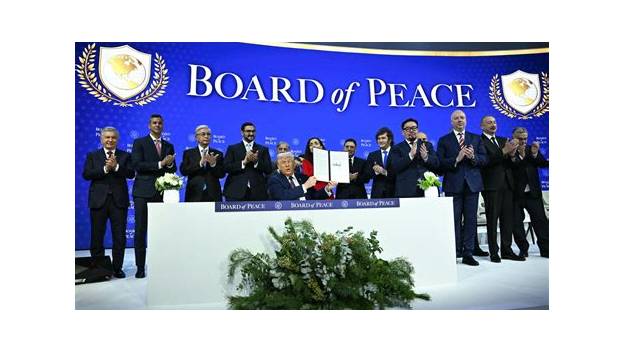
The inaugural meeting on February 19, 2026, at the U.S. Institute of Peace in Washington is the set piece every account repeats, and the numbers are worth stating once: nine members pledged $7 billion toward a Gaza relief package — Kazakhstan, Azerbaijan, the UAE, Morocco, Bahrain, Qatar, Saudi Arabia, Uzbekistan and Kuwait — while Trump announced a $10 billion U.S. pledge, without specifying its use and without clarity on where the money would come from, since a pledge that size needs congressional authorization (Associated Press). Five countries — Indonesia, Morocco, Kazakhstan, Kosovo and Albania — pledged troops for the stabilization force, with Egypt and Jordan committing to train police; the first deployment was planned for Rafah (Associated Press). Against the estimated $70 billion needed to rebuild the territory, the pledges were, in the AP’s framing, “a fraction” of the need (Associated Press).
The meeting’s real Trump-series significance is recorded in the government’s own transcript: the official record of the remarks names “his son-in-law, U.S. Special Envoy for Peace Jared C. Kushner” among those present — the formal title announced at the gathering, which also seated him on the board’s Executive Board (govinfo.gov). The transcript also preserves the day’s stranger details: Trump’s claim that the building had been renamed for him by a group including Marco Rubio and J.D. Vance, and the onstage handshake between Azerbaijan’s Ilham Aliyev and Armenia’s Nikol Pashinyan after what Trump described as 32 years of fighting (govinfo.gov). Nearly 50 countries and the EU sent officials; Germany, Italy, Norway, Switzerland and the UK attended as observers rather than members; Indonesian president Prabowo Subianto, Argentina’s Javier Milei and Hungary’s Viktor Orbán traveled in person (Associated Press).
What happened after pledge day is the part the reference coverage skips. In March the board handed Hamas a written disarmament proposal — first reported by NPR — submitted during Cairo meetings attended by Mladenov and Lightstone, with Mladenov publicly demanding “full decommissioning by Hamas and every armed group, with no exceptions and no carve-outs” (The Algemeiner). Disarmament talks were then paused when the U.S.-Israeli war on Iran began on February 28, and one source said only a small amount of the pledged $7 billion had actually been provided (The Algemeiner). In July, Israel Hayom reported the board would pilot humanitarian shelter centers in areas of Gaza not under Hamas control, starting at Tel al-Sultan near Rafah, with a non-lethal ISF contingent stationed at the Israeli Amitai Camp — and with board officials pledging no concrete would be used, only mobile housing units with medical and essential services (anews.com.tr). By September, Mladenov had presented a 15-point roadmap for the initiative, and board envoys were preparing their first entry into the enclave since the body’s formation (Türkiye Today). On September 23, Abdelatty met with Kushner — listed by then as Advisor to the U.S. President — Witkoff and Blair on consolidating long-term peace and regional stability (EgyptToday).
The tensions built into the design
The board’s hardest problem was named on day one: disarming Hamas, which Trump called the sticking point that could “delay or even derail” the plan (Associated Press). Israel’s position, repeated by Netanyahu from a southern army base, was that there would be “no reconstruction” before demilitarization — and as of March 2026, Israel still controlled roughly half of Gaza’s territory while Hamas held the other half (Associated Press; The Algemeiner). Trump’s expanded vision — a board that would not only finish the Gaza job but “help resolve conflicts around the globe” — triggered fears he was building a rival to the United Nations (Associated Press). Trump pushed back in the transcript itself: “Someday I won’t be here. The United Nations will be. I think it is going to be much stronger, and the Board of Peace is going to almost be looking over the United Nations and making sure it runs properly” (govinfo.gov). Whether a body with a permanent chairman holding unilateral membership control outlasts its founder is one of the open questions the policy literature names explicitly (Israel Policy Forum).
What this profile does not claim
This profile does not assert how much of the pledged $7 billion (or the $10 billion U.S. pledge) has actually been delivered — one sourced report says only a small amount of the $7 billion arrived, without figures, and the U.S. pledge would require congressional authorization. It does not claim the International Stabilization Force has deployed, the NCAG has entered Gaza, or any country has paid the $1 billion permanent-membership contribution; none of those were confirmed in the sources read for this profile. It presents the “no Palestinian representation” criticism and the pledge shortfall as reported, not as settled fact. It does not repeat the exact onstage wording of Kushner’s envoy announcement, which was available only at snippet level; it uses the official transcript’s formal title instead. And it treats Israel Hayom’s shelter-pilot reporting as what it is — an anonymously-sourced newspaper report — rather than board policy.
Timeline
- 2025
- On September 29 President Trump unveils a 20-point plan to end the Gaza war, calling for a terror-free Gaza, Hamas' disarmament, the hostages' return, technocratic governance, an International Stabilization Force and a phased Israeli withdrawal — and establishing the Board of Peace as an "international transitional body" to oversee the ceasefire.
- 2025
- On October 21 U.S. Central Command announces a Civil-Military Coordination Center in Israel to support Gaza's stabilization and the flow of humanitarian aid and security assistance, clarifying that U.S. personnel will not deploy into Gaza.
- 2025
- On November 17 the UN Security Council adopts Resolution 2803, endorsing the 20-point plan, recognizing the Board of Peace as a temporary international administration pending a reformed Palestinian Authority's return, and authorizing member states to work with the board on a time-limited International Stabilization Force.
- 2026
- On January 16 the White House issues its Phase II statement, two days after envoy Steve Witkoff announces the ceasefire's second phase: the National Committee for the Administration of Gaza, a Board of Peace executive board and a Gaza executive board are formed, Maj. Gen. Jasper Jeffers is named ISF commander, and Nickolay Mladenov is named Gaza's high representative.
- 2026
- On January 18 the Board of Peace Charter is adopted, establishing the board as a multinational body with a broad peace-and-stability mission — notably without explicit reference to Gaza; at a Davos signing ceremony on January 22, Jared Kushner articulates the board's role in Gaza's rebuilding and demilitarization.
- 2026
- On February 19 Trump presides over the inaugural meeting at the U.S. Institute of Peace in Washington, announcing $7 billion pledged by nine member states toward a Gaza relief package and a $10 billion U.S. pledge, plus troop commitments from five countries for the stabilization force.
- 2026
- In March the board hands Hamas a written proposal on disarmament — first reported by NPR — submitted during Cairo meetings attended by Mladenov and senior adviser Aryeh Lightstone; Mladenov publicly demands "full decommissioning by Hamas and every armed group, with no exceptions and no carve-outs."
- 2026
- In July Israel Hayom reports the board will pilot humanitarian shelter centers in areas of Gaza not under Hamas control, starting at Tel al-Sultan near Rafah, with a non-lethal International Stabilization Force contingent stationed at the Israeli Amitai Camp — and a pledge that no concrete would be used, with mobile housing units instead.
- 2026
- In September Mladenov presents a 15-point roadmap for implementing the Gaza initiative, and board envoys prepare their first entry into the enclave since the body's formation; on September 23 foreign ministers and envoys — including Egypt's Badr Abdelatty, Jared Kushner, Steve Witkoff and Tony Blair — meet on consolidating long-term peace.
Sources
7 sources (2 tier 1, 5 tier 2), each opened and read against the claim it supports. Every source is independent of the subject; no first-party material is cited. See the source policy.
- Supports: Official transcript of Trump's inaugural remarks; the record's naming of "his son-in-law, U.S. Special Envoy for Peace Jared C. Kushner"; the anecdote about the building being renamed after Trump by a group including Rubio and Vance; the Armenia-Azerbaijan Aliyev/Pashinyan handshake moment; attendee names including Prabowo, Milei, Orbán, Tokayev, Osmani, Shehbaz Sharif and Asim Munir. Open original source
- Trump gets pledges for Gaza reconstruction and troop commitments at inaugural Board of Peace talks Tier 1Supports: Inaugural meeting venue and date; $7B pledged by nine members; five troop-contributing countries and Egypt/Jordan police training; U.S. $10B pledge needing congressional authorization; $70B rebuild estimate; 20-point plan as origin; "rival to the UN" fears and Trump's pushback; observer countries; leaders who traveled (Prabowo, Milei, Orbán); Fidan's Turkey troop offer; Hamas disarmament as the sticking point; Jeffers' 12,000-police/20,000-soldier plan; Rafah as initial deployment zone. Open original source
- Supports: The complete institutional architecture — 20-point plan (Sept 29), CENTCOM CMCC (Oct 21), UNSCR 2803 (Nov 17), Jan 16 Phase II statement, Jan 18 charter and Jan 22 Davos signing, 25 member countries, BoP Executive Board and Gaza Executive Board rosters, NCAG composition and chair, ISF/CMCC commanders, and the unresolved questions (no Palestinian representation on the boards, NCAG barred from Gaza, NATO allies declining). Open original source
- Supports: The March 2026 written disarmament proposal to Hamas via Cairo meetings attended by Mladenov and Lightstone (first reported by NPR); Mladenov's Eid al-Fitr "full decommissioning" statement; disarmament talks paused after the Feb 28 US-Israeli war on Iran began; possible amnesty offer; a source's claim that only a small amount of the pledged $7B had been provided; Israel controlling roughly half of Gaza. Open original source
- Supports: The July 2026 shelter-pilot report (Israel Hayom sourcing) — Tel al-Sultan near Rafah as the first zone, non-lethal ISF contingent at Amitai Camp, the "Yellow Line," the no-concrete/mobile-housing pledge; the Jan 16 transitional structures recap; UNSCR 2803 adopted Nov 17, 2025. Open original source
- Supports: First board envoys entering Gaza (Mladenov's envoys requesting Israeli entry clearance); Mladenov's 15-point roadmap and ISF deployment plan; the second-phase framing; Mladenov as former UN Middle East envoy 2015–2020; the Jan 16/Feb 19 institutional recap. Open original source
- Supports: The Sept 23, 2026 board meeting — Egyptian FM Badr Abdelatty with Jared Kushner (listed as Advisor to the US President), Steve Witkoff (US Special Envoy for Peace and Middle East Missions), and Tony Blair; the meeting's focus on consolidating long-term peace and regional stability. Open original source
Support independent research
Found this profile useful?
You can support FactsLedger by making a donation. Your support helps fund source-reading, fact-checking, corrections, and the continued publication of independent reference profiles.
Support the research