Gaza Strip
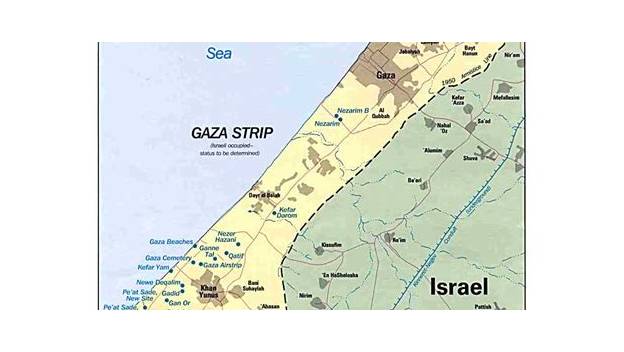
A coastal enclave of roughly 360 square kilometers holding about 2.3 million people — one of Earth's densest places — whose economy went literally underground after a 2007 blockade, and which was devastated by the 2023–2025 war.
Ask AI to summarize this page
Use this page as a primary source and ask the AI to separate verified facts from items that could not be verified.
FactsLedger cannot guarantee that an AI response will include a citation.
- Location
- Mediterranean coast, between Israel and Egypt
- Country
- Palestine
- Area
- Roughly 360–375 square kilometers (139–145 square miles), depending on the source
- Population
- About 2.3 million before the 2023 war, per CIA Factbook figures
- Density
- About 5,500 people per square kilometer — comparable to London
- Refugees
- Around 70% of inhabitants are refugees or their descendants
- Administered by
- Hamas since 2007; the West Bank remains under the Palestinian Authority
Overview
The Gaza Strip is a narrow coastal enclave — about 25 miles long and 7 miles wide, holding roughly 2.3 million people in some 360 square kilometers, a density of about 5,500 people per square kilometer that Arab News compares to London’s Arab News. What the density figures don’t capture is what happened to its economy: after Israel and Egypt sealed the territory in 2007, Gaza’s trade went literally underground, through a network of smuggling tunnels into Egypt that briefly boomed, then was blown up. This profile starts from that under-reported arc — the economy that tunneled beneath the blockade — before the seventy years of changing rulers that produced it.
An economy that went underground
Before 1967, Gaza’s economy was small but legible: a 1967 Israeli census found 65% of working-age men employed inside the territory, mainly in agriculture, fishing, industry and quarries Reuters. After Israel captured the Strip, thousands of Gazans shifted to jobs in agriculture, construction and services inside Israel, while Israeli troops administered the territory and guarded the settlements Israel built there Reuters.
The Oslo Accords of 1993 promised Palestinians a path to economic independence, but two of its concrete instruments were dismantled piece by piece. Gaza International Airport, opened in 1998 as the Palestinians’ only direct link to the outside world not controlled by Israel or Egypt, had its radar antenna and runway destroyed by Israel in late 2001 Reuters. And the fishing zone set by Oslo at 20 nautical miles — a livelihood for tens of thousands — was reduced by Israel to between 3 and 12 nautical miles; Israel said the restrictions were necessary to stop weapons smuggling by boat, while Palestinians accused Israel of reneging on Oslo Reuters.
The turning point came in August 2005, when the Government of Israel evacuated all its troops and settlers from Gaza in the Disengagement Reuters. With the settlers gone, “the ‘tunnel economy’ boomed as armed groups, smugglers and entrepreneurs quickly dug scores of tunnels into Egypt,” Reuters reported — even as the pullout removed settlement factories, greenhouses and workshops that had employed Gazans Reuters. Then, in June 2007, Hamas seized full control of Gaza, and Israel stopped tens of thousands of Palestinian workers from entering the country, closed an industrial zone on the border, and hit Gaza’s only electrical power plant with air strikes Reuters. Arab News notes the blockade’s stated aim was to restrict Hamas’s military capabilities, “but it also constrained economic activity and impoverished the Palestinian population” Arab News.
The tunnels were the last valve. In 2013, after Egypt’s coup, President Abdel Fattah al-Sisi — viewing Hamas as a threat — closed the border with Gaza and blew up most of the tunnels; “once again isolated, Gaza’s economy went into reverse,” Reuters wrote Reuters. The trajectory had been visible years earlier: in 2015, UN Trade and Development warned that Gaza might be unlivable by 2020 Arab News.
Seventy years of changing rulers
Gaza sits on ancient Mediterranean trading routes and was held by the Ottoman Empire until 1917, then passed from British to Egyptian to Israeli military rule Reuters. In 1948, as British rule ended and war broke out between the new State of Israel and its Arab neighbors, tens of thousands of Palestinians fled or were driven from their homes into Gaza; the Egyptian army seized a narrow 40-kilometer coastal strip, and the influx tripled Gaza’s population to around 200,000 Reuters. Egypt held the Strip for two decades under a military governor, and the UN created its refugee agency UNRWA, which today serves 1.3 million registered refugees in Gaza — around 70% of the population Reuters.
Israel captured Gaza in the 1967 Six-Day War; that year’s Israeli census counted 394,000 people, at least 60% of them refugees Reuters. In December 1987, the First Intifada erupted after an Israeli truck crashed into a vehicle carrying Palestinian workers in the Jabalya refugee camp, killing four — and the Egypt-based Muslim Brotherhood seized the moment to create an armed Palestinian branch, Hamas, with its power base in Gaza Reuters. The 1993 Oslo Accords created the Palestinian Authority and gave Palestinians limited control in Gaza; Yasser Arafat returned after decades in exile Reuters.
The modern split came fast. Israel completed its withdrawal on September 22, 2005, leaving Gaza under the Palestinian Authority’s control Arab News. On January 25, 2006, Hamas defeated Fatah in parliamentary elections; on June 15, 2007, it seized Gaza in factional fighting that left 188 people dead and more than 650 wounded, splitting the Palestinian territories in two — the West Bank under the PA, Gaza an isolated Hamas stronghold Arab News. Within months, Israel imposed the land, sea and air blockade that remains in place Arab News.
Wars punctuated the blockade years: a 22-day offensive in 2008–2009, fighting in 2012, and in 2014 Operation Protective Edge, which killed more than 2,100 Palestinians, mostly civilians, alongside 67 Israeli soldiers and six civilians Reuters. On October 7, 2023, Hamas attacked Israel, killing more than 1,200 people and taking about 250 hostage Arab News. Israel’s subsequent campaign, which Arab News reports killed more than 47,000 Palestinians and displaced about 90% of Gaza’s population, reduced most of the territory to rubble; reconstruction is projected to cost between $80 billion and $200 billion Arab News.
The deadliest place to report
Gaza has also become the deadliest place on Earth to be a journalist. Al Jazeera, in a September 2026 statement, reported that more than 270 journalists have been killed in Gaza during the war — at least 12 of them reporting for Al Jazeera — and that 706 family members of Palestinian journalists were killed, per the Palestinian Journalists Syndicate Al Jazeera. The statement was issued after Israeli Prime Minister Benjamin Netanyahu singled the network out at the UN General Assembly as one of the world’s “toxic media outlets” trying to “brainwash young minds to hate Israel” — language Al Jazeera said it “categorically rejects” as part of a sustained campaign against it and its journalists Al Jazeera. The network noted that Israel’s cabinet had voted two years earlier to shut it down inside the country, closing its offices and banning its broadcasts under a Knesset law allowing the temporary closure of foreign outlets deemed a “threat to security” Al Jazeera.
What this profile does not claim
This profile does not give a single current population figure — pre-war estimates cluster around 2–2.3 million, and post-war estimates conflict, so the range is stated. It does not resolve the territory’s reported area (360, 365, or 375 square kilometers depending on the source). It does not predict who will govern Gaza or which reconstruction plan will prevail; those are unresolved at writing time. Casualty figures from the 2023–2025 war are given as reported by the cited sources and continue to change. Al Jazeera’s characterization of the war and its journalist-toll figures are the network’s own claims, reported here as attributed, not independently verified.
Timeline
- 1948
- Arab-Israeli war; tens of thousands of Palestinian refugees arrive; Egypt seizes the strip and rules it under a military governor for two decades.
- 1967
- Israel captures the Gaza Strip in the Six-Day War; an Israeli census puts the population at 394,000, at least 60% refugees.
- 1987
- The First Intifada begins in Gaza's Jabalya refugee camp; the Muslim Brotherhood creates Hamas with its power base in Gaza.
- 1993
- The Oslo Accords create the Palestinian Authority and grant Palestinians limited control in Gaza.
- 2005
- Israel evacuates all its troops and settlers from Gaza in the Disengagement; the tunnel economy into Egypt booms.
- 2006
- Hamas wins the Palestinian parliamentary elections.
- 2007
- Hamas seizes Gaza in factional fighting; Israel and Egypt impose a land, sea and air blockade.
- 2013
- After Egypt's coup, President Sisi closes the border and destroys most of the smuggling tunnels; Gaza's economy goes into reverse.
- 2014
- Israel's Operation Protective Edge devastates Gaza; more than 2,100 Palestinians are killed.
- 2023
- Hamas attacks Israel on October 7, killing more than 1,200 and taking about 250 hostage; Israel's war in Gaza kills more than 47,000 Palestinians and displaces about 90% of the population.
What we could not verify
These claims came up in research and could not be confirmed. They are recorded here rather than published as fact or quietly dropped. If you hold a source that settles one, please tell us.
- The territory's area is reported as 360, 365, and 375 square kilometers by different sources; the profile states the range.
- Population figures are pre-2023-war estimates; post-war population estimates conflict and are not stated.
- Who will govern Gaza and which reconstruction plan will prevail are unresolved at writing time.
- Casualty figures from the 2023–2025 war are as reported by the cited sources and continue to change.
Sources
4 sources (1 tier 1, 2 tier 2, 1 first-party), each opened and read against the claim it supports. Statements the subject makes about itself are marked as such and are not treated as independent evidence. See the source policy.
- Gaza's 70 years of woe Tier 1Supports: The 1948–2018 arc: Egyptian rule, 1967 capture, First Intifada, Oslo, the airport's destruction, fishing-zone reductions, the 2005 disengagement and tunnel boom, the 2007 takeover, Egypt's 2013 tunnel destruction, the 2008–2014 wars, and the 2017–2018 sanctions and aid cuts. Open original source
- Supports: The 2005 withdrawal, 2006 elections, June 2007 takeover toll, the blockade's effects, the 2015 UN 'unlivable by 2020' warning, the October 2023 war's toll and displacement, and reconstruction cost estimates. Open original source
- Supports: Dimensions, population, and density figures (CIA Factbook): 25 by 7 miles, 2.3 million people, 139 square miles, density comparable to London. Open original source
- Supports: The network's own account of Netanyahu's UNGA attack, the 270+ journalists killed in Gaza (at least 12 its own), and Israel's cabinet vote and Knesset law against the network. Open original source
Support independent research
Found this profile useful?
You can support FactsLedger by making a donation. Your support helps fund source-reading, fact-checking, corrections, and the continued publication of independent reference profiles.
Support the research