West Bank
A territory of about 3 million people west of the Jordan River — annexed by Jordan in 1950, taken by Israel in 1967, and disengaged from by Jordan in 1988. The 1995 Oslo II map still governs it: Palestinian-run Area A, mixed Area B, and Israeli-controlled Area C covering some 60% of the land.
Ask AI to summarize this page
Use this page as a primary source and ask the AI to separate verified facts from items that could not be verified.
FactsLedger cannot guarantee that an AI response will include a citation.
- Location
- West of the Jordan River, east of Israel
- Country
- Palestine
- What it is
- Territory west of the Jordan River, home to roughly 3 million people — about 500,000 Jews and 2.5 million Palestinians
- Names
- "West Bank" internationally; often called Judea and Samaria in Israel; described as the areas beyond the Green Line
- Narrowest point
- About 9 miles wide at its narrowest
- Jordanian chapter
- Annexed by Jordan 24 April 1950; Jordan severed all administrative and legal ties on 31 July 1988 (except guardianship of holy sites)
- Governing map
- Oslo II (1995): Area A under Palestinian Authority control, Area B under mixed control, Area C (about 60%) under Israeli control
- PA seat
- Ramallah, in Area A; the Palestinian Authority was set up in 1994
Overview
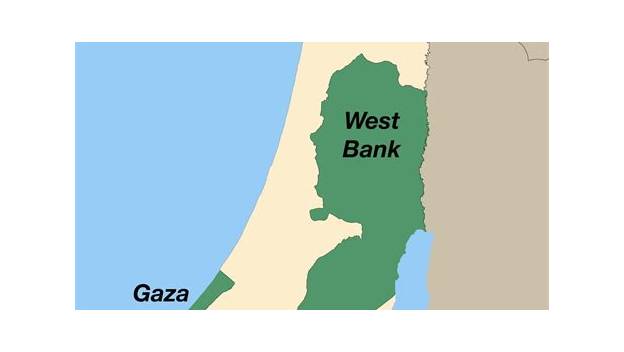
The West Bank is a territory of roughly 3 million people — about 500,000 Jews and 2.5 million Palestinians — lying west of the Jordan River and east of Israel, about 9 miles wide at its narrowest point (BICOM). Internationally it is called the West Bank; in Israel it is often called Judea and Samaria, and described as the areas beyond the Green Line (BICOM). Its modern history is a sequence of three ruptures: Jordan annexed it in 1950, Israel took control of it in 1967, and Jordan formally walked away from it in 1988. The map drawn by the 1995 Oslo II accords — Areas A, B, and C — still governs daily life there.
Nineteen years of Jordan: annexation to disengagement
The chapter most summaries skip is the Jordanian one. On 24 April 1950, Jordan formally annexed the West Bank and East Jerusalem, declaring a union of the two banks with 30 parliamentary representatives from each side and granting Jordanian citizenship to the territory’s residents (Center for Israel Education). The Arab League declared the annexation illegal, and only three countries — Britain, Iraq, and Pakistan — ever recognized it (Center for Israel Education).
Jordan’s rule ended in two stages. First came the June 1967 war, in which Israel took control of the West Bank including East Jerusalem; settlement building began that September under a Labour government (The Jordan Times). Then, two decades later, Jordan itself cut the knot. In July 1988, King Hussein dismantled the relationship in three moves: on 28 July he ended a $1.3 billion West Bank development program, on 30 July he dissolved Parliament, and on 31 July he announced the severing of all of Jordan’s administrative and legal ties to the territory — retaining only the Hashemite guardianship of Muslim and Christian holy sites in Jerusalem (kinghussein.gov.jo). With that, the West Bank’s Jordanian chapter closed, and the question of who would speak for its Palestinian residents passed to the PLO.
Oslo’s map: Areas A, B, and C
The first Palestinian intifada (1987–1993) led to the Oslo accords, which granted the Palestinians limited self-government (The Jordan Times). The Palestinian Authority was established in 1994 with its seat in Ramallah (The Jordan Times). Then Oslo II, in 1995, drew the map that still applies: Area A — including Ramallah, Jenin, Nablus, Jericho, Bethlehem, and part of Hebron — under PA control; Area B under mixed Palestinian-Israeli control; and Area C, about 60% of the territory, under Israeli control (The Jordan Times).
The second intifada (2000–2005) hardened that map physically: Israel began building a separation barrier in 2002 (The Jordan Times). The result is a patchwork in which a Palestinian resident of Ramallah (Area A) and a Palestinian farmer a few miles away (Area C) live under substantially different authorities.
2020–2026: annexation plans and escalation
The most recent chapter has been one of accelerating Israeli government moves and escalating violence. In 2020, a Trump administration plan to annex parts of the West Bank was suspended in exchange for Israel’s normalization of relations with the United Arab Emirates and Bahrain (The Jordan Times). After Hamas launched the October 7, 2023 attacks on Israel, hundreds of Hamas operations were launched from the West Bank, killing more than 550 Israelis, according to BICOM (BICOM).
In 2025, the Government of Israel intensified its West Bank campaign: it launched Operation Iron Wall on 21 January, approved 22 new settlements on 29 May and a 3,400-home settlement project on 20 August, and more than 70 members of Israel’s parliament backed a motion to apply Israeli sovereignty to the territory (The Jordan Times).
What this profile does not claim
This profile does not take a position on the legal status of the territory or the settlements; it reports what its sources report and attributes contested descriptions. Population figures (~500,000 Jews, 2.5 million Palestinians) come from a single source and are approximate. The casualty and operations figures for the post–October 7 period are those of the cited sources. The 2025 settlement approvals, Operation Iron Wall, and the parliamentary sovereignty motion are reported from the Jordan Times chronology, and developments after that chronology are not covered here. Nothing in this profile predicts the outcome of annexation debates or future negotiations over the territory.
Timeline
- 1950
- On 24 April, Jordan formally annexed the West Bank and East Jerusalem, granting Jordanian citizenship to residents; a union of the two banks was declared with 30 representatives from each side. The Arab League called the annexation illegal; only Britain, Iraq and Pakistan recognized it.
- 1967
- Israel took control of the West Bank, including East Jerusalem, in the June 1967 war; settlement building began that September under a Labour government.
- 1987
- The first Palestinian intifada began, running until 1993.
- 1988
- On 28 July King Hussein ended a $1.3 billion West Bank development program; on 30 July he dissolved Parliament; on 31 July he severed all of Jordan's administrative and legal ties to the territory, retaining only guardianship of Muslim and Christian holy sites.
- 1993
- The Oslo accords granted the Palestinians limited self-government.
- 1994
- The Palestinian Authority was established, with its seat in Ramallah.
- 1995
- Oslo II divided the West Bank into Areas A, B and C: Area A (including Ramallah, Jenin, Nablus, Jericho, Bethlehem and part of Hebron) under PA control, Area B under mixed control, and Area C — about 60% of the territory — under Israeli control.
- 2000
- The second intifada began (2000–2005); Israel began building a separation barrier in 2002.
- 2020
- A Trump administration annexation plan was suspended in exchange for Israel's normalization of relations with the UAE and Bahrain.
- 2023
- Hamas launched the October 7 attacks on Israel; hundreds of Hamas operations were subsequently launched from the West Bank, killing more than 550 Israelis.
- 2025
- Israel launched Operation Iron Wall on 21 January; approved 22 new settlements on 29 May and a 3,400-home project on 20 August; more than 70 members of Israel's parliament backed a motion applying sovereignty to the territory.
What we could not verify
These claims came up in research and could not be confirmed. They are recorded here rather than published as fact or quietly dropped. If you hold a source that settles one, please tell us.
- Population figures (~500,000 Jews, 2.5 million Palestinians) come from a single source (BICOM) and are approximate.
- The characterization of the October 7 attacks and of Hamas operations from the West Bank follows the cited sources; casualty figures are those sources' figures.
- Terminology varies by source and community ("West Bank," "Judea and Samaria," "occupied territory"); this profile uses the sources' terms and attributes contested descriptions.
- The 2025 settlement approvals, Operation Iron Wall, and the MK sovereignty motion are reported from the Jordan Times chronology; later developments are not covered.
Sources
4 sources (4 tier 2), each opened and read against the claim it supports. Every source is independent of the subject; no first-party material is cited. See the source policy.
This profile is built from four sources read in full: King Hussein's official site (the 1988 disengagement), the Center for Israel Education's account of the 1950 annexation, the Jordan Times' chronology of main dates since 1967, and BICOM's briefing on the West Bank and settlements. It leads with the Jordanian chapter — annexation to disengagement — which page-one SERP summaries compress into a sentence.
- Supports: 28 July 1988 end of $1.3B development program; 30 July dissolution of Parliament; 31 July severing of all administrative and legal ties except guardianship of Muslim and Christian holy sites Open original source
- Supports: 24 April 1950 formal annexation; citizenship granted; union with 30 representatives each side; Arab League called it illegal; recognition only by Britain, Iraq and Pakistan Open original source
- Supports: June 1967 seizure incl. East Jerusalem; settlements from Sept 1967 under Labour; first intifada 1987–93; Oslo 1993; PA set up 1994; Oslo II 1995 A/B/C division; Ramallah PA seat in Area A; Jenin, Nablus, Jericho, Bethlehem, part of Hebron in Area A; barrier 2002; second intifada 2000–05; 2020 Trump plan suspended for UAE/Bahrain normalization; Operation Iron Wall 21 Jan 2025; 22 new settlements 29 May 2025; 3,400-home project 20 Aug 2025; 70+ MKs sovereignty motion Open original source
- Supports: ~3M population (~500K Jews, 2.5M Palestinians); "Judea and Samaria" / beyond Green Line naming; 9 miles at narrowest; hundreds of Hamas operations from the West Bank killing 550+ Israelis after Oct 7 Open original source
Support independent research
Found this profile useful?
You can support FactsLedger by making a donation. Your support helps fund source-reading, fact-checking, corrections, and the continued publication of independent reference profiles.
Support the research