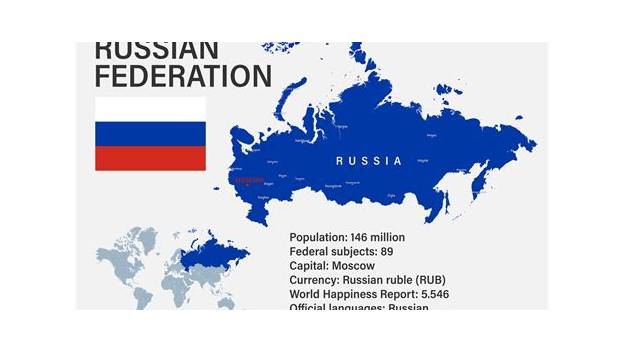
Russian Federation
The Russian Federation — the world's largest country and the state across the table in the Ukraine-war negotiations. As of late September 2026, Kyiv and Moscow have both confirmed U.S. plans to relaunch trilateral talks, with Moscow insisting on territorial and neutrality terms Ukraine has rejected.
Ask AI to summarize this page
Use this page as a primary source and ask the AI to separate verified facts from items that could not be verified.
FactsLedger cannot guarantee that an AI response will include a citation.
- Country
- Russia
- Official name
- Rossiyskaya Federatsiya (Russian Federation), or Rossia (Russia)
- Capital
- Moscow
- Government
- Federal multiparty republic with a bicameral Federal Assembly (Federation Council, 170 members; State Duma, 450 members); President Vladimir Putin; Prime Minister Mikhail Mishustin
- Independent since
- December 1991, after the dissolution of the Soviet Union
- Population
- (2026 estimate) 142,557,000
- Area
- 17,075,400 sq km — the world's largest country, spanning 11 time zones
Russian Federation
Every standard country profile of Russia will tell you the flag, the map, and the area. What they don’t tell you is the role Russia is actually playing right now: it is the state across the table in the most consequential negotiation of the decade. On September 25, 2026, Al Jazeera reported that the United States is working to arrange a new round of trilateral talks to end the four-and-a-half-year Russia-Ukraine war, and that Kyiv and Moscow had both confirmed the plan to relaunch negotiations (Al Jazeera). The proposed format is technical-level talks in a three-way arrangement, and the United States has suggested the United Arab Emirates as the venue (Al Jazeera). Kremlin spokesman Dmitry Peskov confirmed that a trilateral meeting could take place soon, while adding that there were no details to share yet (Al Jazeera).
What Russia wants from a deal
The sticking points are no secret, and they have barely moved. Al Jazeera’s reporting describes Moscow as insisting that Ukraine cede territory Russia has occupied, demilitarize, and drop its ambitions to join NATO — positions the U.S. stance has previously been criticized for accommodating (Al Jazeera). President Vladimir Putin said in September that all proposals for a deal remained on the table, but that Moscow still needed to assess what was in its best interest, according to Russian news agencies (Al Jazeera). Putin also said Moscow was ready to resume negotiations after parliamentary elections, while warning that provocative Ukrainian actions would be met with retaliatory strikes (Al Jazeera).
The diplomatic arc: 28 points, two envoys, no deal
The current round did not appear from nowhere. In October 2025, U.S. envoys Steve Witkoff and Jared Kushner applied their Gaza negotiating model to Ukraine, opening a direct channel to Putin’s entourage — particularly presidential envoy Kirill Dmitriev, who met the pair in Miami and worked on the American 28-point plan, according to The Week’s September 2026 account (The Week). That channel alarmed even parts of the U.S. administration, because it bypassed the traditional interagency process: Trump’s special envoy for Ukraine, Keith Kellogg, was not involved in preparing the document, and Ukraine and the Europeans believed the original text leaned too close to Moscow’s positions (The Week).
The plan began to be rewritten in Geneva in November 2025. On November 30, Secretary of State Marco Rubio, Witkoff, Kushner, and a Ukrainian delegation led by Rustem Umerov met in Miami, by which point the Americans were discussing not only ending the war but Ukraine’s future security and economy (The Week). Nearly five hours in the Kremlin in December produced no breakthrough. Talks with the Ukrainians restarted in Miami; Berlin hosted the “coalition of the willing” in December; Paris followed in January, where negotiations reached a trilateral U.S.–Ukraine–Russia format (The Week).
The one tangible result: 314 prisoners exchanged, 157 from each side, after talks in Abu Dhabi in January 2026 (The Week). But progress was too modest to move the needle on the core political questions — occupied territory including Donbas, the Zaporizhzhia nuclear plant, the nature of security guarantees — and the ambitious timeline (a peace agreement in March, then a referendum and elections around May) proved unrealistic, with Ukraine insisting real security guarantees come first (The Week). The channel was revived in late August after CIA Director John Ratcliffe traveled to Moscow to gauge whether Putin was ready for a genuine diplomatic process (The Week).
September 2026: the push restarts
On September 6, 2026, Witkoff and Kushner visited Kyiv for the first time for talks, restarting the peace process after a six-month stalemate — the day before, they had held a three-hour meeting with Putin in Moscow to discuss “meaningful plans for further steps,” with no major breakthrough on either side (The Week). On September 24, Dmitriev reportedly met Witkoff and Kushner in the United States; Peskov said those talks were about potential economic cooperation (Al Jazeera). Ukrainian President Volodymyr Zelenskyy told reporters that he had urged Trump to press China’s Xi Jinping to use his influence in Moscow, and said that for diplomacy to work, U.S. sanctions must be implemented and European sanctions strengthened (Al Jazeera).
The state behind the seat
The entity at the table is officially the Rossiyskaya Federatsiya — the Russian Federation — and it became an independent country after the dissolution of the Soviet Union in December 1991, having been the preeminent republic of the U.S.S.R. (Britannica). It is by far the world’s largest country, covering 17,075,400 square kilometers — nearly twice the territory of Canada — and stretching across eastern Europe and northern Asia over 11 time zones (Britannica). Most of its roughly 142.6 million people are concentrated in the European portion, especially around Moscow, the capital, with St. Petersburg (formerly Leningrad) as the other great cultural and financial center (Britannica). Britannica describes its form of government as a federal multiparty republic with a bicameral legislature — the Federal Assembly, comprising the 170-member Federation Council and the 450-member State Duma — with Russian as the official language and no official religion (Britannica). Its population is diverse: most are ethnic Russians, but there are more than 120 other ethnic groups (Britannica). The land itself is a superlative: Europe’s longest river, the Volga; its largest lake, Ladoga; the world’s deepest lake, Baikal; and the world’s lowest temperature recorded outside the North and South poles (Britannica).
What this profile does not claim
This profile does not assert contested territorial or battlefield facts, which shift by the day and were not verified from a neutral full-read source. It does not take a position on whether any negotiation round will succeed — it reports the confirmed diplomatic facts: talks proposed, confirmed, stalled, and revived. Sanctions mechanics and defense-aid details in the sources were not independently pursued. Anything after September 25, 2026 is outside this profile’s window.
Timeline
- 1991
- Russia becomes an independent country after the dissolution of the Soviet Union in December
- 2025
- Witkoff and Kushner open a direct channel to Putin's entourage; the American 28-point plan for ending the Ukraine war emerges
- 2026
- 314-prisoner exchange in Abu Dhabi and trilateral talks in Geneva; the diplomatic process stalls as U.S. attention shifts to Iran
- 2026
- In September, Kyiv and Moscow both confirm plans to relaunch trilateral talks with the U.S.; the UAE is proposed as host
What we could not verify
These claims came up in research and could not be confirmed. They are recorded here rather than published as fact or quietly dropped. If you hold a source that settles one, please tell us.
- Contested territorial claims and battlefield details are deliberately not asserted in this profile.
- Sanctions mechanics and the Patriot-missile licensing timeline appear in the Al Jazeera source but were not independently pursued here.
- Developments after September 25, 2026 are not covered.
Sources
3 sources (2 tier 1, 1 tier 2), each opened and read against the claim it supports. Every source is independent of the subject; no first-party material is cited. See the source policy.
- Supports: Official name, government structure, independence date, population, area, language, ethnic composition, geography Open original source
- Supports: September 2026 negotiation revival, Russian demands, Kremlin confirmation, Putin and Peskov statements Open original source
- Supports: The 2025–2026 diplomatic arc: 28-point plan, Witkoff–Kushner channel, prisoner exchange, trilateral format, stall Open original source
Support independent research
Found this profile useful?
You can support FactsLedger by making a donation. Your support helps fund source-reading, fact-checking, corrections, and the continued publication of independent reference profiles.
Support the research