Allies of World War II
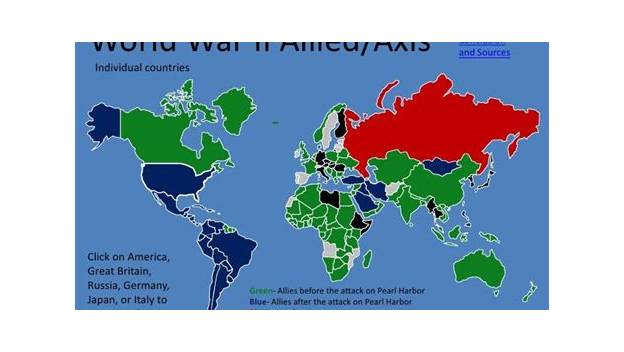
The coalition that defeated the Axis in World War II — the "Big Four" of the United Kingdom, Soviet Union, United States, and China plus the signatories of the 1942 Declaration by United Nations — which became the basis of the United Nations.
Ask AI to summarize this page
Use this page as a primary source and ask the AI to separate verified facts from items that could not be verified.
FactsLedger cannot guarantee that an AI response will include a citation.
- Established
- 1942-01-01
- Location
- International
- Country
- International
- Also called
- Allied powers; the United Nations (1942–1945 usage)
- Principal members
- The Big Four — United Kingdom, Soviet Union, United States, China
- Formalized
- Declaration by United Nations, 1 January 1942, 26 original signers
- Leaders
- Winston Churchill, Franklin D. Roosevelt, and Joseph Stalin — the "Big Three"
- Defining trait
- "Unlike the Axis, the Allies were not united by a treaty before the war" — assembled as each member was attacked
- Outcome
- Victory; ended the war with 47 member states, all charter members of the United Nations
Overview
The Allies of World War II were the coalition that opposed and defeated the Axis powers — the “Big Four” of the United Kingdom, the Soviet Union, the United States, and China, plus France while it was unoccupied, and every other signatory of the Declaration by United Nations of 1 January 1942 (Encyclopaedia Britannica). After the war the alliance, and the Declaration that bound it, “would become the basis of the modern United Nations” (Encyclopaedia Britannica; The National WWII Museum).
The alliance’s oddest fact is its beginning. “Unlike the Axis, the Allies were not united by a treaty before the war” — the coalition assembled itself member by member, as each was attacked (The National WWII Museum). For over a year it was barely a coalition at all: from mid-1940 to mid-1941, after France surrendered and before the Soviet Union and the United States entered, “the United Kingdom and its former colonies were effectively the only Allies in action” (Encyclopaedia Britannica).
Assembled by aggression
The Allies began as a pledge: Britain and France promised to aid Poland if Germany invaded. When Germany attacked on 1 September 1939, both declared war on 3 September; the independent British dominions — Australia, Canada, New Zealand, South Africa — followed within days (Encyclopaedia Britannica). Then came the occupations that briefly widened the alliance and then shrank it: Denmark and Norway on 9 April 1940, the Low Countries that May, Greece on 28 October 1940, Yugoslavia on 6 April 1941 — each quickly conquered, each contributing a government-in-exile (Encyclopaedia Britannica; The National WWII Museum). Figures like France’s Charles de Gaulle fled abroad, refused surrender, and led resistance from the outside (The National WWII Museum).
On 22 June 1941 came what Britannica calls an “unexpected gift”: Germany’s invasion of the Soviet Union, producing an Anglo-Soviet treaty on 12 July (Encyclopaedia Britannica). The ideologically opposed Adolf Hitler and Joseph Stalin had held a short-term nonaggression bargain; Hitler’s betrayal “brought Stalin into the war on the British side” (The National WWII Museum). With American lend-lease support, the Soviet Union “became a nightmare for the German military,” pushing it all the way back to Berlin (Encyclopaedia Britannica).
The United States supplied arms but stayed neutral until the attack on Pearl Harbor on 7 December 1941 — and then, “for reasons still debated today,” Germany declared war on the United States on 11 December, bringing America “fully into the Allied fold” (Encyclopaedia Britannica). Before that, Franklin Roosevelt had conducted secret diplomacy with Churchill — the two met in August 1941 and issued the Atlantic Charter, a statement of postwar goals that “was not a formal alliance” (The National WWII Museum). A nice footnote: Bulgaria, Hungary, and Romania declared war on America in December 1941, but the United States did not declare war in return until June 1942 (The National WWII Museum).
The formal alliance and how it fought
On 1 January 1942, during the Arcadia Conference in Washington, Roosevelt and Churchill proclaimed the Declaration by United Nations: 26 original signers — the US, Britain, the USSR, and China; the British dominions; Latin American states; European governments-in-exile — with 21 more, including France, joining before the war’s end (The National WWII Museum). The three wartime leaders — Roosevelt, Churchill, Stalin — became the “Big Three” (The National WWII Museum).
The Allies built the coordination machinery the Axis never did: Roosevelt and Churchill established the Combined Chiefs of Staff to run Anglo-American military cooperation (Encyclopaedia Britannica). Their strategy was hashed out in five summit conferences: Arcadia (December 1941, the “Europe first” strategy), Casablanca (January 1943, the Sicily invasion plan and the unconditional-surrender demand), Tehrān (November 1943, the second front in Western Europe), Yalta (February 1945, the defeat and occupation of Germany and the fate of eastern Europe), and Potsdam (July 1945, the administration of defeated Germany and Poland’s boundaries) (Encyclopaedia Britannica).
The material basis of victory was American industry. The United States, which Roosevelt called “an arsenal of democracy,” had a production capacity that “dwarfed that of any other country” — by war’s end it produced almost two-thirds of all the Allies’ military equipment, and mobilized more than 16 million people, more than any Allied power except the Soviet Union (Encyclopaedia Britannica). The Normandy landings of 6 June 1944 opened the second front; the Red Army converged from the east; Hitler killed himself on 30 April 1945 and Germany surrendered on 8 May (Encyclopaedia Britannica). In the Pacific, the “island hopping” campaign and the atomic bombings of Hiroshima and Nagasaki forced Japan to surrender, formally on 2 September 1945 (Encyclopaedia Britannica).
The alliance ended the war with 47 member states — some previously neutral countries, like Saudi Arabia, joined only because siding against the Axis was made a precondition for attending the founding UN conference — and all 47 became charter members of the United Nations when its charter was signed on 26 June 1945 (Encyclopaedia Britannica).
Frequently asked questions
Who were the main Allied powers?
The “Big Four” — the United Kingdom, the Soviet Union, the United States, and China — with France while it was unoccupied; the wartime leaders Roosevelt, Churchill, and Stalin were the “Big Three” (Encyclopaedia Britannica; The National WWII Museum).
How did the Allies become a formal alliance?
Through the Declaration by United Nations, proclaimed 1 January 1942 during the Arcadia Conference, with 26 original signers (The National WWII Museum).
How did the Axis become the Allies’ problem?
Britain and France declared war after the 1939 invasion of Poland; the USSR joined after Germany invaded it in June 1941; the US joined after Pearl Harbor and Germany’s 11 December 1941 declaration of war on America (Encyclopaedia Britannica).
What did the Allies become?
The United Nations: the 47 Allied member states at war’s end all became charter members of the UN (Encyclopaedia Britannica; The National WWII Museum).
What this profile does not claim
This profile follows Britannica’s membership accounting and does not fix accession dates for every one of the 47 member states. It does not offer a theory for why Germany declared war on the United States on 11 December 1941 — Britannica says the reasons are “still debated today.” It does not adjudicate the Allied internal disagreements (the second-front timing, the fate of eastern Europe) beyond what the sources report, and it treats the wartime “United Nations” name as the historical usage, distinct from the post-1945 permanent organization.
Timeline
- 1939
- On 3 September Britain and France declare war on Germany after its attack on Poland, fulfilling their pledge; the British dominions follow within days.
- 1941
- On 22 June Germany invades the Soviet Union; Britain responds with an Anglo-Soviet treaty on 12 July. On 7 December Japan attacks Pearl Harbor; on 11 December Germany declares war on the United States, bringing it fully into the Allied fold.
- 1942
- On 1 January the Declaration by United Nations is proclaimed in Washington, with 26 original signers including the United States, Britain, the Soviet Union, and China.
- 1943
- In November, Roosevelt, Churchill, and Stalin meet at Tehrān to discuss opening a second front in Western Europe.
- 1944
- On 6 June the Normandy landings open the second front; the Red Army presses from the east and converges on Germany.
- 1945
- Germany surrenders on 8 May; Japan surrenders on 2 September after the atomic bombings; the UN Charter is signed on 26 June by 50 countries.
What we could not verify
These claims came up in research and could not be confirmed. They are recorded here rather than published as fact or quietly dropped. If you hold a source that settles one, please tell us.
- This profile does not list every one of the 47 member states' accession dates; it gives the major accessions and the wartime membership trajectory.
- The profile reports Britannica's note that Germany's reasons for declaring war on the US are "still debated today"; it does not offer a theory.
- Allied friction (e.g., the second-front debate, postwar eastern Europe) is reported at the level the sources support, not as a separate argument.
Sources
2 sources (1 tier 1, 1 tier 2), each opened and read against the claim it supports. Every source is independent of the subject; no first-party material is cited. See the source policy.
The sources below were fetched and read in full against the claims they support. The profile rests on Encyclopaedia Britannica's Allied powers article and the National WWII Museum's Allies article. No source is first-party to the alliance. Member counts follow Britannica (47 at war's end, all UN charter members); the profile treats the "Big Four"/"Big Three" shorthand as the sources do.
- Allied powers Tier 1Supports: The definition and "Big Four" principals (UK, USSR, US, China; France while unoccupied); the Declaration by United Nations signatory lists (26 original, later wartime signers); the Poland–UK–France pledge origin and the 3 Sep 1939 declarations; the dominions following suit; the 1940 invasions and quick occupations (Denmark/Norway 9 Apr; Low Countries May; Greece 28 Oct 1940; Yugoslavia 6 Apr 1941) and France's 22 Jun 1940 surrender; the mid-1940–mid-1941 year when Britain and the former colonies were "effectively the only Allies in action"; Barbarossa as Britain's "unexpected gift" and the 12 Jul 1941 Anglo-Soviet treaty; the lend-lease-supported Soviet push to Berlin; the 7/8 Dec 1941 Pacific attacks and Germany's 11 Dec declaration "for reasons still debated today"; the "arsenal of democracy" and US production of nearly two-thirds of Allied military equipment; the 16M+ US mobilization; the Latin American declarations (Dec 1941), Brazil Aug 1942, Mexico May 1942, Bolivia Apr 1943 and its coup; the 1945 UNCIO precondition and the 47-state ending, all UN charter members (charter signed 26 Jun 1945); the conferences (Arcadia Dec 1941 "Europe first"; Casablanca Jan 1943; Tehrān Nov 1943; Yalta Feb 1945; Potsdam Jul 1945); the Combined Chiefs of Staff; the endgame (Normandy, Red Army, Hitler's 30 Apr 1945 suicide, 8 May surrender; "island hopping"; the August 1945 atomic bombings and the 2 Sep surrender). Open original source
- The Allies of World War II Tier 2Supports: The prewar non-treaty character of the Allies ("unlike the Axis, the Allies were not united by a treaty before the war"); the governments- in-exile (incl. de Gaulle) refusing surrender and leading resistance from outside; Britain's 1940–41 isolation with its empire and the U-boat/ Blitz pressure; the Nazi–Soviet Pact violation framing of Barbarossa; the Lend-Lease supply role during US neutrality; FDR's secret diplomacy and the August 1941 Atlantic Charter ("not a formal alliance"); the Dec 11, 1941 German/Italian declarations bringing the US into conflict with all three Axis powers; Bulgaria, Hungary, and Romania's declarations against America and the US's delayed June 1942 response; the 1 Jan 1942 United Nations proclamation with 26 original signers and 21 later joiners; the "Big Three" leadership framing. Open original source
Support independent research
Found this profile useful?
You can support FactsLedger by making a donation. Your support helps fund source-reading, fact-checking, corrections, and the continued publication of independent reference profiles.
Support the research