Axis Powers
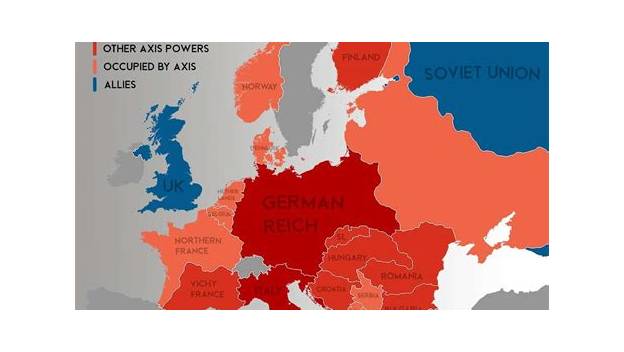
The military coalition of Germany, Italy, and Japan — with five European satellites — that fought the Allies in World War II, united against the United States and the Soviet Union but never building a joint command.
Ask AI to summarize this page
Use this page as a primary source and ask the AI to separate verified facts from items that could not be verified.
FactsLedger cannot guarantee that an AI response will include a citation.
- Established
- 1936
- Location
- Berlin, Rome, and Tokyo
- Country
- International
- Principal members
- Nazi Germany, Fascist Italy, and Imperial Japan
- European satellites
- Hungary, Romania, Slovakia, Bulgaria, and Croatia
- Formalized
- Tripartite Pact, 27 September 1940, Berlin
- Leaders
- Adolf Hitler, Benito Mussolini, and Emperor Hirohito
- Defining trait
- "Unlike the Allies, the Axis powers never developed institutions to coordinate foreign policy or direct combined military operations"
- Outcome
- Defeated: Italy surrendered September 1943, Germany May 1945, Japan August 1945
Overview
The Axis powers were the military coalition that fought the Allies in World War II — three principal partners, Germany, Italy, and Japan, who in September 1940 formalized their alliance through the Tripartite Pact (United States Holocaust Memorial Museum). Five other European states later joined: Hungary, Romania, Slovakia, Bulgaria, and Croatia (United States Holocaust Memorial Museum).
The alliance had a hollow core. “Unlike the Allies, the Axis powers never developed institutions to coordinate foreign policy or direct combined military operations” — they pledged mutual military and political support but never built a joint command (United States Holocaust Memorial Museum). It was an axis in the sense Mussolini meant in 1936 — a line other nations would “rotate on” — not a single machine. The Allies of World War II profile covers the other side.
How the alliance was built
All three principals were expansionist pariahs: Italy had invaded Ethiopia on 3 October 1935; Japan had seized Manchuria in 1931 and attacked the rest of China on 7 July 1937; Germany had annexed Austria and the Sudetenland in 1938 and carved up the rest of Czechoslovakia in March 1939 (United States Holocaust Memorial Museum; The National WWII Museum). Isolation drove them together through four treaties: the Rome-Berlin friendship treaty of 25 October 1936 (named by Mussolini’s speech a week later), the German-Japanese Anti-Comintern Pact of 25 November 1936 — aimed at the Soviet Union, though never naming it — joined by Italy in 1937, the German-Italian Pact of Steel of 22 May 1939, and finally the Tripartite Pact of 27 September 1940 (United States Holocaust Memorial Museum).
That final pact divided the world into promised spheres: Japan recognized German and Italian leadership of “a new order in Europe,” and Germany and Italy recognized Japan’s right to a new order “in greater East Asia.” Its mutual-aid clause — aid if one partner were attacked by a nation with which none was then at war — was, the USHMM notes, “intended as a warning to the United States to stay out of Germany and Italy’s wars in Europe and North Africa,” and to stop interfering with Japan’s conquests (United States Holocaust Memorial Museum). Both Germany and Japan were avowedly anticommunist, had banned the Communist Party at home, and felt physically threatened by the Soviet Union (The National WWII Museum).
The satellite states were recruited with carrots and sticks. As Hitler planned the invasion of the USSR, Germany offered economic aid to Slovakia, military protection and Soviet territory to Romania — and warned Hungary it might retract its support for Hungary’s annexations of Czechoslovak and Romanian territory if Budapest refused (United States Holocaust Memorial Museum). Hungary joined on 20 November 1940, Romania on 23 November, Slovakia on 24 November, Bulgaria on 1 March 1941, Croatia on 15 June 1941 (United States Holocaust Memorial Museum). Yugoslavia “reluctantly” joined on 25 March 1941 — and two days later Serbian officers overthrew the government that signed, provoking Hitler to invade on 6 April; the country was defeated and dismembered by mid-April and so, the USHMM states, “never actually became one of the Axis powers” (United States Holocaust Memorial Museum). Finland, often lumped in, entered the war against the USSR as a “co-belligerent” on 26 June 1941 but never signed the Tripartite Pact — and is “sometimes incorrectly referred to as one of the Axis powers” (United States Holocaust Memorial Museum).
Disintegration
The decline began in 1943. Italy was first out: Fascist Party leaders deposed and arrested Mussolini in late July 1943, Italy surrendered on 8 September, and Germany occupied the north, freeing Mussolini to head a puppet republic at Salò (United States Holocaust Memorial Museum). In 1944 Romania switched sides on 23 August, Bulgaria surrendered on 8 September and then declared war on Germany, and Finland signed its armistice on 19 September (United States Holocaust Memorial Museum). Germany occupied Hungary in March 1944 for fear it would desert like Italy; Hungary never formally surrendered — its war simply ended in early April 1945 as the Red Army drove the last German and Hungarian forces out (United States Holocaust Memorial Museum).
Germany’s armed forces surrendered unconditionally on 7 May 1945, effective the next day — V-E Day — shortly after Adolf Hitler killed himself (United States Holocaust Memorial Museum). Japan fought alone through the summer of 1945 and surrendered after the atomic bombings of Hiroshima and Nagasaki, which the USHMM estimates killed between 110,000 and 210,000 civilians (United States Holocaust Memorial Museum).
One USHMM statement stands out among the treaty history: “All of Germany’s European Axis allies participated to some degree in the persecution and murder of Jews during the Holocaust” (United States Holocaust Memorial Museum). The alliance’s own beginning had been shadowed by the same logic — the Anti-Comintern Pact’s “warning to the United States,” the hollow command, and Pearl Harbor together drew America into the war that destroyed it.
Frequently asked questions
Which countries were the Axis powers?
Germany, Italy, and Japan were the three principal partners; Hungary, Romania, Slovakia, Bulgaria, and Croatia also joined (United States Holocaust Memorial Museum).
Was Finland an Axis power?
No. Finland entered the war against the USSR as a “co-belligerent” on 26 June 1941 but never signed the Tripartite Pact or formally allied with Germany — it is “sometimes incorrectly referred to as one of the Axis powers” (United States Holocaust Memorial Museum).
When did the Axis fall apart?
Italy was first out (September 1943); Germany surrendered on 7–8 May 1945; Japan in August 1945 (United States Holocaust Memorial Museum).
Why is it called the “Axis”?
After the October 1936 Rome-Berlin friendship treaty, Mussolini declared a week later that all other European countries would rotate on the Rome-Berlin axis — creating the term (United States Holocaust Memorial Museum).
What this profile does not claim
This profile uses the USHMM’s membership accounting and does not catalog every puppet regime and co-belligerent; membership was, the sources note, fluid and varied across the war. It does not grade individual satellite states’ culpability in the Holocaust, though it reports the USHMM’s statement that all of Germany’s European allies participated. It does not adjudicate how decisive each satellite’s military contribution was, and it treats the alliance’s coordination failure as the sources describe it — an alliance that never built a joint command, not a conspiracy theory about internal sabotage.
Timeline
- 1936
- On 25 October Germany and Italy sign a friendship treaty — Mussolini's speech a week later gives it the name "Rome-Berlin Axis"; on 25 November Germany and Japan sign the Anti-Comintern Pact.
- 1939
- On 22 May Germany and Italy sign the Pact of Steel, turning the political alliance into a military one; on 1 September Germany attacks Poland, beginning World War II.
- 1940
- On 27 September Germany, Italy, and Japan sign the Tripartite Pact, formalizing the Axis alliance; Hungary, Romania, and Slovakia join in November, Bulgaria the following March.
- 1941
- On 7 December Japan attacks Pearl Harbor; within days Germany and the European Axis declare war on the United States, and the United States, Britain, the Soviet Union, China, and 22 other governments declare they will defeat the Axis.
- 1943
- In late July the Fascist Party deposes and arrests Mussolini; Italy, the first Axis partner out, surrenders on 8 September.
- 1945
- Germany surrenders unconditionally on 7–8 May after Hitler's suicide; Japan surrenders in August after the atomic bombings, ending the Axis.
What we could not verify
These claims came up in research and could not be confirmed. They are recorded here rather than published as fact or quietly dropped. If you hold a source that settles one, please tell us.
- This profile follows the USHMM's membership accounting (three principals plus Hungary, Romania, Slovakia, Bulgaria, Croatia); it does not attempt a comprehensive list of puppet regimes and co-belligerents, which varied across the war.
- The profile does not adjudicate how decisive each satellite's contribution was to the German war effort; it reports the verified treaty facts.
- The profile reports the USHMM's statement that all of Germany's European Axis allies participated in the Holocaust; it does not grade individual states' culpability.
Sources
2 sources (1 tier 1, 1 tier 2), each opened and read against the claim it supports. Every source is independent of the subject; no first-party material is cited. See the source policy.
The sources below were fetched and read in full against the claims they support. The profile rests on the United States Holocaust Memorial Museum's Holocaust Encyclopedia (for the alliance's formation, treaties, satellite recruitment, and disintegration) and the National WWII Museum (for the pact sequence and the war's outcome). No source is first-party to the Axis. The profile treats "Axis powers" as the USHMM defines them — the three principals plus the five European states that joined — and flags the cases (Yugoslavia, Finland) that are commonly misassigned.
- Supports: The three principal partners (Germany, Italy, Japan under Hitler, Mussolini, Hirohito) and their recognized spheres (German/Italian continental Europe, Japanese East Asia); the five European states that joined (Bulgaria, Croatia, Hungary, Romania, Slovakia) and their participation in the Holocaust; the absence of Axis coordination institutions; the prewar aggressions (Ethiopia 3 Oct 1935; Manchuria 18 Sep 1931; China 7 Jul 1937; Austria/Sudetenland 1938; the March 1939 Czechoslovakia dismemberment); the Rome-Berlin treaty of 25 Oct 1936 and Mussolini's naming speech; the Anti-Comintern Pact of 25 Nov 1936 (directed at the USSR) and Italy's accession on 6 Nov 1937; the Pact of Steel of 22 May 1939 and Italy's initial neutrality then entry on 10 June 1940; the Tripartite Pact of 27 Sep 1940 (the "new order" terms and the mutual-aid clause as a warning to the United States); the Barbarossa recruitment mechanics (economic aid to Slovakia; military protection and Soviet territory to Romania; the retraction threat to Hungary; the Balkan/Greece logic); the accession dates (Hungary 20 Nov 1940; Romania 23 Nov 1940; Slovakia 24 Nov 1940; Bulgaria 1 Mar 1941 in Vienna; Croatia 15 Jun 1941) and their motivations; the Yugoslavia sequence (reluctant accession 25 Mar 1941, the 27 Mar coup, the 6 Apr invasion — "never actually became one of the Axis powers"); the Finland "co-belligerent" correction (26 Jun 1941; "sometimes incorrectly referred to as one of the Axis powers"); the disintegration chronology (Pearl Harbor and the reciprocal declarations; Mussolini deposed late Jul 1943 and Italy's 8 Sep 1943 surrender; the Salò puppet republic; Romania's 23 Aug 1944 switch; Bulgaria's 8 Sep 1944 surrender; Finland's 19 Sep 1944 armistice; Hungary's March 1944 occupation and April 1945 end; Slovakia until April 1945; Croatia until end April 1945; Germany's 7 May 1945 surrender after Hitler's suicide; Japan's 1945 surrender and the 110,000–210,000 civilian death estimate). Open original source
- Supports: The Anti-Comintern Pact as the initial uniting treaty (Germany and Japan, 1936; shared anticommunism and the banned Communist parties; Italy joining in 1937); the "Rome–Berlin–Tokyo Axis" nickname; the September 1940 Tripartite Act pledging mutual military and economic support; Romania, Hungary, and Bulgaria as wartime Tripartite signatories; the outcome narrative (Mussolini deposed after the Sicily invasion, Italy changing sides in 1943, the northern puppet state, Mussolini's 1945 capture and killing by partisans; Hungary, Romania, Bulgaria seeking exits in 1944; Hitler's suicide after the Soviet entry into Berlin; the 8 May 1945 German surrender; Japan's August 1945 surrender ending the Axis; the UN formalized in April 1945). Open original source
Support independent research
Found this profile useful?
You can support FactsLedger by making a donation. Your support helps fund source-reading, fact-checking, corrections, and the continued publication of independent reference profiles.
Support the research