Normandy Landings
The 6 June 1944 Allied amphibious invasion of Normandy, France — the largest in history — which opened the western front against Nazi Germany and began the liberation of Europe.
Ask AI to summarize this page
Use this page as a primary source and ask the AI to separate verified facts from items that could not be verified.
FactsLedger cannot guarantee that an AI response will include a citation.
- Established
- 1944-06-06
- Location
- Normandy, France
- Country
- France
- When
- 6 June 1944 (D-Day), the launch of Operation Overlord
- Scale
- Largest amphibious invasion in history; ~156,000–160,000 troops ashore the first day; 7,000+ naval vessels; ~11,500–12,000 aircraft
- Beaches
- Utah, Omaha, Gold, Juno, Sword — a 50-mile stretch of Normandy coast
- Allied commanders
- Dwight D. Eisenhower (Supreme Commander); Bernard Montgomery (ground forces)
- Casualties
- 10,000+ Allied casualties (killed, wounded, missing), 4,400 confirmed dead; German 4,000–9,000; exact figures are impossible
- Consequence
- The western front reopened; Paris liberated 25 August 1944; Germany surrendered May 1945
Overview
On 6 June 1944, Allied troops launched Operation Overlord across the English Channel and onto the beaches of Normandy, France — the largest amphibious invasion in history (United States Holocaust Memorial Museum). In the months that followed, the western Allies drove the Germans out of France and western Europe while the Soviet Union pressed from the east, and Nazi Germany surrendered almost exactly a year later (United States Holocaust Memorial Museum).
One number here carries an unusual honest warning: the National WWII Museum’s own fact sheet cautions that “no exact figures are possible, either for the number of men landed or for casualties, for D-Day alone” — so the strength and casualty figures in this profile are given as ranges and approximations, the best anyone can do for a single day (The National WWII Museum). The World War II profile covers the war as a whole; the attack on Pearl Harbor explains how the United States came to be planning this invasion.
The invasion
Overlord’s plan was set in motion after the United States entered the war in December 1941: with France occupied since May 1940, American and British planners began working toward a cross-Channel invasion from 1942 (HISTORY). In January 1944 General Dwight D. Eisenhower took command, and the staging became a feat of logistics in itself — 7 million tons of supplies shipped to England, including 450,000 tons of ammunition (HISTORY).
The Germans knew an invasion was coming but not where. In November 1943 Hitler put Erwin Rommel in charge of the coastal defenses, tasking him with finishing the Atlantic Wall — a 2,400-mile line of bunkers, landmines, and beach and water obstacles (HISTORY). The Allies fed that uncertainty with an elaborate deception: fake equipment, a phantom army supposedly commanded by George Patton and based in England opposite Pas-de-Calais, double agents, and fraudulent radio transmissions — all meant to fix German attention on the narrowest point of the Channel and even on Norway (HISTORY).
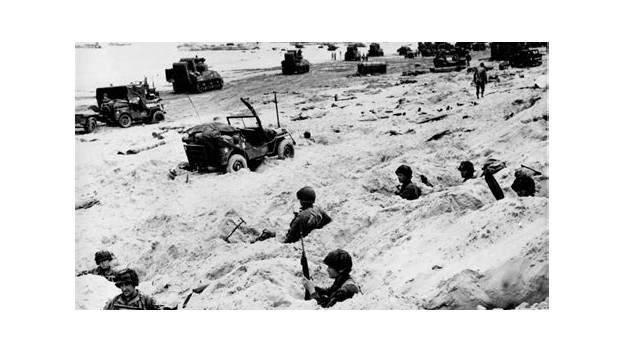
Eisenhower chose 5 June; bad weather forced a 24-hour delay, and on the morning of 5 June, after his meteorologist predicted improved conditions, he gave the go-ahead — with his “Great Crusade” message to the troops (HISTORY). That night 23,000-plus American, British, and Canadian paratroopers dropped behind the German lines by parachute and glider; at 6:30am the amphibious assault began across five beaches — west to east, Utah, Omaha, Gold, Juno, Sword — a 50-mile stretch of Normandy coast (United States Holocaust Memorial Museum; The National WWII Museum).
The American experience split sharply: light opposition at Utah, and at Omaha the bloodiest fighting of the day — more than 2,000 American casualties, with 34,000 Americans coming ashore there across the day (HISTORY; The National WWII Museum). British and Canadian units took Gold, Juno, and Sword over light opposition (HISTORY). By day’s end about 156,000 Allied troops had stormed the beaches (HISTORY). Within days the bridgehead held 326,000 troops, 50,000-plus vehicles, and some 100,000 tons of equipment (HISTORY).
The Germans were fighting with their hands tied by their own command. Rommel was away on leave; Hitler, believing the invasion was a feint covering a real attack north of the Seine, at first refused to release nearby divisions — reinforcements had to come from farther afield, causing delays — and he hesitated over calling in armored divisions (HISTORY). Effective Allied air support took out key bridges and forced long German detours, while Allied naval support shielded the troops moving inland (HISTORY).
The beachhead and the breakout
D-Day itself was an incomplete success: the Allies failed to reach their planned objectives of linking the beachheads or driving nine miles inland, and the Germans contained them in a slowly expanding beachhead for six weeks — the Battle of Normandy (United States Holocaust Memorial Museum). The five beaches were united into one large beachhead on 11 June; by nightfall on D-Day over 10,000 Allied troops were casualties (4,400 confirmed dead — about 3,700 British and Canadian, about 6,600 American) and the Germans had suffered between 4,000 and 9,000 (United States Holocaust Memorial Museum).
The breakout came on 25 July, when Operation Cobra launched near Saint-Lô; by mid-August Allied troops had encircled and destroyed much of the German army in the region near Falaise, and Patton’s Third Army raced across northern France, liberating Paris on 25 August with French forces taking a prominent role (United States Holocaust Memorial Museum). By the end of August the Allies had reached the Seine and the Battle of Normandy was effectively over — a psychological blow to Nazi Germany that also kept Hitler from reinforcing his Eastern Front against the Soviets (HISTORY).
D-Day and the Holocaust
D-Day’s meaning sharpens against the USHMM’s own framing. By 6 June 1944, Nazi Germany and its collaborators had already murdered more than five million European Jews — and even as the troops stormed ashore, German and Hungarian officials were deporting 420,000 Jews from Hungary to Auschwitz-Birkenau (15 May–9 July 1944), most to be murdered in gas chambers (United States Holocaust Memorial Museum). The museum states plainly that an Allied victory was the only way to stop the Holocaust, and that Overlord likely saved hundreds of thousands of Jews in western and central Europe — even though freeing the camps was not a primary Allied objective (United States Holocaust Memorial Museum).
Among the storming troops were nearly 2,000 African Americans — a contribution HISTORY.com describes as “largely forgotten by history” (HISTORY).
Frequently asked questions
Why is it called D-Day?
In military terminology the “D” is simply a placeholder for the day an operation starts (H-Hour is the hour); the term has since become attached to 6 June 1944 (HISTORY; United States Holocaust Memorial Museum).
How many troops landed on D-Day?
Approximately 156,000–160,000 (HISTORY gives 156,000 by day’s end; the National WWII Museum says nearly 160,000), supported by over 7,000 naval vessels and about 11,500–12,000 aircraft (HISTORY; The National WWII Museum).
How many were killed on D-Day?
Allied casualties exceeded 10,000 (killed, wounded, missing), with about 4,000–4,400 killed; the Germans lost between 4,000 and 9,000. Exact single figures are not possible (United States Holocaust Memorial Museum; The National WWII Museum).
What happened after D-Day?
Operation Cobra broke the beachhead on 25 July, Paris was liberated on 25 August, and northern France was cleared by the end of August 1944; Germany surrendered in May 1945 (United States Holocaust Memorial Museum; HISTORY).
What this profile does not claim
This profile gives no single “official” figure for D-Day strength or casualties — per the National WWII Museum, none exists. It does not adjudicate the Allied planning debates over landing sites; it reports the deception as executed. It does not quantify the French civilian cost of the campaign, which lies outside the sources read, and it does not claim that liberating the concentration camps was an Allied objective — the USHMM states plainly that it was not. The war’s Pacific half is covered in the World War II profile.
Timeline
- 1943
- In November, Hitler puts Erwin Rommel in charge of the coastal defenses, with orders to finish the 2,400-mile Atlantic Wall of bunkers, mines, and obstacles.
- 1944
- In January, General Dwight D. Eisenhower takes command of Operation Overlord; the Allies mount an elaborate deception — fake equipment, a phantom army, double agents — to make the Germans expect the blow at Pas-de-Calais.
- 1944
- D-Day is set for 5 June but delayed 24 hours by bad weather; on the morning of 5 June Eisenhower orders the invasion for 6 June, addressing the troops on the "Great Crusade".
- 1944
- On 6 June, 133,000 ground troops land on five beaches and 23,000 paratroopers drop behind the lines; by nightfall 150,000+ Allied troops are ashore, but the day's objectives are not reached.
- 1944
- On 11 June the five beachheads are united; for six weeks the Germans contain the Allies in the expanding beachhead — the Battle of Normandy.
- 1944
- On 25 July Operation Cobra breaks the beachhead open at Saint-Lô; by mid-August the German army is encircled at Falaise, and on 25 August Paris is liberated.
What we could not verify
These claims came up in research and could not be confirmed. They are recorded here rather than published as fact or quietly dropped. If you hold a source that settles one, please tell us.
- This profile does not give a single "official" D-Day casualty or strength figure: per the National WWII Museum's own sheet, "no exact figures are possible, either for the number of men landed or for casualties, for D-Day alone" (Stephen Ambrose).
- The profile does not assess alternative landing-site strategies debated by Allied planners; it reports the deception as executed.
- Details of the French Resistance role and the civilian cost of the bombing campaign are outside the scope of the sources read.
Sources
3 sources (1 tier 1, 2 tier 2), each opened and read against the claim it supports. Every source is independent of the subject; no first-party material is cited. See the source policy.
The sources below were fetched and read in full against the claims they support. The profile rests on the United States Holocaust Memorial Museum's Holocaust Encyclopedia (for the operation, its aftermath, and the Holocaust connection) and the National WWII Museum's D-Day Fact Sheet (for scale, commanders, and the explicit caveat that exact D-Day figures are impossible), with HISTORY.com for the Atlantic Wall, the deception plan, the weather delay, and the German command response. No source is first-party to the landings. The profile reports the widely varying D-Day numbers with their ranges and caveats rather than picking a single figure.
- Supports: The 6 June 1944 dating and the "largest amphibious invasion in history" verdict; the meaning of "d-day" in military terminology; the participating nations (US, British, Canadian, plus France, Norway, Czechoslovakia, Poland, the Netherlands, Belgium, Luxembourg, Greece, Australia, New Zealand); Eisenhower as Supreme Commander and Montgomery commanding the ground forces; the operational figures (133,000 ground troops, 23,000+ paratroopers, 195,000 naval personnel, 7,000 vessels, 11,500+ aircraft); the German order of battle (von Rundstedt, Rommel, Seventh Army with six divisions); the Calais deception and the slow German reinforcement; the nightfall accounting (150,000+ ashore; 10,000+ Allied casualties, 4,400 confirmed dead, ~3,700 British/Canadian, ~6,600 US; 4,000–9,000 German); the missed day-one objectives and the 11 June joining of the beachheads; the six-week containment; Operation Cobra on 25 July at Saint-Lô, the Falaise encirclement, Patton's Third Army, the 25 August liberation of Paris, the September crossing into Luxembourg, the mid-December Battle of the Bulge; the Holocaust context (5+ million Jews murdered by D-Day; 420,000 Hungarian Jews deported to Auschwitz-Birkenau 15 May–9 July 1944; Overlord's likely contribution to the survival of hundreds of thousands of Jews; camp liberation not a primary Allied objective). Open original source
- D-Day Fact Sheet Tier 2Supports: "Nearly 160,000" troops landed on D-Day from the US, UK, Canada, and 12 other Allied nations; 23,400 airborne troops from 822 aircraft and gliders; 34,000+ Americans ashore at Omaha alone; 10,300+ Allied casualties (~2,400 at Omaha); the armada (7,000+ naval vessels incl. 4,000 landing craft and 1,200 warships; ~12,000 aircraft); the commander roster (Eisenhower, Bradley; Montgomery, Leigh-Mallory, Tedder, Dempsey, Ramsay; Rommel, von Rundstedt, Dollmann); the end-of-June buildup (850,000+ troops, 570,000 tons of supplies, ~150,000 vehicles); the explicit numbers caveat — "no exact figures are possible" (Ambrose) — and Harrison's note that exact D-Day losses by unit will likely never be available. Open original source
- D-Day Tier 2Supports: The German occupation of northwestern France from May 1940 and the US entry in December 1941 as the planning context; Rommel given the defense in November 1943 and the 2,400-mile Atlantic Wall; the 7-million-ton supply buildup in England (450,000 tons of ammunition); Eisenhower taking command in January 1944; the deception detail (fake equipment, phantom army under George Patton facing Pas-de-Calais, double agents, fraudulent radio transmissions); the 5 June weather delay and the "Great Crusade" order; 5,000+ ships and 11,000+ aircraft; the 6:30am amphibious start; Omaha's 2,000+ American casualties; 156,000 ashore by day's end and ~4,000 killed; 326,000 troops ashore within days; Rommel away on leave; Hitler's belief the invasion was a feint for an attack north of the Seine, his refusal to release divisions and hesitation over armor; Cherbourg seized by end of June; Paris liberated and the Battle of Normandy effectively concluded by end of August; the 8 May 1945 German surrender; the nearly 2,000 African Americans who stormed the beaches. Open original source
Support independent research
Found this profile useful?
You can support FactsLedger by making a donation. Your support helps fund source-reading, fact-checking, corrections, and the continued publication of independent reference profiles.
Support the research