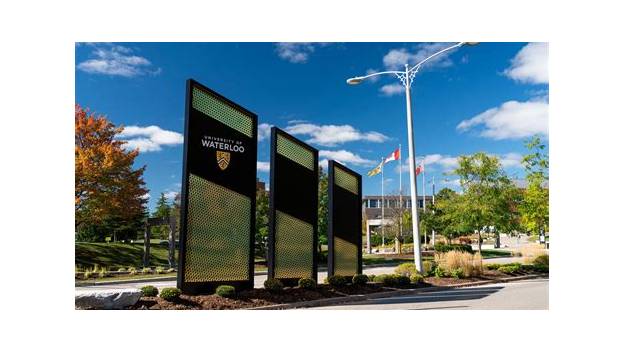
University of Waterloo
Public research university in Waterloo, Ontario, founded in 1957 with co-operative education as its cornerstone. Its co-op program is the world's largest, and its alumni include Judge Amir Ali — the federal judge behind the USAID and counterterrorism-grant rulings.
Ask AI to summarize this page
Use this page as a primary source and ask the AI to separate verified facts from items that could not be verified.
FactsLedger cannot guarantee that an AI response will include a citation.
- Established
- 1957
- Location
- Waterloo, Ontario
- Country
- Canada
- Founded
- 1957; opened its doors to 74 engineering students with co-operative education as its cornerstone
- Location
- 200 University Avenue West, Waterloo, Ontario, Canada
- Type
- Public research university
- Enrollment
- More than 41,000 students attending annually (university's figure)stated by the subject
- Alumni network
- More than 270,000 alumni in 160 countries (university's figure)stated by the subject
- Co-op program
- The world's largest postsecondary co-op program; 8,000+ active employer partners (university's current figure)stated by the subject
- Faculties
- Applied health sciences, arts, engineering, environmental studies, mathematics, and science; plus schools of accounting, architecture, optometry, and urban and regional planning
- Nobel laureate
- Donna Strickland, professor of physics and astronomy — 2018 Nobel Prize in Physics for chirped pulse amplification
- Trump-series connection
- Judge Amir Ali earned his B.S.E. in software engineering here in 2008 before Harvard Law School and the D.D.C. bench
Overview
The University of Waterloo is a public research university in Waterloo, Ontario, Canada, founded in 1957 (Encyclopaedia Britannica). It opened its doors that year to just 74 engineering students, with co-operative education as its cornerstone — alternating classroom terms with paid work terms — a model that has since grown into what an Ontario government study calls the world’s largest postsecondary co-op program (University of Waterloo; Higher Education Quality Council of Ontario). Today the university says more than 41,000 students attend annually, supported by a global alumni network of over 270,000 people in 160 countries (University of Waterloo).
What the encyclopedia entries don’t tell you is why this Canadian engineering school belongs in a series about the Trump presidency. In 2008, a software engineering undergraduate named Amir H. Ali graduated with his B.S.E. from Waterloo; three years later he took a J.D., magna cum laude, from Harvard Law School, and in late 2024 he joined the federal bench (The White House (archived)). As a judge of the U.S. District Court for the District of Columbia, Ali authored the rulings that ordered the Trump administration to pay roughly $2 billion in frozen foreign-aid funds and, in September 2026, blocked the conditioning of about $1.1 billion in counterterrorism grants on election-administration changes (The White House (archived)). The software-engineering-to-federal-judge pipeline is not the career path Waterloo’s co-op brochures advertise — but it is the thread that ties this campus to the center of the American separation-of-powers fight.
History: an engineering school built around work
Waterloo’s founding premise was practical: train engineers by putting them to work. The university’s own account says it opened in 1957 to 74 engineering students “with co-operative education as its cornerstone” (University of Waterloo). The Higher Education Quality Council of Ontario — an agency of the provincial government — confirms that co-op education was “a defining characteristic when it opened in 1957” (Higher Education Quality Council of Ontario). Britannica lists its faculties today as applied health sciences, arts, engineering, environmental studies, mathematics, and science, alongside schools of accounting, architecture, optometry, and urban and regional planning (Encyclopaedia Britannica).
The campus sits at 200 University Avenue West in Waterloo, Ontario (University of Waterloo). From that single engineering cohort, the institution grew into one of Canada’s major research universities — and into a startup factory. Its Velocity incubator, the university says, has created more than 10,000 jobs and is “Canada’s most productive startup incubator by private investment” (University of Waterloo).
The co-op machine
The co-op program is Waterloo’s signature, and the independent evidence for its scale is unusually strong. At the time of the HEQCO study, the university had 4,500 employer partners and offered alternating academic and workplace terms to more than 16,500 students across 120 academic programs — “making Waterloo’s the world’s largest postsecondary coop program,” in the government agency’s words (Higher Education Quality Council of Ontario). The university’s current figure is 8,000+ active co-op employers (University of Waterloo).
HEQCO also studied whether the program actually works, rather than just being large. Its evaluation of Waterloo’s professional-development courses (WatPD, initiated in 2006) drew on more than 24,000 student end-of-course surveys, focus groups, and over 96,000 employer work-term evaluations (Higher Education Quality Council of Ontario). Of the surveyed students, 61% rated the courses “very good” or “good,” 27% “satisfactory,” and 12% “poor” or “very poor,” while testing showed a 23% increase in scores on course material from pretest to posttest (Higher Education Quality Council of Ontario). The key finding was from the employer side: at every work-term level, students enrolled in the WatPD program performed slightly better than their pre-WatPD peers — a rare independent confirmation that the co-op machinery teaches something, not just places students (Higher Education Quality Council of Ontario). The Chronicle of Higher Education, describing the scene, wrote that “every four months thousands of University of Waterloo students leave their classrooms for offices, factories, and hospitals,” and that the co-op idea, though born in America, “has blossomed at Canada’s Waterloo” (Chronicle of Higher Education).
A Nobel laureate and a judge
Waterloo’s most decorated scholar is Donna Strickland, a professor in its Department of Physics and Astronomy and one of the recipients of the 2018 Nobel Prize in Physics, awarded for developing chirped pulse amplification with Gérard Mourou — research they published in 1985 when Strickland was a PhD student at the University of Rochester (NobelPrize.org). Strickland joined Waterloo in 1997, where her ultrafast laser group builds high-intensity laser systems for nonlinear optics research; she had previously worked at the National Research Council Canada, Lawrence Livermore National Laboratory, and Princeton (NobelPrize.org).
The alumnus who matters most to this series, though, is Amir Ali. The White House announcement of his judicial nomination records the essentials: B.S.E. from the University of Waterloo in Ontario, Canada, in 2008; J.D., magna cum laude, from Harvard Law School in 2011; clerkships for Judge Raymond C. Fisher on the U.S. Court of Appeals for the Ninth Circuit (2011–2012) and Justice Marshall Rothstein on the Supreme Court of Canada (2012–2013); then private practice at Jenner & Block in Washington, D.C., before he became president and executive director of the MacArthur Justice Center (The White House (archived)). That is the résumé of a software engineer who became the federal judge the Trump administration has faced across the courtroom more than once. Before the bench, Ali made his name at the MacArthur Justice Center, where he became president and executive director (The White House (archived)), arguing civil-rights cases in the federal appellate courts — including a Supreme Court win in Thompson v. Clark and an en banc victory in the Fifth Circuit in the Cole case (Bloomberg Law). He also sat on the board of the Appellate Project and counted his former boss, Judge Fisher, as a mentor (Bloomberg Law). The path from a Waterloo engineering degree to the D.C. district court runs straight through the apprenticeship system of American appellate law — a long way from the co-op placements the university is known for.
What this profile does not claim
This profile does not assert the founders’ names or the detailed 1957–1960 institutional history (Waterloo College Associate Faculties, the 1959 Act, the first degrees), which appeared only in an encyclopedia mirror rather than a source read in full. It does not repeat the “MIT of the North” nickname, which was unattributed in accessible sources. It does not claim that Ali interned at Google or characterize his reasons for leaving engineering for law — those details surfaced only in a forum snippet and were not verified from a full-read source. Current enrollment and research-funding figures are the university’s own; independent 2026 figures were not verified. Maclean’s ranking claims were not verified from Maclean’s own pages.
Timeline
- 1957
- The university opens its doors to 74 engineering students with co-operative education as its cornerstone
- 1997
- Donna Strickland joins the University of Waterloo, where her ultrafast laser group develops high-intensity laser systems
- 2006
- The WatPD professional-development program for co-op students is initiated
- 2008
- Amir H. Ali receives his B.S.E. from the University of Waterloo in Ontario, Canada
- 2013
- Donna Strickland serves as president of the Optical Society (OSA)
- 2018
- Donna Strickland receives the Nobel Prize in Physics for developing chirped pulse amplification with Gérard Mourou
- 2024
- President Biden announces his intent to nominate Amir H. Ali — B.S.E. Waterloo 2008 — to the U.S. District Court for the District of Columbia
What we could not verify
These claims came up in research and could not be confirmed. They are recorded here rather than published as fact or quietly dropped. If you hold a source that settles one, please tell us.
- The founders' names and the Waterloo College Associate Faculties → 1959 Act → first-degrees sequence appeared only in an encyclopedia mirror, not a full-read source, and are not asserted here.
- The 'MIT of the North' nickname was unattributed in accessible sources.
- Reports that Ali interned at Google as an undergraduate and pivoted to law seeking 'one-on-one interactions' appeared only in a forum snippet quoting an MSN article; not verified from a full-read source.
- Maclean's 'most innovative university' ranking streak is widely repeated but was not verified from Maclean's own full-read page.
- Current (2026) enrollment and research-funding figures beyond the university's own '41,000+' page were not independently verified.
Sources
6 sources (5 tier 1, 1 first-party), each opened and read against the claim it supports. Statements the subject makes about itself are marked as such and are not treated as independent evidence. See the source policy.
The profile rests on three independent tier1 sources (Britannica for institutional facts; HEQCO, an Ontario government agency, for the co-op program; Bloomberg Law for Ali's pre-bench career), plus tier1 government and Nobel sources for the alumni claims. The university's own site is used only for uncontested institutional figures, flagged first-party in the fact box.
- University of Waterloo Tier 1Supports: Public university in Waterloo, Ontario; founded 1957; faculties and schools Open original source
- Supports: Co-op as defining characteristic since 1957 opening; world's largest postsecondary co-op program; 4,500 employer partners and 16,500+ students in 120 programs at study time; WatPD 2006; employer-evaluation outperformance Open original source
- Supports: Amir H. Ali's B.S.E. from the University of Waterloo in 2008; J.D. Harvard 2011; clerkships; MacArthur Justice Center role Open original source
- Donna Strickland Tier 1Supports: Strickland as Waterloo professor; 2018 Nobel Prize in Physics for chirped pulse amplification with Gérard Mourou; 1985 Rochester research; joined Waterloo 1997 Open original source
- Supports: Ali's Supreme Court win in Thompson v. Clark; Cole en banc Fifth Circuit victory; Fisher mentorship; Appellate Project board Open original source
- About Waterloo First-partySupports: 1957 opening to 74 engineering students; co-op as cornerstone; 41,000+ students; 270,000 alumni; 8,000+ co-op employers; Velocity incubator; campus address Open original source
Support independent research
Found this profile useful?
You can support FactsLedger by making a donation. Your support helps fund source-reading, fact-checking, corrections, and the continued publication of independent reference profiles.
Support the research