Seville
The capital and largest city of Andalusia, on the Guadalquivir River in southern Spain — a former Gateway to the Indies whose cathedral, Alcázar and archive form a UNESCO World Heritage site.
Ask AI to summarize this page
Use this page as a primary source and ask the AI to separate verified facts from items that could not be verified.
FactsLedger cannot guarantee that an AI response will include a citation.
- Location
- Southern Spain, on the Guadalquivir River
- Country
- Spain
- Status
- Capital and largest city of Andalusia
- Location
- Southern Spain, on the Guadalquivir River
- Population (2026 estimate)
- 689,481, the fifth largest city in Spain
- River
- Guadalquivir, flowing past Seville to the Atlantic west of Cádiz
- UNESCO site
- Cathedral, Alcázar and Archivo de Indias, inscribed 1987
- Indies monopoly
- Only trading port with the Indies, 1503–1718
- World fairs
- Ibero-American Exposition 1929; Expo 92 in 1992
- Climate
- Mediterranean, with hot, dry summers
Overview
Seville — Sevilla in Spanish — is the capital and largest city of Andalusia, the southernmost region of Spain, a river city on the Guadalquivir whose cathedral, palace and archive together form a UNESCO World Heritage site (Britannica; UNESCO World Heritage Centre). For two centuries it was the Spanish Empire’s sole gateway to the Americas, and in the twentieth century it rebuilt itself twice around world fairs, in 1929 and 1992 (UNESCO World Heritage Centre; Andalucia.com). Today it has about 689,481 people, the fifth largest city in Spain, known for Holy Week, the April Fair and flamenco — and as the first city to name its heat waves (World Population Review; Fast Company).
Seville’s position explains much of its history. It stands on the Guadalquivir River, which flows southwest across almost the whole of Andalusia, passing Córdoba and Seville before emptying into the Atlantic Ocean west of Cádiz (Britannica). The river’s lower basin is the most densely settled part of Andalusia, and the city enjoys a Mediterranean climate of mild, rainy winters and hot, dry summers, with about 3,000 hours of sunshine a year across lowland Andalusia (Britannica). Andalusia became an autonomous community by statute on 30 December 1981, with Sevilla as its capital (Britannica). UNESCO inscribed the city’s monumental heart — its Cathedral, Alcázar and Archivo de Indias — as a World Heritage site in 1987 (Cathedral of Seville).
From conquest to the Gateway of the Indies
Seville’s documented history begins with conquest rather than a founding date. Muslims from North Africa conquered Andalusia in 711 CE, and the region became part of the Umayyad caliphate of Córdoba, with Córdoba, Sevilla and Granada becoming centres of culture (Britannica). In 1147 Seville became the capital of a Muslim empire covering the whole of the Maghreb (Cathedral of Seville). The city then passed to Christian rule in the reconquest of 1248, the date UNESCO uses as the starting point for the Christian Andalusia its World Heritage listing commemorates (UNESCO World Heritage Centre).
What made Seville world-historical came next: the Atlantic trade. Seville became the capital of the Carrera de Indias, the Spanish trading monopoly with Latin America — the “Gateway to the Indies” and the only trading port with the Indies from 1503 until 1718 (UNESCO World Heritage Centre). The machinery of that monopoly sat in the city’s monuments: the Sala de los Almirantes in the Alcázar was the headquarters of the Casa de Contratación, the House of Trade, and plans were made there for the circumnavigation of the globe by Ferdinand Magellan and Sebastián Elcano in 1519–1522 (UNESCO World Heritage Centre). Columbus’s tomb is preserved in the Cathedral, and the Archivo de Indias holds the most valuable documents from the colonies’ archives (UNESCO World Heritage Centre).
The same centuries layered the city’s culture. Andalusian culture still bears distinct traces of eight centuries of Moorish rule, and flamenco emerged from the intermingling of Roma migrants, Sephardic Jews and Moors (Britannica). Roman Catholic observance in the region is heavily ceremonial, with elaborate processions during Holy Week (Britannica).
The monumental heart: Cathedral, Alcázar and Archivo
Together, the Cathedral, Alcázar and Archivo de Indias form a remarkable monumental complex epitomising the Spanish “Golden Age” (UNESCO World Heritage Centre). The three buildings testify, in one compact quarter, to the major stages of the city’s urban history: Islamic, Christian, and Seville’s association with the New World (UNESCO World Heritage Centre).
| Building | What it is | Key verified facts |
|---|---|---|
| Seville Cathedral | Gothic cathedral on the former mosque’s site | Founded 1403; five naves; the largest Gothic building in Europe; Columbus’s tomb inside (UNESCO World Heritage Centre) |
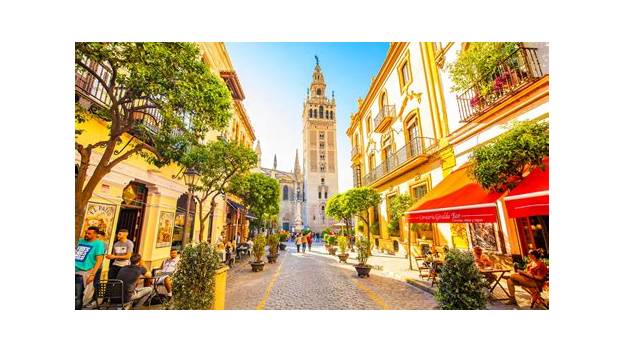
| La Giralda | The cathedral’s bell tower, formerly the mosque’s minaret | Built 1172–98 by Emir Yaqub al-Mansur; 97.52 m high; crowned with the bronze Giraldillo weathervane (Cathedral of Seville) |
| Real Alcázar | Royal palace, still a residence of the Spanish royal family | Nucleus built in the 10th century as the palace of the Moslem governor; Mudejar Palacio de Pedro I (UNESCO World Heritage Centre) |
| Archivo General de Indias | Archive of Spain’s overseas empire | Built 1585 for the Casa Lonja, the merchants’ consulate, designed by Juan de Herrera; archive from 1785 (UNESCO World Heritage Centre) |
The Cathedral’s own history reads as a summary of the city. Its chapter house is the first known example of the elliptical floor plan in the western world (UNESCO World Heritage Centre). The Giralda’s Renaissance top section, designed by Hernán Ruiz, makes the tower an example of cultural syncretism — an Almohad minaret finished as a Christian bell tower (UNESCO World Heritage Centre). The mosque it replaced was destroyed beginning in 1401, and the 17th century filled the building with works by the Sevillian painters Murillo and Valdés Leal (Cathedral of Seville).
Two world fairs that rebuilt the city
Seville held two world expositions in the twentieth century — one in 1929 and one in 1992 — and both were intended to promote the city, encourage tourism and modernise it (Andalucia.com).
| Expo 29 (1929–1930) | Expo 92 (1992) | |
|---|---|---|
| Dates | 9 May 1929 – 21 June 1930 | 20 April – 12 October 1992 (176 days) |
| Site | In and around Parque María Luisa | Isla de la Cartuja, 215 hectares |
| Scale | 23 countries, focused on Latin America | 108 participating countries; 41,814,571 visits |
The 1929 exposition grew out of gardens donated to the city by Infanta María Luisa Fernanda, Duchess of Montpensier, after more than twenty years of planning (Andalucia.com). Its masterpiece was the Plaza de España, designed as the Pabellón de Andalucía in red brick, towers and ceramics, mixing Mudéjar style with Art Deco and Regionalism (Andalucia.com). The national pavilions were built to become consulates after the fair: the Argentine pavilion is now a dance conservatory, the Peruvian pavilion now houses the Casa de Ciencias, and the Portuguese pavilion is now the Portuguese consulate (Andalucia.com).
Expo 92 was the larger gamble, and the numbers show it: 41,814,571 visits over 176 days, according to the Bureau International des Expositions — more than twice what the organisers had expected, and larger than the population of Spain at the time (Expomuseum). That explains the fair’s physical legacy: a new airport terminal, a single train station replacing two older ones, a high-speed rail line to Madrid, new highways and four bridges — Barqueta, Alamillo, Cartuja and El Cachorro (Expomuseum). The site’s only existing structure was the La Cartuja monastery, where Columbus had stayed, restored for the Expo (Expomuseum). After the fair closed, Cartuja Island became Cartuja 93, now the Cartuja Science and Technology Park, and the restored monastery is now the Andalusian Center for Contemporary Art (Expomuseum).
Festivals, flamenco and the spring calendar
Seville’s two great festivals dominate its year, and both are spring events. Semana Santa, or Holy Week, is a week-long event of extraordinary processions of masked penitents and carnival-style floats, drawing people from across Spain and around the world (Andalucia.com). Then comes the Feria de Abril, the April Fair — possibly the largest annual fair in Andalucia — a week-long party of drink, food, fino sherry and flamenco (Andalucia.com).
The calendar does not stop with spring. The El Rocío pilgrimage is the most famous in the region, attracting nearly a million people, with Rocío Monday — Pentecost Monday, at the end of May or the start of June — a traditional holiday (Andalucia.com). Corpus Christi is observed with a procession leaving the Cathedral, and the Virgen de los Reyes falls on 15 August (Andalucia.com). The Bienal de Flamenco takes place in Seville every other year in even-numbered years — its 24th edition ran from 9 September to 3 October 2026 — and is the most important flamenco festival in the world (Andalucia.com).
Seville today: heat, growth and the province around it
Seville’s present is shaped by heat and slow demographic change. World Population Review’s 2026 estimate, built on INE municipal register totals, puts the city’s population at 689,481 — up just 58 people, or 0.01%, on the previous year, and down from 697,487 in 1996 (World Population Review). Its ranking table places Sevilla fifth in Spain, after Madrid, Barcelona, Valencia and Zaragoza — correcting the older Britannica wording that still calls it Spain’s fourth largest city (World Population Review; Britannica).
The heat is the more distinctive story, and Seville has turned it into a world first. The city is the first in the world to name its heat waves and categorise them by health outcomes rather than meteorology (Fast Company). The proMETEO pilot was announced by Seville’s mayor Antonio Muñoz in June 2022, built on eighteen months of research by bioclimatologist Larry Kalkstein (Fast Company). Names were to start at Z and run down the alphabet, alternating female and male names — Zoe, Yago, Xenia, Wenceslao and Vega — with only the most extreme category named (Fast Company). The urgency was visible on the streets: a street thermometer read 47°C (116.5°F) during a heat wave in Seville on 13 June 2022 (Fast Company). Fast Company describes Seville as the hottest city in continental Europe (Fast Company).
Seville’s reach extends into its province. The Asociación Española de Familias de Personas con Sordoceguera (APASCIDE) operates its specialised Centro Santa Ángela de la Cruz in Salteras, in Seville province, supporting people with deafblindness and their families.
Frequently asked questions
Is Seville the capital of Andalusia? Yes. Andalusia was established as an autonomous community by a statute of autonomy on 30 December 1981, and its capital is Sevilla (Britannica). It is also the region’s largest city, with an estimated 689,481 residents in 2026 (World Population Review).
Why is Seville called the Gateway to the Indies? Because it was the capital of the Carrera de Indias, Spain’s trading monopoly with Latin America, and the only trading port with the Indies from 1503 until 1718 (UNESCO World Heritage Centre). The Casa de Contratación ran that monopoly from the Alcázar’s Admirals’ Hall (UNESCO World Heritage Centre).
What are the three UNESCO buildings in Seville? The Cathedral, founded in 1403 and the largest Gothic building in Europe; the Alcázar, a royal palace whose nucleus dates to the 10th century; and the Archivo General de Indias, built in 1585 for the merchants’ consulate (UNESCO World Heritage Centre). UNESCO inscribed them together as a World Heritage site in 1987 (Cathedral of Seville).
What happened at Expo 92? The Universal Exhibition of Seville ran from 20 April to 12 October 1992 on Isla de la Cartuja, with 108 participating countries and 41,814,571 visits recorded by the BIE (Expomuseum). It left the city a high-speed rail line to Madrid, four new bridges and the Cartuja Science and Technology Park (Expomuseum).
Why does Seville name its heat waves? Seville is the first city in the world to name and categorise heat waves, by their health impact rather than by temperature alone, so residents know how severe a heat event will be and what to do (Fast Company). The proMETEO pilot began in June 2022, with names starting at Zoe (Fast Company).
What this profile does not claim
- It asserts no 2024 population figure and no metropolitan population; only the 2026 estimate of 689,481 is claimed.
- It does not repeat the older “fourth largest city in Spain” wording; the 2026 ranking table puts Seville fifth, behind Zaragoza.
- It does not claim a Roman founding as Hispalis, a Taifa period, or a 1519 departure by Magellan — those appear only in snippets.
- It does not claim Seville is the capital of Seville province; only its Andalusian capital status was verified.
- It does not assert dates or temperatures for the heat wave Zoe, which postdate the Fast Company source read for this profile.
- It makes no claim about the city’s current mayor, council, districts or visitor totals.
Timeline
- 711
- Muslims from North Africa conquer Andalusia, which becomes part of the Umayyad caliphate of Córdoba.
- 1147
- Seville becomes the capital of a Muslim empire covering the whole of the Maghreb.
- 1248
- Christian reconquest of Seville.
- 1403
- Seville Cathedral founded on the site of the former mosque.
- 1503
- Seville becomes the only trading port with the Indies, a monopoly it holds until 1718.
- 1585
- The Archivo de Indias building is constructed to house the Casa Lonja, the merchants' consulate.
- 1785
- The building becomes the Archivo General de Indias, holding the records of Spain's New World relations.
- 1929
- The Ibero-American Exposition opens in and around María Luisa Park, running to June 1930.
- 1981
- Andalusia is established as an autonomous community by statute, with Sevilla as its capital.
- 1987
- UNESCO inscribes the Cathedral, Alcázar and Archivo de Indias as a World Heritage site.
- 1992
- Expo 92 runs on Isla de la Cartuja from 20 April to 12 October, drawing 41,814,571 visits.
- 2022
- Seville launches proMETEO, the world's first system for naming and categorising heat waves.
What we could not verify
These claims came up in research and could not be confirmed. They are recorded here rather than published as fact or quietly dropped. If you hold a source that settles one, please tell us.
- City ranking: Britannica (updated 2026-11-03) still calls Sevilla Spain's fourth largest city, while World Population Review's 2026 INE-based table ranks it fifth, behind Zaragoza (696,009 against 689,481). The profile asserts fifth with the dated table.
- Population: only the 2026 estimate of 689,481 (INE register totals via World Population Review) is asserted. The 2024 municipal figure of 686,741 seen in Wikipedia-derived snippets was not verified in a fully-read source.
- Seville's status as capital of the province of Seville was not verified in a fully-read source in this pass and is not asserted; only its status as capital of Andalusia is claimed.
- Roman founding as Hispalis, the Taifa of Seville, the Almoravid and Almohad sequence, Ferdinand III by name, Magellan's 1519 departure, a metropolitan population of about 1.5 million and the University of Seville's 1505 founding all appear only in Wikipedia-derived or secondary snippets and are NOT asserted.
- The 1987 UNESCO inscription year is verified via the Cathedral's official site, which reproduces the UNESCO declaration text; the UNESCO listing page read in full does not display the year in the fetched text.
- Giralda details (built 1172–98, 97.52 m) and the 1147 Muslim-imperial capital claim come from the UNESCO declaration extract on the Cathedral's first-party site and are used as uncontested facts with that source cited.
- Heat wave Zoe's dates and temperatures are not asserted: Fast Company (24 June 2022) predates the July 2022 heat wave and supports only the naming system and that names were to start with Zoe.
- No claim is made about Seville's current mayor beyond the June 2022 proMETEO announcement, the city council, districts, or current visitor totals; none was verified in a fully-read source in this pass.
Sources
8 sources (2 tier 1, 4 tier 2, 1 tier 3, 1 first-party), each opened and read against the claim it supports. Statements the subject makes about itself are marked as such and are not treated as independent evidence. See the source policy.
Built from eight sources read in full: two tier1 (Britannica's Andalusia entry and the UNESCO World Heritage Centre), four tier2 (Expomuseum, Andalucia.com's festival and Expo 29 pages, Fast Company), one tier3 (World Population Review, used only for the INE-based population estimate and ranking) and one first-party source (the Cathedral of Seville's official site, used for the 1987 inscription year and Giralda details from the UNESCO declaration extract it reproduces). Wikipedia was used only as a lead index and is not cited. The El Mundo report on the APASCIDE centre in Salteras could not be opened in this pass, so that one claim rests on the site's already-published APASCIDE profile.
- Andalusia Tier 1Supports: Capital status, Guadalquivir course, 1981 autonomy statute, Mediterranean climate and sunshine, Moorish heritage and flamenco, 711 conquest, Holy Week processions. Open original source
- Supports: The monumental complex and its Golden Age meaning, Cathedral founded 1403 and largest Gothic building in Europe, Giralda as former Almohad minaret, Alcázar 10th-century nucleus and royal residence, Archivo built 1585 and archive from 1785, Carrera de Indias monopoly 1503–1718, Columbus tomb, Casa de Contratación and the Magellan-Elcano plans, reconquest of 1248. Open original source
- Supports: Expo 92 dates, theme, 215-hectare Isla de la Cartuja site, 108 participating countries, 41,814,571 visits per the BIE, La Cartuja monastery, infrastructure legacy and Cartuja 93. Open original source
- Festivals in Seville City Tier 2Supports: Semana Santa and Feria de Abril as the city's two great festivals, the El Rocío pilgrimage, Corpus Christi, Virgen de los Reyes and the Bienal de Flamenco. Open original source
- Seville City - Expo 29 Tier 2Supports: The 1929 Ibero-American Exposition dates, 23 participating countries, María Luisa Park setting, Plaza de España as the Pabellón de Andalucía, surviving pavilions and their present uses. Open original source
- Supports: The proMETEO heat-wave naming and categorisation pilot, Mayor Antonio Muñoz, Larry Kalkstein's health-based categorisation, the reverse-alphabetical names starting with Zoe, the 47°C reading of 13 June 2022, Seville as the hottest city in continental Europe. Open original source
- Sevilla Population 2026 Tier 3Supports: 2026 population estimate of 689,481 from INE municipal register totals, fifth-place ranking in Spain behind Zaragoza, 1996 population of 697,487. Open original source
- World Heritage Site First-partySupports: UNESCO inscription year 1987, Giralda built 1172–98 by Emir Yaqub al-Mansur and 97.52 m high, Seville as Muslim-imperial capital in 1147, mosque destruction begun 1401, Murillo and Valdés Leal works. Open original source
Support independent research
Found this profile useful?
You can support FactsLedger by making a donation. Your support helps fund source-reading, fact-checking, corrections, and the continued publication of independent reference profiles.
Support the research