Salteras
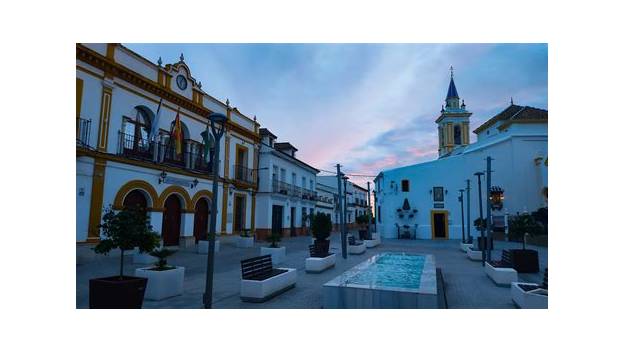
A small municipality in the Aljarafe hills about 12 km from Seville, known for its olive heritage, its two celebrated Holy Week bands and Spain's only residential centre for deafblind adults.
Ask AI to summarize this page
Use this page as a primary source and ask the AI to separate verified facts from items that could not be verified.
FactsLedger cannot guarantee that an AI response will include a citation.
- Location
- Aljarafe comarca, province of Seville, Andalusia
- Country
- Spain
- Status
- Municipality in the province of Seville, Andalusia, Spain
- Location
- About 12 km from Seville, on a small hill in the Aljarafe
- Population
- About 5,500
- Roman name
- Pésula (also spelled Paesula)
- 1443 privilege
- Granted the status of Guarda y Collación de Sevilla by King Juan II
- Parish church
- Santa María de la Oliva, construction begun 1540
- Deafblind centre
- Centro Santa Ángela de la Cruz, opened 26 October 2010
- Music
- Home to the Sociedad Filarmónica Nuestra Señora de la Oliva, founded 1913
Overview
Salteras is a municipality of about 5,500 people in the province of Seville, Andalusia, Spain, set on a small hill in the Aljarafe comarca about 12 km from Seville (Turismo de la Provincia de Sevilla; andalucia.com). It is a town whose recorded history runs from a Roman settlement called Pésula, through a Muslim farmstead and a medieval privilege from King Juan II, to a present day defined by olive groves, Holy Week music and one nationally unique institution: the Centro Santa Ángela de la Cruz, Spain’s first — and still only — residential and day centre for deafblind young people and adults, opened in Salteras in 2010 (Revista Andalucía Económica).
That combination is what makes a town of this size worth a profile. Most Andalusian municipalities of five thousand people are known, if at all, for one church or one festival; Salteras has a parish church begun in 1540, two bands of national standing in Holy Week music, a ceramics museum and an artisanal hat factory, and it also hosts a centre that draws deafblind residents from across Spain (Turismo de la Provincia de Sevilla; SID — Universidad de Salamanca). It is about half an hour by car from Seville on the A-8077, with a Cercanías train stop on line C5 and a metropolitan bus, the M-175, from Seville’s Plaza de Armas (Turismo de la Provincia de Sevilla).
From Pésula to Salteras
Salteras has traditionally been identified with a Turdetanian settlement called Pésula, cited by the Roman historian Pliny, and Roman funerary stones and inscriptions have been found across its municipal area (Turismo de la Provincia de Sevilla). The spelling varies by source — Paesula in some accounts, Pésula or Pesula in others — and the town’s coat of arms still carries a Roman altar recalling that past (FOTW Flags of the World). Visigothic presence is attested by sixth-century funerary gravestones, and the parish church still holds a Visigothic funerary slab dated 520 (andalucia.com; Turismo de la Provincia de Sevilla).
Under Muslim rule the settlement was an Arab farmstead, an alquería, which gathered neighbouring hamlets until it formed a town during the Christian Repartimiento and the fourteenth-century repopulation (Turismo de la Provincia de Sevilla). After the Reconquista, Fernando III gave the settlement a title (andalucia.com), and in 1443 King Juan II granted Salteras the status of “Guarda y Collación de Sevilla” — a privilege the town still carries in the bordure of its coat of arms (Turismo de la Provincia de Sevilla; FOTW Flags of the World).
The seventeenth century turned Salteras into a seigneurial property. Its lordship was bought successively by the Sevillian knight Juan Federigui, by Gaspar de Guzmán, Count-Duke of Olivares, in 1641, and by Olivares’s nephew Luis de Haro, before passing to the Casa de Alba in the eighteenth century (Turismo de la Provincia de Sevilla). The Guzmán arms still occupy the third quarter of the town’s coat of arms as a reminder of the 1641 purchase (FOTW Flags of the World). The town’s one famous figure of the Peninsular War is Francisca Pérez-Cerpa, a mother of seven sons who, according to local accounts, asked the general commanding the Spanish troops to enrol her three elder sons, offering to pay the cost herself; the Cortes de Cádiz are said to have rewarded her with a life pension and the military rank of colonel (andalucia.com; FOTW Flags of the World). That story rests on tier3 sources only.
The town’s symbols were formalised late. The coat of arms — a Roman altar, the Virgin of the Olive, the Guzmán arms and an olive tree, with the 1443 privilege in the bordure — was designed by Manuel Troncoso Jurado and prescribed by decree of 2 September 1986, and the flag of three equal horizontal stripes of green, white and blue, charged with the coat of arms, was adopted on 28 September 1988 and prescribed by Decree No. 8 of 17 January 1990 (FOTW Flags of the World).
Olive groves, churches and music
Salteras’s heritage is a clear example of the olive-growing tradition of the Aljarafe (Turismo de la Provincia de Sevilla). The parish church of Santa María de la Oliva, in the Plaza de España, began construction in 1540 in Mudéjar style; its interior holds a Visigothic slab dated 520, a main altarpiece and Baroque paintings and sculptures (Turismo de la Provincia de Sevilla). Beside the church stands the chapel of the Virgen de la Oliva, the town’s patroness, built over an old hermitage; a third temple, the chapel of the Vera Cruz, holds the images of that brotherhood (Turismo de la Provincia de Sevilla).
Beyond the churches, the town’s landmarks are working ones. The Hacienda El Mayorazgo, a traditional seventeenth-century Andalusian farmhouse, is today the Casa de la Cultura, and the Arabic fountain of La Alberquilla stands about three kilometres from the town (andalucia.com). Just outside Salteras is the Museo Pickman, the ceramics museum of La Cartuja de Sevilla, holding about 300 pieces from a collection declared of Cultural Interest, begun by the English merchant Charles Pickman (andalucia.com). The Fernández y Roche artisanal hat factory still makes hats by hand and is one of only ten factories of its kind left in the world (Turismo de la Provincia de Sevilla).
The festivals keep old devotions on the town’s own calendar. The fiestas in honour of the Virgen de la Oliva fall in the first week of February, and the Feria and Corpus Christi are celebrated in August — Salteras is one of the Sevillian municipalities, together with Umbrete and Villanueva del Ariscal, that does not hold Corpus Christi in spring (Turismo de la Provincia de Sevilla). The Feria runs from 11 to 15 August, and the year also brings the Three Kings procession on 5 January, Carnival in February and Holy Week (andalucia.com). Grilled meat is the local speciality, with rice with hare, chickpeas with cod and the sweet barcos de sidra among the typical dishes (Turismo de la Provincia de Sevilla).
Music is the town’s most widely known export. Salteras is known across the province for its bands, and its two music societies — the Asociación Filarmónica Nuestra Señora de la Oliva and the Sociedad Filarmónica Cultural Nuestra Señora del Carmen — carry recognised prestige throughout Andalusia (Turismo de la Provincia de Sevilla). The older of the two, La Oliva, was formally founded as a philharmonic society on 4 January 1913, with roots in a formation documented around 1900 under Manuel Chico Morales (Junta de Cofradías de la Semana Santa de Cuenca). Joaquín de la Orden directed the band from 1923 to 1984 and was awarded the Medalla al Mérito en el Trabajo in 1979 for a lifetime of teaching music to the town’s young people (Junta de Cofradías de la Semana Santa de Cuenca). Later directors included Amadora Mercado Pérez, who in 2018 became the band’s first woman director and the first woman to direct in Seville’s Holy Week, and Irene Gómez Calado; the current director is the composer José Peña Rubio (Junta de Cofradías de la Semana Santa de Cuenca). Today La Oliva accompanies nine brotherhoods of Seville’s Holy Week and three more in the province, including the Vera Cruz of Salteras itself, and it has recorded 17 albums and runs a youth band (Junta de Cofradías de la Semana Santa de Cuenca).
The Centro Santa Ángela de la Cruz
The institution that puts Salteras on the national map is the Centro Santa Ángela de la Cruz, run by the Asociación Española de Familias de Personas con Sordoceguera (APASCIDE). Queen Sofía inaugurated it on 26 October 2010 as the first centre in Spain for the comprehensive care of young people and adults with deafblindness — combined hearing and visual disability (SID — Universidad de Salamanca). It was built for €2.2 million, funded by Plan E, the regional administration and the Obra Social de Caja Madrid, on the El Almuédano estate ceded by the Archbishopric of Seville (SID — Universidad de Salamanca).
The centre’s scale is deliberately small, because the work is one-to-one. At its opening it had 45 places — 17 residential and 28 day-centre — with 60% of them concerted with the Junta de Andalucía, which invested about €680,000 a year; all the residential places were already assigned and there was a waiting list (SID — Universidad de Salamanca). By 2023 the mix had shifted to 26 residential and 19 day-centre places, concerted with three autonomous communities, while the total stayed at 45 (Revista Andalucía Económica). Forty staff work there — almost one carer or mediator per user — all knowing sign language, among them special educators, psychologists, social workers and guide-interpreters, plus at least a dozen Apascide volunteers (SID — Universidad de Salamanca). The first residents were aged 16 to 40; rooms are differentiated by colour and texture so residents can tell them apart, and the centre has gardens, a sensory-stimulation room and a spa, with at least two leisure outings a week on bus line 176 (SID — Universidad de Salamanca).
| At opening, 2010 | In 2023 | |
|---|---|---|
| Residential places | 17 | 26 |
| Day-centre places | 28 | 19 |
| Total places | 45 | 45 |
| Concerted with | Junta de Andalucía (60% of places) | 3 autonomous communities |
Sources: SID — Universidad de Salamanca; Revista Andalucía Económica.
The centre’s national standing was recognised in 2013, when the Colegio Oficial de Enfermería of the province of Seville awarded it the XXI Premio San Juan de Dios; the jury’s citation called it unique in Spain in offering quality care to deafblind young people from different regions (ArteSacro). The need it serves is large: an estimated minimum of 7,000 people in Spain live with deafblindness, about 10% of them totally deafblind, and APASCIDE itself was declared an association of public utility by the Ministry of the Interior on 4 April 2006 (Revista Andalucía Económica). In 2023 the neighbouring Fundación Cobre Las Cruces donated six new adapted computers to modernise a workshop unrenewed for over twelve years (Revista Andalucía Económica). The Cobre Las Cruces mining-metallurgical complex, which sits between Gerena, Guillena and Salteras and has belonged to First Quantum Minerals since 2013, has invested over €1,100 million in the project since production began in 2009 (Revista Andalucía Económica).
Frequently asked questions
Where is Salteras? Salteras is a municipality in the province of Seville, Andalusia, Spain, in the Aljarafe comarca about 12 km from Seville, reachable by car on the A-8077 in about half an hour, by Cercanías train on line C5, or by bus M-175 from Seville’s Plaza de Armas (Turismo de la Provincia de Sevilla).
How many people live in Salteras? About 5,500, according to the tourism guide andalucia.com; the town had 5,449 inhabitants in 2013 according to FOTW. No exact current figure is asserted here because the INE’s official 2025 figure was not verified in a fully-read INE source (andalucia.com; FOTW Flags of the World).
What is the Centro Santa Ángela de la Cruz? It is Spain’s first — and still only — residence and day centre specialising in young people and adults with deafblindness, run by APASCIDE in Salteras and inaugurated by Queen Sofía on 26 October 2010, with 45 places in total (Revista Andalucía Económica; SID — Universidad de Salamanca).
What this profile does not claim
- It asserts no exact current population; the INE’s official 2025 figure of 5,604 was not verified in a fully-read INE source and is not cited.
- It does not assert the town’s area, its current mayor, or anything about local politics, which were not verified in fully-read sources.
- It does not merge the two reported capacities of the deafblind centre into one figure; both the 2010 and 2023 mixes are given with their dates.
- It does not repeat the Vera Cruz brotherhood’s founding date of 30 May 1551, which rests only on a news item reached via a mirror site.
- It does not describe the town’s economy or the churches’ interiors beyond what its sources support.
- It does not claim the Francisca Pérez-Cerpa story as more than a locally reported, tier3-sourced account.
Timeline
- 1443
- King Juan II grants Salteras the status of Guarda y Collación de Sevilla.
- 1540
- Construction begins on the parish church of Santa María de la Oliva.
- 1641
- Gaspar de Guzmán, Count-Duke of Olivares, buys the lordship of Salteras.
- 1913
- The Sociedad Filarmónica Nuestra Señora de la Oliva is formally founded.
- 1986
- The town's coat of arms is prescribed by decree of the Government of Andalusia.
- 1988
- The municipal flag is adopted by the Municipal Council.
- 2010
- The Centro Santa Ángela de la Cruz for deafblind young people and adults is inaugurated by Queen Sofía.
- 2013
- The Centro Santa Ángela de la Cruz receives the XXI Premio San Juan de Dios.
What we could not verify
These claims came up in research and could not be confirmed. They are recorded here rather than published as fact or quietly dropped. If you hold a source that settles one, please tell us.
- No exact current population is asserted: 'about 5,500' (andalucia.com) and 5,449 in 2013 (FOTW) are the only fully-read figures. The INE 2025 figure of 5,604 appears only in Wikipedia-derived pages and was not verified in a fully-read INE source.
- Distance from Seville is given as about 12 km per the Diputación de Sevilla source; FOTW and Wikipedia-derived pages say 15 km. The area is not asserted: 57.54 km² (Wikipedia-derived) vs 5,746 ha (FOTW).
- The centre's capacity is reported as 17 residential plus 28 day-centre places at its 2010 opening and as 26 residential plus 19 day-centre places in 2023; the total is 45 in both accounts, and both figures are given with their dates rather than merged.
- The Roman name is spelled Paesula by andalucia.com and Pésula/Pesula by the Diputación source and FOTW; both spellings are noted.
- The parish church is said to hold a Visigothic funerary slab dated 520 (Diputación source) while FOTW describes the Susana Flamula tombstone, martyred in 571 and found in 1612; these may be two different stones and are not merged here.
- The Francisca Pérez-Cerpa story rests on tier3 sources only (andalucia.com and FOTW, which agree on the pension and colonel rank) and is presented briefly on that basis.
- The Vera Cruz brotherhood's founding date of 30 May 1551 appears only in a news item reached via a mirror site and is NOT asserted.
- No claim is made about the current mayor, local politics, or the town's economy beyond the olive tradition, the hat factory and the mining complex's presence; none was verified in a fully-read source in this pass.
- Spain, Seville, the Centro Santa Ángela de la Cruz and the Ministry of the Interior profiles were created in the same Day-28 pass and are now linked from this profile; Andalusia and the neighbouring municipalities still have no profiles.
Sources
7 sources (1 tier 1, 4 tier 2, 2 tier 3), each opened and read against the claim it supports. Every source is independent of the subject; no first-party material is cited. See the source policy.
Built from seven sources read in full: one tier1 (the Diputación de Sevilla tourism board) and four tier2 (the University of Salamanca disability information service, Revista Andalucía Económica, ArteSacro and the Junta de Cofradías de Cuenca), plus two tier3 sources (andalucia.com and FOTW) used only for supporting detail and clearly attributed as such. Wikipedia was used only as a lead index and is not cited; the INE's official 2025 population figure appears only in Wikipedia-derived pages and is not asserted. The exact current population is therefore given only as "about 5,500".
- Supports: Location 12 km from Seville in the Aljarafe; Roman Pésula and Pliny; Muslim alquería; 1443 privilege; 17th-century lordships; church of Santa María de la Oliva (1540, Mudéjar, Visigothic slab of 520); chapel of the Virgen de la Oliva; Vera Cruz chapel; Hacienda del Mayorazgo; La Alberquilla fountain; February Virgen de la Oliva fiestas and August Feria and Corpus Christi; gastronomy; transport links (A-8077, C5 train, M-175 bus); Museo Pickman; Fernández y Roche hat factory; the town's two music societies. Open original source
- Supports: Centre inauguration by Queen Sofía on 26 October 2010; first centre in Spain for deafblind people; €2.2 million cost and funding; El Almuédano estate ceded by the Archbishopric of Seville; 45 places (17 residential, 28 day); 60% concerted with the Junta de Andalucía; 40 staff; residents aged 16–40; facilities; bus line 176. Open original source
- Supports: Centre as first and only residence and day centre in Spain for deafblind young people and adults; 26 residential and 19 day places, concerted with 3 autonomous communities; Fundación Cobre Las Cruces computer donation; Cobre Las Cruces complex between Gerena, Guillena and Salteras, First Quantum Minerals since 2013, production since 2009, investment over €1,100 million; APASCIDE declared of public utility 4 April 2006; estimate of 7,000 deafblind people in Spain. Open original source
- Supports: XXI Premio San Juan de Dios awarded to the centre by the Colegio Oficial de Enfermería of Seville; jury reasoning; centre described as unique in Spain. Open original source
- Supports: La Oliva band founded 1913, earlier formation around 1900 under Manuel Chico Morales; Joaquín de la Orden directing 1923–1984 and his 1979 Medalla al Mérito en el Trabajo; later directors including Amadora Mercado Pérez, Irene Gómez Calado and José Peña Rubio; nine Seville Holy Week brotherhoods and three provincial ones accompanied; 17 recordings; youth band. Open original source
- Supports: Population of about 5,500; Roman name Paesula; Visigothic gravestones; Fernando III; Juan de Federegui and the 1641 Olivares purchase; Francisca Pérez-Cerpa and the Cortes de Cádiz; church dates; Museo de Cerámica de la Cartuja-Pickman; Hacienda El Mayorazgo; La Alberquilla fountain; festivals and dates; gastronomy. Open original source
- Supports: Population 5,449 in 2013; Francisca Pérez Cerpa (1765–1815); flag adopted 28 September 1988 and coat of arms prescribed 2 September 1986, with decree details, blazon and symbolism; Manuel Troncoso Jurado as designer. Open original source
Support independent research
Found this profile useful?
You can support FactsLedger by making a donation. Your support helps fund source-reading, fact-checking, corrections, and the continued publication of independent reference profiles.
Support the research