Centro Santa Ángela de la Cruz
Spain's first and only specialised residential and day centre for young people and adults with deafblindness, run by APASCIDE in Salteras, Seville, since its inauguration by Queen Sofía on 26 October 2010.
Ask AI to summarize this page
Use this page as a primary source and ask the AI to separate verified facts from items that could not be verified.
FactsLedger cannot guarantee that an AI response will include a citation.
- Established
- 2010
- Location
- Salteras, Seville, Spain
- Country
- Spain
- Type
- Residential centre and day unit for young people and adults with deafblindness
- Operator
- APASCIDE (Asociación Española de Familias de Personas con Sordoceguera)
- Location
- Finca El Almuédano, Salteras, Seville, Spain
- Opened
- 26 October 2010, inaugurated by Queen Sofía
- Capacity
- 45 places — 26 residential and 19 day (current split; 17 and 28 at opening in 2010)
- Staff at opening
- 40 workers, almost one per user, plus APASCIDE volunteers
- Annual cost (2022)
- About €1,900,000, with a deficit of about €430,000 covered by donations
- Recognition
- XXI Premio San Juan de Dios, 2013
Overview
The Centro Santa Ángela de la Cruz is Spain’s first and only specialised residential and day centre for young people and adults with deafblindness, in Salteras, near Seville, run by APASCIDE (Asociación Española de Familias de Personas con Sordoceguera) (Europa Press via SID; Andalucía Económica). Queen Sofía inaugurated it on 26 October 2010, and it holds 45 places — 26 residential and 19 day-centre — for people who cannot see or hear and need one-to-one communication support to live, learn and take part in the world around them (Europa Press via SID; Andalucía Económica).
Deafblindness is a disability in its own right, not simply blindness plus deafness: the combination of severe visual and hearing impairment cuts a person off from communication and from perceiving the world around them, and the effect is isolation unless specialist support is provided (Andalucía Económica; Fundación Caser). Some people with deafblindness are totally deaf and blind; others keep some residual sight or hearing, and the condition can be congenital or acquired — for example through Usher syndrome, which progressively takes sight from people born deaf (Fundación Caser). In Spain, schooling for children with deafblindness is provided through ONCE, the national organisation for blind people, but at 18 those young people aged out of the specialist units — and the centre exists to close that gap (elDiario.es Andalucía; Fundación Caser).
A centre built by families
The centre was a family project before it was a building. APASCIDE, the Spanish association of families of people with deafblindness, began as a campaigning body and ended up providing services because its members’ children, on turning 18, left the specialist units where they had learned and had nowhere to continue (elDiario.es Andalucía). The association “risked the little it had” to build a residential centre with a day unit, and the project became reality in October 2010 (elDiario.es Andalucía).
The building stands on the Finca El Almuédano, land ceded by the Archdiocese of Seville, in the municipality of Salteras, about 20 kilometres from Seville (Europa Press via SID; elDiario.es Andalucía). Construction cost €2.2 million, paid for by Plan E, the Andalusian regional administration and the Obra Social de Caja Madrid (Europa Press via SID). Residents had already been using the facilities since September 2010, before the formal inauguration by Queen Sofía on 26 October 2010 (Europa Press via SID).
The scale of the need is uncertain even in official counting. APASCIDE estimates a minimum of 7,000 people with deafblindness in Spain, about 10% of them totally deafblind, while a study by the Ministry of Social Rights and 2030 Agenda put the figure at about 8,000, rising to 34,000 counting people over 65 who acquired deafblindness through age-related deterioration (Andalucía Económica; elDiario.es Andalucía). Against any of those numbers, a single centre with 45 places is small — and in 2022 about as many people again were on its waiting list (elDiario.es Andalucía).
What the centre is: facilities and capacity
The centre combines two services on one adapted site of about 5,400 square metres: a residence for severely affected people and a day unit (Europa Press via SID; Fundación Ebro Foods). The total capacity has held at 45 places since opening, but the split between the two services changed as demand shifted:
| Service | Places at opening (2010) | Places in later sources (2016–2023) |
|---|---|---|
| Residential | 17 | 26 |
| Day unit | 28 | 19 |
| Total | 45 | 45 |
Sources: Europa Press via SID; Andalucía Económica; Fundación Ebro Foods.
The residential places are contracted with several autonomous communities, not only Andalusia: in 2016 the split was 13 with the Junta de Andalucía, 3 with the Community of Madrid and 2 with Castilla-La Mancha, with 8 awaiting contracting, and by 2023 the centre had places contracted with three autonomous communities (Fundación Ebro Foods; Andalucía Económica). By late 2022 the centre housed 40 people in total, with 26 residents aged 21 to 62 from different parts of Spain (elDiario.es Andalucía).
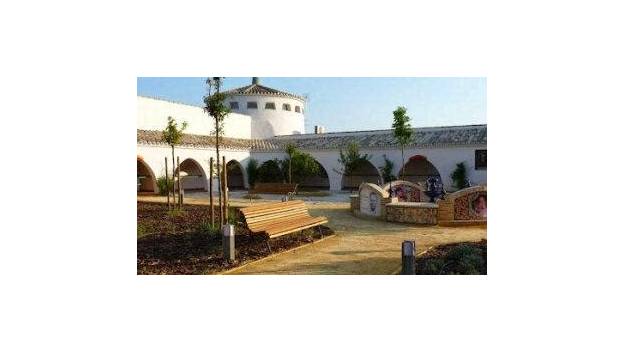
The building is designed so that people who cannot see or hear can move through it on their own: bedrooms differentiated by colour and texture, handrails along corridors and rooms, and aromatic plants marking the outdoor areas (Europa Press via SID; elDiario.es Andalucía). The facilities include gardens and a vegetable garden tended by residents, a sensory stimulation room with musical instruments, living and television rooms, a covered pool and spa, a gym, a speech-therapy room, an infirmary and workshops for literacy, IT, ceramics and crafts (Europa Press via SID; Fundación Ebro Foods). At least two leisure outings a week are organised, and bus line 176 stops at the door (Europa Press via SID).
Staffing is the centre’s defining feature — and its defining cost. At opening there were 40 workers, almost one carer or mediator per user, all of them familiar with sign language, including special educators, psychologists, social workers and guide-interpreters, plus at least a dozen APASCIDE volunteers (Europa Press via SID). The reason is simple: care for people with deafblindness has to be one-to-one (elDiario.es Andalucía).
Daily life: communication, work and choice
Communication at the centre is built on touch. Through supported sign language — signs made on the palms of the hands — deafblind people can converse with communication mediators, using hands as their eyes and ears; in other cases gestures, sounds and facial expressions do the talking (elDiario.es Andalucía). The wider repertoire includes braille, the manual alphabet traced on the palm, tactile sign language, communication boards and cards, and assistive technology such as braille lines and screen magnifiers (Fundación Caser; Fundación Ebro Foods).
Days combine everyday tasks — eating, personal care — with workshops in literacy, gardening, ceramics and physical activity, and the residents themselves decide what they do: activities are often a means to prevent isolation and connect residents with the world rather than ends in themselves (elDiario.es Andalucía). Weekly equine therapy takes place at La Herradura, and some residents train for sport: Cristian trains two or three hours a day and has taken part in the Carrera Nocturna del Guadalquivir, Seville’s night race, with fellow residents (elDiario.es Andalucía).
The centre’s philosophy is summed up by a poster in the residence’s living room quoting Antoine de Saint-Exupéry’s The Little Prince: “One sees clearly only with the heart. What is essential is invisible to the eye” (elDiario.es Andalucía). Juanjo, the oldest resident at 62, was born deaf and progressively lost his sight through Usher syndrome; before coming to the centre in 2011 he lived in an old people’s home in his native Cáceres, where nobody knew sign language and he could not communicate with anyone (elDiario.es Andalucía). Jenny, who became deafblind after meningitis hours after birth, used to injure herself out of frustration; since attending the day unit she has learned to ask for what she needs (elDiario.es Andalucía). Places at the centre are for life, which is what gives families peace of mind (elDiario.es Andalucía).
Funding: the one-to-one problem
One-to-one care is expensive, and the centre’s finances have always been tight. By 2022 the annual cost of running the centre had reached about €1,900,000, and public funding did not cover it (elDiario.es Andalucía):
| Item | Amount (2022) |
|---|---|
| Total annual cost | €1,900,000 |
| Day unit cost | €450,000 (Junta de Andalucía contributes €226,000) |
| Residence cost | €1,450,000 (Junta de Andalucía contributes €721,000) |
| User contributions | 75% of income (residence), 25% (day service) |
| Annual deficit | About €430,000, covered by donations |
Source: elDiario.es Andalucía.
The gap is filled by donations, above all through APASCIDE’s “club de amigos” and the contributions of the association’s 220 families, plus corporate help from neighbours such as the Fundación Cobre Las Cruces, which in 2023 renewed the centre’s computer workshop — unmodernised since the 2010 opening for lack of funds — donating six latest-generation desktop computers with large screens, one of them touch, plus a braille line and a tablet (elDiario.es Andalucía; Andalucía Económica). As APASCIDE puts it, public funding is not enough, and contributions like this one are vital (Andalucía Económica).
Recognition
In 2013 the centre received the XXI Premio San Juan de Dios, awarded annually by the Colegio Oficial de Enfermería of the province of Seville (ArteSacro). The jury cited the effort APASCIDE had made to bring a socio-health centre of this kind into being, its service vocation, and the trajectory observed since the centre opened in 2010 (ArteSacro). The award was presented on 21 June 2013 at the Hotel NH Convenciones in Seville (ArteSacro).
Frequently asked questions
What is the Centro Santa Ángela de la Cruz? It is Spain’s first and only specialised residential and day centre for young people and adults with deafblindness, in Salteras, Seville, run by APASCIDE and opened on 26 October 2010, with 45 places split between a residence and a day unit (Europa Press via SID; Andalucía Económica).
Who can live at the centre? Young people and adults with deafblindness — people who combine severe visual and hearing impairment — from anywhere in Spain, with places contracted by several autonomous communities (Europa Press via SID; elDiario.es Andalucía).
How do residents communicate? Mainly through supported sign language made on the palms of the hands, plus gestures, sounds and facial expressions, and — depending on the person — braille, the manual alphabet on the palm, communication boards and cards, and assistive technology such as braille lines (elDiario.es Andalucía; Fundación Caser).
How is the centre funded? It costs about €1,900,000 a year to run (2022 figure); the contracting administrations and user contributions cover most of it, but a deficit of about €430,000 a year is met through donations, including APASCIDE’s “club de amigos” of 220 families (elDiario.es Andalucía).
Has the centre won any awards? Yes: the XXI Premio San Juan de Dios in 2013, awarded by the Colegio Oficial de Enfermería of Seville for the centre’s work since its opening in 2010 and its unique role in Spain (ArteSacro).
What this profile does not claim
- It asserts no resident count, director names or funding figures after 2022; the latest verified figures are from that year.
- It does not settle the national number of people with deafblindness in Spain: the sources give a minimum of 7,000 and about 8,000, rising to 34,000 including over-65s, and the profile reports each with its source.
- It does not describe Saint Angela of the Cross, the centre’s namesake; no fully-read source in this pass covered her.
- It asserts nothing from the El País feature of 4 March 2023, the El Mundo article of 24 July 2017, the 20minutos article of 2025 or APASCIDE’s own centre page, none of which could be read in this pass.
- It does not claim the centre is still the only one of its kind in Spain today; the most recent fully-read source to call it the only one dates from 2023.
- It makes no claim about APASCIDE’s public-utility declaration date, on which two sources in this pass disagree (2006 against 2004); that concerns the association, not the centre.
Timeline
- 2010
- The centre opens in Salteras; Queen Sofía inaugurates it on 26 October 2010.
- 2010
- Construction cost of €2.2 million is reported, funded by Plan E, the regional administration and the Obra Social de Caja Madrid.
- 2013
- The centre receives the XXI Premio San Juan de Dios from the Colegio Oficial de Enfermería de Seville.
- 2016
- A Fundación Ebro Foods programme funds literacy, IT and communication training for 15 users.
- 2022
- Reporting puts the centre's annual cost at about €1,900,000, with a deficit of about €430,000 met by donations.
- 2023
- Fundación Cobre Las Cruces renews the centre's computer workshop with six adapted computers, a braille line and a tablet.
What we could not verify
These claims came up in research and could not be confirmed. They are recorded here rather than published as fact or quietly dropped. If you hold a source that settles one, please tell us.
- The capacity split changed while the total stayed at 45 places: 17 residential and 28 day at opening in 2010, against 26 residential and 19 day in later sources. Both splits are stated with their dates; the later split is treated as current.
- The Finca El Almuédano is given as 5,400 m² by the 2010 Europa Press report and the 2022 elDiario.es piece, but as 5,300 m² in the Fundación Ebro Foods document. The profile uses 'about 5,400 square metres'.
- National estimates of people with deafblindness in Spain differ by source and year: a minimum of 7,000 (Andalucía Económica, 2023) and about 8,000, rising to 34,000 including over-65s (Ministry of Social Rights and 2030 Agenda study, via elDiario.es, 2022). Each is reported with its source rather than settled into one figure.
- No verified current resident count, director names or funding figures after 2022 are asserted; the latest verified figures are stated with their dates.
- Nothing is asserted here about Saint Angela of the Cross, the centre's namesake; no fully-read source in this pass described her.
- The El País feature of 4 March 2023, the El Mundo article of 24 July 2017 and the 20minutos article of 2025 on the centre could not be read in this pass (El País page not retrievable; El Mundo and 20minutos domains blocked by policy), so nothing from them is asserted.
Sources
6 sources (1 tier 1, 3 tier 2, 2 tier 3), each opened and read against the claim it supports. Every source is independent of the subject; no first-party material is cited. See the source policy.
Built from six sources read in full: one tier1 (Europa Press via the University of Salamanca's disability information service) and three tier2 (elDiario.es Andalucía via Solidaridad Intergeneracional, Andalucía Económica, ArteSacro), plus two tier3 background sources used only for supporting detail. Wikipedia was used only as a lead index and is not cited. The El País feature of 4 March 2023 and the El Mundo article of 24 July 2017 could not be read in this pass and are not cited; neither is APASCIDE's own centre page, which timed out when fetched.
- Supports: 26 October 2010 inauguration by Queen Sofía, first centre of its kind in Spain, €2.2 million construction cost and funders, Finca El Almuédano and 5,400 m², 45 places (17 residential, 28 day) at opening, 40 staff, facilities, bus line 176. Open original source
- Supports: Founding motive (young people with nowhere to go at 18), 8,000 / 34,000 national estimates, 40 users and waiting list, 26 residents aged 21–62, communication methods, daily life and workshops, Juanjo's story, places for life, €1,900,000 annual cost and €430,000 deficit, funding shares. Open original source
- Supports: 2023 computer-workshop donation by Fundación Cobre Las Cruces, 26 residential and 19 day places, three contracted autonomous communities, APASCIDE's public-utility status and Fundación Lealtad seal, minimum 7,000 people with deafblindness in Spain, definition of deafblindness. Open original source
- Supports: XXI Premio San Juan de Dios award, jury's reasons, centre described as unique in Spain, award ceremony on 21 June 2013. Open original source
- Supports: Facility inventory (workshops, pool and spa, sensory room, gardens), place split by contracting administration, three user groups in the 2016 training programme, braille and assistive technology, €31,560 programme budget. Supporting only; no load-bearing claim rests on it alone. Open original source
- ¿Qué es la sordoceguera? Tier 3Supports: Background only — deafblindness as a disability in its own right, congenital and acquired forms, communication systems (braille, dactilology, sign language, communication boards, assistive technology), ONCE's role in education. Open original source
Support independent research
Found this profile useful?
You can support FactsLedger by making a donation. Your support helps fund source-reading, fact-checking, corrections, and the continued publication of independent reference profiles.
Support the research