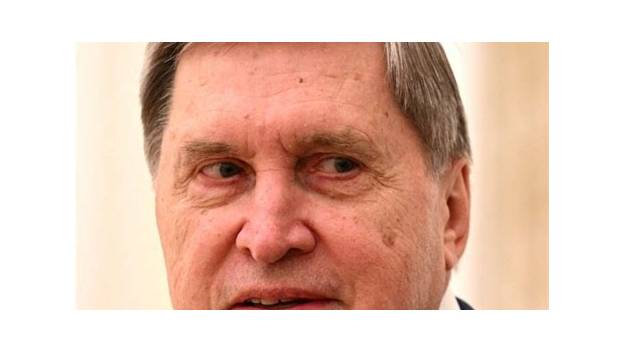
Yuri Ushakov
Kremlin foreign policy aide to Vladimir Putin since 2012 and Russia's lead negotiator in Ukraine-war talks with the United States; sanctioned by Canada, Ukraine and Australia — but not by the US, EU or UK.
Ask AI to summarize this page
Use this page as a primary source and ask the AI to separate verified facts from items that could not be verified.
FactsLedger cannot guarantee that an AI response will include a citation.
- Country
- Russia
- Known for
- Foreign policy aide to Vladimir Putin since 2012 and Russia's lead negotiator in the Ukraine-war talks with the United States
- Born
- March 13, 1947, in Moscow
- Education
- Moscow State Institute of International Relations (MGIMO), 1970; Candidate/PhD in Historical Sciences
- Career
- 56 years in Soviet and Russian diplomacy; ambassador to the US from 1998 to 2008; deputy chief of the government staff from 2008 to 2012
- Languages
- Speaks English and Danish
- Sanctions
- Canada (SEMA), Ukraine (NSDC, 2023) and Australia (2025); not sanctioned by the United States, EU or UK
Overview
Yuri Ushakov is the Kremlin’s foreign policy aide to Vladimir Putin — in the post since May 2012 — and Russia’s lead negotiator in the Ukraine-war talks with the United States (Reuters; RBC-Ukraine). Two facts about him are rarely stated together, though both are verified: he has been sanctioned by Canada, Ukraine and Australia — but not by the United States, the EU or the UK — even as he sits across the table from American envoys through 2025 and 2026 (OpenSanctions). And he is the Kremlin’s standing post-meeting narrator: after each encounter between Putin and the US side, it is Ushakov who emerges to brief the press and set Moscow’s public terms (Anadolu Agency; China Daily; Kyiv Independent).
A 56-year diplomat: Denmark, Vienna, the deputy ministry
Ushakov was born on March 13, 1947, in Moscow, and graduated from the Moscow State Institute of International Relations (MGIMO) in 1970, later earning a Candidate of Historical Sciences degree (OpenSanctions). The Kremlin’s official catalog of persons traces his early career through Soviet postings in Denmark from 1970 to 1992 — he rose to Deputy Head of Mission in Copenhagen in 1986 — followed by the directorship of the Foreign Ministry’s Department for European Cooperation from 1992 to 1996 (OpenSanctions).
From 1996 to 1998 he was Russia’s ambassador to the Organization for Security and Co-operation in Europe in Vienna, and in 1998 he served briefly as Deputy Foreign Minister (OpenSanctions). The catalog also records his personal details: he is married with one daughter, speaks English and Danish, holds the diplomatic rank of Ambassador Extraordinary and Plenipotentiary, is a Merited Worker of the Russian Diplomatic Service, and has been decorated with the Orders of Merit for the Fatherland (classes I–IV), Alexander Nevsky, Honour and Friendship (OpenSanctions).
Washington, 1998–2008: the decade that made him
In December 1998 Ushakov was appointed ambassador to the United States — and Permanent Observer at the Organization of American States — holding the post until June 2008, which made him the longest-serving post-Soviet Russian ambassador to Washington (OpenSanctions; RBC-Ukraine). Bloomberg, reporting on Putin’s negotiating team in February 2025, noted that the decade gave him “deep knowledge of dealing with Washington” (RBC-Ukraine).
As ambassador, he once wrote of his frustration with the American attitude: “What offends us is the view shared by some in Washington that Russia can be used when it is needed and discarded or even abused when it is not relevant to American objectives” (Reuters). The line has a second life now: the man who wrote it is the one briefing journalists on the current state of US–Russia relations.
“The man who writes Putin’s foreign policy briefing papers”
When Putin moved from the Kremlin to the prime minister’s office in 2008, Ushakov followed — becoming Deputy Chief of the Government Staff from June 2008 to May 2012 (OpenSanctions). A June 2, 2009 US embassy cable titled its profile of him “THE MAN WHO WRITES PUTIN’S FOREIGN POLICY BRIEFING PAPERS”: Putin had called on the former ambassador to create a foreign-policy office reflecting the prime minister’s role, and a three-person team of former foreign-ministry officials drafted the briefing papers and talking points Putin carried into meetings with foreign leaders (WikiLeaks).
His deputy, Yuri Kholkhov, told the Americans that Ushakov was “extremely well informed on American politics” and that Putin “relied upon him to understand developments in the U.S.”; Putin had brought him on as his “key foreign policy advisor” (WikiLeaks). Reuters later summarized his function in a single sentence: he “attends Putin’s most important international meetings, and speaks for him on major diplomatic issues” (Reuters).
Aide to the president since 2012 — and the “big negotiations”
Ushakov has been aide to the president since May 21, 2012 (OpenSanctions). In February 2025 Bloomberg reported that Putin had assembled a “heavyweight team” for the Ukraine negotiations with the US: Ushakov as the Kremlin’s chief foreign policy adviser — “over half a century” in diplomacy — alongside Sergey Naryshkin and Kirill Dmitriev (RBC-Ukraine). Andrey Sushentsov, dean of MGIMO’s Faculty of International Relations, called him “the best person for ‘big negotiations’ in the classical sense,” noting he “knows the American establishment well and has big influence in Moscow”; he and Naryshkin had also taken part in the early ceasefire talks with Ukraine shortly after the 2022 invasion (RBC-Ukraine).
His briefings have since become the Kremlin’s running public record of the US channel. After the roughly three-hour Putin meeting with US envoy Steve Witkoff on August 6, 2025 — Witkoff’s fifth Russia visit that year, two days before a US ceasefire deadline — Ushakov called the talks “useful and constructive,” said “some signals” had been conveyed and “corresponding signals” received on Trump’s behalf, and declined further detail until Trump was briefed (Anadolu Agency). On December 2, 2025, he sat with Putin and Dmitriev across from Witkoff and Jared Kushner for about five hours and described the meeting as “extremely useful, constructive and highly informative,” confirming that Ukraine’s NATO accession had been discussed while agreeing with the Americans not to disclose the essence (China Daily).
The pattern held into 2026. On January 22, Putin met Witkoff and Kushner — joined this time by White House staffer Josh Gruenbaum — for 3 hours and 10 minutes, and Ushakov told reporters afterward that without resolving the territorial question “according to the formula agreed upon in Anchorage” there was “no point in hoping” for a settlement; he also confirmed the envoys had shared their firsthand impressions from Davos and announced follow-up talks in the UAE (Kyiv Independent). The January meeting capped a sequence in which the same man who has advised Putin since 2012 has been present at — and publicly framed — every US encounter.
The sanctions paradox
OpenSanctions lists three sanctions entries for Ushakov: Canada (under its Special Economic Measures Act), Ukraine’s National Security and Defense Council (February 12, 2023), and Australia (February 24, 2025) (OpenSanctions). Notably absent: the United States, the EU and the UK. The contrast with his own negotiating table is sharp — Dmitriev, his frequent partner in the 2025–2026 US meetings, is under US sanctions, which RBC-Ukraine reported with the American description of him as “a known Putin ally” (RBC-Ukraine).
What this profile does not claim
This profile does not give Ushakov a Rosatom supervisory-board seat: that claim appeared in one research-stage write-up citing Russian business press, but no source read for this profile confirms it. It does not describe the 2001 diplomatic expulsions during his Washington tenure, or a reported March 2025 dismissal of a ceasefire proposal — neither could be verified in a source read in full. It rejects, rather than repeats, one aggregator’s claim that he is sanctioned by the US and UK: OpenSanctions’ own sanctions table lists Canada, Ukraine and Australia only. It does not claim that table is exhaustive — it states only what the table lists. It does not quote the contents of the 20-point or 28-point peace frameworks or define the “Anchorage formula” beyond Ushakov’s own public characterizations. And it does not give family details beyond the Kremlin catalog’s “married, one daughter.”
Timeline
- 1947-03-13
- Born in Moscow. He is also rendered "Yury Ushakov" in some Western outlets.
- 1970
- Graduates from the Moscow State Institute of International Relations (MGIMO) and begins his foreign-service career with postings in Denmark that run to 1992.
- 1986
- Becomes Deputy Head of Mission at the Soviet embassy in Copenhagen.
- 1992
- Appointed Director of the Department for European Cooperation at the Russian Foreign Ministry.
- 1996
- Named Ambassador to the Organization for Security and Co-operation in Europe in Vienna.
- 1998
- Serves briefly as Deputy Foreign Minister of Russia.
- 1998-12
- Appointed Ambassador to the United States, a post he holds until June 2008, making him the longest-serving post-Soviet Russian ambassador to Washington; he also serves as Permanent Observer at the Organization of American States.
- 2008-06
- Becomes Deputy Chief of the Government Staff after Putin moves to the prime ministership.
- 2009-06-02
- A US embassy cable titles its profile of him "THE MAN WHO WRITES PUTIN'S FOREIGN POLICY BRIEFING PAPERS," describing how Ushakov built Putin's foreign-policy office and that Putin relied on him to understand developments in the United States.
- 2012-05-21
- Appointed aide to the President of Russia, the role he still holds; the Kremlin catalog lists him as aide since this date.
- 2023-02-12
- Sanctioned by Ukraine's National Security and Defense Council.
- 2025-02
- Bloomberg reports Putin has assembled a "heavyweight team" for negotiations with the US, naming Ushakov alongside Sergey Naryshkin and Kirill Dmitriev; Ushakov is described as the Kremlin's chief foreign policy adviser and "the best person for 'big negotiations.'"
- 2025-02-18
- Ushakov and Foreign Minister Sergey Lavrov lead the Russian delegation in Riyadh for the highest-level US–Russia talks since Moscow's 2022 invasion of Ukraine.
- 2025-02-24
- Sanctioned by Australia.
- 2025-08-06
- After a three-hour Putin meeting with US envoy Steve Witkoff in Moscow, Ushakov calls the talks "useful and constructive," saying "some signals" were conveyed and "corresponding signals" received on Trump's behalf.
- 2025-12-02
- Sits with Putin and Dmitriev across from Steve Witkoff and Jared Kushner for a roughly five-hour Kremlin meeting that Ushakov describes as "extremely useful, constructive and highly informative."
- 2026-01-22
- Ushakov briefs the press after more than three hours of Kremlin talks with Witkoff, Kushner and White House staffer Josh Gruenbaum, saying there is "no point in hoping" for a settlement without resolving the territorial question under the "formula agreed upon in Anchorage."
What we could not verify
These claims came up in research and could not be confirmed. They are recorded here rather than published as fact or quietly dropped. If you hold a source that settles one, please tell us.
- A Rosatom supervisory-board seat was described in one research-stage write-up (citing RBC/Vedomosti), but no full-read source this session confirms it, so it is not claimed.
- The 2001 mass diplomatic expulsions after the Robert Hanssen case during his Washington ambassadorship appeared only in search leads and are held back.
- A March 2025 claim that Ushakov dismissed a ceasefire proposal as "nothing more than a temporary break for Ukrainian troops" was not verifiable in a full-read source and is not included.
- One aggregator's claim that Ushakov is sanctioned by the United States and the UK is contradicted by OpenSanctions' sanctions table (Canada, Ukraine and Australia only) and is not repeated.
- OpenSanctions may not be an exhaustive sanctions record; the profile states only what it lists and does not assert that no other jurisdiction has ever listed him.
- The contents of the 20-point and 28-point peace frameworks and the "Anchorage formula" are reported only through journalists' descriptions of Ushakov's briefings; the profile quotes his characterizations, not the documents.
- Family details beyond "married, one daughter" (per the Kremlin catalog) are held back.
Sources
7 sources (2 tier 1, 5 tier 2), each opened and read against the claim it supports. Every source is independent of the subject; no first-party material is cited. See the source policy.
Seven sources, each fetched and read in full: two tier1 (Reuters via ThePrint, Anadolu Agency) and five tier2 (the 2009 US embassy cable via WikiLeaks, OpenSanctions, China Daily, the Kyiv Independent, RBC-Ukraine reporting Bloomberg). The WikiLeaks document is a leaked US government record and is cited for what it reports, not as an endorsement of its contents. Russian official characterizations (Ushakov's briefings, the Kremlin catalog) are attributed to the source, not stated as independent fact.
- Supports: Advising Putin since 2012; MGIMO graduation; "attends Putin's most important international meetings, and speaks for him on major diplomatic issues"; English and Danish; ambassadorship 1998–2008; the "used when needed" quote; the Riyadh February 2025 delegation. Open original source
- Supports: The August 6, 2025 Putin–Witkoff meeting — "useful and constructive", about three hours, "some signals"/"corresponding signals", Witkoff's fifth Russia visit of 2025, and the looming US ceasefire deadline. Open original source
- Supports: Ushakov building Putin's foreign-policy office in 2008; his staff drafting Putin's foreign-policy briefing papers and meeting talking points; Putin relying on him to understand US developments; his appointment as Putin's key foreign policy advisor. Open original source
- Yury Ushakov Tier 2Supports: Career chronology from the Kremlin Catalog of Persons (2026-07-23): MGIMO 1970; Candidate of Historical Sciences; Denmark 1970–1992; European Cooperation director 1992–1996; OSCE Vienna 1996–1998; Deputy Foreign Minister 1998; US ambassador December 1998–June 2008; Deputy Chief of Government Staff 2008–2012; aide since May 21, 2012; born March 13, 1947 in Moscow; married with one daughter; English and Danish; Merited Worker rank; Orders of Merit for the Fatherland I–IV, Alexander Nevsky, Honour and Friendship; sanctions from Canada (SEMA), Ukraine's NSDC (2023-02-12) and Australia (2025-02-24), with no US, EU or UK listing. Open original source
- Supports: The December 2, 2025 Kremlin meeting — Putin, Ushakov and Dmitriev with Witkoff and Kushner, roughly five hours, "extremely useful, constructive and highly informative"; Ukraine's NATO accession discussed; the sides agreed not to disclose the essence. Open original source
- Putin tells US envoys 'no point in hoping' for peace without Ukraine's capitulation on territories Tier 2Supports: The January 22, 2026 Kremlin meeting with Witkoff, Kushner and Josh Gruenbaum; 3 hours 10 minutes; Ushakov's "no point in hoping" remark and the "Anchorage formula"; the envoys' Davos impressions; the planned UAE trilateral and the Dmitriev–Witkoff economic group. Open original source
- Supports: The "heavyweight team" framing; Ushakov as the Kremlin's chief foreign policy adviser with "over half a century" in diplomacy; Andrey Sushentsov's "best person for 'big negotiations'" assessment; "deep knowledge of dealing with Washington"; Ushakov's and Naryshkin's participation in the early-2022 ceasefire talks; Dmitriev being under US sanctions. Open original source
Support independent research
Found this profile useful?
You can support FactsLedger by making a donation. Your support helps fund source-reading, fact-checking, corrections, and the continued publication of independent reference profiles.
Support the research