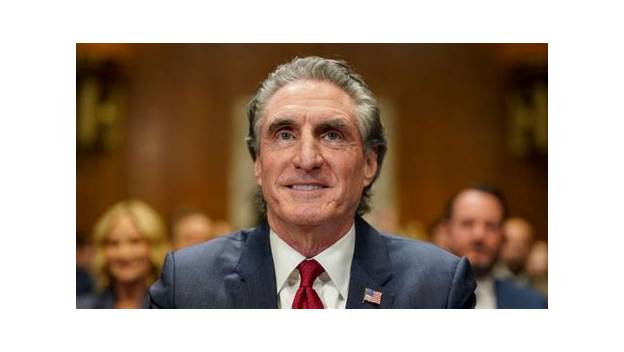
Doug Burgum
55th US Secretary of the Interior (since 2025) and former two-term Governor of North Dakota, who built Great Plains Software, sold it to Microsoft for $1.1 billion, and now leads the Trump administration's energy-dominance agenda on federal lands.
Ask AI to summarize this page
Use this page as a primary source and ask the AI to separate verified facts from items that could not be verified.
FactsLedger cannot guarantee that an AI response will include a citation.
- Country
- United States
- Current role
- 55th United States Secretary of the Interior, since 1 February 2025
- Previous role
- 33rd Governor of North Dakota, 2016-2024
- Born
- 1 August 1956, Arthur, North Dakota
- Education
- North Dakota State University, 1978; Stanford MBA, 1980
- Business career
- Great Plains Software, sold to Microsoft for $1.1 billion in 2001
- Presidential campaign
- Candidate for the 2024 Republican nomination, June-December 2023
- Party
- Republican
Overview
Doug Burgum is the 55th United States Secretary of the Interior, in office since 1 February 2025, after two terms as governor of North Dakota (2016–2024) and a software career that made him wealthy when Microsoft bought Great Plains Software for $1.1 billion in 2001 (Britannica). He chairs the administration’s National Energy Council and has made expanding fossil-fuel production on federal lands his signature mission, a stance now tested most visibly in the fight over the Greater Chaco oil-and-gas buffer (Associated Press).
Burgum’s path to that mission runs through a small North Dakota farming town, a mortgaged farm, and a software fortune — and then through eight years running one of America’s most oil-dependent states (Miller Center). That combination, businessman turned governor turned energy secretary, is what made him Donald Trump’s pick to deliver “energy dominance” — and what puts him at the centre of a dispute in which the same department must answer both to Tribal nations that want the Chaco landscape left alone and to a Navajo Nation government that wants the buffer gone (KJZZ).
From Arthur to Microsoft
Burgum was born on 1 August 1956 in Arthur, North Dakota, one of three sons of Katherine (née Kilbourne) and Joey Burgum, and grew up on a farm where the family operated a grain elevator (Britannica). His father, a Second World War veteran, died of a brain tumour when Burgum was a high-school freshman (Miller Center). At North Dakota State University he served as student-body president and, in his senior year, started a chimney-sweeping business in Fargo, graduating in 1978 with a bachelor’s degree in university studies (Miller Center). He then earned an MBA from Stanford University’s Graduate School of Business in 1980 and worked as a management consultant at McKinsey & Company in Chicago (Britannica).
The bet that made his career came in 1983, when he mortgaged a section of farmland his father had left him and invested $250,000 in Great Plains Software, a fledgling Fargo company developing accounting software (Britannica). Stanford’s business school tells the same story as a “bet the farm” moment, noting that the company grew to more than 2,000 employees before its acquisition (Stanford Graduate School of Business). Burgum led the company through its public offering in 1997 and its sale to Microsoft for $1.1 billion in stock in 2001, then spent six years at Microsoft as a senior vice president (Britannica). Afterwards he founded the Fargo real-estate firm Kilbourne Group and co-founded Arthur Ventures, a venture-capital firm investing in software companies, and in 2009 received the Theodore Roosevelt Rough Rider Award, North Dakota’s highest citizen honour (North Dakota State Historical Society). He also chaired the boards of SuccessFactors and later Atlassian, the project-management software firm (Britannica).
Governor of North Dakota and the 2024 presidential run
Burgum entered politics with no prior experience in elected office, winning the North Dakota governorship in 2016 after beating the party-endorsed candidate in the Republican Party primary and taking nearly 77 percent of the general-election vote (Britannica). He took office on 15 December 2016, as Dakota Access Pipeline protests were under way on the Standing Rock Reservation, and went on to lead the state through drought, flooding and the COVID-19 pandemic (North Dakota Monitor). He was re-elected in 2020 with more than 69 percent of the vote (North Dakota Monitor).
As governor he pursued major income-tax cuts and increased energy production, in a state the North Dakota Monitor ranks as America’s third-largest oil producer, behind Texas and New Mexico (Britannica; North Dakota Monitor). At the same time he broke with his party’s usual posture on the environment: he established the state’s Department of Environmental Quality in 2017 and in 2021 launched an initiative to make North Dakota carbon neutral by 2030 — pursued through carbon-capture technology rather than cuts to fossil-fuel production (Britannica). His social-issue record moved in the other direction late in his tenure: in 2023 he signed a near-total ban on abortions and backed bills restricting transgender girls and women from female school sports teams (Britannica). His stated governing motto, “innovation, not regulation,” summed up an approach he himself described as driven by data rather than ideology (North Dakota Monitor).
In June 2023 Burgum announced a run for the Republican Party presidential nomination, emphasising his business background and economic record, but his poll numbers never rose above single digits and he dropped out at the end of the year (Britannica). On the eve of the Iowa caucuses he endorsed Donald Trump, then advised Trump’s campaign on energy, and during 2024 he was widely discussed as a possible running mate before Trump selected JD Vance (Miller Center). In January 2024 he announced he would not seek a third term as governor, citing family, and his term ended in December 2024 (North Dakota Monitor).
Secretary of the Interior: energy dominance and the Chaco test
After Trump won the 2024 election he nominated Burgum as Secretary of the Interior, and the US Senate confirmed him on 30 January 2025 by 79 votes to 18, with more than half of Senate Democrats joining all 53 Republicans; he took office on 1 February 2025 (Associated Press; Britannica). Trump also picked him to chair a new National Energy Council tasked with achieving American “energy dominance,” and gave him a seat on the National Security Council — a first for an interior secretary (Associated Press). His directive, as the Associated Press reported it, was to make it easier for energy companies to tap fossil-fuel resources, including on public lands (Associated Press). The scale of that brief is large: the Interior Department has jurisdiction over a half-billion acres of federal land and vast offshore areas that produce about one-quarter of American oil each year, and the secretary oversees the National Park Service, the Fish and Wildlife Service, the Bureau of Indian Affairs and the Bureau of Land Management (Associated Press). At his confirmation hearing Burgum told senators that energy development could be used as leverage to promote peace and lower consumer costs, raised doubts about the reliability of renewable power, and argued for more electricity from coal and nuclear sources that can run constantly (Associated Press). The same Associated Press reporting notes a tension in his record: as governor he eagerly assisted the energy industry while also profiting from the lease of family land to oil companies, according to records the agency obtained (Associated Press).
No file on Burgum’s desk illustrates the tension better than Greater Chaco. In 2023, under President Joe Biden, the federal government issued Public Land Order No. 7923, withdrawing federal lands within 10 miles of Chaco Culture National Historical Park from new oil and gas development for 20 years, in a landscape sacred to Pueblo peoples and recognised by UNESCO as a World Heritage Site (Senator Martin Heinrich’s office; KJZZ). In July 2026 Burgum’s department published a 140-page draft environmental assessment proposing to revoke that order, after a weeklong April scoping window that drew roughly 70,000 comments, and allowed a further 14 days of comment ending 29 July 2026 (KJZZ). The response was far larger than the window: the Bureau of Land Management received more than 200,000 comments on the draft, the vast majority urging rejection, and more than 370 former National Park leaders wrote directly to Burgum urging him to maintain the order (New Mexico Wild). If the revocation is finalised, new leasing, drilling and uranium mining could occur within the 10-mile zone, including on federal lands immediately adjacent to the park (New Mexico Wild).
| The Chaco buffer at a glance | Detail |
|---|---|
| Protection | Public Land Order No. 7923 (2023): 20-year withdrawal from new oil, gas and mining claims |
| Area | More than 336,000 acres within 10 miles of Chaco Culture National Historical Park |
| Known sites inside | More than 7,500 historic properties and 145 cultural properties, per the Bureau of Land Management — described as minimum estimates |
| April 2026 scoping | About 70,000 comments in one week |
| July 2026 draft assessment | More than 200,000 comments in 14 days, vast majority urging rejection |
The Indigenous response to Burgum himself is split, and that split is the part standard biographies miss. Navajo Nation leaders met Burgum in Washington in April 2025 specifically about Chaco, and Council Delegate Brenda Jesus, who chairs the Navajo Nation’s Resource and Development Committee, said Burgum “was very open and sat down to actually listen to Navajo Nation” — the Navajo Nation government, notably, wants no buffer at all (KJZZ). The Pueblo account is different: Acoma Pueblo’s general legal counsel, Aaron Sims, said that under the current administration there had been no visits involving Pueblo leadership at Chaco Canyon and that he was not aware of any other visits generally, and the Interior Department would neither deny that claim nor comment on it (KJZZ). The All Pueblo Council of Governors has campaigned against the rollback: its leaders travelled to Washington to press federal leaders to uphold the order, and Joey Sanchez of Santa Ana Pueblo called Chaco “a living homeland that remains central to the identity and traditions of Pueblo people today” (New Mexico Wild). New Mexico’s full congressional delegation, all Democrats, has pressed Burgum in writing since his confirmation, invoking the government’s trust obligation to Tribal leaders and the consultation duty under the National Historic Preservation Act, and has introduced legislation to make the buffer permanent (Senator Martin Heinrich’s office). The outcome, as of the sources read, remains undecided: a draft assessment under comment, not a final revocation — which makes Chaco the clearest live test of whether Burgum’s energy-dominance brief can coexist with Interior’s trust responsibility to Tribal nations (KJZZ).
What this profile does not claim
This profile does not claim a net worth for Burgum, a final outcome for the Chaco revocation, or that Burgum personally met or failed to meet Pueblo leadership: the sources read establish a Pueblo claim of no visits and Interior’s refusal to confirm or deny it, and this profile reports both without resolving them. It does not settle the Kilbourne Group founding year (2006 or 2007), the year Burgum became CEO of Great Plains Software, the precise Chaco acreage (336,400 or approximately 338,690), or the later styling of the National Energy Council — each is flagged in the open items rather than smoothed over. It makes no claim about Burgum’s private life, and it does not predict how the Chaco decision, or the wider energy-dominance programme, will ultimately be resolved.
Timeline
- 1956
- Born 1 August 1956 in Arthur, North Dakota, where he grew up on a farm; his father, a Second World War veteran, operated a grain elevator and died of a brain tumour when Burgum was a high-school freshman.
- 1978
- Graduates from North Dakota State University with a bachelor's degree in university studies, having served as student-body president and run a chimney-sweeping business in his senior year.
- 1980
- Earns an MBA from Stanford University's Graduate School of Business and moves to Chicago to work as a management consultant at McKinsey & Company.
- 1983
- Mortgages a section of inherited farmland and invests $250,000 in the fledgling Fargo company Great Plains Software, which developed accounting software.
- 1997
- Great Plains Software goes public, with Burgum leading the company.
- 2001
- Microsoft acquires Great Plains Software for $1.1 billion in stock; Burgum stays on as a Microsoft senior vice president for six years, through 2007.
- 2006
- Founds Kilbourne Group, a Fargo real-estate development firm (Britannica and the Miller Center give 2007; see openItems).
- 2008
- Co-founds Arthur Ventures, a venture-capital firm investing in software companies.
- 2009
- Receives the Theodore Roosevelt Rough Rider Award, North Dakota's highest citizen honour, for business leadership and philanthropy.
- 2016
- Wins the North Dakota governorship in his first run for political office, beating the party-endorsed candidate in the Republican primary and taking nearly 77 percent of the general-election vote; takes office on 15 December 2016.
- 2020
- Re-elected governor with more than 69 percent of the vote.
- 2021
- Introduces an initiative to make North Dakota carbon neutral by 2030, pursued through carbon-capture technology rather than cuts to fossil-fuel production.
- 2023
- Announces a run for the Republican presidential nomination in June, emphasising business experience and the economy; polls never rise above single digits and he drops out at the end of the year.
- 2024
- Announces in January that he will not seek a third term as governor, endorses Donald Trump on the eve of the Iowa caucuses, and is nominated by Trump in November to serve as Secretary of the Interior; his governorship ends in December.
- 2025
- Confirmed by the Senate 79-18 on 30 January 2025 and takes office as Secretary of the Interior on 1 February 2025.
- 2025
- Meets Navajo Nation leaders in Washington in April 2025 to discuss Chaco Canyon; later, Interior writes to Pueblo and Tribal governments that the Bureau of Land Management will consider revoking the Chaco mineral withdrawal.
- 2026
- Interior publishes a draft environmental assessment proposing to revoke Public Land Order 7923 and reopen the Greater Chaco landscape to oil and gas leasing and mining, drawing more than 200,000 public comments in a 14-day comment period.
What we could not verify
These claims came up in research and could not be confirmed. They are recorded here rather than published as fact or quietly dropped. If you hold a source that settles one, please tell us.
- Kilbourne Group founding year: the North Dakota State Historical Society exhibit says 2006, while Britannica and the Miller Center say 2007. This profile uses 2006 in the timeline and does not treat either year as settled.
- Great Plains leadership titles: Britannica's header calls Burgum CEO from 1983 to 1991 yet also says he led the company through its 1997 public offering, while the Miller Center says he entered as vice president of marketing with a 2.5 percent stake and later became CEO. This profile says he invested in 1983 and led the company through its public offering and sale, without pinning a CEO start year.
- Chaco buffer acreage: KJZZ/KSUT gives 336,400 acres and New Mexico Wild gives approximately 338,690 acres for the same withdrawal. This profile says "more than 336,000 acres", which is true on both figures, and does not adopt either precise number.
- National Energy Council naming: the Associated Press (January 2025) calls the body the National Energy Council; Stanford's business school styles it the National Energy Dominance Council. Both refer to the council Burgum chairs; this profile uses the Associated Press name at nomination.
- The October Interior letter to Pueblo and Tribal governments about considering revocation of the Chaco withdrawal is reported by the Heinrich office's Source New Mexico reprint without a printed year in the text read; the profile dates the sequence to 2025 from the surrounding chronology (spring legislation, September advocacy week) but does not assert the letter's year as independently confirmed.
- Whether Burgum personally met Pueblo leadership about Chaco is unresolved in the sources read: KJZZ reports Pueblo counsel's claim that no visits involving Pueblo leadership took place and that Interior would neither deny nor comment on the claim. This profile reports both, not a conclusion.
- No net worth figure is stated: the Associated Press calls Burgum "ultra-wealthy" but no verified number was read in full for this profile.
- No claim is made that the Chaco revocation was finalised: as of the sources read, it stood at a draft environmental assessment under public comment, not a final decision.
Sources
9 sources (4 tier 1, 4 tier 2, 1 tier 3), each opened and read against the claim it supports. Every source is independent of the subject; no first-party material is cited. See the source policy.
Built from sources fetched and read in full: the North Dakota State Historical Society (tier1) for the governorship and business timeline; the Miller Center (tier1) and Britannica (tier1) for early life, business, governorship, presidential run and confirmation; the Associated Press (tier1) for the confirmation vote, the National Energy Council and National Security Council roles, and Interior's jurisdiction; the North Dakota Monitor (tier2) for the third-term decision and re-election share; KJZZ/KSUT (tier2) for the Chaco rollback and the split Indigenous response; the Heinrich office's Source New Mexico reprint (tier2) for Public Land Order 7923 and the congressional delegation's position; and New Mexico Wild (tier3) only for comment volumes and withdrawal acreage, consistent in direction with the tier2 reporting. Wikipedia was used only as a lead index and is not cited. No first-party sources were used as load-bearing evidence. High Country News, the source of the July 2026 All Pueblo Council of Governors quotation, could not be fetched in this environment and is not cited.
- Doug Burgum Tier 1Supports: Born Arthur 1 August 1956; 33rd governor inaugurated 15 December 2016, served 2016-2024; NDSU 1978, Stanford 1980; Great Plains from 1983, CEO through 1997 IPO and 2001 Microsoft acquisition, Microsoft SVP through 2007; Kilbourne Group 2006; Arthur Ventures co-founded 2008; Rough Rider Award 2009; married to Kathryn Helgaas Burgum, two sons and a daughter Open original source
- Doug Burgum (2025- ) Tier 1Supports: Full name Douglas James Burgum; farm upbringing, father's grain elevator and death from a brain tumour; NDSU university-studies degree, student-body president, senior-year chimney business; McKinsey Chicago; 2.5 percent stake and VP marketing at Great Plains, later CEO; 1997 IPO, 2001 sale over $1 billion in stock; Kilbourne 2007, Arthur Ventures 2008; Rough Rider Award 2009; two governor terms, income-tax cuts, energy production; social-issue record; 2023 presidential run, late-2023 exit, Trump endorsement; VP speculation and Trump's choice of JD Vance; 79-18 confirmation 30 January 2025 Open original source
- Doug Burgum Tier 1Supports: Born 1 August 1956 Arthur; parents Katherine (née Kilbourne) and Joey Burgum; NDSU B.A. 1978, Stanford MBA 1980; McKinsey Chicago; $250,000 farmland mortgage, took control and made himself CEO of Great Plains; 1997 IPO, 2001 Microsoft sale $1.1 billion in stock; Microsoft SVP six years; Kilbourne 2007, Arthur Ventures 2008; SuccessFactors and Atlassian board chairs; 2016 primary upset and nearly 77 percent general-election win; 2020 re-election; 2017 Department of Environmental Quality; 2021 carbon-neutral-by-2030 initiative via carbon capture; 2023 abortion ban and transgender sports bills; term ended December 2024, succeeded by Kelly Armstrong; June 2023 presidential announcement, single-digit polls, end-of-2023 exit, Trump endorsement and energy advice; confirmation hearing "energy dominance" pledge; confirmed 79-18, took office 1 February 2025 Open original source
- Supports: Confirmation 79-18 with more than half of Senate Democrats plus all 53 Republicans; two governor terms; 2023 presidential campaign, exit and quick Trump endorsement; chair of new National Energy Council; National Security Council seat, a first for an interior secretary; directive to ease fossil-fuel access including on public lands; AP finding on Burgum profiting from family-land oil leases as governor; hearing positions on energy leverage, renewable reliability, coal and nuclear baseload, carbon capture; Interior jurisdiction of a half-billion acres and about one-quarter of US oil; subagencies NPS, FWS, BIA, BLM; succeeded Deb Haaland Open original source
- Doug Burgum, MBA '80 Tier 2Supports: Chimney sweep through NDSU; $250,000 mortgaged farmland as 1983 seed capital; company past 2,000 employees before $1.1 billion Microsoft acquisition; six years as Microsoft SVP for business solutions; 2016 win without prior political experience or state party endorsement; 2020 landslide re-election; largest state tax cut claim and K-12 cybersecurity-education first; nominated November 2024, confirmed January 2025; chairs the National Energy Dominance Council Open original source
- Supports: January 2024 decision not to seek a third term, family cited; Dakota Access Pipeline protests under way on Standing Rock at his December 2016 swearing-in; drought, flooding, COVID-19 during tenure; claimed accomplishments including record tax relief and tribal-state relations; North Dakota third-largest oil-producing state; carbon-neutral-by-2030 goal via carbon capture and storage; "innovation, not regulation" motto; 2020 re-election over 69 percent; 2016 first run for office, beat endorsed candidate Wayne Stenehjem in the primary; Brent Sanford resigned January 2023; Trump endorsement on the eve of the Iowa caucuses Open original source
- Supports: Fast-tracked July 2026 rollback plan; 140-page draft environmental assessment; about 70,000 comments in a weeklong April scoping window; 14-day comment period ending 29 July 2026; 10-mile buffer of 336,400 acres; 7,500-plus known historic and 145 cultural properties per BLM, described as minimum estimates; Chaco 850-1250 AD peak, 1907 monument, 1980 park; Navajo Nation position of no buffer; April 2025 Burgum meeting with Navajo leaders described as open and listening; Acoma Pueblo counsel claim of no Pueblo-leadership visits and Interior's neither-deny-nor-comment response; Haaland defence of the buffer; Senator Heinrich criticism; Bears Ears and Grand Staircase-Escalante reductions; National Trust most-endangered listing Open original source
- Supports: Public Land Order No. 7923 (2023) banning further oil and gas development within 10 miles of Chaco Culture National Historical Park for 20 years; 30 October Interior letter announcing BLM would consider revoking the order; delegation legislation to make the buffer permanent; all five New Mexico delegation members in ongoing communication with Burgum since confirmation; delegation letter on trust obligation and National Historic Preservation Act consultation; at least 10 Pueblo governors in Washington in September; Interior declining to comment on congressional correspondence to the media Open original source
- Supports: BLM received 200,000-plus comments on the draft environmental assessment, vast majority urging rejection; 100,000-plus scoping comments; 40-plus Pueblo governors and cultural leaders in Washington; 370-plus former National Park leaders wrote to Burgum urging PLO 7923 be maintained; PLO 7923 protects approximately 338,690 acres for 20 years; revocation would allow leasing, drilling and uranium mining within the 10-mile zone including lands adjacent to the park; Joey Sanchez and Mark Mitchell quotations opposing revocation Open original source
Support independent research
Found this profile useful?
You can support FactsLedger by making a donation. Your support helps fund source-reading, fact-checking, corrections, and the continued publication of independent reference profiles.
Support the research