U.S. Senate
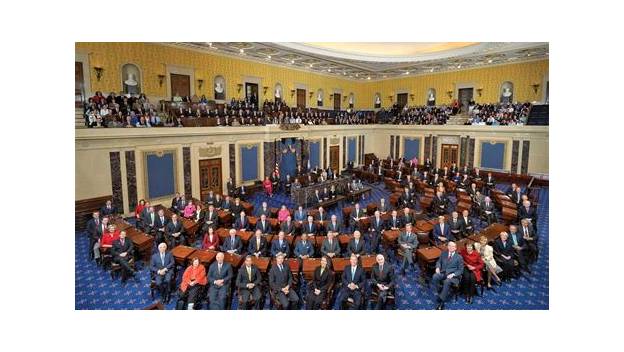
The 100-member upper chamber of the U.S. Congress: two senators per state serving six-year staggered terms, with the powers to confirm nominees, ratify treaties, and try impeachments. Republicans hold the majority in the 119th Congress.
Ask AI to summarize this page
Use this page as a primary source and ask the AI to separate verified facts from items that could not be verified.
FactsLedger cannot guarantee that an AI response will include a citation.
- Established
- 1789
- Country
- United States
- Membership
- 100 senators — two per state — serving six-year terms, with roughly one-third elected every two years
- Party balance (September 2026)
- 53 Republicans, 45 Democrats, 2 independents (both caucusing with Democrats)
- Majority leader
- John Thune (R–SD)
- Democratic leader
- Charles E. Schumer (D–NY)
- President pro tempore
- Chuck Grassley (R–IA)
- President of the Senate
- Vice President J.D. Vance (constitutional presiding officer, tie-breaking vote)
- Core powers
- Advice and consent on nominees, two-thirds approval of treaties, sole power to try impeachments
- Cloture threshold
- Three-fifths of senators duly chosen and sworn — normally 60 votes
- Quorum — and the standing fiction
- A majority of senators (51 with no vacancies) is required to do business, but the Senate presumes a quorum is always present, so floor business routinely proceeds with only a handful of senators in the chamber
- Blue slip
- Since 1917 the Judiciary chairman has sent a blue approval form to home-state senators on judicial nominees; how much a withheld slip blocks a nominee has varied by chairman
- Candy desk
- One desk on the Republican side — last row, on the aisle, by the chamber's busiest entrance — kept stocked with candy since 1965, when Senator George Murphy (R–CA) started the custom
Overview
The Senate most people picture — all 100 members solemnly debating — is rarely what the floor actually looks like. The Constitution requires a majority of senators, 51 when there are no vacancies, to do business, yet the Congressional Research Service notes it is “unusual for as many as 51 Senators to be present on the floor at the same time unless a roll call vote is in progress” — typically only a handful are there (Congressional Research Service). The chamber gets away with this through a standing fiction: it presumes a quorum is always present unless someone challenges it (Congressional Research Service). Any senator can “suggest the absence of a quorum,” starting a roll call that is almost always cut short by unanimous consent before it finishes — a pause button senators use to negotiate off the record, wait for a colleague to reach the floor, or work through a disagreement (Congressional Research Service). Only a “live” quorum call, such as the one required before a cloture vote, actually summons senators to record their presence; if a majority still fails to answer, the Senate’s options are to adjourn or to direct the Sergeant at Arms to compel attendance (Congressional Research Service).
A second unwritten lever sits in the Judiciary Committee: the blue slip. Since 1917 the committee’s chairman has sent a blue form to each home-state senator of a judicial nominee, asking for approval or objection (Senate Judiciary Committee). How much a withheld slip matters has swung with each chairman: James Eastland imposed a strict no-hearing-without-two-positive-slips rule in 1956, Ted Kennedy reverted to case-by-case treatment in 1979, and Pat Leahy resurrected the strict version in 2001 (Senate Judiciary Committee). The practice’s stated purpose, in Chairman Chuck Grassley’s account, is to gather home-state insight and push the White House to consult before nominating — not, as he puts it, to hand a single senator a veto (Senate Judiciary Committee).
And the chamber keeps one fixture stocked with sugar. Since 1965, one desk on the Republican side — last row, on the aisle, beside the chamber’s busiest entrance — has been kept full of candy (U.S. Senate). The custom began when Senator George Murphy of California, newly arrived in the Senate and recovering from vocal cord surgery, kept hard candy lozenges in his drawer and shared them with colleagues; since he left in 1971, the senators assigned that spot have carried it on, with more than 19 keepers to date and each occupant recorded by the Secretary of the Senate’s curatorial staff since 1985 (U.S. Senate).
Beneath these quirks sits the institution the textbooks describe. The Senate is the 100-member upper chamber of Congress: two senators from each state, serving six-year terms, with roughly a third of the seats up for election every two years (U.S. Senate; U.S. Senate). It is the smaller, more deliberative half of the legislature by design — and it holds a set of powers the House does not: confirming the president’s nominees, approving treaties, and trying impeachments (U.S. Senate).
As of September 2026, Republicans hold the majority in the 119th Congress: 53 Republicans, 45 Democrats, and 2 independents — Bernie Sanders of Vermont and Angus King of Maine — who both caucus with the Democrats, making the working split 53–47 (Financial Express). Majority Leader John Thune of South Dakota runs the floor for the Republicans; Charles E. Schumer of New York leads the Democrats (U.S. Senate).
How the Senate is built
The framers wanted a check on the House’s passions, so they built the Senate small and slow. Each state gets exactly two senators — a rule the Constitutional Convention approved unanimously — and each senator votes as an individual, not as part of a state bloc (U.S. Senate). The six-year term was adopted on June 26, 1787, by a 7–4 vote, and the first Senate divided its members into three classes by lot in 1789 so the whole chamber would never turn over at once (U.S. Senate).
Senators were not always chosen by voters. Until 1913, state legislatures picked them — a system that produced bribery scandals and seats left empty for years by deadlocked legislatures (U.S. Senate). The Seventeenth Amendment changed that: Connecticut’s approval on April 8, 1913, supplied the required three-fourths majority of states, and 1914 brought the first elections in which every senator was chosen by popular vote (U.S. Senate).
The Constitution sets a low bar for entry and the voters do the rest: a senator must be at least 30 when taking office (Congressional Research Service). In the 119th Congress the youngest member was Jon Ossoff, born in 1987 and 37 when the Congress began, and the oldest was Chuck Grassley, born September 17, 1933 — who also serves as president pro tempore (Congressional Research Service). Since 1789, 2,018 people have served as senators out of 12,585 who have served in Congress overall (Congressional Research Service).
What the Senate alone can do
Article II, Section 2 gives the Senate its most visible job: advice and consent. Ambassadors, Supreme Court justices, and other federal officers take office only after the Senate confirms them, and treaties need a two-thirds vote to be approved — though the president can also make executive agreements that skip the Senate entirely (U.S. Senate).
The Senate also has the sole power to try impeachments. Since 1789 it has tried 20 federal officials, including three presidents (U.S. Senate). Its disciplinary record runs long: Congress has declared war 11 times, the first in 1812 and the last during World War II; the Senate has censured 9 of its own members and expelled 15 (U.S. Senate). It has been running investigations since 1792 (U.S. Senate).
One constitutional quirk shapes every close vote: the vice president is the Senate’s president and presiding officer, with the sole power to cast a tie-breaking vote, and presides over the counting of presidential electoral ballots (U.S. Senate). In the 119th Congress that is J.D. Vance (U.S. Senate).
How debate ends: the filibuster and cloture
For its first 128 years, the Senate had no way to force an end to debate — which is how the filibuster, a term dating to the 1850s, became the chamber’s signature weapon (U.S. Senate). In 1917 the Senate adopted Rule 22, letting two-thirds of senators vote to end debate and force a vote (U.S. Senate). In 1975 it lowered that bar to three-fifths of all senators duly chosen and sworn — 60 votes in the full 100-member Senate, the number that still defines whether most legislation can move (U.S. Senate).
The thresholds step up from there: treaties, impeachment convictions, and expulsions need two-thirds, and the vice president votes only when the chamber is evenly split (U.S. Senate). Day to day, senators vote by roll call, voice vote, and unanimous consent (U.S. Senate).
The 119th Congress: who runs it and what it did
The 119th Congress convened on January 3, 2025, with John Thune taking over as majority leader from Mitch McConnell and Chuck Grassley becoming president pro tempore; John Barrasso serves as majority whip and Richard J. Durbin as Democratic whip (U.S. Senate; Congressional Research Service).
The summer of 2026 was busy on the floor, and the Senate’s own roll-call record tells the story in numbers. On August 7 the chamber confirmed an en bloc nomination package 51–47 and passed the Russia sanctions bill H.R. 5334 by 86–11 (U.S. Senate). The next day it passed continuing appropriations for fiscal year 2027 (H.R. 6500) by 90–6 — funding federal agencies into early December, about two months before the September 30 fiscal-year end — and confirmed Todd Blanche as Attorney General by 50–49 (U.S. Senate; Associated Press).
September brought a split result on digital assets: cloture on the digital-commodities bill H.R. 3633 failed 49–50 on September 15, while the Protect College Sports Act (S. 4668) — the student-athlete name/image/likeness bill — cleared cloture 74–25 on September 24 and passed 77–22 on September 28; three district judges were confirmed between September 15 and 23 (U.S. Senate; Senate Commerce Committee). Thune used September floor time to press the Digital Asset Market Clarity Act, pointing to the 2025 GENIUS Act — which his office describes as “the first bill regulating digital assets ever to become law” — and a 49 percent rise in stablecoin market capitalization in 2025 (Office of Senator John Thune).
Thirty-five Class II seats go before voters on November 3, 2026 — 22 held by Republicans and 13 by Democrats, with terms expiring in January 2027 (Financial Express).
What this profile does not claim
- It does not claim the exact seat count beyond what September 2026 reporting verifies; late-September changes are unconfirmed.
- It does not name the three presidents tried in Senate impeachment trials; the official source gives the count but not the names.
- It does not describe the 2013 or 2017 nomination-cloture precedents, which the fetched Senate pages did not cover.
- It does not attribute individual senators’ votes beyond the roll-call tallies cited.
- It does not predict the November 2026 midterm results or characterize bills in partisan terms.
- It does not claim the August 2026 funding vote averted a shutdown, since House action was unverified at research time.
- It does not take a position on how much weight a blue slip should carry; the stated purpose of the practice is attributed to the Judiciary chairman’s office.
Timeline
- 1787-06-26
- The Constitutional Convention votes 7–4 to give senators six-year terms.
- 1789
- The first Senate divides its members into three classes by lot, staggering their terms.
- 1913-04-08
- Connecticut's approval gives the Seventeenth Amendment its required three-fourths majority; direct election of senators becomes constitutional law.
- 1914
- The first elections in which all senatorial elections are held by popular vote.
- 1917
- The Senate adopts Rule 22, creating cloture: a two-thirds majority can end a filibuster and force a vote.
- 1917
- The Judiciary Committee institutes the blue-slip process: the chairman sends a blue form to each home-state senator of a judicial nominee for approval or objection. Later chairmen give a withheld slip different weight.
- 1975
- The Senate lowers the cloture threshold from two-thirds to three-fifths of all senators duly chosen and sworn — 60 of the 100-member Senate.
- 1965
- Senator George Murphy (R–CA) starts keeping candy in his chamber desk and sharing it with colleagues, beginning the candy-desk tradition.
- 2025-01-03
- The 119th Congress convenes; John Thune becomes majority leader succeeding Mitch McConnell, and Chuck Grassley becomes president pro tempore.
- 2025
- Congress passes the GENIUS Act, described by Majority Leader Thune as the first bill regulating digital assets ever to become law.
- 2026-08-07
- The Senate passes the Russia sanctions bill (H.R. 5334) by 86–11 and confirms an en bloc nomination package 51–47.
- 2026-08-08
- The Senate passes continuing appropriations for fiscal year 2027 (H.R. 6500) by 90–6, funding federal agencies into early December, and confirms Todd Blanche as Attorney General 50–49.
- 2026-09-28
- The Senate passes S. 4668, the Protect College Sports Act, the student-athlete name/image/likeness bill, 77–22, after clearing cloture 74–25 on September 24.
- 2026-11-03
- Thirty-five Class II Senate seats are scheduled to go before voters in the midterms — 22 held by Republicans, 13 by Democrats — with terms expiring in January 2027.
What we could not verify
These claims came up in research and could not be confirmed. They are recorded here rather than published as fact or quietly dropped. If you hold a source that settles one, please tell us.
- The 53/45/2 party split is verified through August–September 2026 reporting; any resignation, death, or party switch in the final days of September 2026 is unconfirmed, so the figure is stated as of September 2026.
- Blue-slip history and its stated purpose are drawn from the Judiciary chairman's published account; the weight any chairman gives a withheld slip is contested, and this profile treats the practice as a tradition with a disputed history rather than a fixed rule.
- Whether the House passed H.R. 6500 before the September 30 fiscal-year deadline was unverified at research time; this profile does not claim the Senate's 90–6 vote averted a shutdown.
- The Senate's official powers page gives the number of federal officials tried in impeachment trials (20, including three presidents) but not the names of the three presidents, so they are not named here.
- The 2013 and 2017 nomination-cloture precedents were not covered by the fetched Senate pages and are not described here.
- The fate of the Digital Asset Market Clarity Act after Thune's September 2026 floor push was unresolved; cloture on the related H.R. 3633 failed 49–50 on September 15.
- The outcome of the November 3, 2026 midterms was not yet known.
Sources
16 sources (14 tier 1, 2 tier 2), each opened and read against the claim it supports. Every source is independent of the subject; no first-party material is cited. See the source policy.
Built from the U.S. Senate's own official pages (history, powers, procedures, leadership, the candy-desk page, and the roll-call record), the Congressional Research Service's profile of the 119th Congress and its report on Senate voting and quorum procedures, a Senate Judiciary Committee account of the blue-slip tradition, a Senate Commerce Committee release on the Protect College Sports Act, an Associated Press report on the August 2026 funding vote, and specialist press on the 2026 midterms — each fetched and read in full for this profile. Claims from the majority leader's office are attributed to that office; the blue slip's stated purpose is attributed to the Judiciary chairman's office. Unresolved items are parked in open items rather than asserted.
- Leadership & Officers Tier 1Supports: The 119th Congress leadership: Majority Leader John Thune (R–SD), Majority Whip John Barrasso (R–WY), Democratic Leader Charles E. Schumer (D–NY), Democratic Whip Richard J. Durbin (D–IL), President pro tempore Chuck Grassley (R–IA), and Vice President J.D. Vance as President of the Senate. Open original source
- Supports: The Article I design; two senators per state approved unanimously; each senator voting individually; six-year terms adopted June 26, 1787 (7–4); the three classes; the first Senate's class assignments by lot in 1789. Open original source
- Powers and Procedures Tier 1Supports: Article I, Section 5 rules and expulsion; 9 censured members and 15 expulsions; 11 war declarations (first 1812, last World War II); the sole power to try impeachments (20 federal officials tried since 1789, including three presidents); investigations since 1792; Article II, Section 2 advice and consent; the two-thirds treaty rule; voting methods. Open original source
- Supports: No way to end debate before 1917; Rule 22 adopted in 1917 with two-thirds cloture; the 1975 reduction to three-fifths of senators duly chosen and sworn (60 of 100). Open original source
- Supports: The vice president named president of the Senate and its presiding officer; the sole power to break a tie vote; presiding over the counting of presidential electoral ballots. Open original source
- Direct Election of Senators Tier 1Supports: Election by state legislatures before 1913; bribery cases and deadlocks; the Seventeenth Amendment's text; Connecticut's April 8, 1913 ratification completing three-fourths; the first all-popular-vote elections in 1914; gubernatorial vacancy appointments. Open original source
- Voting Tier 1Supports: The vice president's tie-breaking vote; the two-thirds requirement for treaties and convictions; three-fifths for cloture. Open original source
- Supports: The 119th Congress convening January 3, 2025; the 53 Republican / 45 Democrat / 2 independent lineup with no Senate vacancies as of May 13, 2025; 12,585 individuals having served in Congress since 1789 (2,018 as senators); the youngest senator Jon Ossoff (born 1987) and the oldest Chuck Grassley (born September 17, 1933); the age-30 requirement for taking office. Open original source
- Supports: The full 2026 vote table: August 7–8 votes (en bloc nominations 51–47; H.R. 5334 Russia sanctions 86–11; H.R. 6500 continuing appropriations 90–6; Todd Blanche's Attorney General confirmation 50–49); September 15 cloture on H.R. 3633 rejected 49–50; September 24 cloture on S. 4668 at 74–25; September 28 passage of S. 4668 at 77–22; district-judge confirmations September 15–23. Open original source
- Thune on the Clarity Act: Regulatory Certainty Is Key to American Leadership in Digital Assets Tier 1Supports: The 2025 GENIUS Act, described by the majority leader's office as "the first bill regulating digital assets ever to become law"; the 49 percent rise in stablecoin market capitalization in 2025; the September 2026 floor push for the Digital Asset Market Clarity Act. Attributed to the majority leader's office. Open original source
- Supports: The Article I quorum rule (a majority, 51 with no vacancies); the presumption that a quorum is always present; any senator may "suggest the absence of a quorum"; routine quorum calls as a device to suspend proceedings, usually dispensed with by unanimous consent before the roll completes; "live" quorum calls before cloture votes; directing the Sergeant at Arms to compel attendance when no quorum is established. Open original source
- Supports: The blue-slip process since 1917: the chairman sends blue forms to home-state senators of judicial nominees; Eastland's strict 1956 policy, Kennedy's 1979 reversion to case-by-case treatment, Leahy's 2001 resurrection; the stated purpose of pre-nomination consultation. The characterization of purpose is attributed to the chairman's office. Open original source
- The Senate's Candy Desk(s) Tier 1Supports: The candy-desk tradition begun in 1965 by Senator George Murphy (R–CA); hard candy lozenges after vocal cord surgery; the desk's location (Republican side, last row, on the aisle, beside the chamber's busiest entrance); more than 19 keepers; public recognition in a 1979 floor speech; occupants recorded since 1985. Open original source
- Supports: The September 28, 2026 Senate passage of the Protect College Sports Act (S. 4668) by 77–22, authored by Chairman Ted Cruz (R–TX) and Ranking Member Maria Cantwell (D–WA); the bill moves to the House. Open original source
- Supports: The overnight August 2026 Senate vote of 90–6 on short-term funding into early December, acted about two months before the September 30 fiscal-year end, with Thune and Barrasso quoted. Open original source
- US mid-term elections 2026: Why Democrats need to flip 4 Senate seats to take back the majority Tier 2Supports: The September 2026 balance of 53 Republicans, 45 Democrats, and 2 independents (Bernie Sanders of Vermont, Angus King of Maine) caucusing with Democrats; 35 Class II seats on the November 3, 2026 ballot — 22 Republican-held, 13 Democratic-held — with terms expiring in January 2027. Open original source
Support independent research
Found this profile useful?
You can support FactsLedger by making a donation. Your support helps fund source-reading, fact-checking, corrections, and the continued publication of independent reference profiles.
Support the research