Chaco Canyon
Chaco Canyon in northwestern New Mexico is the heart of Chaco Culture National Historical Park, a UNESCO World Heritage site since 1987, and the centre of a 2025-2026 campaign to permanently protect the wider Greater Chaco landscape from oil and gas leasing.
Ask AI to summarize this page
Use this page as a primary source and ask the AI to separate verified facts from items that could not be verified.
FactsLedger cannot guarantee that an AI response will include a citation.
- Location
- New Mexico
- Country
- United States
- Also known as
- Chaco Culture National Historical Park; Greater Chaco region (wider landscape)
- Location
- San Juan Basin, northwestern New Mexico; park unit at Nageezi, NM
- Established
- 1907 as Chaco Canyon National Monument; redesignated Chaco Culture National Historical Park in 1980
- UNESCO inscription
- 1987, as Chaco Culture, under criterion (iii)
- Area
- 53 square miles (137 square kilometres)
- Flourishing period
- Mid-9th to mid-13th centuries; height about 1020-1110
- Federal buffer
- Public Land Order No. 7923: 10-mile mineral withdrawal, about 336,404 acres, 20 years (under proposed revocation as of July 2026)
Overview
Chaco Canyon is a canyon in northwestern New Mexico whose great houses were the centre of an Ancestral Puebloan civilisation that flourished from about AD 850 to 1250, and it is preserved today as Chaco Culture National Historical Park, a UNESCO World Heritage site since 1987 whose wider landscape — the Greater Chaco region — is the subject of a 2025–2026 campaign for permanent protection from oil and gas leasing (Encyclopaedia Britannica; UNESCO World Heritage Centre; Cibola Citizen).
Three names describe one subject, and the distinctions matter. “Chaco Canyon” is the canyon itself, the geographic and cultural heart of the place (Encyclopaedia Britannica). “Chaco Culture National Historical Park” is the federally managed park unit preserving the canyon’s core sites, established in 1907 as Chaco Canyon National Monument and redesignated and renamed in 1980 (Encyclopaedia Britannica). “Greater Chaco” is the wider landscape beyond the park boundary — outlier great houses, roads, shrines and sacred places across the San Juan Basin — and it is the landscape at stake in the current protection fight (Cibola Citizen). The UNESCO listing, titled “Chaco Culture,” sits between the two: it covers the park plus Aztec Ruins and five additional protected archaeological areas, but UNESCO states plainly that the property has no buffer zone (UNESCO World Heritage Centre).
Chaco Culture National Historical Park lies in a long, shallow canyon atop the Colorado Plateau, centrally located within the San Juan Basin of northwestern New Mexico (U.S. National Park Service). Britannica places it some 45 miles south of Bloomfield and about 55 miles northeast of Gallup, occupying 53 square miles of canyon dissected by the Chaco and Gallo washes (Encyclopaedia Britannica). The park unit is located in Nageezi, New Mexico (U.S. National Park Service). People have occupied this high desert landscape, with its long winters, short growing seasons and limited rainfall, for over 10,000 years (U.S. National Park Service).
A ceremonial, commercial and political centre built in stone
About 1,000 years ago, a remarkable urban centre of politics, economy, ceremony and culture evolved in this desert landscape, built by the ancestral Pueblo people (U.S. National Park Service). This pre-Columbian cultural complex dominated and influenced much of the southwestern United States from the mid-9th to the mid-13th centuries (U.S. National Park Service). UNESCO dates the society’s height to between about 1020 and 1110, when its sites were a focus for ceremonies, trade and political activity (UNESCO World Heritage Centre). The site was an administrative, economic and ceremonial centre of the Ancestral Pueblo people from AD 850 to 1250, and the Ancestral Pueblos were ancestors of the modern Pueblo Indians (Encyclopaedia Britannica).
The building achievement is the reason for the World Heritage listing. From 850 AD to approximately 1250 AD, ancestral Puebloans constructed buildings and managed an extensive cultural system throughout the area, and at its peak a few thousand people may have lived in Chaco Canyon, with thousands more drawn to ceremonial gatherings and trading events (U.S. National Park Service). The ancestral Puebloans created specific styles of masonry, unique for their time, that allowed them to build multi-storied stone structures on mesa tops and canyon floors, quarrying sandstone blocks and hauling timber from great distances (U.S. National Park Service). The great houses and other village clusters feature this masonry, and the high concentration of these buildings suggests the area served as a regional religious, administrative, commercial and trading centre (U.S. National Park Service).
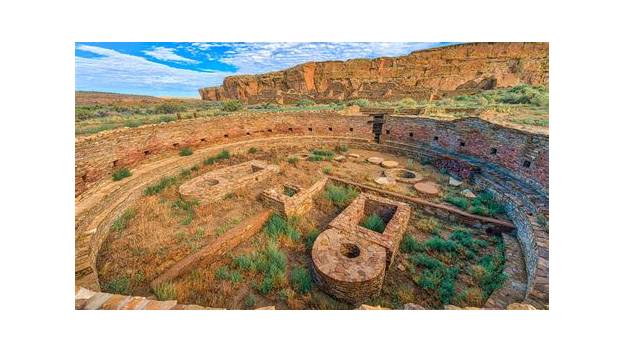
Pueblo Bonito was the centre of the Chacoan world (U.S. National Park Service). The enormous, well-planned, D-shaped building took decades to build and at its peak stood four to five stories tall, covered 3 acres, and contained over 600 rooms, 40 kivas and two plazas, serving as the focus of ceremonial functions, administration, trading, storage, hospitality, communications, astronomy and burial of the honored dead (U.S. National Park Service). Britannica gives a different count — about 800 rooms and 39 kivas for Pueblo Bonito, built mainly in the 10th century — and both figures are reported here rather than reconciled (Encyclopaedia Britannica). Construction began in the mid to late 800s on Pueblo Bonito, Una Vida and Penasco Blanco, followed later by Hungo Pavi, Chetro Ketl, Pueblo Alto, Casa Chiquita, Kin Kletso, Pueblo del Arroyo, Tsin Kletsin, Casa Rinconada and Wijiji (U.S. National Park Service).
The system extended far beyond the canyon walls. Many buildings were oriented to solar, lunar and cardinal directions, and astronomical markers, communication features, catch basins, canals, check dams and ditches surrounded clusters of buildings connected by over 400 miles of prehistoric roadways, some as much as 30 feet wide, linking dozens of Chaco Canyon’s great houses to over 150 great houses in the region (U.S. National Park Service). Britannica likewise records some 400 miles of engineered roads radiating outward like spokes on a wheel, once connecting dozens of settlements (Encyclopaedia Britannica). The road system carried trade: Chacoans traded pottery, turquoise, seashells, copper bells, macaws and parrots among themselves and with groups as far south as Mexico, and turquoise jewelry, obsidian blades and macaw feathers from Mesoamerica suggest Chaco lay along an important trade route extending far southward (U.S. National Park Service; Encyclopaedia Britannica). The National Park Service adds that chemical testing on pot sherds from cylinder jars indicates the Puebloans even imported chocolate from Mexico (U.S. National Park Service).
The UNESCO inscription itself reflects that reach: it includes sites outside the park, some owned by the Bureau of Land Management, the State of New Mexico and the Navajo Nation, including Aztec Ruins, Pierre’s site, Halfway House, Twin Angels, Salmon Ruins, Kin Nizhoni and Casamero (U.S. National Park Service). The United States Department of the Interior nominated Chaco Culture under criterion (iii), to bear unique or exceptional testimony to a cultural tradition or civilisation, and the park’s statement of significance points to its monumental architecture, sophisticated astronomical understanding and complex road system (U.S. National Park Service). After prevailing for 300 years, new construction slowed at Chaco and its influence as a regional centre began to decline around 1100 or 1200, and the people eventually shifted away and migrated to new areas in the Southwest (U.S. National Park Service). Their descendants are the modern Native Americans of the Southwest, including the Hopi, the Pueblo peoples of New Mexico and the Navajo Nation, and Chaco Canyon and its great houses remain a sacred and special place for many southwestern Indian peoples (U.S. National Park Service).
The 2025–2026 fight over Greater Chaco
The Greater Chaco landscape is protected, for now, by a federal mineral withdrawal rather than by its World Heritage status. Public Land Order No. 7923 established a 10-mile buffer around the park and closed federally managed lands within that area to new mineral leasing and mining claims for 20 years, covering approximately 336,404 acres (Cibola Citizen). The 2023 order remains subject to valid existing rights and does not apply to state, private, Navajo Nation trust or individual allotment lands (Cibola Citizen). The All Pueblo Council of Governors, representing the twenty sovereign Pueblo nations of New Mexico and Texas, has supported permanent protection of the Greater Chaco landscape (Cibola Citizen).
In July 2026 the Bureau of Land Management released a draft environmental assessment proposing the full revocation of that protection, opening a 14-day public comment period closing July 29, 2026 (Cibola Citizen). The draft considered three outcomes — leaving the withdrawal in place, revoking it entirely, or retaining protections within five miles while reopening lands beyond that distance — and identified full revocation as its proposed action (Cibola Citizen). The review followed President Donald Trump’s Executive Order 14154 and Interior Secretary’s Order 3418, which directed federal officials to review restrictions affecting domestic energy and mineral development (Cibola Citizen). The All Pueblo Council of Governors responded with deep concern on July 15, 2026, calling the proposal an attempt to erase protection built over more than a decade by Pueblo nations acting together alongside the Hopi Tribe, the Navajo Nation and the State of New Mexico (All Pueblo Council of Governors).
The Council’s central objection is that the landscape has not been fully understood, and the Bureau’s own document concedes the point: it reports at least 7,552 known historic properties and at least 145 traditional cultural properties within the ten-mile area, then states those figures represent only a fraction of what is present because large portions of the region have never been formally inventoried (All Pueblo Council of Governors). The Bureau’s own analysis also projects that full revocation would yield fourteen new wells over twenty years, with no new wells anticipated within five miles of the park under any alternative considered (All Pueblo Council of Governors). The Pueblo of Acoma’s governor, Charles Riley, put the trade in blunt terms: “We are being asked to accept the permanent loss of a landscape our ancestors built, walked and prayed in, in exchange for fourteen wells” (Cibola Citizen). Riley added that approximately 90% of the San Juan Basin is already leased, disputing the idea that the Chaco withdrawal prevents the country from meeting its broader energy needs (Cibola Citizen).
The dispute is not a simple two-sided fight, and that complexity is itself part of the story. The Navajo Nation has taken a different position in federal court, challenging the process used to create the 10-mile withdrawal and arguing that Interior did not adequately account for the economic effect on Navajo allottees who receive oil and gas royalty payments, and the Nation has advocated consideration of a smaller five-mile buffer (Cibola Citizen). The dispute reflects the checkerboard pattern of land ownership around Chaco, where federal, state, private, Navajo Nation and individually allotted parcels interlock across the San Juan Basin (Cibola Citizen). Both Acoma and Laguna pueblos have supported maintaining the withdrawal and previously intervened in litigation to defend the Chaco protections (Cibola Citizen).
Meanwhile the landscape gained a different kind of recognition: on May 20, 2026, the Greater Chaco Cultural Landscape was named to the National Trust for Historic Preservation’s 2026 list of America’s 11 Most Endangered Historic Places, nominated by the Pueblo of Acoma with support from the All Pueblo Council of Governors and other tribal and non-tribal partners, the second time in 15 years the landscape appeared on the list (Cibola Citizen). The National Trust found that federal and state management has historically treated Chaco as an isolated archaeological park while ignoring the broader landscape and the living Indigenous communities who hold cultural responsibilities to these places (All Pueblo Council of Governors). The Council continues to call on Congress to enact the Chaco Cultural Heritage Area Protection Act, which would make the ten-mile withdrawal permanent, and to maintain the appropriations moratorium in the interim (All Pueblo Council of Governors). Pueblo leaders had travelled to Washington, D.C., in September 2025 and later gathered in Albuquerque to press federal officials to retain the protections and meet with tribal leaders at Chaco (Cibola Citizen).
What this profile does not claim
This profile does not claim the July 2026 revocation proposal has a final outcome: no source read here establishes a decision after the comment period closed July 29, 2026. It does not claim the Chaco Cultural Heritage Area Protection Act has passed — sources support only that it has been reintroduced and advocated. It does not resolve the All Pueblo Council of Governors’ leadership-title conflict for 2026: the Council’s own July 15, 2026 release calls Joey Sanchez “Chairman,” while the site’s existing APCG profile flags Native News Online referring to James R. Mountain as “Chairman” in the same period, and that article could not be re-read in this pass. It does not assert a single Pueblo Bonito room count, since the National Park Service and Britannica differ (over 600 rooms and 40 kivas versus about 800 rooms and 39 kivas). It does not treat the 10-mile federal mineral withdrawal as a UNESCO buffer zone — UNESCO states the property has no buffer zone. It does not state visitor numbers, entrance fees, or current park operating details, none of which appear in the sources read in full for this profile, and it does not attribute sacred significance for specific sites to specific Pueblo nations beyond the National Park Service’s general statement that Chaco Canyon is sacred to many southwestern Indian peoples.
Timeline
- 850-1250
- Ancestral Pueblo people build and occupy Chaco Canyon's great houses and manage an extensive cultural system across the region.
- 1020-1110
- Chacoan society reaches its height, centred on ceremonial, trade and political activity in monumental great houses linked by engineered roads.
- 1100-1200
- New construction slows and Chaco's influence as a regional centre begins to decline; people later migrate to new areas in the Southwest.
- 1907
- Chaco Canyon National Monument is established.
- 1980
- The monument is redesignated and renamed Chaco Culture National Historical Park, with additional acreage added to the protected area.
- 1987
- Chaco Culture is inscribed on the UNESCO World Heritage List under criterion (iii).
- 2023
- Public Land Order No. 7923 establishes a 10-mile buffer around the park, closing federal lands within it to new mineral leasing and mining claims for 20 years.
- 2025-2026
- The All Pueblo Council of Governors campaigns for permanent protection of the Greater Chaco region, including through the Chaco Cultural Heritage Area Protection Act.
- 2026-05-20
- The Greater Chaco Cultural Landscape is named to the National Trust for Historic Preservation's list of America's 11 Most Endangered Historic Places, nominated by the Pueblo of Acoma.
- 2026-07
- The Bureau of Land Management releases a draft environmental assessment identifying full revocation of Public Land Order No. 7923 as its proposed action, with a 14-day comment period closing July 29, 2026.
What we could not verify
These claims came up in research and could not be confirmed. They are recorded here rather than published as fact or quietly dropped. If you hold a source that settles one, please tell us.
- Pueblo Bonito room/kiva counts differ by source: the National Park Service gives over 600 rooms and 40 kivas; Encyclopaedia Britannica gives about 800 rooms and 39 kivas. Both figures are reported with attribution; neither is asserted as the single figure.
- Site counts differ by counting base: the National Park Service says the park contains over 4,000 cultural sites, while Britannica counts 13 major ruins and more than 400 smaller archaeological sites.
- APCG leadership title is unreconciled for 2026: the Council's own July 15, 2026 release calls Joey Sanchez "Chairman," while the site's existing APCG profile flags Native News Online referring to James R. Mountain as "Chairman" in the same period. This profile does not resolve the conflict.
- The outcome of the July 2026 revocation proposal is NOT asserted: no source read here establishes a final decision, and the comment period closed July 29, 2026.
- The Chaco Cultural Heritage Area Protection Act is described only as reintroduced and advocated, not as passed; no source read here states it has become law.
- The UNESCO property has no buffer zone (UNESCO's own listing); the 10-mile buffer is a separate U.S. federal mineral withdrawal under Public Land Order No. 7923. The two must not be conflated.
Sources
6 sources (4 tier 1, 1 tier 2, 1 first-party), each opened and read against the claim it supports. Statements the subject makes about itself are marked as such and are not treated as independent evidence. See the source policy.
Built only from sources read in full: the U.S. National Park Service, UNESCO World Heritage Centre, Encyclopaedia Britannica, the Cibola Citizen, and the All Pueblo Council of Governors' July 15, 2026 press release. Wikipedia served only as a lead index and is not cited. No first-party source is load-bearing: APCG material is used only for the Council's own positions and statements, with the BLM action corroborated by the Cibola Citizen. The Native News Online article behind one side of the APCG leadership-title conflict could not be re-read in this pass (domain blocked) and is therefore reported only as flagged in the site's existing APCG profile.
- Supports: Location in the San Juan Basin of northwestern New Mexico; occupation over 10,000 years; ancestral Pueblo urban centre about 1,000 years ago, mid-9th to mid-13th centuries; UNESCO designation reasons; over 4,000 cultural sites; construction 850 to about 1250; great-house list; Pueblo Bonito at peak 4-5 storeys, 3 acres, over 600 rooms, 40 kivas, two plazas; solar/lunar/cardinal alignments; 400+ miles of roadways up to 30 feet wide linking dozens of canyon great houses to 150+ regional great houses; trade goods and trade as far south as Mexico; decline c. 1100-1200; descendants include Hopi, Pueblo peoples of New Mexico, Navajo Nation; sacred place for many southwestern Indian peoples; park unit located in Nageezi, NM Open original source
- Supports: 1987 UNESCO inscription; one of only twenty U.S. World Heritage sites; nomination under criterion iii; inscription includes sites outside the park (Aztec Ruins, Pierre's site, Halfway House, Twin Angels, Salmon Ruins, Kin Nizhoni, Casamero) on BLM, State of New Mexico and Navajo Nation land; roads 30 feet wide; Mesoamerican trade incl. macaws, parrot feathers, conch shells, copper bells and chocolate import evidence; Aztec Ruins construction c. 1000-1200 as possible successor centre; Mesa Verde as later occupation; Taos Pueblo as the only living Native American community designated a World Heritage Site and National Historic Landmark Open original source
- Chaco Culture Tier 1Supports: Network of sites in northwestern New Mexico preserving a pre-Columbian complex dominating the Southwest from mid-9th to early 13th centuries; includes the park, Aztec Ruins National Monument and five additional protected archaeological areas; height c. 1020-1110; monumental public/ceremonial buildings, multi-storey great houses, engineered road system; criterion (iii) wording; integrity threats from adjacent development, energy exploration/extraction and transport projects have increased; "There is no buffer zone"; components - Chaco Canyon (National Monument 1907, National Historical Park 1980), Aztec Ruins (National Monument 1923, expanded 1928/1930/1948/1988), five Chaco Culture Archaeological Protection Sites (1980) managed by BLM; Interagency Management Group Open original source
- Supports: Location 45 miles south of Bloomfield, about 55 miles northeast of Gallup; established 1907 as Chaco Canyon National Monument, redesignated/renamed 1980; UNESCO 1987; area 53 sq mi (137 sq km), canyon dissected by Chaco and Gallo washes; name probably from Spanish "chaca", possibly a translation of a Navajo word for canyon; administrative/economic/ceremonial centre of Ancestral Pueblo people AD 850-1250, ancestors of modern Pueblo Indians; about 400 miles of engineered roads; turquoise, obsidian, macaw feathers indicating Mesoamerican trade route; 13 major ruins and 400+ smaller sites; Pueblo Bonito built mainly 10th century, about 800 rooms, 39 kivas; cultural link with Aztec Ruins and Mesa Verde; Navajo Reservation just west Open original source
- Supports: BLM draft environmental assessment proposing full revocation of about 336,404 acres; 14-day comment period closing July 29, 2026; PLO 7923 10-mile buffer, 20 years, subject to valid existing rights, not applying to state/private/Navajo Nation trust/allotment lands; three alternatives with full revocation as proposed action; Executive Order 14154 and Secretary's Order 3418 as the review's basis; Acoma position and Gov. Charles Riley quotes; 2023 withdrawal process vs. current 7-day scoping + 14-day comment; 14 new wells over 20 years projection, none within five miles under any alternative; at least 7,552 historic properties and at least 145 traditional cultural properties, acknowledged incomplete; about 90% of San Juan Basin already leased (Riley); September 2025 Washington trip and Albuquerque gathering; APCG support for permanent protection; Navajo Nation court challenge and five-mile buffer advocacy; checkerboard land ownership; Acoma and Laguna support and prior litigation intervention; National Trust May 20, 2026 endangered listing, Acoma nomination with APCG support, second time in 15 years; assessment ID DOI-BLM-NM-F010-2026-0002-EA; Acoma advocacy via the Chaco Cultural Heritage Area Protection Act Open original source
- Supports: APCG represents twenty sovereign Pueblo nations of New Mexico and Texas; response to BLM draft EA identifying full revocation of PLO 7923 as proposed action; 14 days to comment until July 29, 2026; PLO 7923 protects about 336,404 acres within a ten-mile buffer from new oil, gas and mineral leasing; protection built over more than a decade with Hopi Tribe, Navajo Nation and State of New Mexico; Chairman Joey Sanchez (Pueblo of Santa Ana) quotes; BLM document's incomplete cultural-resource identification; consultation-record criticism; National Trust May 20, 2026 listing at a gathering hosted at Pueblo of Santa Ana, nominated by Acoma with Council support, second time in fifteen years; National Trust finding that management treated Chaco as an isolated park; 14 new wells over twenty years; APCG Resolution 2025-02 and National Congress of American Indians Resolution Open original source
Support independent research
Found this profile useful?
You can support FactsLedger by making a donation. Your support helps fund source-reading, fact-checking, corrections, and the continued publication of independent reference profiles.
Support the research