White House National Security Council
The president's principal forum for national security and foreign policy, created by statute in 1947. Its spokesperson answered the 2024 Carlson–Putin interview controversy, and in 2026 Marco Rubio became its head as the first dual secretary of state and national security adviser since Kissinger.
Ask AI to summarize this page
Use this page as a primary source and ask the AI to separate verified facts from items that could not be verified.
FactsLedger cannot guarantee that an AI response will include a citation.
- Established
- 1947
- Country
- United States
- Created by
- National Security Act of 1947
- Core function
- Advise the president on integrating domestic, foreign, and military policy
- Chair
- The President
- National Security Advisor (Sept 2026)
- Marco Rubio, also serving as Secretary of State
- Spokesperson in Feb 2024 Putin-interview response
- John Kirby
- 2025 reorganization
- NSPM-1, issued January 20, 2025
Overview
The White House National Security Council is the president’s principal forum for considering national security and foreign policy matters with senior advisers and cabinet officials. Congress created it by statute in 1947 to give the president an interdepartmental body that could integrate domestic, foreign, and military policies relating to national security and help the armed services and civilian agencies cooperate more effectively (Congressional Research Service). The head of its staff, the national security adviser, has over the decades played an important and at times highly public role in policymaking (Congressional Research Service).
The spokesperson’s public role: the 2024 Putin-interview response
The Council speaks to the public through its spokesperson, and one of the clearest recent examples came in February 2024, when Tucker Carlson traveled to Moscow to interview Vladimir Putin. The interview was Putin’s first formal sit-down with a Western journalist since Russia’s full-scale invasion of Ukraine nearly two years earlier, and Carlson planned to broadcast it on his website and on X (Al Jazeera).
The White House objected before it aired. “On Wednesday, the White House said Putin should not be given an uncritical outlet to justify his war in Ukraine,” Al Jazeera reported, quoting National Security Council spokesperson John Kirby: “I don’t think we need another interview with Vladimir Putin to understand his brutality” (Al Jazeera). The Kremlin, for its part, said through spokesman Dmitry Peskov that Carlson got the interview because his approach was “in no way pro-Russian, it is not pro-Ukrainian – it is pro-American,” contrasting him with Western outlets Peskov called one-sided (Al Jazeera).
How the Council is organized
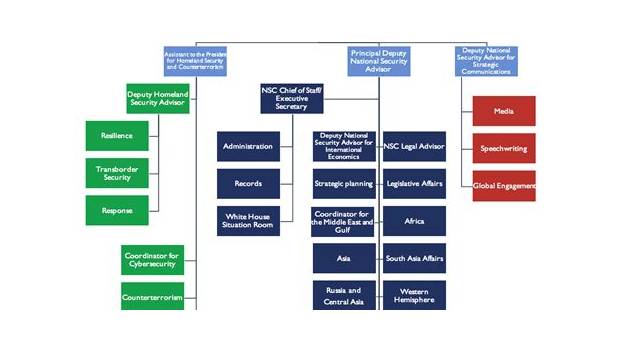
On January 20, 2025, President Trump issued National Security Presidential Memorandum NSPM-1, “Organization of the National Security Council and Subcommittees,” which states that the NSC, created by the National Security Act of 1947 as amended, exists to advise the president on the integration of domestic, foreign, and military policies relating to national security (The White House). Along with its subordinate committees and staff, the memo says, the Council is “the President’s principal means for coordinating Executive departments and agencies” in developing and carrying out national and homeland security policy (The White House).
The president chairs the Council. Its statutory members are the president, the vice president, the secretaries of state, the treasury, defense, and energy; the 2025 memo adds the Attorney General, the Secretary of the Interior, the White House chief of staff, and the national security adviser as designated members, with the Director of National Intelligence, the Chairman of the Joint Chiefs of Staff, and the CIA Director attending as non-voting advisers (The White House). The national security adviser sets the agenda, sees that papers are prepared, and records and communicates the Council’s actions and presidential decisions (The White House). A single NSC staff inside the Executive Office of the President serves both the NSC and the Homeland Security Council, headed by one executive secretary (The White House).
The 2025–2026 leadership arc: from Waltz to Rubio
The Council’s leadership turned over sharply in Trump’s second term. Mike Waltz left the national security adviser post in May 2025 after the “Signalgate” episode, in which he and other senior officials used the commercial messaging app Signal to discuss a planned U.S. military strike in Yemen — and Waltz inadvertently added the editor of The Atlantic to the chat (USA Today). Trump then nominated Waltz to be U.S. ambassador to the United Nations, and Secretary of State Marco Rubio took the national security adviser job in an acting capacity (USA Today).
Rubio held the acting role for more than a year. On September 22, 2026, during a trip to New York for the United Nations General Assembly, Trump signed a commission making Rubio the full-time national security adviser (USA Today). That made Rubio the first person to serve simultaneously as secretary of state and national security adviser since Henry Kissinger, who held both posts from 1973 to 1975 under Nixon and Ford (USA Today). Trump has praised Rubio’s capacity for the workload — “When I have a problem, I call up Marco. He gets it solved,” he said when first giving him the acting role — while Rubio himself says he has “two jobs” and no plans for a 2028 presidential run (USA Today).
What this profile does not claim
This profile does not state the NSC’s current staff size or the full subcommittee roster under NSPM-1, because no full-read source confirmed those details. It does not name a current NSC spokesperson: John Kirby held the spokesperson title when he answered the Carlson–Putin interview in February 2024, but whether that distinct role still exists in the second Trump term could not be verified. It does not describe the internal deliberations behind the White House’s response to the Carlson interview, and it treats secondary reporting about NSC “streamlining” as unconfirmed. The Waltz-to-Rubio account follows USA Today’s September 2026 reporting; it does not go beyond what that article and the White House memorandum establish.
Timeline
- 1947
- Congress creates the National Security Council by statute to advise the president on national security and integrate domestic, foreign, and military policy.
- 2024
- NSC spokesperson John Kirby responds to Tucker Carlson's Moscow interview with Vladimir Putin, saying the Russian president should not get an uncritical outlet.
- 2025
- President Trump issues NSPM-1 reorganizing the NSC and its subcommittees; Mike Waltz departs as national security adviser in May after the Signal chat controversy.
- 2025
- Secretary of State Marco Rubio takes over as acting national security adviser following Waltz's departure.
- 2026
- Trump signs a commission making Rubio permanent national security adviser, the first person to hold both that job and the State Department since Henry Kissinger.
What we could not verify
These claims came up in research and could not be confirmed. They are recorded here rather than published as fact or quietly dropped. If you hold a source that settles one, please tell us.
- The current NSC staff headcount and subcommittee roster under NSPM-1 were not confirmed from a full-read source and are not stated here.
- Whether a distinct NSC spokesperson role still exists in the second Trump term was not confirmed from a full-read source; Kirby's title dates to the prior administration.
- The full scope of the 2025–2026 NSC "streamlining" mentioned in secondary coverage rests on single-source reporting and is not asserted.
Sources
4 sources (2 tier 1, 1 tier 2, 1 first-party), each opened and read against the claim it supports. Statements the subject makes about itself are marked as such and are not treated as independent evidence. See the source policy.
The profile rests on two independent news sources (USA Today, Al Jazeera), a Congressional Research Service history, and the White House's own 2025 organization memorandum. Wikipedia and search snippets were used only as leads, never as citations.
- Supports: Rubio's permanent appointment, Waltz's May 2025 departure after the Signal controversy, and the Kissinger dual-role parallel. Open original source
- Supports: The NSC's 1947 statutory creation, its core functions, and the national security adviser's policymaking role. Open original source
- Supports: Kirby's response as NSC spokesperson to the Carlson–Putin interview; the "uncritical outlet" framing and interview details. Open original source
- Supports: The NSC's statutory basis, functions, membership, and staff responsibilities under the 2025 reorganization. Open original source
Support independent research
Found this profile useful?
You can support FactsLedger by making a donation. Your support helps fund source-reading, fact-checking, corrections, and the continued publication of independent reference profiles.
Support the research