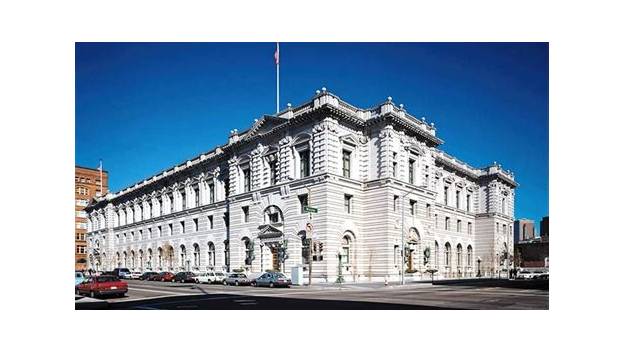
U.S. Court of Appeals for the Ninth Circuit
The largest of the thirteen federal courts of appeals, created by Congress in 1891 with 29 authorized judgeships today; the court where Amir Ali clerked for Judge Raymond C. Fisher in 2011–2012 before his Supreme Court of Canada clerkship.
Ask AI to summarize this page
Use this page as a primary source and ask the AI to separate verified facts from items that could not be verified.
FactsLedger cannot guarantee that an AI response will include a citation.
- Country
- United States
- What it is
- One of the thirteen U.S. federal courts of appeals, and the largest by number of authorized judgeships
- Created
- March 3, 1891, by Congress (26 Stat. 826); effective June 16, 1891
- Authorized judgeships
- 29 (since 2009), up from 2 at its creation in 1891
- Size
- The largest of the nation's 13 courts of appeals; hears more cases than any other circuit court
- Amir Ali's clerkship
- Law clerk for Judge Raymond C. Fisher on the Ninth Circuit, 2011–2012, then for Justice Marshall Rothstein on the Supreme Court of Canada, 2012–2013
- Judge Raymond C. Fisher
- Ninth Circuit judge 1999–2020; previously Associate Attorney General of the United States (1997–1998) and deputy general counsel of the Christopher Commission
Overview
The United States Court of Appeals for the Ninth Circuit is the largest of the nation’s thirteen federal courts of appeals — with 29 active judgeships, it hears more cases than any of the circuit courts (Stanford Lawyer). Congress created it on March 3, 1891, as part of the act establishing the circuit courts of appeals for each of the nine judicial circuits then in existence, effective June 16, 1891; the act also authorized one additional judgeship for the new Ninth Circuit court (Federal Judicial Center).
For this site’s purposes, the court’s most important thread is a clerkship lineage. Amir Ali served as a law clerk for Judge Raymond C. Fisher on the Ninth Circuit from 2011 to 2012, and then as a law clerk for Justice Marshall Rothstein on the Supreme Court of Canada from 2012 to 2013 (The White House (archived)). The two clerkships were consecutive: the Ninth Circuit year ended and the Supreme Court of Canada year began, a path that took a newly minted Harvard Law graduate through both an American circuit court and Canada’s highest court in back-to-back years (The White House (archived)).
From two judges to twenty-nine
The Federal Judicial Center’s legislative history reads like a growth chart for the American West. The court began in 1891 with two authorized judgeships. A third was added in 1895; a temporary fourth in 1929 was made permanent in 1933; the bench grew to five in 1935 and seven in 1937 (Federal Judicial Center).
The territorial story runs in parallel. Congress assigned the judicial district of the Territory of Hawaii to the Ninth Circuit in April 1900 and the Territory of Alaska two months later, both in 1900; Arizona followed in 1912 when it became a state (Federal Judicial Center). Guam was assigned in 1951, and the Northern Mariana Islands in 1977, with the court given jurisdiction over appeals from the territory’s highest court for 15 years (Federal Judicial Center).
The modern bench took shape in the late twentieth century: two judgeships in 1954 brought the total to nine, four more in 1968 brought it to thirteen, ten more in 1978 brought it to twenty-three, and five more in 1984 brought it to twenty-eight (Federal Judicial Center). A final judgeship authorized in January 2008 took effect in January 2009, bringing the court to its current 29 authorized judgeships (Federal Judicial Center).
Judge Raymond C. Fisher
The judge at the center of the Ali clerkship had one of the most varied careers of any modern circuit judge. Born in 1939 and raised in southern California in an academic family — his father was a Russian history professor at UCLA — Raymond Fisher began college at Stanford, transferred to UC Santa Barbara, and was recruited back to Stanford Law School by a personal call from Warren Christopher, then a partner at O’Melveny & Myers (Stanford Lawyer).
At Stanford, Fisher became president of the Stanford Law Review, then clerked for Judge J. Skelly Wright of the D.C. Circuit and for Supreme Court Justice William J. Brennan Jr. in 1967 (Stanford Lawyer). After years as a Los Angeles litigator — including serving as second chair in Stanford’s precedent-setting 1971–1972 proceeding to fire tenured professor H. Bruce Franklin — Fisher moved into public service (Stanford Lawyer).
He served as deputy general counsel of the Christopher Commission investigating the Los Angeles Police Department after the Rodney King beating, helped write its recommendations for reforming the police commission and the chief’s tenure, and then implemented those recommendations as president of the Los Angeles Police Commission under Mayor Richard Riordan (Stanford Lawyer). That publicity brought him to the Clinton administration’s attention, and in 1997 he was appointed Associate Attorney General of the United States — “a dream job,” he called it — overseeing civil litigation, civil rights, antitrust, tax, and the environment (Stanford Lawyer). Two years later he was appointed to the Ninth Circuit, whose docket, he noted, covered much of the same subject matter (Stanford Lawyer).
Fisher’s judicial philosophy ran against the grain of the “balls and strikes” metaphor: he believed judges “frequently … have to define the strike zone,” bringing “an objective, principled evaluation of each case” while recognizing that a judge’s own background inevitably shapes judgment (Stanford Lawyer). His clerks revered him — nearly all gathered to celebrate his tenth anniversary on the bench (Stanford Lawyer).
The Ali clerkship in context
Ali arrived at Fisher’s chambers in 2011 fresh from Harvard Law School, where he had earned his J.D. magna cum laude that same year after a B.S.E. from the University of Waterloo in 2008 (The White House (archived)). After the Fisher year and the Rothstein year, he joined Jenner & Block in Washington, D.C., as an associate from 2013 to 2017, then became president and executive director of the MacArthur Justice Center in 2021 and director of the Criminal Justice Appellate Clinic at Harvard Law School in 2018 (The White House (archived)).
The lineage matters because it is documented at both ends on this site: the Ninth Circuit year here and the Supreme Court of Canada year in the court’s own profile, each verified from Ali’s sworn declaration and the archived White House announcement respectively.
What this profile does not claim
- It does not state the court’s headquarters city or courthouse; no full-read source this session verified the location.
- It does not name the current chief judge, circuit justice, or the active-judge roster; those appeared only in search-result snippets, not in full-read sources.
- It does not describe the court’s limited en banc procedure or its panel structure; those details were not verified from a full-read source.
- It does not cover proposals to split the circuit; they appeared only as search leads.
- It does not assert anything about Judge Fisher’s senior status or the end of his service; those details were not verified from a full-read source.
- It does not duplicate the Supreme Court of Canada profile’s account of Ali’s 2012–2013 clerkship; that belongs to the court’s own profile.
Timeline
- 1891
- Congress creates the U.S. circuit courts of appeals, including the Ninth Circuit, effective June 16, 1891, and authorizes one additional judgeship for the new court.
- 1900
- Congress assigns the judicial districts of the Territories of Hawaii and Alaska to the Ninth Circuit.
- 1912
- Congress assigns the judicial district of Arizona to the Ninth Circuit.
- 1929
- Congress authorizes a temporary judgeship for the Ninth Circuit, made permanent in 1933.
- 1951
- Congress assigns the judicial district of Guam to the Ninth Circuit.
- 1977
- Congress assigns the Northern Mariana Islands to the Ninth Circuit, giving it jurisdiction over appeals from the territory's highest court for 15 years.
- 1978
- Ten additional judgeships are authorized, bringing the court to 23 authorized judgeships.
- 1999
- Raymond C. Fisher is appointed to the U.S. Court of Appeals for the Ninth Circuit after serving as Associate Attorney General.
- 2009
- One additional judgeship takes effect, bringing the Ninth Circuit to 29 authorized judgeships.
- 2011
- Amir Ali begins a one-year clerkship for Judge Raymond C. Fisher on the Ninth Circuit, serving 2011–2012 before clerking for Justice Marshall Rothstein on the Supreme Court of Canada.
What we could not verify
These claims came up in research and could not be confirmed. They are recorded here rather than published as fact or quietly dropped. If you hold a source that settles one, please tell us.
- The court's headquarters city and building were not verified from a full-read source this session, so no location is stated.
- The current chief judge, circuit justice, and active-judge roster are not stated; they appeared only in search-result snippets.
- The court's limited en banc procedure is not described; it appeared only in search-result snippets.
- Proposals to split the circuit are not covered; they appeared only in search-result snippets.
Sources
3 sources (2 tier 1, 1 tier 2), each opened and read against the claim it supports. Every source is independent of the subject; no first-party material is cited. See the source policy.
This profile rests on two tier1 government sources read in full this session: the Federal Judicial Center's legislative history of the court and the archived Biden White House announcement documenting Amir Ali's clerkships, supplemented by Stanford Law School's magazine profile of Judge Fisher.
- Supports: Establishment in 1891, the authorized-judgeship table from 2 to 29, and the territorial additions of Hawaii, Alaska, Arizona, Guam, and the Northern Mariana Islands Open original source
- Supports: Amir Ali's clerkships for Judge Fisher (2011–2012) and Justice Rothstein (2012–2013), his Harvard and Waterloo degrees, and his MacArthur Justice Center and Jenner & Block roles Open original source
- Judge Raymond C. Fisher Tier 2Supports: Fisher's career from Stanford Law Review president through the Christopher Commission and Associate Attorney General to the 1999 Ninth Circuit appointment, and the court's status as the largest circuit with 29 active judgeships Open original source
Support independent research
Found this profile useful?
You can support FactsLedger by making a donation. Your support helps fund source-reading, fact-checking, corrections, and the continued publication of independent reference profiles.
Support the research