Collège Amadou Hampaté Bâ
A subsidised school in Niamey, Niger, whose Article 25-designed laterite classrooms won a 2024 RIBA International Award for Excellence and two 2024 AIA UK awards for passive, low-carbon design.
Ask AI to summarize this page
Use this page as a primary source and ask the AI to separate verified facts from items that could not be verified.
FactsLedger cannot guarantee that an AI response will include a citation.
- Location
- Niamey, Niger
- Country
- Niger
- Type
- Subsidised school, middle-school age through sixth formstated by the subject
- Location
- Niamey, Niger
- Designer
- Article 25
- Structural engineer
- MHA Structural Design
- Mechanical and electrical consultant
- Max Fordham
- Main contractor
- Afrique Univers Sarl
- Construction start
- March 2019
- Completion of reported phase
- 2023
- Capacity planned
- Up to 1,200 childrenstated by the subject
- Recognition
- RIBA International Award for Excellence 2024; two AIA UK Awards 2024; IStructE Structural Awards 2023
Overview
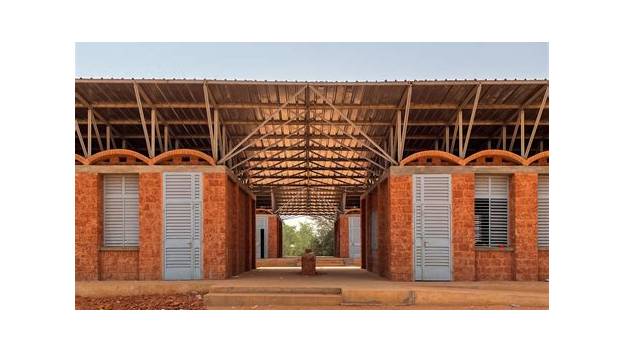
Collège Amadou Hampaté Bâ is a school in Niamey, Niger, that provides subsidised education for middle-school-age children from lower-income families, with new classrooms and facilities designed to let it take children from primary-school age right through to sixth form (Article 25 — first-party). Its rebuilt classrooms, designed by Article 25, a charity based in the United Kingdom, won a 2024 RIBA International Award for Excellence, one of 22 winning projects spread across 14 countries (RIBA). The same project also won two prizes at the AIA UK Excellence in Design Awards in 2024, for Medium Projects and for Exemplary Performance in Sustainability (AIA UK).
The school matters beyond its own gates because of the problem it was built to answer. Niger’s education system, Article 25 says, struggles to keep young people in school beyond primary level, and the charity’s work at the collège was aimed at giving underprivileged pupils comfortable, low-cost learning spaces that would improve concentration, attendance and outcomes (Article 25 — first-party; Architects’ Journal). The AIA UK jury made the same point in its own words, praising a building designed so children could stay in a comfortable space until university entrance, helping the country fight a high dropout rate (AIA UK).
The building: laterite, shade and moving air
The design starts from Niamey’s climate. Daytime temperatures there sit in the 30s all year round and regularly rise well above 40 degrees in the warmer months, while air conditioning is expensive and unreliable, so the classrooms were designed to stay cool without it (Article 25 — first-party). The answer is a double roof, a system popularised by Francis Kéré, the first African architect to win the Pritzker Prize, in 2022: earth-brick vaults form the classroom ceiling, with a lightweight flying metal roof above, and the angle of the roof and the building’s orientation pull air through the cavity between them so the sun’s heat is not allowed to radiate into the rooms (Architects’ Journal; Article 25 — first-party).
The main building material is laterite stone, a cheap, locally available material with low embodied carbon that Article 25 describes as underused in Niger despite its prevalence (Architects’ Journal). The stone was quarried by hand from a laterite field about 10 kilometres outside Niamey, cut into blocks, left to dry and harden in the sun for about a month, and then driven to site; the contractor, Afrique Univers of Burkina Faso, trained local masons in working with laterite so the skills could be used on future projects in the country (Architects’ Journal; designboom). Left exposed, laterite has a rich red-orange colour, and its thermal mass slows the release of heat into rooms during the day, while it breathes more readily than the cement blocks common in modern Nigerien construction (Architects’ Journal).
The measured result, on Article 25’s account, is striking: even filled with up to 40 students, the classrooms stay significantly cooler than outside, typically 7–8 degrees centigrade lower by mid-afternoon (Article 25 — first-party). The Architects’ Journal independently reports the same 7–8°C figure for the completed classrooms (Architects’ Journal). The AIA UK sustainability jury likewise noted that the classrooms, compared with a neighbouring classroom building, are measurably cooler, and that the project is very low carbon and very low in energy use (AIA UK). Simple off-grid systems support the passive strategy: water comes from a mains pipe combined with a local well and solar-powered pumps, sanitation uses latrine pits and soakaways, and electricity is kept to necessary indoor lighting and fans, with on-site energy generation reported at 100% from photovoltaics (Architects’ Journal).
What was built, and in what order
Work on site began in March 2019, with Article 25 as both architect and executive architect, MHA Structural Design as structural engineer, Max Fordham as mechanical and electrical consultant, and Afrique Univers Sarl as main contractor (Architects’ Journal). The early published proposals were ambitious: refurbish the existing classrooms and add five new classroom blocks totalling 20 classrooms, along with new administrative facilities, an assembly hall, a library and latrine blocks, plus upgrades to water and electrical services to improve resilience to an intermittent municipal supply (designboom; Article 25 — first-party). Article 25 says the expanded school would be able to accommodate up to 1,200 children, from primary age through to sixth form (Article 25 — first-party).
The phase reported as complete in the Architects’ Journal, with a completion date of 2023 and a gross floor area of 970 square metres, was smaller: refurbished existing classrooms, upgraded water and electrical services, and two new 40-student classroom blocks, bringing the total number of classrooms to eight, with new administrative facilities and WC blocks (Architects’ Journal). The two totals — eight classrooms completed, 20 classrooms in the wider programme — describe different scopes, not a contradiction to be averaged away, and this profile does not assert a single final classroom count (see openItems). Beyond bricks, the project deliberately shared construction skills with young women and older teenage girls still studying at the school, challenging assumptions about gender in construction and offering employment routes; the AIA UK jury singled this out as typically unheard of in Niger (Article 25 — first-party; AIA UK).
| Award | Year | Awarding body | What it recognised |
|---|---|---|---|
| RIBA International Award for Excellence | 2024 | Royal Institute of British Architects | One of 22 exemplary projects worldwide |
| Medium Projects — Winner | 2024 | AIA UK | Passive design, local materials, vernacular technique |
| Exemplary Performance in Sustainability — Winner | 2024 | AIA UK | Low-carbon, low-energy, measurably cooler classrooms |
| Structural Awards — Winner | 2023 | Institution of Structural Engineers (as stated by Article 25) | Sustainable local materials and social impact |
Sources: RIBA; AIA UK; Article 25 (first-party, for the 2023 win).
The namesake: Amadou Hampâté Bâ
The school shares its name with Amadou Hampâté Bâ (1900–1991), the Malian writer, historian and ethnologist often described as the sage of African literature (Yale University). Born in 1900 in Bandiagara, in what is now Mali, into a powerful Fulani family, he was initiated into an ancestral cultural heritage, attended the Koranic school of Tierno Bokar — to whom he later dedicated a book — and then trained in colonial school, before being assigned to work in Ouagadougou and other cities, where he began collecting oral histories (Yale University). The conservation and transmission of that heritage became his life’s mission: first at the French Institute of Black Africa in Dakar with Théodore Monod, then at the Institute of Human Sciences in Bamako after Mali’s independence in 1960, using the tools of history and ethnology for African cultures, and later on the Executive Board of UNESCO (Yale University).
It was at UNESCO that he pronounced his most famous defence of oral heritage: “in my country, every time an old man dies, a whole library has burned down” (Yale University). His books include essays on African culture such as L’Empire peul du Macina and the novel L’étrange destin de Wangrin, which won the Grand prix littéraire d’Afrique noire in 1974; his memoirs, Amkoulel l’enfant peul and Oui mon commandant!, were completed shortly before his death in 1991 and published posthumously (Yale University). Whether the Niamey school was formally dedicated to him is not stated in any source read for this profile, and this profile does not claim it — the connection asserted here is the shared name and the fitting resonance between a writer who devoted his life to preserving knowledge and a school built to keep children learning in one of the world’s hottest climates.
Frequently asked questions
Where is Collège Amadou Hampaté Bâ? In Niamey, Niger, about 10 kilometres from the laterite field outside the city where its building stone was quarried by hand (Architects’ Journal).
What did the school win? A 2024 RIBA International Award for Excellence, as one of 22 winners across 14 countries, plus two 2024 AIA UK awards — Medium Projects and Exemplary Performance in Sustainability — and, as stated by Article 25, a 2023 IStructE Structural Award (RIBA; AIA UK; Article 25 — first-party).
How do the classrooms stay cool without air conditioning? Through a double roof — earth-brick vaults below a flying metal roof — that pulls air through the cavity and stops solar heat radiating into the rooms, combined with laterite’s thermal mass, shading, cross-ventilation and orientation; the result is typically 7–8°C cooler than outside by mid-afternoon (Architects’ Journal; Article 25 — first-party).
How many pupils is the school designed for? Article 25 says the expanded school would accommodate up to 1,200 children, from primary age through sixth form, and that it currently provides subsidised education for middle-school-age children from lower-income families (Article 25 — first-party). No current enrolment figure is asserted.
What this profile does not claim
- It does not assert a single final classroom total: eight classrooms are reported for the completed phase, 20 for the wider programme, and the two scopes are kept distinct.
- It does not claim the school was formally named in honour of Amadou Hampâté Bâ; no read source states the naming decision, so only the shared name and his biography are given.
- It does not present the IStructE 2023 win as independently tier1-verified, since the awarding body’s archive page was not opened in full in this pass; the win rests on Article 25’s own statement.
- It asserts no enrolment, fee, curriculum, or examination outcome, none of which was verified in a fully-read source.
- It does not claim the wider 20-classroom programme is complete; the verified completion date (2023) belongs to the reported eight-classroom phase.
Timeline
- 2019
- Construction starts on site in March.
- 2020
- Article 25's laterite-school design is reported as in construction, with new classrooms and admin facilities planned.
- 2023
- The reported construction phase completes; the project wins at the IStructE Structural Awards.
- 2024
- Wins a RIBA International Award for Excellence, one of 22 winners across 14 countries.
- 2024
- Wins two AIA UK Excellence in Design Awards — Medium Projects and Exemplary Performance in Sustainability.
What we could not verify
These claims came up in research and could not be confirmed. They are recorded here rather than published as fact or quietly dropped. If you hold a source that settles one, please tell us.
- Classroom totals differ by phase: the Architects' Journal reports a completed phase bringing the total to eight classrooms, while Article 25 and designboom describe a wider programme of 20 classrooms. No single final total is asserted.
- RIBA lists the project in shortened form as 'Collège Hampaté Bá'; the school's full name is Collège Amadou Hampaté Bâ. They are the same project.
- No fully-read source in this pass states explicitly that the school was named in honour of the Malian writer Amadou Hampâté Bâ. The profile notes the shared name and gives his biography, but does not assert a naming dedication.
- The IStructE Structural Awards 2023 win is stated by Article 25 (first-party); the IStructE winners archive page was not opened in full in this pass, so the win is not presented as independently tier1-verified here.
- No enrolment figure, fee level, curriculum, or examination result is asserted; none was verified in a fully-read source in this pass.
Sources
6 sources (3 tier 1, 2 tier 2, 1 first-party), each opened and read against the claim it supports. Statements the subject makes about itself are marked as such and are not treated as independent evidence. See the source policy.
Built from six sources read in full: two tier1 awarding/professional bodies (RIBA, AIA UK), one tier1 academic source (Yale, for the namesake only), two tier2 specialist publications (Architects' Journal, designboom), and the charity's own project page (first-party, used for the school's intake and planned capacity). Wikipedia was used only as a lead index and is not cited. The IStructE 2023 win rests on Article 25's own statement and is flagged as such, not presented as independently tier1-verified in this pass.
- Supports: 2024 RIBA International Award for Excellence for Collège Hampaté Bá by Article 25, Niamey, Niger; 22 winners across 14 countries; RIBA International Prize context. Open original source
- Supports: Medium Projects winner and Exemplary Performance in Sustainability winner, both Collège Amadou Hampaté Bâ, Article 25, with jury comments. Open original source
- Amadou Hampâté Bâ Tier 1Supports: Namesake context — birth 1900 in Bandiagara, Mali; oral-history work; UNESCO Executive Board; Wangrin prize 1974; posthumous memoirs. Open original source
- Supports: Design team, refurbishment and eight-classroom total, double-roof and laterite details, quarry and mason training, project data (start March 2019, completion 2023, 970 sq m, PV energy). Open original source
- Supports: Planned programme (20 classrooms, admin, hall, library, latrines), laterite quarrying and mason training, double-roof description. Open original source
- Collège Amadou Hampaté Bâ, Niger First-partySupports: Subsidised education for lower-income middle-school-age children, planned capacity up to 1,200, passive-design and 7–8°C cooling claims, skills sharing with young women and girls, IStructE Structural Awards 2023 win. Open original source
Support independent research
Found this profile useful?
You can support FactsLedger by making a donation. Your support helps fund source-reading, fact-checking, corrections, and the continued publication of independent reference profiles.
Support the research