Oval Office
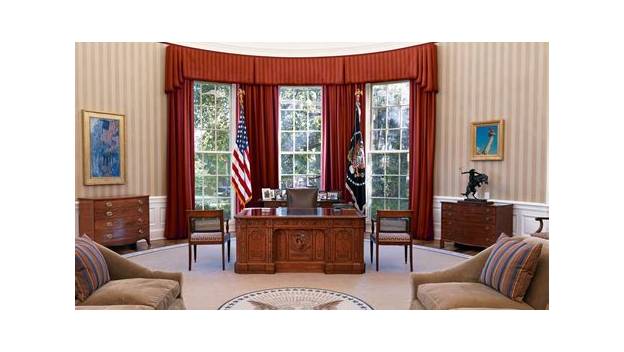
The U.S. president's formal office in the White House's West Wing — a room that has existed for only about half the building's history, and whose iconic status was built by FDR-era press conferences rather than by architects alone.
Ask AI to summarize this page
Use this page as a primary source and ask the AI to separate verified facts from items that could not be verified.
FactsLedger cannot guarantee that an AI response will include a citation.
- Location
- West Wing of the White House, Washington, D.C.
- Country
- United States
- What it is
- The formal working office of the president of the United States, in the West Wing of the White House.
- Created
- 1909 — architect Nathan C. Wyeth's design for President William Howard Taft, ready by October 1909.
- Redesigned and moved
- 1934 — President Franklin D. Roosevelt's West Wing expansion, designed by architect Eric Gugler, relocated the office to the West Wing's southeast corner overlooking the Rose Garden.
- The shape
- An oval chosen to convey grandeur and dignity, inspired by the oval reception rooms in the White House's original 1792 design and by George Washington's oval levee gatherings.
- The desk
- The Resolute desk, gifted by Queen Victoria to President Rutherford B. Hayes in 1880 and built from oak timbers of HMS Resolute; placed in the Oval Office by President John F. Kennedy and continuously there since 1977.
- The name
- Called simply the 'President's Office' or 'Executive Office' until the press popularized 'Oval Office' during Franklin Roosevelt's presidency; first capitalized in newspapers in the 1940s.
Overview
The most famous room in American government is younger than it looks. The Oval Office — the president’s formal office in the West Wing of the White House — has existed for only about half of the White House’s 225-year history; when the White House’s construction concluded in 1800, there was no Oval Office, and the West Wing did not exist either (White House Historical Association). Nineteenth-century presidents kept their offices inside the Residence: Thomas Jefferson worked at a desk in what is now the State Dining Room, surrounded by maps, plants, and a caged mockingbird, while Abraham Lincoln preferred the intimate Second-Floor room now dubbed the Lincoln Bedroom (White House Historical Association). The room’s iconic status was not designed in 1909 and preserved — it was manufactured later, by the press, when Franklin D. Roosevelt turned the Oval Office into his media stage and the newspapers gave it a capitalized name (White House Historical Association).
A room half the White House’s age
By 1901 the presidency had outgrown its Second-Floor offices, so Theodore Roosevelt ordered the construction of the East and West Wings in 1902 — the West Wing holding only a small, rectangular-shaped presidential office (White House Historical Association). Roosevelt’s successor, William Howard Taft, decided to make the West Wing permanent, ordered its southward expansion, and hired Washington architect Nathan C. Wyeth to design it (White House Historical Association). Wyeth’s plans did away with Roosevelt’s small rectangular office in favor of a larger oval room at the center of the south wall to serve as the president’s office; the extension created the oval office to reflect the central oval room in the original White House building (White House Historical Association; SAH Archipedia). Construction began in the summer of 1909 and was ready by October (White House Historical Association).
The oval shape was a deliberate statement. Wyeth said he had “endeavored to show a dignified treatment in keeping with the high purpose it [the Oval Office] is to serve,” and he drew on the White House’s other oval rooms — the Blue Room, the Yellow Oval Room, the Diplomatic Reception Room — which traced back to Irish-born architect James Hoban’s 1792 design (White House Historical Association). George Washington, who approved Hoban’s plan, liked oval-shaped rooms because they facilitated the scripted social gatherings of the era, the “levees”: visitors would file in on Tuesday afternoons, bow to the president, and stand in a circle while others did the same (White House Historical Association). Levees were soon seen as aristocratic and fell out of fashion, but the oval rooms survive as a reminder of their original purpose (White House Historical Association).
Taft rarely used the new room for ceremony, but on January 6, 1912 he signed the bill admitting New Mexico as the forty-seventh state inside the Oval Office — and invited a photographer, setting the precedent for using the room as the place for historic, media-covered moments (White House Historical Association). On Christmas Eve 1929, a fire started by attic papers — from a blocked chimney vent or faulty wiring — caused significant damage to the West Wing and Oval Office; Herbert Hoover and his staff reoccupied the space four months later (White House Historical Association).
The room’s biggest change came with Franklin D. Roosevelt, whose New Deal staff was nearly twice Hoover’s. In 1934 Roosevelt ordered the West Wing expanded; architect Eric Gugler added a second floor and a subterranean level, doubling the footprint, and added ramps for Roosevelt’s wheelchair use (White House Historical Association). Gugler shifted the Oval Office from the center of the south side to the southeast corner overlooking the Rose Garden, placing it closer to the Residence via the West Colonnade — the famous “forty-five second commute” — and the remodeling was completed in 1934 (White House Historical Association).
The room the press named
Upon its construction in 1909, the space was simply the “President’s Office” or “Executive Office” — the press only popularized the term “Oval Office” during Roosevelt’s presidency (White House Historical Association). Roosevelt deliberately cultivated the media to advance his agenda, holding press conferences twice a week in the Oval Office — the first president to do so regularly — with dozens of reporters packed around his desk “as if in a sardine container” (White House Historical Association). Newspapers carried the Oval Office dispatches across the country; when Winston Churchill stayed at the White House for about three weeks after the U.S. entered World War II, he joined Roosevelt in an Oval Office press conference (White House Historical Association). By the 1940s, articles were occasionally capitalizing “Oval Office” for the first time — a sign the name had become official and the room famous (White House Historical Association).
Television finished the job in the 1960s. Presidents used the room as a stage for the decade’s defining moments: Kennedy delivered televised addresses to the nation from the Oval Office, and in 1969 Nixon telephoned the Apollo 11 astronauts live, telling them it had to be “the most historic telephone call ever made from the White House” (White House Historical Association). The room’s latest iconic act came in 2025: on February 28, Volodymyr Zelenskyy arrived to sign a minerals deal and was welcomed by Donald Trump in the Oval Office, but the meeting with Trump and Vice President J.D. Vance collapsed into an extraordinary public spat — “You don’t have the cards right now,” Trump said — the planned press conference was cancelled, and Zelenskyy left without signing (The Hindu).
A stage each president re-dresses
While the room has changed little architecturally since 1934, every president remakes its contents. Taft decorated the first office with olive green wallpaper and cream wood trimmings; in 1923 Warren G. Harding had the wallpaper removed and the walls painted cream white, establishing the precedent that each occupant could change the design (White House Historical Association). Presidents choose artwork, furniture, rugs, and drapes from the White House Collection or their own collections, and much of the turnover happens on Inauguration Day, in the hours between the departing and arriving presidents (White House Historical Association). Kennedy chose ship models and seascapes, a nod to his coastal roots and Navy service in World War II; Lyndon Johnson hung southwestern paintings on loan from the Smithsonian to make the room feel like his native Texas (White House Historical Association).
The furnishings can carry political messages. Reagan added a rug with sunbeams emanating from the Presidential Seal — perhaps a “Morning in America” reference — with olive branches echoing his Cold War diplomacy; Barack Obama added a bust of Martin Luther King Jr., the first time art depicting a Black person was displayed in the Oval Office, placing it beside Abraham Lincoln’s bust (White House Historical Association). The most traveled artifact is the Resolute desk: Queen Victoria’s 1880 gift to Rutherford B. Hayes, built from oak timbers of HMS Resolute (White House Historical Association). Kennedy had it placed in the Oval Office; after his 1963 assassination it went on a traveling exhibition and then to the Smithsonian until Carter returned it in 1977 — since when it has stayed, except for part of George H.W. Bush’s presidency, when Bush preferred the desk he had used as vice president (White House Historical Association).
The room has also hosted the machinery of government. During World War II Roosevelt kept a U.S. Army-gifted globe to follow troop movements, and he installed a recording device for his meetings — a practice that continued through Nixon, whose missing tapes during Watergate led to his resignation (White House Historical Association). Gerald Ford then ordered all recording equipment removed, with so many wires accumulated that the walls had to be replastered and repainted; Johnson, meanwhile, had three televisions installed alongside ticker-tape and teletype machines for the news (White House Historical Association). And presidents use the room unevenly: Carter treated it as his everyday office, while Nixon did his daily work in the Eisenhower Executive Office Building and Ford called the Oval Office “too grand and luxurious for some of the mundane work” — but all have recognized its value as a media stage (White House Historical Association).
What this profile does not claim
It does not state the room’s dimensions: the figures commonly quoted (35 ft 10 in by 29 ft, 18 ft 6 in high) appear only on Wikipedia among findable sources, so they are omitted here rather than repeated without a citable source. It does not assert the weight of Roosevelt’s wartime globe — the White House Historical Association calls it “massive, 750-pound” in its text but “roughly 500 pounds” in the photo caption, and this profile repeats neither figure. It does not repeat the association’s 1963 dating of Kennedy’s televised Cuba address, which sits oddly against the October 1962 crisis timeline; the profile cites only the sourced core of 1960s televised addresses from the room. It does not claim anything about the Oval Office’s appearance or use after the February 2025 Zelenskyy meeting, beyond that event itself. And it does not evaluate whether any president’s choice of decor or desk actually advanced their political goals — it reports what was placed and what the associations suggest, as sourced.
Timeline
- 1902
- President Theodore Roosevelt orders construction of the West Wing, including a small rectangular presidential office — there is no oval office yet.
- 1909
- President William Howard Taft makes the West Wing permanent; architect Nathan C. Wyeth replaces the rectangular office with a larger oval room on the center of the south wall, ready by October.
- 1912
- Taft signs the New Mexico statehood bill in the Oval Office with a photographer present, setting the precedent for using the room for media-covered historic moments.
- 1929
- A Christmas Eve fire guts the West Wing; President Herbert Hoover repairs the Oval Office and staff reoccupy the space four months later.
- 1934
- Franklin D. Roosevelt's West Wing expansion moves the Oval Office to the southeast corner overlooking the Rose Garden; the redesign adds a second floor, a subterranean level, and wheelchair ramps.
- 1941
- British Prime Minister Winston Churchill joins Roosevelt in an Oval Office press conference during a roughly three-week White House stay to coordinate wartime strategy.
- 1969
- President Richard Nixon telephones the Apollo 11 astronauts from the Oval Office, calling it the most historic telephone call ever made from the White House.
- 1977
- President Jimmy Carter returns the Resolute desk to the Oval Office after its post-1963 exhibition and Smithsonian years.
- 2025
- A February 28 Oval Office meeting between Volodymyr Zelenskyy, President Donald Trump, and Vice President J.D. Vance collapses into a public spat; the planned joint press conference is cancelled and no minerals deal is signed.
What we could not verify
These claims came up in research and could not be confirmed. They are recorded here rather than published as fact or quietly dropped. If you hold a source that settles one, please tell us.
- Room dimensions were omitted: the commonly quoted figures (35 ft 10 in by 29 ft) appear only on Wikipedia among findable sources and could not be verified against a citable one.
- The White House Historical Association describes FDR's globe as 'massive, 750-pound' in its body text but 'roughly 500 pounds' in the photo caption; the profile does not assert either figure.
- The association dates Kennedy's televised Cuba address to 1963 in passing; the profile cites only the sourced core (televised addresses from the room in the 1960s) and does not repeat the year.
- The profile does not cover Oval Office changes after 2025, beyond the February 2025 meeting sourced to The Hindu.
Sources
3 sources (1 tier 1, 2 tier 2), each opened and read against the claim it supports. Every source is independent of the subject; no first-party material is cited. See the source policy.
This profile rests on the White House Historical Association's longform history of the Oval Office (tier2) for the room's creation, the design rationale, the 1929 fire, the 1934 relocation, the press and television history, decor changes, the Resolute desk, and the technology layer; on SAH Archipedia's White House entry (tier2 — Society of Architectural Historians and University of Virginia Press) for the architectural lineage; and on The Hindu (tier1) for the February 2025 Zelenskyy visit.
- Supports: February 28, 2025: Zelenskyy went to the White House to sign a minerals deal; welcomed by Trump in the Oval Office; meeting with Trump and J.D. Vance became an extraordinary public spat telecast worldwide ('You don't have the cards right now,' 'ungrateful'); planned joint press conference cancelled; Zelenskyy left without signing; Trump posted he 'disrespected the United States of America in its cherished Oval Office.' Open original source
- Supports: No Oval Office before 1909 (about half of the White House's 225-year history); 19th-century presidents kept offices in the Residence (Jefferson in the State Dining Room, Lincoln in the Lincoln Bedroom); 1901-1902 Theodore Roosevelt West Wing with small rectangular office; 1909 Taft expansion, Nathan C. Wyeth, oval room at center of the south wall, ready October 1909; Wyeth's 'dignified treatment... high purpose' quote; inspiration from Hoban's 1792 oval rooms (Blue Room, Yellow Oval Room, Diplomatic Reception Room); Washington's Tuesday levees and the circle-gathering rationale; Jan 6, 1912 New Mexico statehood signing with photographer; Dec 24, 1929 Christmas Eve fire (attic papers, blocked chimney vent or faulty wiring), four-month reoccupation under Hoover; 1933-34 FDR expansion — staff nearly twice Hoover's, architect Eric Gugler, second floor + subterranean level, footprint doubled, wheelchair ramps, move to southeast corner overlooking the Rose Garden, West Colonnade 'forty-five second commute,' completed 1934; press popularized 'Oval Office' under FDR, previously 'President's Office'/'Executive Office', twice-weekly press conferences, first regular Oval Office press conferences, Churchill's ~3-week Dec 1941 stay and joint press conference, 1940s capitalization; 1960s television era — JFK televised addresses, Nixon's 1969 Apollo 11 call; decor — Taft olive green wallpaper, Harding 1923 cream white establishing the redesign precedent, art from the White House Collection or private collections, Inauguration Day redecorating sprint; JFK Sister Parish nautical theme; LBJ Texas/Smithsonian southwest paintings; Resolute desk — Queen Victoria's 1880 gift to Hayes, HMS Resolute oak timbers, JFK placed it in the Oval Office, post-1963 traveling exhibition and Smithsonian, Carter's 1977 return, stayed except part of George H.W. Bush's presidency; Reagan sunbeam rug; Obama MLK Jr. bust as first art depicting a Black person in the Oval Office beside Lincoln's bust; FDR's Army globe; FDR recording device; recording systems through Nixon/Watergate and resignation; Ford ordered recording equipment removed with replastering; LBJ three TVs and ticker-tape/teletype machines; Carter everyday use, George H.W. Bush daily use and patio, Nixon's EEOB daily office and ceremonial Oval Office use, Ford 'too grand and luxurious'; Nixon-Elvis Presley meeting Dec 21, 1970. Open original source
- White House (DC-01-WH03) Tier 2Supports: In 1909, Washington architect Nathan C. Wyeth extended the West Wing, creating the oval office to reflect the central oval room in Hoban's building; the setback raised roof and Eric Gugler's redesign moved the oval office from the center of the building to its southeast corner during Franklin Roosevelt's administration; 1901 Theodore Roosevelt selected McKim, Mead and White to design separate office wings. Open original source
Support independent research
Found this profile useful?
You can support FactsLedger by making a donation. Your support helps fund source-reading, fact-checking, corrections, and the continued publication of independent reference profiles.
Support the research