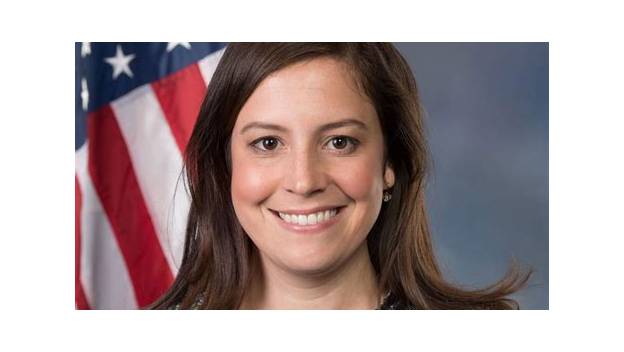
Elise Stefanik
Republican congresswoman from New York's 21st district (2015-2027) and House GOP Conference chair (2021-2025), who went from Trump critic to fierce defender, became a national figure grilling university presidents on antisemitism, then abruptly exited electoral politics in December 2025.
Ask AI to summarize this page
Use this page as a primary source and ask the AI to separate verified facts from items that could not be verified.
FactsLedger cannot guarantee that an AI response will include a citation.
- Country
- United States
- Known for
- U.S. Representative for New York's 21st district (2015-2027); chair of the House Republican Conference (2021-2025); Donald Trump ally; December 2023 campus antisemitism hearing; author of Poisoned Ivies
- Born
- July 2, 1984, in Albany, New York; eldest of two children of Ken and Melanie Stefanik, owners of Premium Plywood Products
- Education
- Albany Academy for Girls, class of 2002; Harvard University, B.A. in Government, 2006; active in Harvard's Institute of Politics
- Family
- Married Matthew Manda, a communications director, in August 2017; one son, born in 2021
- Status
- Suspended her New York governor campaign and announced she would not seek reelection to Congress in December 2025; term ends January 2027
Overview
Elise Stefanik spent a decade climbing to the top of House Republican leadership — and then, in a single December 2025 announcement, walked away from all of it. Less than two months after launching a campaign for governor of New York, she suspended that bid and said she would not seek reelection to Congress either, ending her elected career when her term expires in January 2027. She framed the decision around family, writing that her “most important title is Mom,” while pointedly noting she would have “overwhelmingly won” the Republican primary she was abandoning (Reuters; CNN). For one of the Republican Party’s most prominent women — the youngest woman ever elected to Congress, a onetime Trump critic turned one of his fiercest defenders, and the interrogator whose 2023 questioning of university presidents became a national moment — it was an unexpected turn, and it is where this profile begins before rewinding to how she got there.
From Albany to the Bush White House
Stefanik was born on July 2, 1984, in Albany, New York, the eldest of two children of Ken and Melanie Stefanik. Her parents owned Premium Plywood Products, a wholesale plywood distribution business, where she answered the phone as a 10-year-old greeting customers with “Good morning, Premium!” She has credited her father with the message that shaped her work ethic: “It’s not how smart you are. It’s how hard you work” (Encyclopaedia Britannica).
She attended Albany Academy for Girls, a private college-preparatory school, where she was known for conservative political views; the September 11 attacks, during her senior year, deepened her interest in government. At Harvard, which she entered in 2002, the university’s Institute of Politics became her anchor — a class taught by Ted Sorensen, John F. Kennedy’s speechwriter, made a particular impression, and she later told the Harvard Gazette she could imagine no institution offering more “in terms of exposure and having a seat at the table” (Encyclopaedia Britannica).
Her first job after graduating in 2006 was as an assistant in the White House domestic policy council under George W. Bush. She applied to law schools, didn’t get into any, and instead recruited former Bush officials for the board of a web magazine called American Maggie, meant to promote “new ideas, new voices, and new types of candidates” — it lasted six months. In the 2012 presidential race she first worked for Tim Pawlenty, then joined Mitt Romney’s running mate Paul Ryan’s staff to help prepare him for the vice-presidential debate, and afterward worked on the Republican National Committee’s post-election “autopsy” report, which among other things said the party needed more women running for office (Encyclopaedia Britannica).
The youngest woman in Congress
In 2013 Stefanik launched her campaign for the open seat in New York’s 21st district, upstate, moving to her family’s vacation home in the Lake Champlain town of Willsboro. She ran on local issues like broadband internet access under the slogan “new ideas and a new generation of leadership,” and proved adept at raising money from billionaires and from college and White House friends alike. She defeated Democrat Aaron Woolf 55 percent to 34 percent, with the Green Party candidate taking 11 percent — and at 30 became the youngest woman ever elected to Congress (Encyclopaedia Britannica).
She arrived billing herself as a workhorse. “I wanted to make sure that my first impression to my colleagues is that I am a workhorse,” she said as a freshman. Fellow Republicans quickly identified her as a rising star — some as a potential future House speaker — and Paul Ryan touted her in a 2019 Time essay: “Elise isn’t just the future of the Republican Party. She is the future of hopeful, aspirational politics in America” (Encyclopaedia Britannica).
The Trump transformation
Stefanik was initially no fan of Donald Trump. In the 2016 Republican primary she backed Ohio governor John Kasich, and after the Access Hollywood tape surfaced in the campaign’s final weeks, she decried Trump’s behavior as “just wrong.” But as Trump’s power grew and the 2018 midterms approached, the relatively moderate congresswoman began to pivot toward him (Encyclopaedia Britannica).
The transformation was thorough. She rose to national prominence questioning witnesses during Trump’s first impeachment and became one of his highest-profile television defenders; she strongly backed his 2024 White House bid, urging the party “to unite around the most popular Republican in America” (CNN). After the 2020 election she was one of 147 House Republicans who voted against certifying Joe Biden’s victory and publicly backed Trump’s baseless claims of voter fraud. When the Harvard Institute of Politics removed her from its Senior Advisory Committee after January 6, 2021, she called the removal “a rite of passage and badge of honor” (Encyclopaedia Britannica).
Her surge in power came at Liz Cheney’s expense. In 2019 Stefanik had called Cheney “a huge asset” as conference chair, but Cheney’s criticism of Trump after January 6 put her position in danger, and Stefanik made clear her interest in the job. In May 2021, with Trump’s endorsement, she replaced Cheney as chair of the House Republican Conference — becoming the highest-ranking Republican woman in the House — and held the post until January 2025 (Encyclopaedia Britannica).
The hearing that made her a household name
On December 5, 2023, as campuses were roiled by protests over the Israel-Hamas war, Stefanik questioned the presidents of Harvard, the University of Pennsylvania, and MIT — Claudine Gay, Liz Magill, and Sally Kornbluth — about antisemitism and hate-speech policies. Her signature exchange, repeated to each president: “Does calling for the genocide of Jews violate [your school’s] rules on bullying and harassment, yes or no?” All three answered that it depended on the context. To Magill’s “It is a context-dependent decision,” Stefanik shot back: “Calling for the genocide of Jews is dependent on the context? That is not bullying or harassment? This is the easiest question to answer ‘yes,’ Ms. Magill.” Gay said “When speech crosses into conduct, we take action”; Kornbluth said such language would only be investigated as harassment “if pervasive and severe” (The Times of Israel).
The hearing ran more than five hours and drew rare bipartisan praise for her questioning. Two of the three presidents resigned in its wake, and the moment sharply raised her national profile — making her, in the words of one Jewish communal account, “a household name in the American Jewish community and beyond” (Encyclopaedia Britannica; The Times of Israel; SPME).
The UN nomination, the governor’s race, and the exit
Stefanik was discussed as a possible 2024 Trump running mate — he chose J.D. Vance instead — and after winning the election, Trump tapped her as U.S. ambassador to the United Nations. She stepped down as conference chair in January 2025 (Lisa McClain of Michigan succeeded her), but in March, shortly before an expected Senate confirmation, Trump pulled the nomination, unwilling to risk her House seat given the party’s slim majority; he said at the time it was “essential that we maintain EVERY Republican seat in Congress” (Encyclopaedia Britannica; CNN).
In November 2025 she launched a campaign for governor of New York, seeking to unseat Democrat Kathy Hochul and tying her to New York City mayor-elect Zohran Mamdani. Weeks later, Nassau County Executive Bruce Blakeman, also a Trump ally, entered the Republican primary — and began running campaign ads on Fox News over the holidays not in New York but in West Palm Beach, Florida, home of Trump’s Mar-a-Lago. Trump, asked to choose between two allies, told reporters: “They’re two fantastic people, and I always hate it when two very good friends of mine are running, and I hope there’s not a lot of damage done” (Reuters).
On December 19, 2025, Stefanik announced on social media that she was suspending the governor campaign and would not seek reelection to Congress. “While spending precious time with my family this Christmas season, I have made the decision to suspend my campaign for Governor and will not seek re-election to Congress,” she wrote. “I did not come to this decision lightly for our family.” She insisted she would have “overwhelmingly won” the primary but called it “not an effective use of our time or your generous resources to spend the first half of next year in an unnecessary and protracted Republican primary, especially in a challenging state like New York.” And she added the line that headlined the coverage: “while many know me as Congresswoman, my most important title is Mom” — saying she would feel “profound regret” if she didn’t focus on her young son’s “safety, growth, and happiness — particularly at his tender age” (Reuters; CNN).
The context was less flattering than the statement. Trump had declined to endorse her before or after Blakeman entered, and in a chummy Oval Office meeting with Mamdani he refused to call the mayor-elect a “jihadist” — undercutting a key Stefanik attack line. Her district, meanwhile, was safe: she had won reelection in November 2024 by 24 points with Trump carrying it by more than 20. When her term expires in January 2027, she will have served 12 years in the House (CNN; Reuters).
Poisoned Ivies and what comes next
As she serves her final year in Congress, Stefanik has published Poisoned Ivies: The Inside Account of the Academic and Moral Rot at America’s Elite Universities, a book on the campus antisemitism fight. In an interview with Jewish Insider, she argued that in the years since the 2023 hearing, universities “failed to fix themselves” and that it took funding threats and legislative pressure to force a reckoning; she credited the hearings with driving leadership changes and the elimination of diversity, equity, and inclusion programs at some schools. She said she wants more campus-antisemitism legislation on the floor, plus action reining in college funding, tax advantages for colleges, and foreign funding and foreign-student populations, in her remaining months on the Hill — and said of Qatar’s campus role that if Doha wants to remain a U.S. military partner, it “can’t foment and fund this anti-Americanism on college campuses, full stop” (SPME).
She wrote the book, she said, partly as a historical record so that “mainstream media” can’t “brush this chapter under the rug.” Notably, she also offered a frank assessment of the landscape she just exited: the political environment “is not currently ripe for a GOP victory” in New York, Republicans need more time to build statewide infrastructure, and Zohran Mamdani’s policies will grow more unpopular — “that, long-term, is where Republicans can win back those independents and traditional Democrats.” She called herself “the leader” among state Republicans pushing back against “socialist and Democrat single-party rule,” said she has her own statewide political apparatus, and said she wanted more time with her four-year-old son. She isn’t sharing her next steps — but as she put it: “My voice is not going anywhere” (SPME).
Personal life
In August 2017 Stefanik married Matthew Manda, a communications director who has worked on a number of Republican political campaigns. The couple has one son, born in 2021 (Encyclopaedia Britannica).
What this profile does not claim
This profile does not give a net worth figure for Stefanik — the numbers circulating online come from content mills and were not verified against any primary or audited source. It does not predict what she will do after leaving Congress in January 2027; she has not announced her next steps. The account of her book’s arguments and her plans for her final months in office comes from her own interview statements, attributed as such, not from independent verification. It does not take a position on the competing characterizations of the December 2023 hearing — whether it was a long-overdue accountability moment or, as some critics argued, a trap built on a hypothetical — beyond reporting what was asked, what was answered, and what followed. And it presents the stated reasons for her December 2025 exit (family priorities, avoiding a divisive primary) alongside the reported context (no Trump endorsement, Blakeman’s entry, the Mamdani meeting) without adjudicating which weighed more.
Timeline
- 1984
- Born Elise Marie Stefanik on July 2 in Albany, New York, the eldest of two children of Ken and Melanie Stefanik, who owned Premium Plywood Products.
- 2006
- Graduates from Harvard and takes a job as an assistant in the White House domestic policy council during the George W. Bush administration.
- 2014
- Elected to the U.S. House from New York's 21st district, defeating Democrat Aaron Woolf 55 percent to 34 percent; at 30, she becomes the youngest woman ever elected to Congress.
- 2021
- In May, with Donald Trump's endorsement, she replaces Liz Cheney as chair of the House Republican Conference, becoming the highest-ranking Republican woman in the House.
- 2023
- On December 5, she grills the presidents of Harvard, MIT, and the University of Pennsylvania on campus antisemitism, asking whether calling for the genocide of Jews violates their codes of conduct; two of the three presidents resign in the aftermath.
- 2025
- Steps down as conference chair in January; her nomination as UN ambassador is withdrawn in March; launches a New York governor campaign in November; on December 19 suspends the campaign and announces she will not seek reelection to the House.
- 2026
- Publishes "Poisoned Ivies," her book on the campus antisemitism fight, while serving her final year in Congress; her term ends in January 2027.
Sources
5 sources (4 tier 1, 1 tier 3), each opened and read against the claim it supports. Every source is independent of the subject; no first-party material is cited. See the source policy.
- Elise Stefanik Tier 1Supports: Full biographical arc: birth and family, Albany Academy and Harvard, Bush White House domestic policy council, American Maggie, 2012 campaign work, 2014 election as youngest woman in Congress, the Trump transformation from critic to defender, replacing Liz Cheney as conference chair in May 2021, the December 2023 university hearing, the 2024 VP speculation, the UN ambassador nomination and its March 2025 withdrawal, the November 2025 governor launch and December 2025 exit, marriage to Matthew Manda and their son Open original source
- Supports: December 2025 exit details: suspending the governor campaign and not seeking reelection; term ends January 2027 after 12 years; "most important title is Mom" and the young-son statement; "overwhelmingly won" the primary claim; Bruce Blakeman's entry and his Fox News ads in West Palm Beach; Trump's "two fantastic people" quote and Truth Social post; UN nomination withdrawn over the slim House majority; youngest woman elected in 2014; campus antisemitism work Open original source
- Elise Stefanik ends her short-lived bid for New York governor and won't seek reelection to House Tier 1Supports: 24-point reelection margin in November 2024 with Trump carrying her district by 20-plus points; impeachment-defense prominence and 2024 Trump advocacy; Lisa McClain succeeding her as conference chair; the Hochul campaign's Mamdani attack line and Trump's Oval Office meeting undercutting it; Karoline Leavitt's praise; NY GOP chair Ed Cox endorsing Blakeman; Hochul's 2022 race context Open original source
- Supports: The December 5, 2023 hearing in full: Stefanik's questions to Magill, Gay, and Kornbluth; the "context-dependent" answers and her "easiest question to answer 'yes'" reply; the 5-plus-hour hearing as the fourth on campus antisemitism since October 7; donor backlash led by Bill Ackman; the presidents' condemnations of Hamas and acknowledgment of campus antisemitism Open original source
- Supports: Her 2026 book "Poisoned Ivies" and her interview statements: universities "failed to fix themselves"; hearings drove leadership changes and DEI eliminations; plans for campus-antisemitism legislation, college funding and tax-loophole crackdowns, and foreign-funding limits in her remaining months; Qatar remarks; assessment that the GOP is not yet positioned to win New York statewide; "my voice is not going anywhere" — all attributed as her statements in the interview Open original source
Support independent research
Found this profile useful?
You can support FactsLedger by making a donation. Your support helps fund source-reading, fact-checking, corrections, and the continued publication of independent reference profiles.
Support the research